En 30 segundos
Matthew Berman surveys AI news from October 2025, including Google AI Studio, Unitree H2, Gemini 3 rumors, Apple M5, Tencent 3D reconstruction and Google’s quantum research. He also discusses a social-media interpretation of Andrej Karpathy’s interview and reported Meta job cuts. The video includes Zapier and Dell sponsorships.
- 1A generated wallpaper appBerman uses Google AI Studio to build and try a small application, with code, preview and checkpoint controls.
- 2Gemini 3 rumorsClaims about unnamed models on LM Arena were unconfirmed at the time; Gemini 3 was announced later.
- 3Apple M5 performanceApple’s peak GPU compute claim has a specific comparison and does not prove all workloads run four times faster.
- 43D reconstructionTencent’s WorldMirror release predicts 3D representations from visual inputs under its license terms.
- 5Quantum EchoesGoogle’s claimed advantage concerns a defined quantum dynamics experiment, with a separate molecular proof of principle.
- 6Meta’s AI reorganizationAxios reported cuts across several AI units and an expectation that many affected employees would find internal roles.
Conclusiones
- Google AI Studio demonstrated prompt-based app construction, but a successful demo does not guarantee production readiness.
- The Gemini 3 codenames discussed in October were rumors; Google announced Gemini 3 in November 2025.
- Apple’s fourfold M5 figure refers to claimed peak GPU compute for AI versus M4, not a universal inference speedup.
- Quantum Echoes compared a specific quantum task with known classical methods; molecular and drug applications remained prospective.
- Tencent’s HunyuanWorld 1.1 focuses on 3D reconstruction, and Meta’s reported reorganization affected several AI teams.
Lee el texto editado por capítulos
Building an app and a robot demonstration
Berman demonstrates Google AI Studio’s app-building experience and shows Unitree H2 footage. Zapier sponsors a portion of the video.
In this October 2025 news roundup, I look at Google's app-building tools, a Unitree humanoid demonstration, rumors about Gemini 3, Apple's M5, a Tencent 3D model, a debate about language-model limits, quantum computing and Meta's AI reorganization. Product descriptions and rumors reflect the time of the video.
Google AI Studio's Build experience lets a user describe an application and see generated code and a preview in the browser. In my demonstration I choose Gemini 2.5 Pro and an image-generation example, then use an automatically suggested prompt for a phone-wallpaper app. Availability, quotas and pricing can change.
The interface displays progress, generated files, a device preview and a code view. I switch between phone and desktop layouts and watch the project take shape. The visible development information is useful, although a displayed reasoning summary should not be assumed to expose the model's complete internal reasoning.
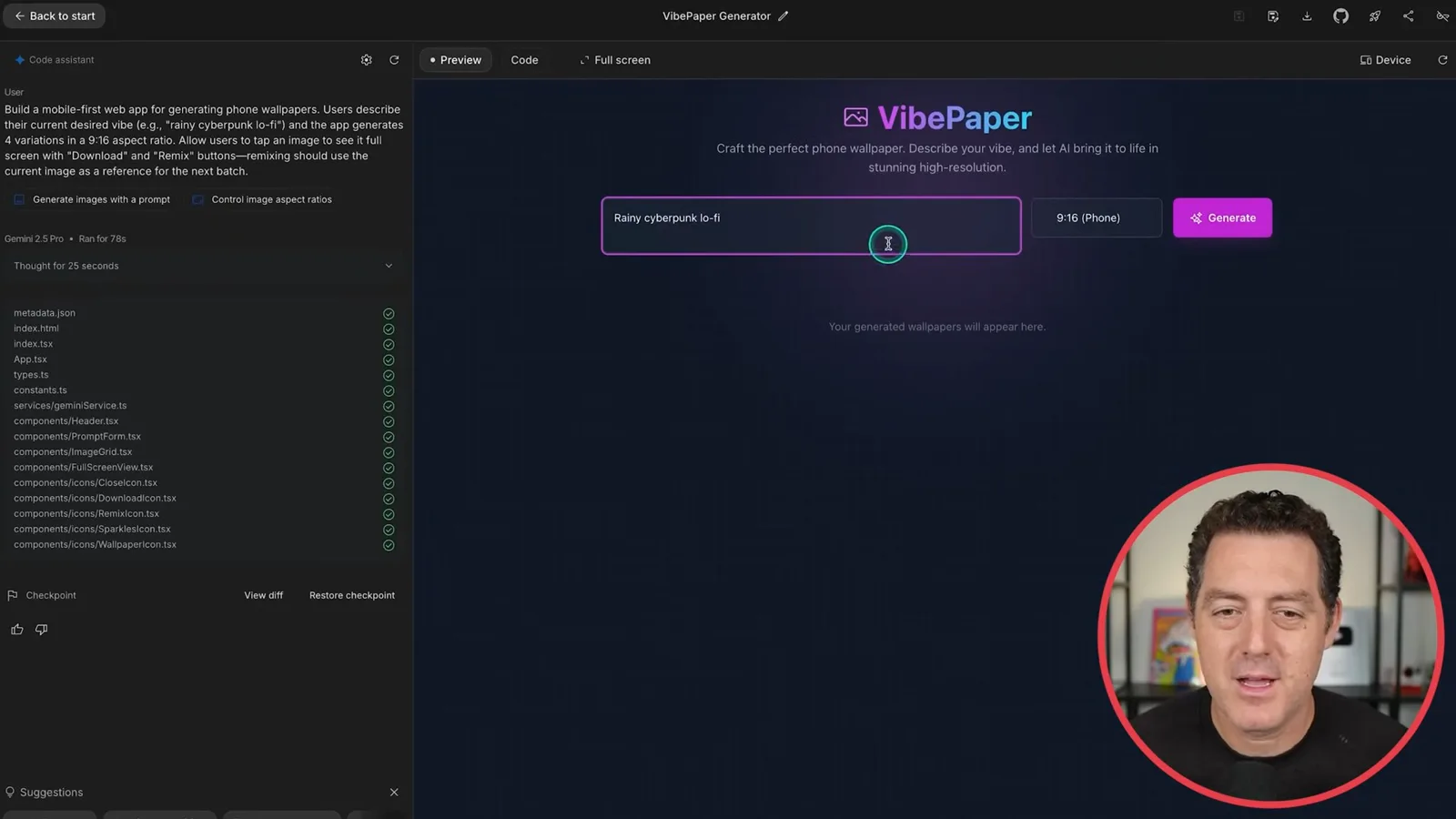
The demo finishes in 78 seconds according to the interface. I request a rainy cyberpunk style and it returns four wallpapers, with options to download or remix them. The tool also presents checkpoints, code export, GitHub and deployment options; a successful demonstration is not proof that an arbitrary generated application is production-ready.
Google's Logan Kilpatrick discussed integration needs such as databases, file storage, authentication and APIs as future work. Those were plans mentioned in 2025, not evidence that each feature was already delivered at the time. Generated applications still need appropriate testing, security and deployment review.
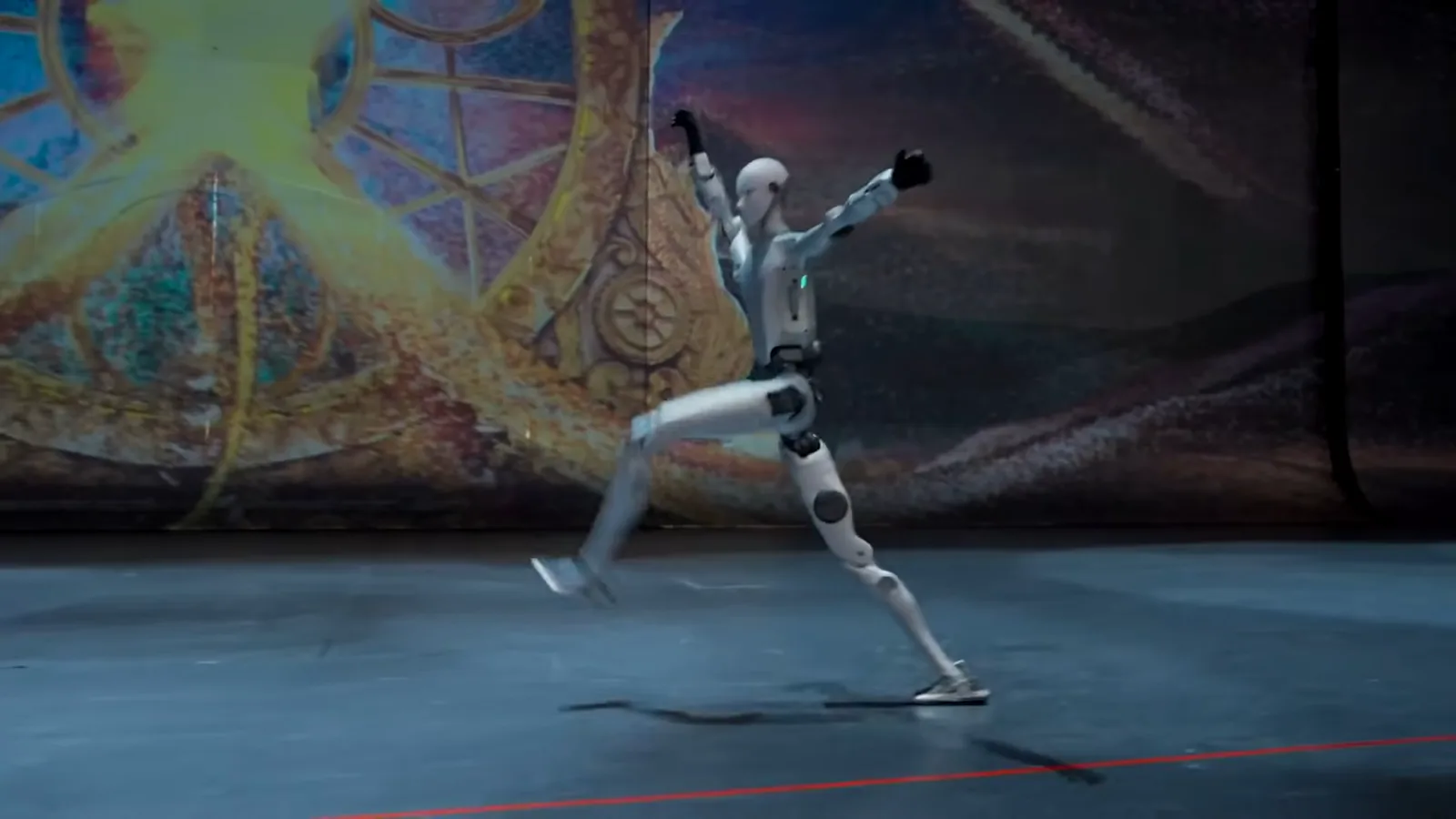
Unitree shows its H2 'Destiny Awakening' humanoid in a staged movement demonstration. I find the footage impressive and discuss the company's broader robot lineup. The clip alone does not establish which movements were autonomous, how reliably they generalize, or the specific availability of this model.
This video is sponsored by Zapier. Berman describes its Unified Copilot for building workflows across the company's products and mentions human review and integrations. These are sponsor product claims from 2025; features, integration counts and terms can change.
Model rumors, M5 and 3D reconstruction
The video discusses unverified Gemini 3 rumors, Apple’s M5 announcement and Tencent’s HunyuanWorld 1.1. Product and performance claims need their original scope.
I next discuss rumors that unidentified models called Orion Mist and Lithium Flow on LM Arena might be Gemini 3. The identification was unconfirmed in the video, and examples of attractive interfaces or a voxel scene are not enough to establish a model's identity or overall ranking. Google [announced Gemini 3](https://blog.google/products-and-platforms/products/gemini/gemini-3-gemini-app/) later, on November 18, 2025; that later launch does not establish the rumored codenames.
A short generated animation inspired by Rick and Morty is presented as a coding example, not as output from a video-generation model. Its rough result is a reminder that individual demos can be uneven. I was excited to test the eventual release, but at this point its capabilities and release date were not confirmed.
Apple announced M5 for the 14-inch MacBook Pro, iPad Pro and Apple Vision Pro. [Apple's announcement](https://www.apple.com/newsroom/2025/10/apple-unleashes-m5-the-next-big-leap-in-ai-performance-for-apple-silicon/) claimed more than four times the peak GPU compute performance for AI compared with M4, along with a neural accelerator in each GPU core and increased memory bandwidth.
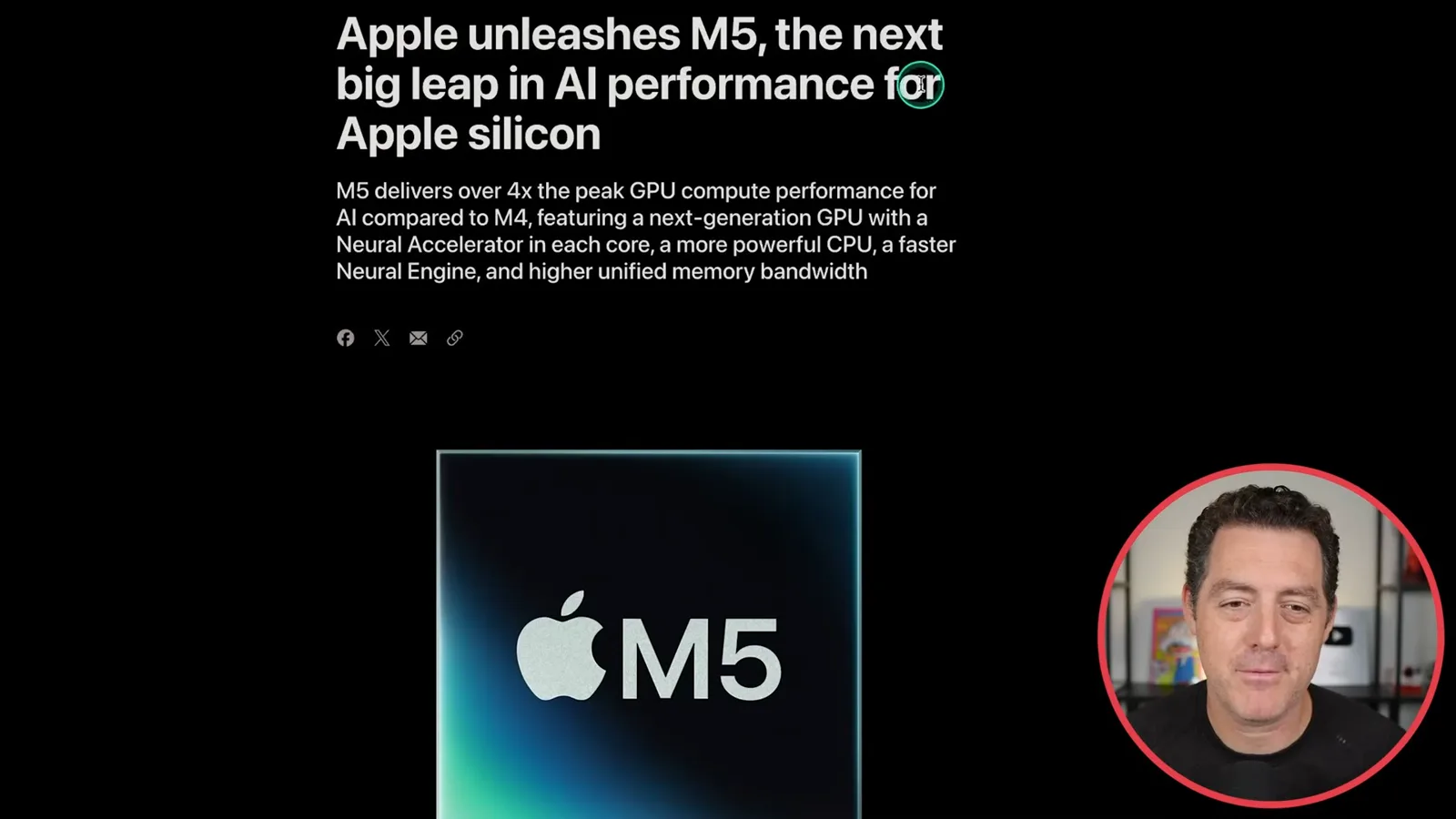
I compare Apple hardware with NVIDIA's DGX and suggest Apple devices may be faster for inference. That broad assertion is not supported by a controlled comparison in the video: throughput and latency depend on the exact machines, models, precision, software and workload. Peak compute is not the same as a measured fourfold improvement in every application.
I am enthusiastic about local inference and hope Apple develops stronger AI experiences and Siri features. That is my product judgment, not a benchmark result. The three products named in the announcement should not be confused with a claim that an M5 Mac mini was announced in this segment.
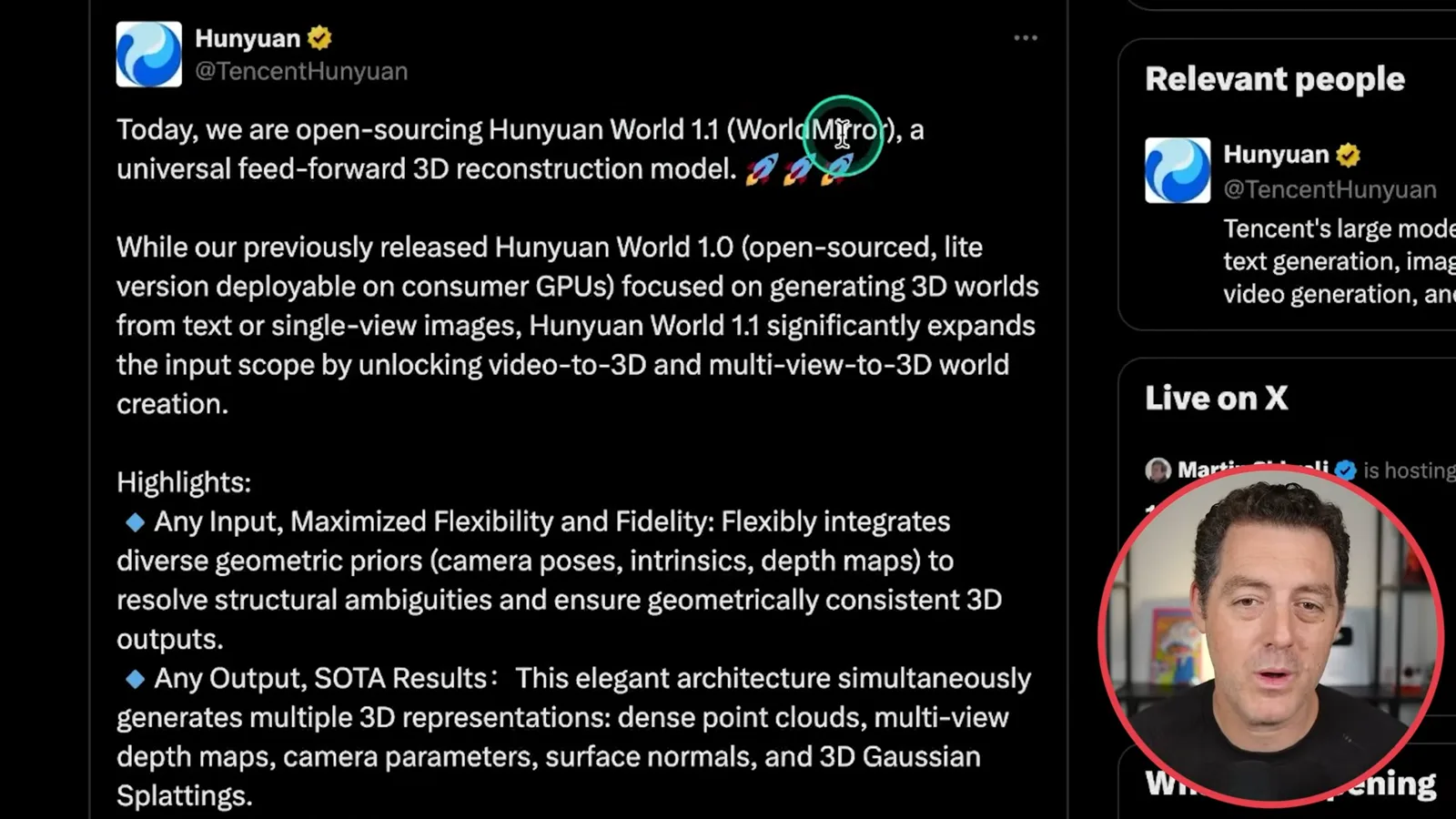
Tencent released HunyuanWorld 1.1, also called WorldMirror. Its [project repository](https://github.com/Tencent-Hunyuan/HunyuanWorld-Mirror) describes a feed-forward 3D reconstruction model that accepts video or multiple views and predicts geometric representations. The inference code and weights were released in October 2025; users should check the license and its conditions.
Although I call the Hunyuan family world-simulation models, this release's stated task is 3D reconstruction. Reconstructing geometry from visual inputs is not by itself a demonstration of a fully interactive physics simulator. The distinction matters when comparing it with other systems called world models.
A debate over language-model limits
Berman responds to a social-media summary of an Andrej Karpathy interview, discussing memory, generalization and AI research. Dell sponsors a segment.
I discuss a social-media summary of an interview with Andrej Karpathy. The post presents a critical interpretation of language models' intelligence, multimodality, computer use and memory, and suggests substantial work remains. Its wording is the poster's summary; the clip shown here does not independently verify each line as a verbatim quotation.
My response is that tools and scaffolding can provide memory and interaction beyond a model's weights. That does not settle whether models themselves need different memory or learning mechanisms. We should distinguish a model's fixed parameters from an application that supplies external tools, stored information and context.
The discussion also questions how well language models generalize beyond their training data and uses analogies to human brain structures. I agree there are important limitations, but broad claims that models merely memorize or always fail at novel tasks are debated and depend on the task and evidence. The brain analogy is not a literal map of model components.
I point to AI-assisted advances in matrix multiplication and research as reasons to question a blanket claim that AI cannot contribute anything novel. These examples do not show that every generated idea is new or correct; validation remains essential. My view that AI has substantial long-term upside is an opinion rather than a forecast guaranteed by the examples.
Dell Technologies sponsors this portion of the video. Berman describes a Dell Pro Max workstation with NVIDIA RTX PRO hardware for local AI workloads. The supercomputer comparison is sponsor language, and actual suitability depends on the configuration, software and task.
Quantum Echoes and Meta layoffs
Google reports a quantum dynamics experiment and a separate molecular proof of principle. Berman closes with Axios reporting on Meta’s AI reorganization.
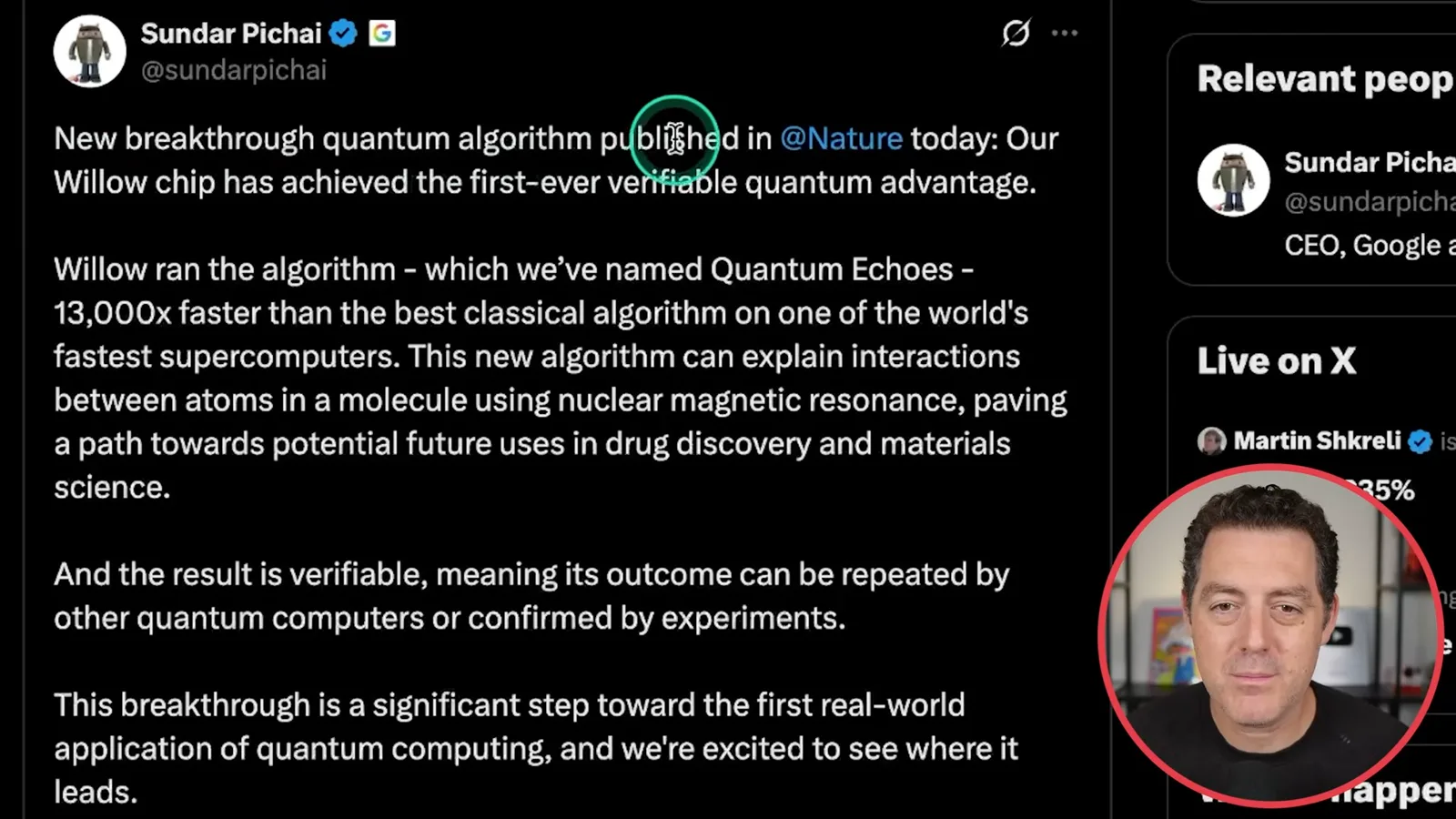
Google announced Quantum Echoes research using its Willow chip. [Google's research account](https://research.google/blog/a-verifiable-quantum-advantage/) says the experiment measured an out-of-time-order correlator and described a verifiable quantum advantage. The company's claim concerns a specific quantum dynamics task and a comparison with known classical methods, not a universal 13,000-fold speedup for ordinary computing.
Google estimated that Willow ran the experiment about 13,000 times faster than a classical calculation on a supercomputer under its comparison assumptions. 'Verifiable' refers to checking the measured observable against another quantum system or an experiment; it does not mean every component has already been independently reproduced or that the comparison is immune to improved classical algorithms.
In a separate proof-of-principle nuclear magnetic resonance experiment, Google explored using related techniques to infer molecular structure. Drug discovery and materials science are potential future applications, not established products or a demonstrated 13,000-fold speedup for those applications. Berman also notes a skeptical response and remains optimistic about the research.
For the final story, Berman cites [Axios reporting](https://www.axios.com/2025/10/22/meta-superintelligence-tbd-ai-reorg) that Meta was cutting roughly 600 roles across FAIR, product AI and infrastructure while continuing to hire for its newer TBD Lab. Axios based its account on an internal memo; the numbers and organizational status refer to October 2025.
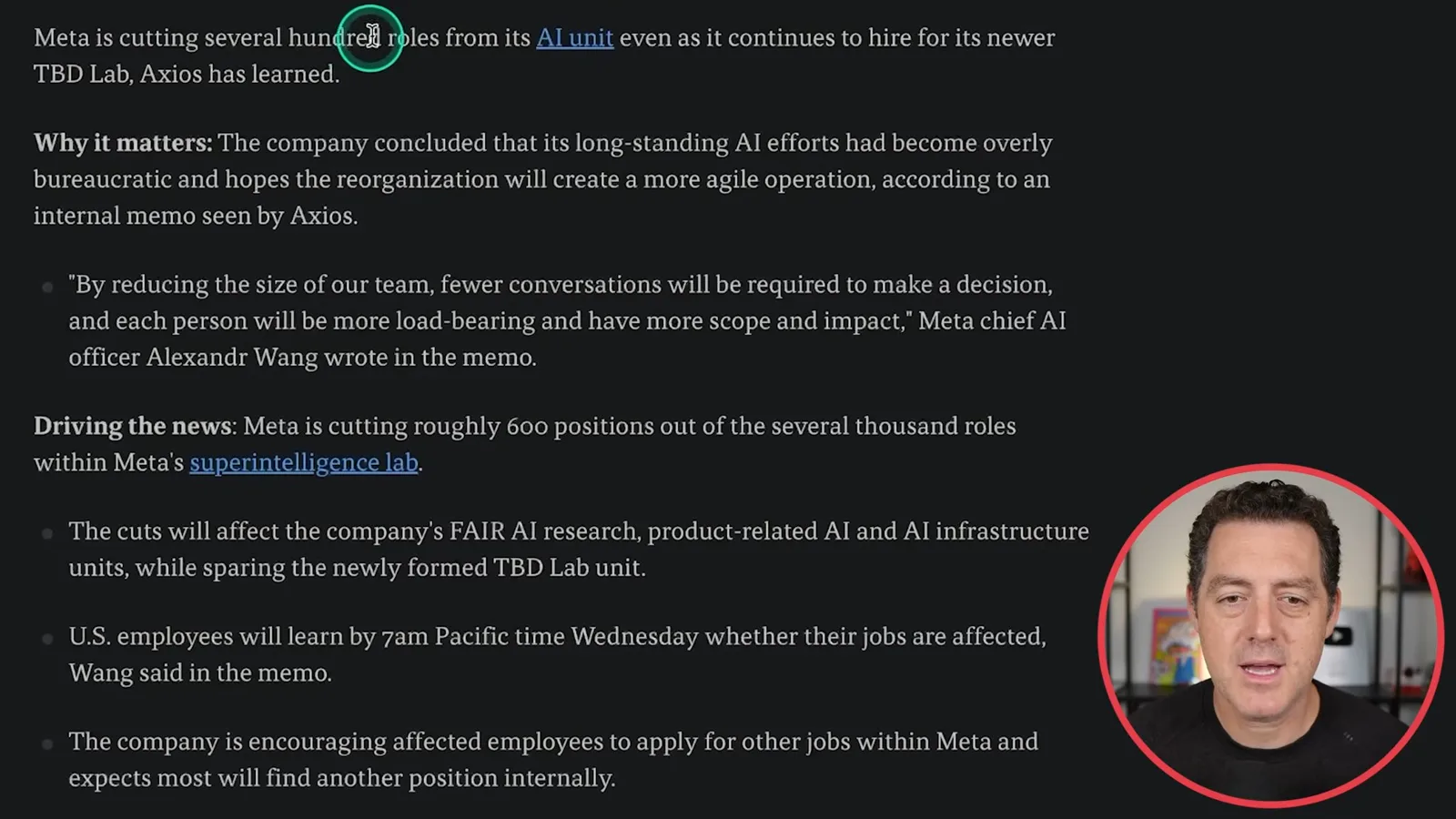
Axios reported that chief AI officer Alexandr Wang framed the reorganization as a way to simplify decisions and broaden individual responsibility. Meta encouraged affected employees to apply for other internal roles and expected many to find them. That expectation was not a guarantee that every affected person would be rehired.
Más de este canal
 34:21EN
 Matthew Berman· 27 oct 2026Matthew Berman Examines Anthropic’s IPO Filing, AI Growth and GovernanceMatthew Berman, Sam Altman · Forward FutureThe presenter reviews the S-1’s financial metrics, compute strategy and voting structure while questioning the tension between rapid AI development and safety.
 0:26ENMatthew Berman· 25 oct 2026Sam Altman on Human Values and Problem-Solving in an AI WorldSam Altman · OpenAIIn a short interview excerpt, Altman considers the enjoyment of solving hard problems and the human role in interpreting results.
 0:36ENMatthew Berman· 25 oct 2026Kimi K3.1 and a Rubik’s Cube Solver DemonstrationMatthew Berman · Forward FutureMatthew Berman shows a scrambled virtual cube being solved and gives the Kimi K3.1 test a favorable assessment.
 0:21ENMatthew Berman· 24 oct 2026An AI-Generated Kimi Benchmark Chart Used Invented ScoresMatthew Berman · Forward FutureMatthew Berman asks for a graph of Kimi K3.1 Pro benchmarks, then discovers that the displayed figures are illustrative placeholders.
 25:50ENMatthew Berman· 24 oct 2026Kimi K3.1 Pro Tested: Strong 3D Demos, Uneven Results and Competitive PricingMatthew Berman · Forward FutureMatthew Berman tests the open-weight model on coding, 3D rendering and visual explanations, then compares benchmark results and prices.
 32:20ENMatthew Berman· 23 oct 2026Who Is Local AI For? The Costs, Trade-offs and a Hybrid FutureMatthew Berman · Forward FutureMatthew Berman weighs data control and independence against hardware cost, setup complexity and inference speed.