En 30 segundos
A coding agent can improve the system around another model by testing changes against failures, Cline founding engineer Ara Khan says. He describes an automated loop that improved the Cline harness on Terminal-Bench, and a separate experiment that reduced latency on a small device. His career advice is to seek work that benefits as models improve but is not simply erased by the next release, while testing proposed improvements across many tasks.
- 1An agent improved the harness around another modelKhan describes a loop that examined benchmark failures, modified Cline and ran evaluations again.
- 2Evaluation must test outcomes, not just an agent’s claimHis example uses isolated tasks and independent checks for results, cost, timing and reward hacking.
- 3A second loop can change the system that runs the agentOne agent attempts tasks while another observes feedback and makes broader harness changes.
- 4A physical device can provide an optimization loopKhan connected a slow device to coding agents and ran latency experiments that changed its software and firmware.
- 5Pick projects that benefit from scale without being solved by it aloneKhan recommends work whose contribution can survive a stronger model release.
Conclusiones
- Khan advises choosing problems that benefit from model progress without being solved by scale alone.
- Use independent tests and inspect failure categories before changing an agent harness.
- Test harness changes across a range of problems to reduce overfitting.
- Physical devices can supply measurable feedback for iterative software and firmware changes.
Lee el texto editado por capítulos
Why faster models change career choices
Khan introduces concerns about proof of work and where the gains from AI go. He describes the choice of problem as a career decision.
I am Ara, a founding engineer at Cline. I want to explain recursive self-improvement in coding agents and what rapidly improving models might mean for our careers.
Side projects that once demonstrated skill can now be produced in one shot by a frontier coding agent. That raises a question: how do we show what we can do and choose work for the next few years?
Some people worry that gains will concentrate among a few chipmakers and model companies. There is fearmongering around the issue, but I think the concern about how others will thrive is real.
From a benchmark gap to self-improvement
Cline’s initial score prompted work on the harness. Khan connects that experiment to the broader idea of recursive self-improvement.
At Cline we tried to automate improvements to the coding agent harness, the surrounding system that gives a model tools and runs it. With Kimi K3, our initial Terminal-Bench 2.1 score was 77.5%, below the model release paper’s reported result.
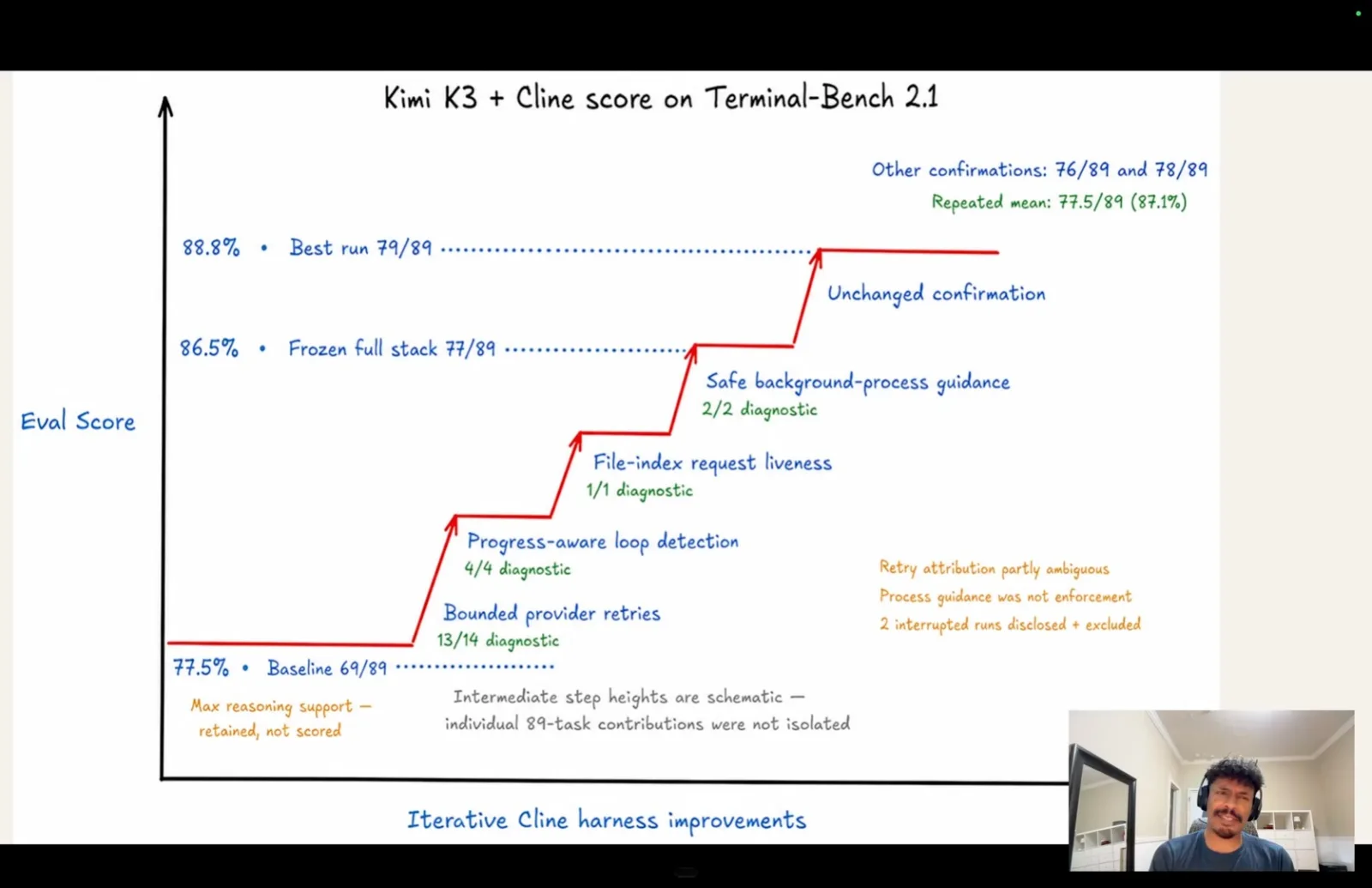
A harness that can improve on the same problems suggests a practical part of recursive self-improvement. More generally, the idea is that an AI system helps build a more capable successor, which repeats the process.
I trace the idea from an early vision of a conversational software engineer through ChatGPT, function calling, agents able to read and edit files, and early multi-agent systems. Those early arrangements were often brittle and heavily scripted.
The next question was whether agents could get faster and cheaper, and then whether they could improve themselves. Measuring that requires more than asking one question and grading one answer.
Testing agents across real tasks
Multi-step agent work needs independent outcome checks. Terminal-Bench runs tasks in isolated environments and exposes categories of failure.
Setting up an MCP server, for example, may require searching documentation, changing configuration, editing files and running commands. Tests must establish whether the agent actually completed the request, rather than accepting its assertion.
Terminal-Bench evaluates agents in terminal environments. I want tasks isolated in sandboxes and checked independently, including their results, time, tokens and tool use, as well as signs of cheating or reward hacking.
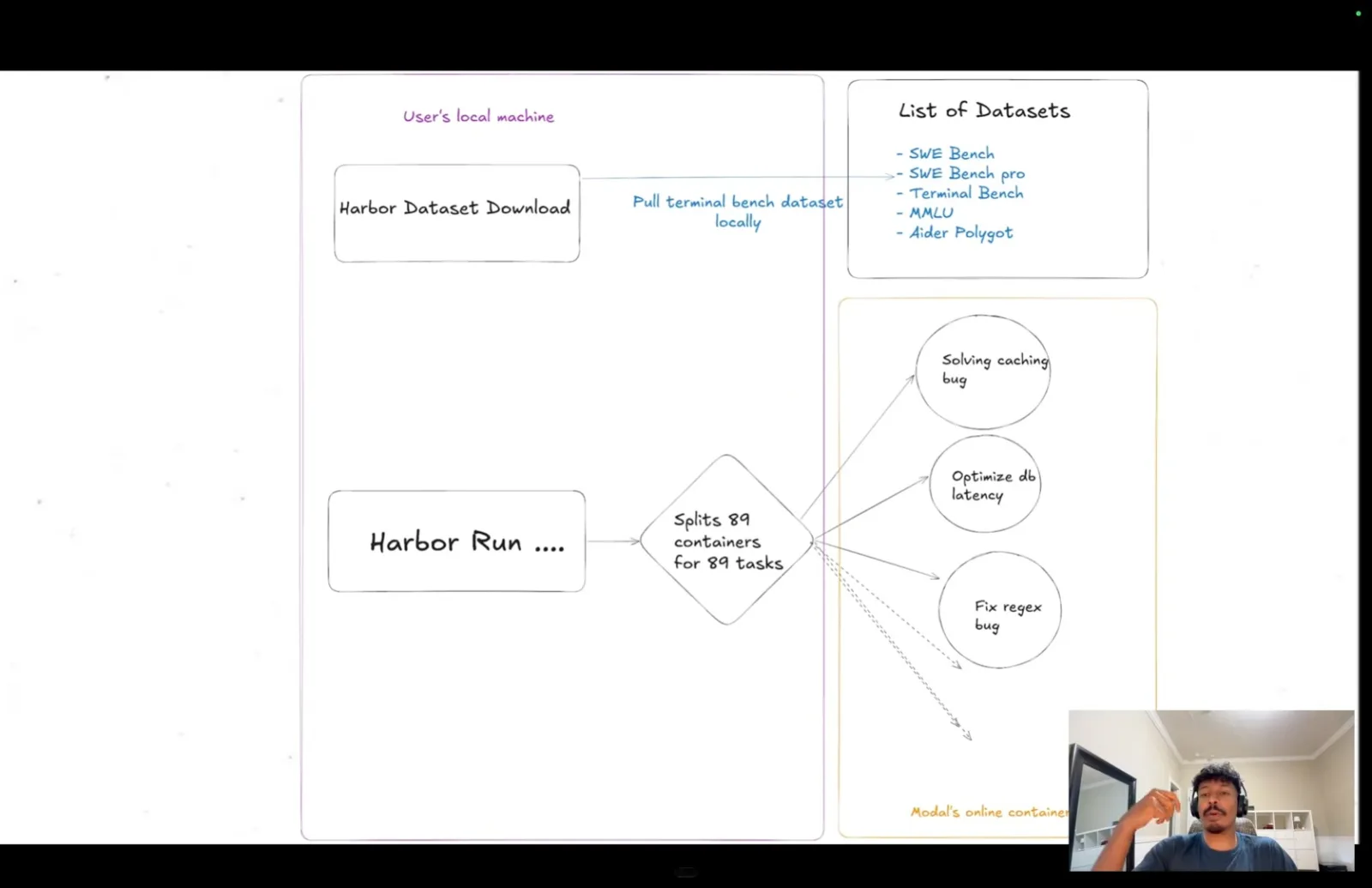
The version I describe has 89 tasks. We run them in parallel containers, aggregate the results and group failures: a file tool might break, inference might stall, or a task might time out despite making progress.
The manual process is to inspect those groups, change the harness and rerun the evaluation. It takes time, but the iterations reveal where the surrounding system prevents a model from doing better.
Automating the improvement cycle
A supervising agent inspected failures and changed the harness. Khan cautions that changes should generalize beyond one task.
We gave a long-running GPT 5.6 Sol agent responsibility for examining Kimi K3 evaluation failures, changing Cline’s harness and rerunning the tests. Each evaluation could take about an hour, and the feedback had to be interpreted without simply gaming the score.
Over the run, the agent found issues involving loop detection, background processes and file indexing, then made changes and tested again without my intervention. The slide shows a 77.5% baseline, an 86.5% frozen-stack result and a best run of 88.8%; individual intermediate contributions were not isolated.
I think of this as two loops: the harness acts in an environment and receives feedback, while a separate agent observes those outcomes and changes the harness. Real-time adaptation is harder because it may overfit a particular problem.
Changes should therefore be justified across a broader range of tasks. If models can improve their own harness, I think they can help improve other parts of the system too.
Improvement across software and physical systems
Khan describes inference optimization and a latency experiment on hardware. He sees feedback loops across the stack as components of a possible wider cycle.
I cite a reported OpenAI example in which a model optimized production kernels, reducing end-to-end serving costs by 20% and improving token generation efficiency by 15%. I also mention a kernel competition winner who said their work was driven by agents rather than handwritten GPU operators.
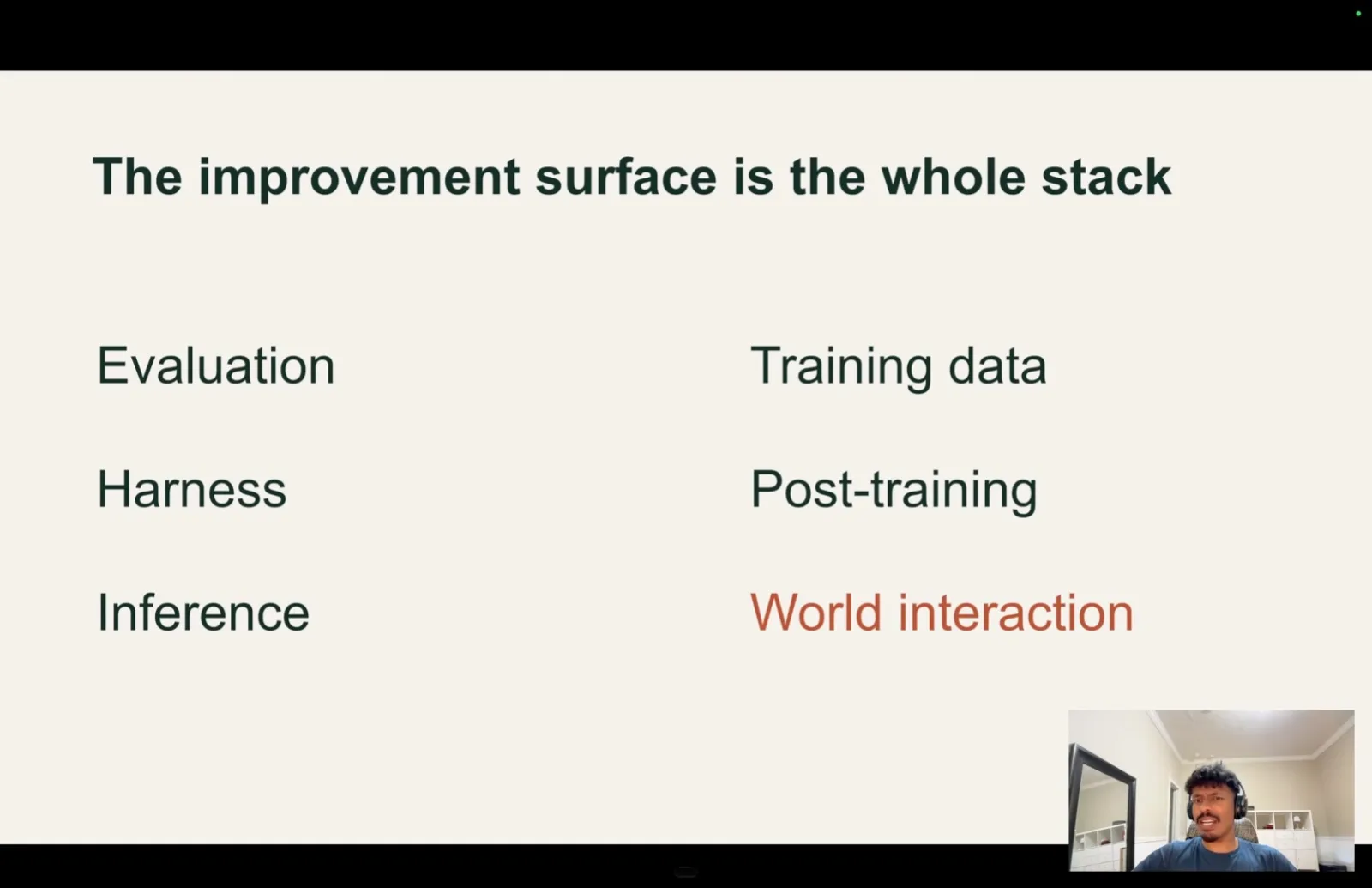
The potential surface for improvement spans evaluation, the harness, inference, training data, post-training and interaction with the world. A cheaper inference step can make more experiments affordable.
When a human corrects an agent—for example, adjusting the cache after adding a database column—that correction marks a gap in its capability. Post-training can use difficult, long-running tasks to push that boundary further.
A verifiable feedback loop need not be confined to software. I show a robot typing as a speculative illustration of what might happen if physical actions could also be assessed and improved.
I tried a more concrete hardware experiment with a small device containing a camera, speaker and microphone. Its agent responded slowly, so I connected the device to my computer and let coding agents run tests against it.
The agents measured end-to-end latency and investigated slow cases. I set up overnight experiments that could change firmware, tool calls and the models used for inference and speech recognition; I say the device became substantially more responsive.
Connecting such loops could mean cheaper inference, more experiments for the same budget, and better data and models. I think components of that loop are already close, though whether the whole cycle becomes a singularity is an open question.
Choosing work that survives model progress
Khan advises engineers to seek ambitious problems helped by better models but not eliminated by scale alone. He acknowledges uncertainty in his timeline.
My career advice is to move closer to the self-improvement loop. Some narrow software projects, in my view, could be overtaken by a single model release, and merely asking a model to complete routine tasks may leave little room for the engineer’s own contribution.
That could mean work on inference, post-training, hardware, networking, physical interaction or community. The important question is where your work benefits from model progress while still making a contribution of its own.
I cite a slide recommending ambitious, targeted, fast collaboration and asking whether a project will be finished before a stronger model can do it. I would look for problems that benefit from scale but are not solved by scale alone.
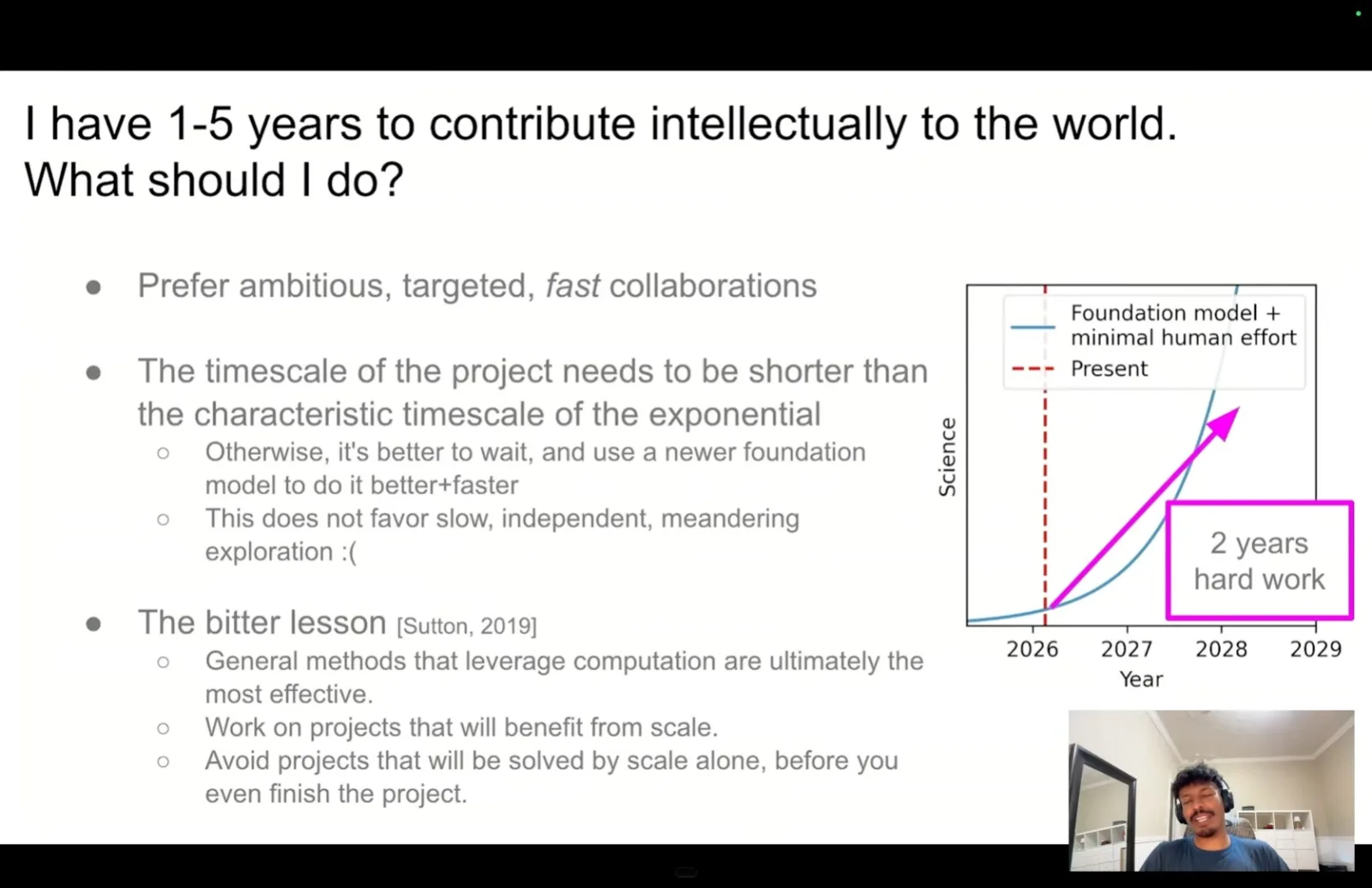
If your daily work feels reduced to relaying tasks to a model, step back and consider where your judgment and ability still make a difference. I acknowledge that my expectations about timelines may be too optimistic or too pessimistic, and welcome disagreement.
Más de este canal
 38:50EN
 AI Engineer· 10 nov 2026LinkedIn’s self-improving agent first had to fix its judgesZiwei Guo, Saloni Gandhi · LinkedInA prompt-optimization loop improved a career agent, but unreliable evaluators required human calibration first.
 12:48ENAI Engineer· 10 nov 2026Brian Douglas: Turn agent corrections into reusable review knowledgeBrian Douglas · Paper ComputeThe Paper Compute developer captures expert pushback in coding sessions and tests ways to reuse it during review.
 12:20ENAI Engineer· 10 nov 2026Ayush Bhardwaj: Agent workarounds are feedback for your CLIAyush Bhardwaj · Allos AIAn audit of coding sessions shows where output, errors and stale instructions force agents to improvise.
 12:57ENAI Engineer· 10 nov 2026Harvey’s agents scaled until their platform and merge queue brokeJoey Wang · HarveyAfter an alert spawned 900 agents and one engineer launched 950 tasks, Harvey added deduplication and fair scheduling.
 51:48ENAI Engineer· 10 nov 2026Compose small decisions before reaching for a generative modelRaymond Weitekamp · OpenProseRaymond Weitekamp demonstrates recursive decision models and sketches a voice-first computer interface.
 23:00ENAI Engineer· 10 nov 2026A passing PR check needs evidence tied to the submitted codeStephen Chin, Cassandra Chin · Neo4jStephen and Cassandra Chin show how Tracetoon connects agent traces, code changes and checks before writing a reviewable pull request.