En 30 segundos
On December 19, 2025, Matthew Berman and Nick Wentz host a Box-sponsored livestream with SemiAnalysis president Doug O’Laughlin, Google chief AI architect Koray Kavukcuoglu, Google DeepMind product lead Logan Kilpatrick and Robinhood product vice president Abhishek Fatehpuria. They examine inference speed, chip infrastructure and export controls, Google’s research and product strategy, and the design of prediction markets and financial AI. The guests distinguish current products from their plans and forecasts, though some claims are speculative or reflect their employers’ interests. Reuters’ reported Chinese EUV prototype had not produced working chips at the time, and prediction-market prices are not guaranteed probabilities or perfect hedges.
- 1Speed and serving economicsO’Laughlin explains that batching and user load can trade individual responsiveness for aggregate throughput.
- 2EUV prototype reportsHe discusses Reuters’ reporting on China’s prototype and predicts further progress; Reuters said it had not yet produced working chips.
- 3Research meets productsKavukcuoglu says Google uses feedback from Gemini, AI Mode and enterprise customers alongside research and safety work.
- 4Fast versus frontierKilpatrick says Gemini 3 Flash serves many daily needs, while capable frontier models remain important for demanding tasks and distillation.
- 5Prediction-market mechanicsFatehpuria explains binary event contracts and early exit, then discusses surveillance and product risks with the hosts.
- 6Robinhood CortexFatehpuria describes AI-powered market and portfolio summaries and a planned assistant, presenting longer-term advice as an ambition.
Conclusiones
- Inference service design balances per-user latency, aggregate throughput, model quality and cost.
- A reported Chinese EUV prototype was under testing in December 2025; producing commercial chips was a future goal, not an established achievement.
- Kavukcuoglu describes user feedback and safety testing as part of Google’s research and release cycle.
- Kilpatrick argues both frontier models and faster models matter, with the appropriate choice depending on the task.
- Event contracts can settle at fixed amounts and may be sold early, but prices, liquidity and hedging outcomes are uncertain.
- Robinhood’s AI and prediction-market plans are its product executive’s outlook, not proof of future returns or model accuracy.
Lee el texto editado por capítulos
Opening: speed and AI deployment
The hosts debate model speed against quality and the importance of implementation. Berman notes that some tasks still require more reasoning.
Matthew Berman and Nick Wentz open Forward Future Live on December 19, 2025, with four guests from SemiAnalysis, Google DeepMind and Robinhood. Box sponsored the show, a relationship disclosed by the hosts at the end.
Berman says Gemini 3 Flash strengthened his preference for fast, inexpensive models that are good enough for most everyday tasks. He argues that deployment, interfaces and education can create value even without an immediate leap in model capabilities. His assessment is a personal view, not a claim that quality no longer matters.
Wentz asks about exceptions in medicine, law and finance. Berman agrees the choice depends on the task: he uses deeper reasoning for research and sees science as a case where extra compute may matter. His estimate that 99% of his own use cases do not need the largest model describes his workflow, not an industry measurement.
The hosts consider the trade-off between using limited compute for research and serving existing users. Berman speculates that the pursuit of self-improving AI may create winner-take-all incentives; that is a forecast rather than an established outcome. He also notes that enterprise model changes involve testing and change management, not merely swapping an API key.
Doug O’Laughlin: chips, inference and geopolitics
The SemiAnalysis president explains serving trade-offs, considers a proposed data-center pause and discusses reported Chinese EUV development and accelerator competition.
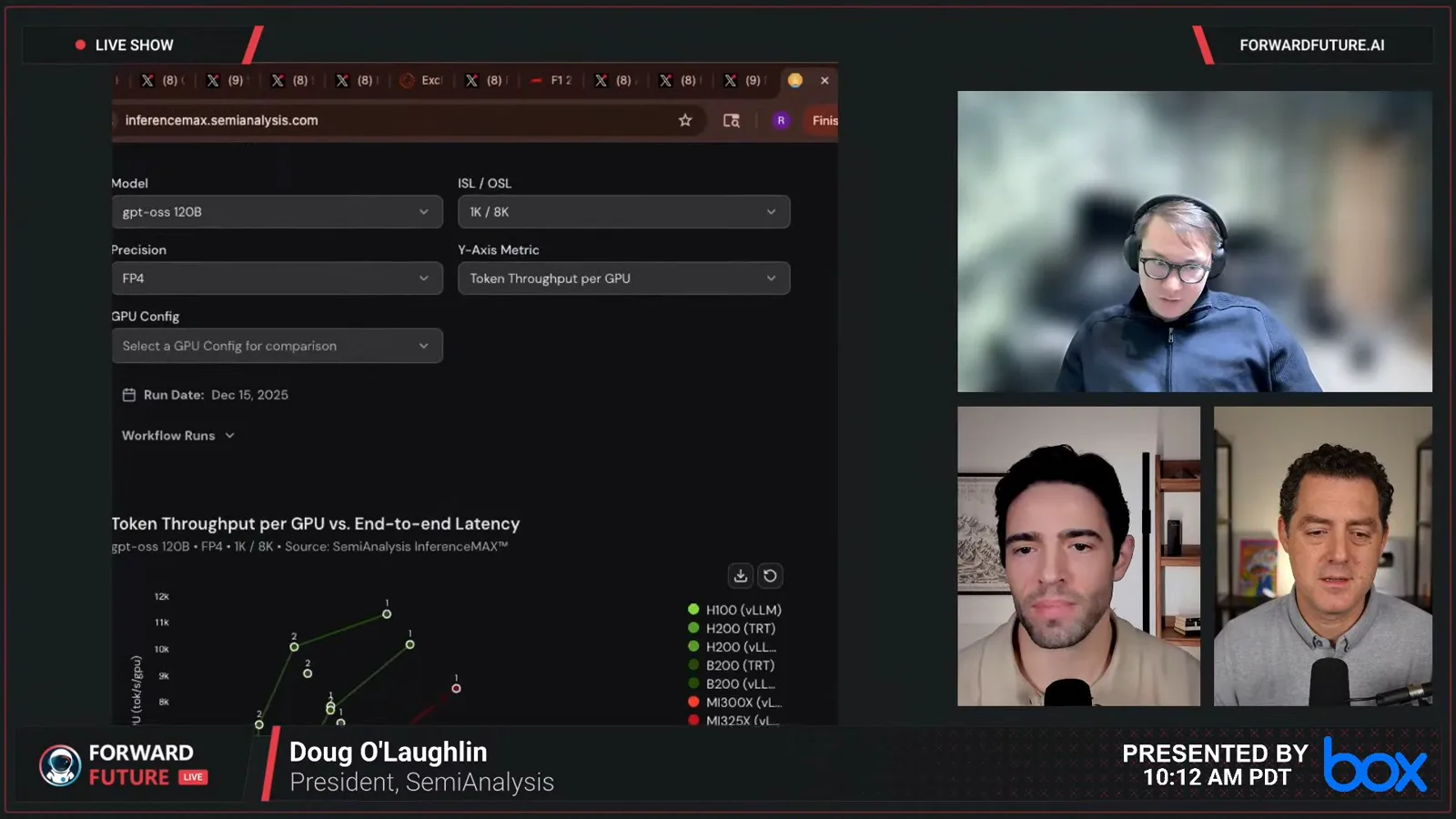
Doug O’Laughlin, president of SemiAnalysis, joins to discuss inference speed. He says model design, hardware capacity, demand and serving strategy all matter. A provider can batch requests to increase aggregate throughput, but greater concurrency can reduce the response speed experienced by each user.
O’Laughlin refers to SemiAnalysis’ InferenceMAX charts, comparing throughput and interactivity across GPU configurations. Providers must balance cost and total tokens served against users’ willingness to wait. He personally prefers a slower, higher-quality model for some work; the ideal combination of maximum quality and speed can be expensive.
The hosts ask about Senator Bernie Sanders’ proposed pause on new AI data centers. O’Laughlin discusses employment concerns, political incentives and the difficulty of coordinating a pause internationally. His comments about politicians’ motives and future election outcomes are his interpretations, not established facts.
Asked to imagine a six- or twelve-month infrastructure pause, he suggests constrained supply might slow service and that investment could move abroad. He acknowledges the scenario has many possible outcomes. Wentz raises relocation to other jurisdictions, while Berman worries about competitiveness with China; these are hypothetical consequences.
The conversation turns to Reuters’ December 2025 report about a Chinese extreme-ultraviolet lithography prototype. O’Laughlin says he has heard of extensive investment and a machine built using older components, and predicts further progress. Reuters reported that the prototype was being tested and had not produced working chips; a stated 2028 target was not a demonstration of production readiness.
Asked about reports of Nvidia chips reaching China, O’Laughlin speculates that Chinese AI developers may use several types of hardware, including domestic and imported chips. He does not provide evidence establishing the exact devices used by DeepSeek or the means by which they were obtained. His conjecture should not be treated as a finding that a particular company smuggled specific chips.
On whether the United States should sell advanced accelerators to China, O’Laughlin describes a trade-off: exports can support U.S. suppliers and reinforce their ecosystem, while also giving competitors access to technology and opportunities to learn from it. He says he is not certain which policy is best and frames the decision as one involving both economics and geopolitics.
The hosts ask what he means by hardware instability. O’Laughlin explains that large accelerator systems rely on many high-speed connections and that debugging link failures and signal integrity can be difficult. He compares Nvidia’s rack-scale design with Huawei’s much larger CloudMatrix system; his statements about specific failure rates and performance are impressions, not measurements presented in the show.
Berman asks why the U.S. does not build a complete competing lithography system. O’Laughlin points to the American origins of Cymer’s EUV light-source technology and describes the difficult engineering of stable light, mirrors and wafer positioning. ASML’s commercial systems depend on a global supply chain; ownership of one component does not by itself establish an entire national capability.
Turning to accelerator competition, O’Laughlin describes Google’s TPU approach as a system of many smaller connected chips, contrasting it with Nvidia’s rack-scale design. He uses a slider-versus-large-sandwich analogy to explain different choices about chip size, networking and scale. He sees Google’s vertically integrated hardware and software as a more serious competitive challenge.
He also discusses the possibility of wider external access to TPUs and expects Nvidia to respond with future products. These are market judgments and predictions, not established future performance results. Hardware choices depend on software support, workload, availability and total costs as well as peak specifications.
Asked about quantum computing, O’Laughlin does not expect it to replace production AI accelerators soon and sees potential in specialized scientific problems. His timeline and suggestions about chemistry, materials or genomics are forecasts. Quantum computers do not automatically solve all NP-hard problems, and future advantage depends on algorithms, error correction and practical hardware.
Koray Kavukcuoglu: Google research and safety
Google’s chief AI architect describes product feedback, AGI research, science applications and safety evaluation.
The next guest is Koray Kavukcuoglu, Google’s chief AI architect and a Google DeepMind leader. He says 2025 brought a rapid release cadence, with closer coordination between model research and product teams. Shipping creates a second phase of learning because developers receive user feedback after release.
Kavukcuoglu says rapid iteration only helps when releases are meaningfully different. He describes organizing research on several time horizons so mature ideas can be incorporated into model updates, while teams also fix weaknesses found in previous releases. The goal is to coordinate research, deployment and product feedback.
Asked whether product demands compete with frontier research, he calls resource allocation a strategic decision rather than an inherent opposition. Google DeepMind’s stated goal is AGI, he says, but real product use helps illuminate difficult use cases and failure modes. Compute remains limited and requires governance and choices.
He identifies three important feedback sources: the Gemini app for broad everyday use, AI Mode in Search for information-seeking tasks, and developers and enterprise customers for practical workflows. He says each provides different signals about where model capabilities need to improve.
The hosts ask for a definition of AGI. Kavukcuoglu emphasizes generality: a system should be useful across domains rather than having a separate model for each narrow problem. He describes strong support for reasoning-intensive work as a sign of progress, not a test that has already been conclusively passed.
On whether scale alone will suffice, he stresses that research and innovation remain necessary. Scaling relationships can guide choices about data and compute, but achieving a given capability is not automatic. This is his assessment of the research program, not a guarantee of AGI.
The discussion moves to science, including AlphaFold, materials and fusion research. Kavukcuoglu says DeepMind has long sought to use AI on fundamental scientific problems both for their potential benefits and because difficult problems can advance AI methods. The examples illustrate research directions; he does not establish that these fields are solved.
Berman asks whether self-improving AI is the ultimate objective. Kavukcuoglu calls it one research direction, not the sole goal, and says models already help researchers and developers work through problems. He argues that real-world use and iterative safety and security testing should accompany increasingly capable systems.
He describes AI progress as the convergence of hardware, data, methods and decades of research. He feels fortunate to work at this moment and argues that the opportunity requires humility and responsibility as well as ambition. These are his views about the field and its potential.
Asked about job displacement and existential concerns, he acknowledges anxiety and says useful deployment requires feedback from users, researchers, safety specialists and external parties. He expects benefits from learning and productivity, while recognizing that systems are not completely safe. His optimism is not evidence that labor or safety risks have been resolved.
On practical safety, Kavukcuoglu says safety and security researchers participate during model development, not only at release. He describes testing for dangerous capabilities, including cyber-related risks, under a frontier safety framework and says testing processes evolve with new evidence. These are Google’s described practices, not an independent audit.
Logan Kilpatrick: Gemini Flash and software interfaces
The Google DeepMind product lead discusses fast and frontier models, creativity and generated interfaces.
Logan Kilpatrick, a Google DeepMind product lead, joins after Kavukcuoglu. He says Gemini 3 Flash changes the older perception of “Flash” as simply a cheaper, less capable model: it is stronger than Pro on some dimensions but not all. Berman welcomes the combination of quality and responsiveness.
Kilpatrick argues that frontier models still matter for attracting users, advancing research and improving smaller models through techniques such as distillation. He distinguishes this from Flash’s role in broad, fast product experiences. The claim that every smaller model is derived in the same way should not be inferred from his general description.
He says a launch creates substantial work: customers try the model, teams gather feedback, and distribution across Google’s many surfaces requires infrastructure and coordination. He frames user feedback as an input to later model iterations, echoing Kavukcuoglu’s account.
Kilpatrick describes internal AI Studio observations from a blind Pro-versus-Flash comparison for app generation. He says more users completed and iterated on apps with the faster model. The interview gives no experimental details or independent replication, so this is an employer-reported observation rather than a general performance guarantee.
Asked where Pro still helps, he names professional coding and creative writing, while saying results vary by prompt and modality. A user tolerant of higher cost and latency may prefer a larger model on some demanding tasks; the right choice is use-case specific.
Berman asks why larger models might be more creative and how that could be measured. Kilpatrick presents an explicitly tentative intuition about breadth and model size, and invites correction. He acknowledges that novelty and creativity are difficult to assess and that smaller models may also improve.
Both speakers say they prefer to write their own public words. Kilpatrick describes writing as an expression of personal perspective that is difficult to encode fully in a prompt, even though he has used AI-generated images, video and code. Berman adds that writing can clarify a person’s ideas; neither claim is a universal rule for other users.
They turn to generative interfaces. Kilpatrick predicts that software will increasingly create interactive experiences for an immediate question, alongside chat and voice. He imagines possible uses in documents and messaging, while explicitly saying these are ideas rather than confirmed product-roadmap commitments.
Asked whether real-time software generation threatens conventional SaaS, he draws a distinction between personal, disposable tools and shared enterprise applications. A company may need consistent behavior, agreed requirements and verification across thousands of users. He sees value in reliable shared software even if parts can be generated.
For search, Kilpatrick imagines generated simulations that help explain topics such as airflow or car engines. He suggests reusable interactive artifacts might avoid regenerating the same explanation for every user. The examples are exploratory product ideas; generated explanations would still need to be checked for correctness.
Asked about the coming quarter, he says Google has work planned across models, AI Studio and APIs but does not announce specific releases. The hosts thank him and move to the final guest.
Abhishek Fatehpuria: prediction markets and financial AI
The Robinhood executive explains event contracts, surveillance and Cortex, while the hosts ask about risks and future applications.
Robinhood product vice president Abhishek Fatehpuria joins. The hosts quote customer, asset and valuation figures, while he emphasizes product development rather than confirming those numbers. He describes Robinhood’s ambition to offer trading, investing, credit and banking products in one application.
Fatehpuria describes prediction markets as event contracts that let a customer express a view about an outcome. In the example discussed, a contract pays $1 if its specified condition is met and otherwise resolves according to its terms. A trader can lose the purchase price and fees, and the exact payoff and rules depend on the contract.
He says a position can sometimes be sold before the event resolves rather than held to settlement. An early exit depends on market liquidity and the available price; a sale is not guaranteed at the trader’s preferred value. The hosts observe that event contracts differ from owning a share of a company.
Wentz asks whether prediction markets amount to the casino-like financialization of information. Fatehpuria sees nuance and says active traders can express specific views or use markets as information sources. Market prices can reflect participants’ beliefs and incentives, but are not necessarily unbiased or accurate probabilities.
He cites interest-rate and corporate-acquisition contracts, then weather contracts, as examples of events linked to economic decisions. He suggests some users may try to hedge exposure. Whether a contract is an effective hedge depends on the match between its terms and the actual exposure, along with price, fees and liquidity.
The hosts raise insider-information concerns. Fatehpuria says Robinhood takes surveillance seriously and intends to apply experience from equity markets as prediction markets grow. When pressed on the value of early information, he distinguishes research-based expertise from insider trading; his general answer does not settle the legal rules for every type of event contract.
Wentz asks whether low-risk retirement products and speculative contracts should be separated in the interface. Fatehpuria describes customers mentally dividing money among active trading, savings and long-term investing, and says Robinhood wants to serve those different needs. Retirement accounts are account types, not inherently low-risk investments; risk depends on their holdings.
Turning to AI, Fatehpuria describes Robinhood Cortex, announced in March 2025, and stock summaries that combine market data, news and other signals. He says the company expanded the approach to other assets and announced portfolio-level summaries and an assistant. Robinhood’s December announcement described the assistant as a forthcoming feature for eligible Gold subscribers, not a guarantee of accuracy.
He outlines three ambitions: streamline active-trader workflows, personalize the application and eventually help with financial advice. Asked whether users could connect a general-purpose model to manage an account autonomously, he says Robinhood does not actively support that and argues that timely account and market data could give a dedicated assistant an advantage. That is his company’s assessment, not evidence of superior investment performance.
Berman asks about passive investors. Fatehpuria points to portfolio summaries as an initial step and says broader financial management would take longer and require work with regulators. He contrasts that vision with Robinhood Strategies, which uses questionnaires about preferences and risk tolerance to manage portfolios and can include individual stocks as well as funds.
Asked whether AI-driven investing becomes a race for compute, Fatehpuria emphasizes data: timely market prices, fundamentals, news and company information can matter alongside model capability. He argues a brokerage may be well positioned to supply these inputs, while acknowledging the importance of keeping the information current.
His stated priorities for the coming year are active trading, a larger share of customers’ financial activity and international expansion. He cites further development of Robinhood Legend and retirement offerings but does not disclose specific future product plans.
On prediction markets in 2026, he anticipates growth beyond sports into weather, crypto and company-related events and hopes market data will inform other products. Asked whether contracts could resemble passive equity investments, he does not give a definitive answer, but suggests possible hedging uses and mentions interest in weather contracts as alternatives to insurance. These are views about possible uses, not evidence of equivalent protection or suitability.
Closing and sponsor
The hosts reflect on prediction markets and thank the guests. They disclose that Box sponsored the show.
After the guest leaves, Berman says he has only begun exploring prediction markets and tried sports contracts mainly to learn the interface. The hosts thank their guests and explicitly thank Box for sponsoring the show. They close after the final discussion.
Más de este canal
 34:21EN
 Matthew Berman· 27 oct 2026Matthew Berman Examines Anthropic’s IPO Filing, AI Growth and GovernanceMatthew Berman, Sam Altman · Forward FutureThe presenter reviews the S-1’s financial metrics, compute strategy and voting structure while questioning the tension between rapid AI development and safety.
 0:26ENMatthew Berman· 25 oct 2026Sam Altman on Human Values and Problem-Solving in an AI WorldSam Altman · OpenAIIn a short interview excerpt, Altman considers the enjoyment of solving hard problems and the human role in interpreting results.
 0:36ENMatthew Berman· 25 oct 2026Kimi K3.1 and a Rubik’s Cube Solver DemonstrationMatthew Berman · Forward FutureMatthew Berman shows a scrambled virtual cube being solved and gives the Kimi K3.1 test a favorable assessment.
 0:21ENMatthew Berman· 24 oct 2026An AI-Generated Kimi Benchmark Chart Used Invented ScoresMatthew Berman · Forward FutureMatthew Berman asks for a graph of Kimi K3.1 Pro benchmarks, then discovers that the displayed figures are illustrative placeholders.
 25:50ENMatthew Berman· 24 oct 2026Kimi K3.1 Pro Tested: Strong 3D Demos, Uneven Results and Competitive PricingMatthew Berman · Forward FutureMatthew Berman tests the open-weight model on coding, 3D rendering and visual explanations, then compares benchmark results and prices.
 32:20ENMatthew Berman· 23 oct 2026Who Is Local AI For? The Costs, Trade-offs and a Hybrid FutureMatthew Berman · Forward FutureMatthew Berman weighs data control and independence against hardware cost, setup complexity and inference speed.