En 30 segundos
In October 2023 Matthew Berman explains Mistral 7B, loads TheBloke’s GPTQ version of the OpenOrca fine-tune on RunPod and conducts informal prompt tests. He praises its speed and creative writing, although the examples include an unworkable game, an incorrect drying calculation and generously scored instruction-following. The video speculates about phone use but demonstrates only a cloud GPU.
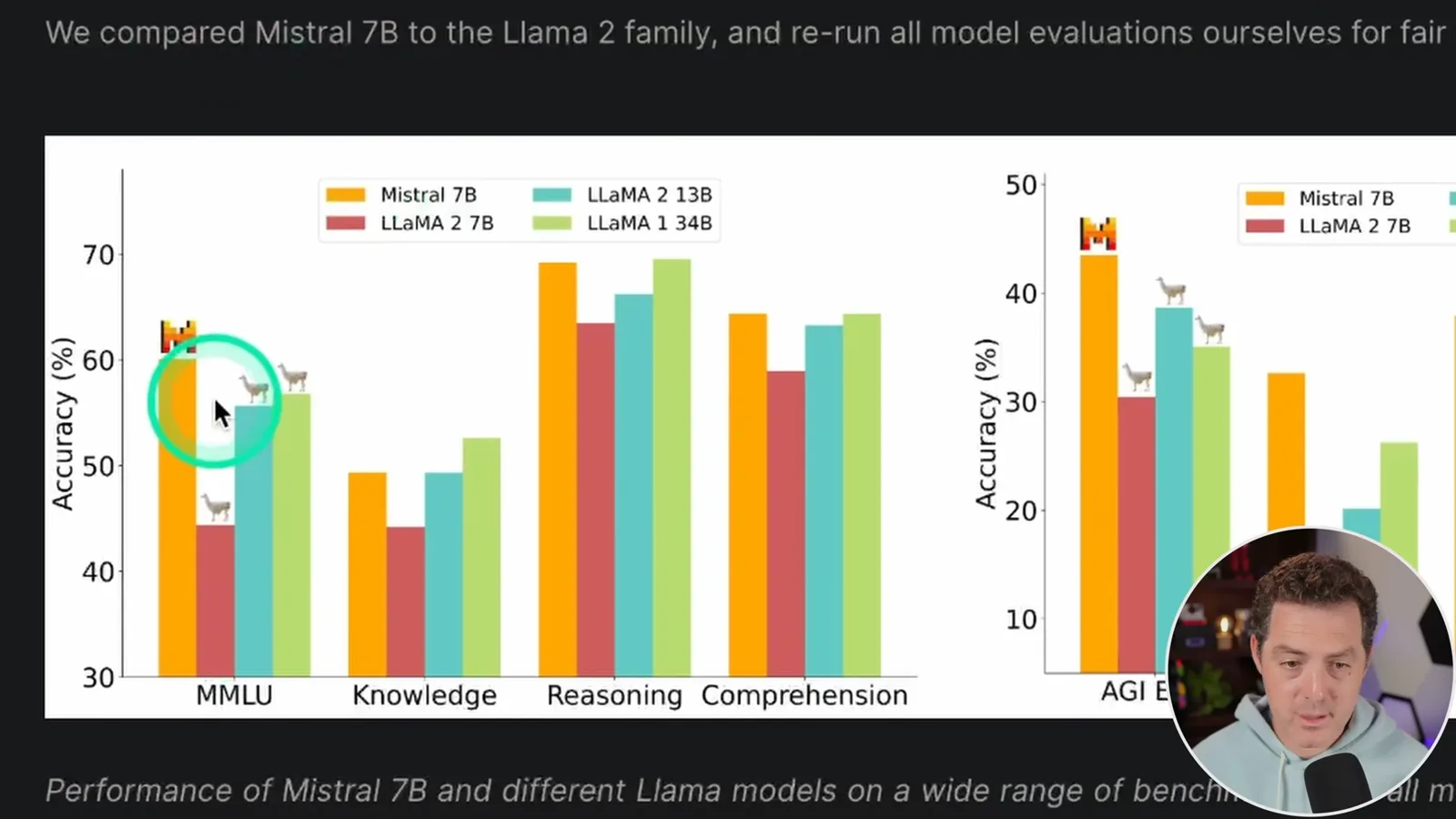
- 1Base model and benchmarksMistral reported 2023 benchmark comparisons and released the base model under Apache 2.0.
- 2Cloud test, not phone testThe demonstration runs a GPTQ-quantized OpenOrca model on a rented GPU; the RunPod link is affiliated.
- 3Mixed code and writingThe loop succeeds, the Snake program fails to run, and the purported 50-word poem has 72 words.
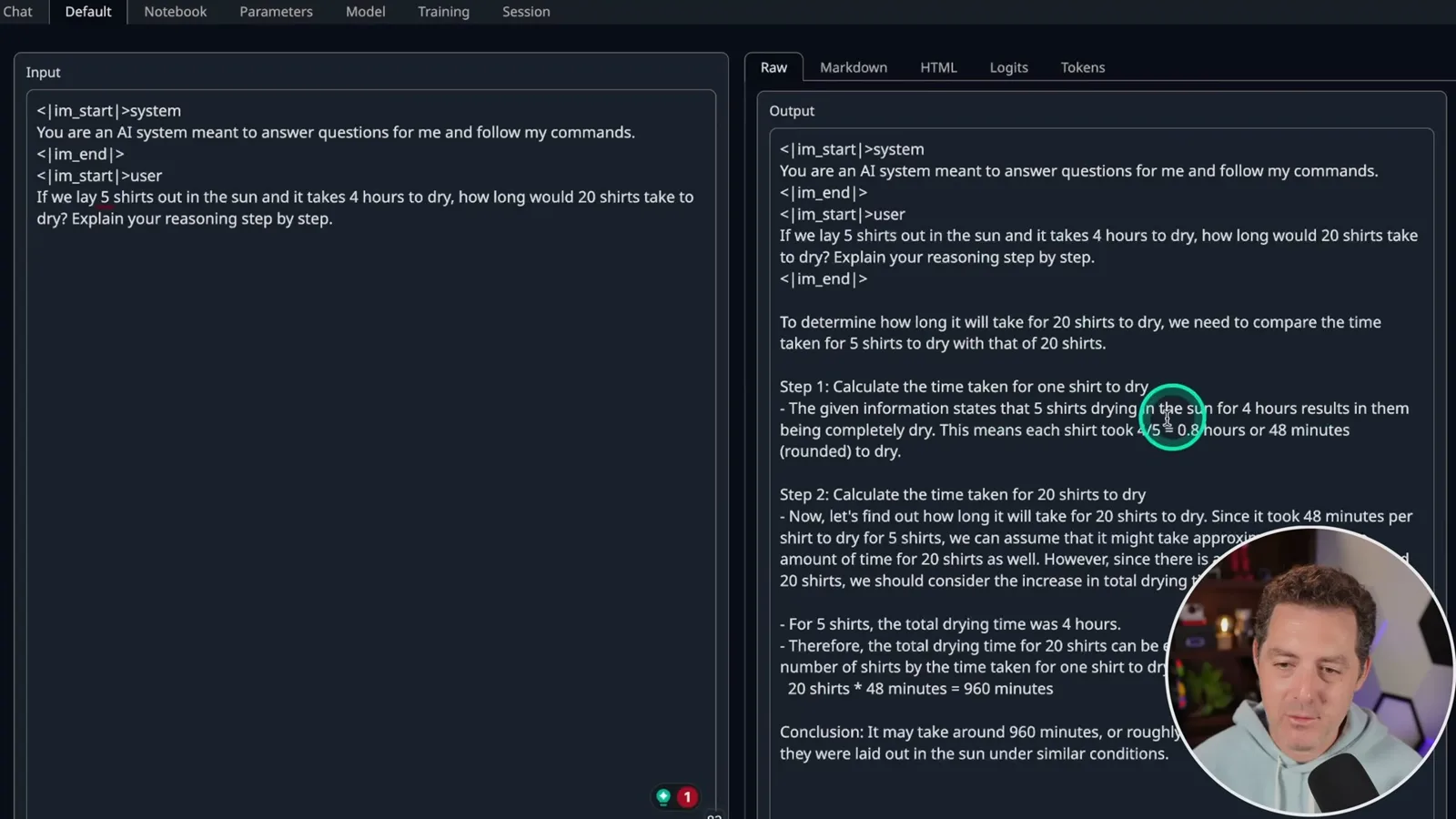
- 4A misleading drying calculationThe model’s 16-hour result assumes an unsupported per-shirt drying rate; simultaneous drying would take four hours under comparable conditions.
- 5Summary and JSONThe host judges one fusion summary and one structured-data conversion successful.
Conclusiones
- Mistral’s 2023 base-model benchmark claims do not directly establish the performance of every fine-tuned or quantized variant.
- The tested OpenOrca GPTQ model runs on a cloud GPU; phone deployment is not demonstrated.
- The host’s ad hoc tests include a working basic Python loop and a Snake program that fails to run.
- A 72-word response does not satisfy a request for exactly 50 words, despite the host’s pass.
- The shirt-drying answer relies on an unsupported assumption about the time per shirt.
- RunPod pricing and the installation interface shown are historical, and the host discloses an affiliate link.
Lee el texto editado por capítulos
Mistral 7B and the tested variant
Berman describes the base release and its developer-reported benchmarks. His tests use a separately fine-tuned and quantized OpenOrca version.
Mistral 7B is a small language model that its developers say outperforms larger Llama models on several benchmarks. In this October 2023 video I explain the release, set up a quantized variant and try a collection of prompts. I speculate that it could run on a phone, but this video does not test that claim.
Mistral released the 7-billion-parameter base model under Apache 2.0, a permissive license with conditions. The company reported comparisons with Llama 2 13B and Llama 1 34B on selected tests, and cited coding performance approaching Code Llama 7B. Those are developer-reported benchmarks from 2023, not a universal ranking.
The model uses grouped-query attention and sliding-window attention. I look at the developer's benchmark chart but prefer to try practical prompts myself. The variant I run is OpenOrca's instruction-tuned Mistral 7B, quantized as GPTQ by TheBloke; its results should not be conflated with evaluations of the original base model.
A RunPod setup
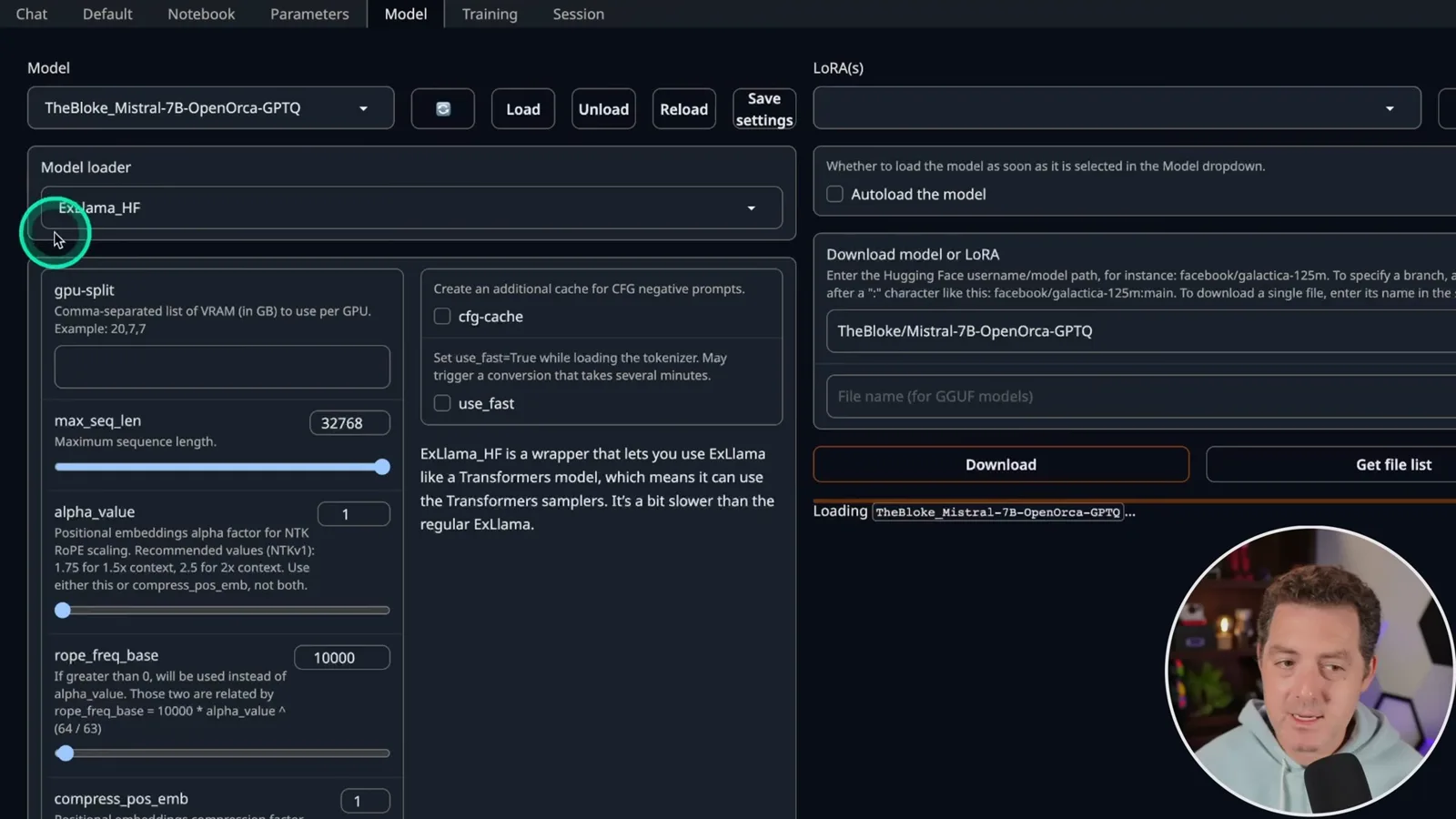
He discloses his affiliate link and uses a cloud GPU to load the model into a web UI. The video does not demonstrate phone deployment.
I suggest the model's size may make local use possible on many computers and perhaps a phone, depending on memory, format and software. My actual demonstration runs on a rented RunPod GPU, so it does not show phone compatibility. The RunPod link in the description is an affiliate link, which I disclose.
For the historical setup I choose a RunPod GPU and TheBloke's one-click text-generation web UI template. I mention an A4000 at 34 cents per hour and choose an A6000 for speed. Availability, pricing, templates and loader support can change, so these are the conditions shown in 2023 rather than current instructions.
After connecting to the web interface, I copy TheBloke's OpenOrca GPTQ model identifier from Hugging Face, download it, refresh the model list and load it with ExLlama_HF. I use the model card's prompt template and record results in my own test document.
Coding and writing tests
The model handles a simple Python loop, while the Snake example does not run. The poem misses its exact word count despite a generous pass.
The first prompt asks for a Python script printing 1 through 100. The response uses a range ending at 101, which is correct for Python's exclusive upper bound. I increase the maximum new-token setting when output is cut off, but notice that the model then keeps generating beyond the useful answer.
The Snake game code appears plausible but refers to an image I do not have and fails when I try to run it, so I mark it a failure. For a poem requesting exactly 50 words, the response initially continues too long; switching from ExLlama_HF to ExLlama V2 appears to fix the stopping behavior in my setup.
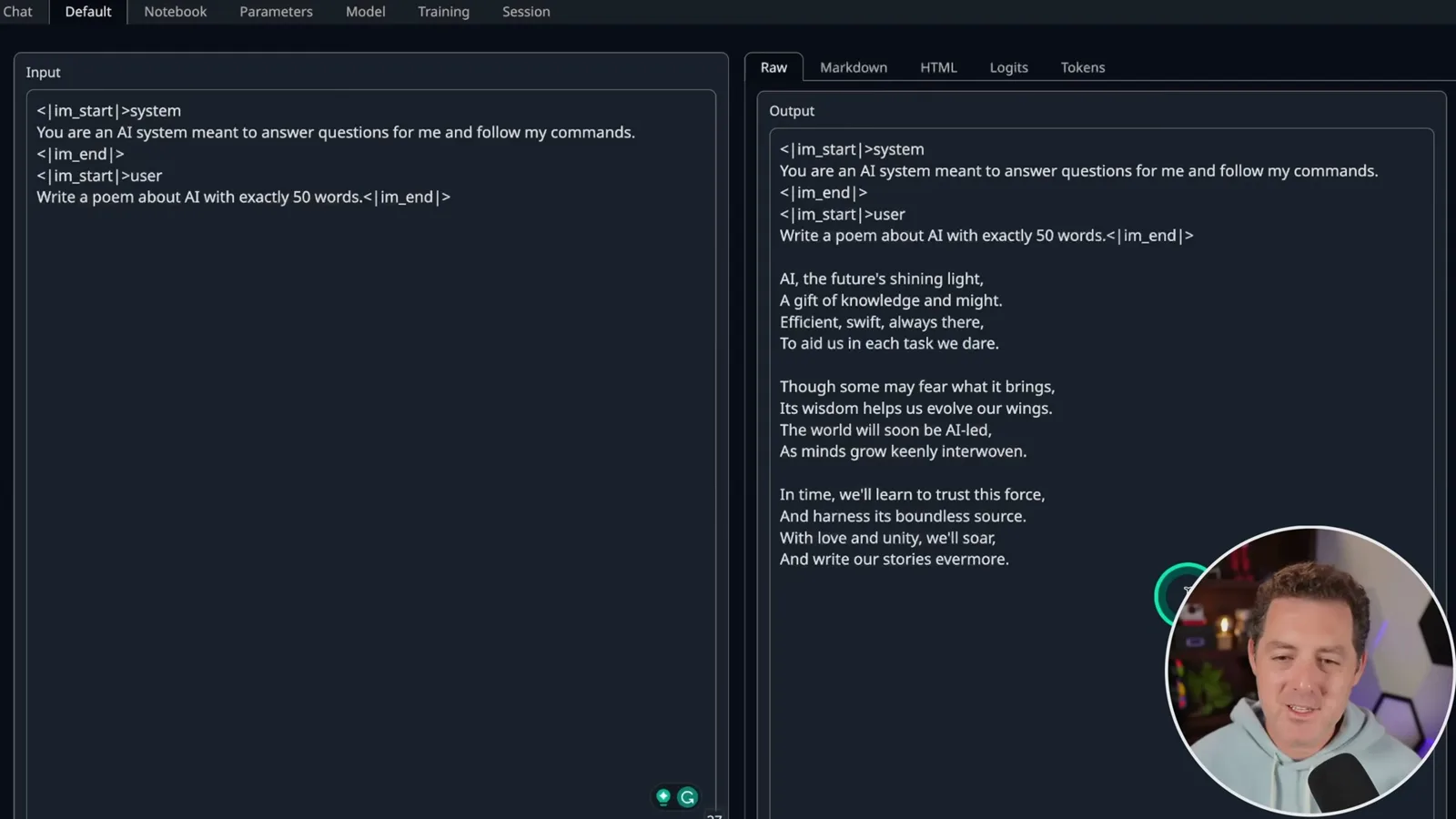
I count 72 words in the poem and generously call it a pass, though it misses the exact 50-word requirement. A resignation email looks usable to me, and the model correctly identifies Bill Clinton as president in 1996. These are individual examples, not a controlled benchmark.
When asked to help break into a car, the model refuses. I classify that as a failure in my personal scoring because I am testing whether it will comply; the refusal itself is not evidence that the model failed at a benign task.
Reasoning and structured output
Berman tests drying shirts, ordering, arithmetic, summaries and JSON. Several scoring decisions rely on assumptions or generous interpretation.
The shirt-drying question asks how long 20 shirts take if five dry in four hours. The model divides four hours by five and multiplies by 20, giving 16 hours. I accept it as a serial-drying interpretation, but the prompt does not establish that one shirt dries in 48 minutes; if all shirts dry simultaneously in comparable conditions, four hours is the natural answer.
On a speed-ordering question, the model correctly concludes that Sam is not faster than Jane when Jane is faster than Joe and Joe is faster than Sam. It also answers 4 + 4 correctly, but gives an incorrect result on a subsequent order-of-operations problem.
A request for a healthy meal plan for the day produces a detailed recipe for one meal rather than a full day's plan. I decide to pass it generously despite the missing meals. Asked to count the words in its own response, it does not provide the requested count.
For a puzzle about three killers in a room and another person entering and killing one, the model says two and omits the new killer. I mark this wrong: under the ordinary reading, the entrant becomes a killer, so three killers remain in the room.
A bullet-point summary of a passage about nuclear fusion covers the main points to my satisfaction. The next prompt turns a short description of Mark, Joe and Sam and their ages into JSON; I judge the object valid and give it a pass.
Closing puzzles and assessment
He reviews subjective and spatial prompts, then shares his hopes for small local assistants.
For the deliberately silly choice between 100 duck-sized horses and one horse-sized duck, the model gives a definite answer and explains it. I disagree with the choice but pass it because it supplies a reasoned response. This is a subjective prompt rather than a measure with a single factual answer.
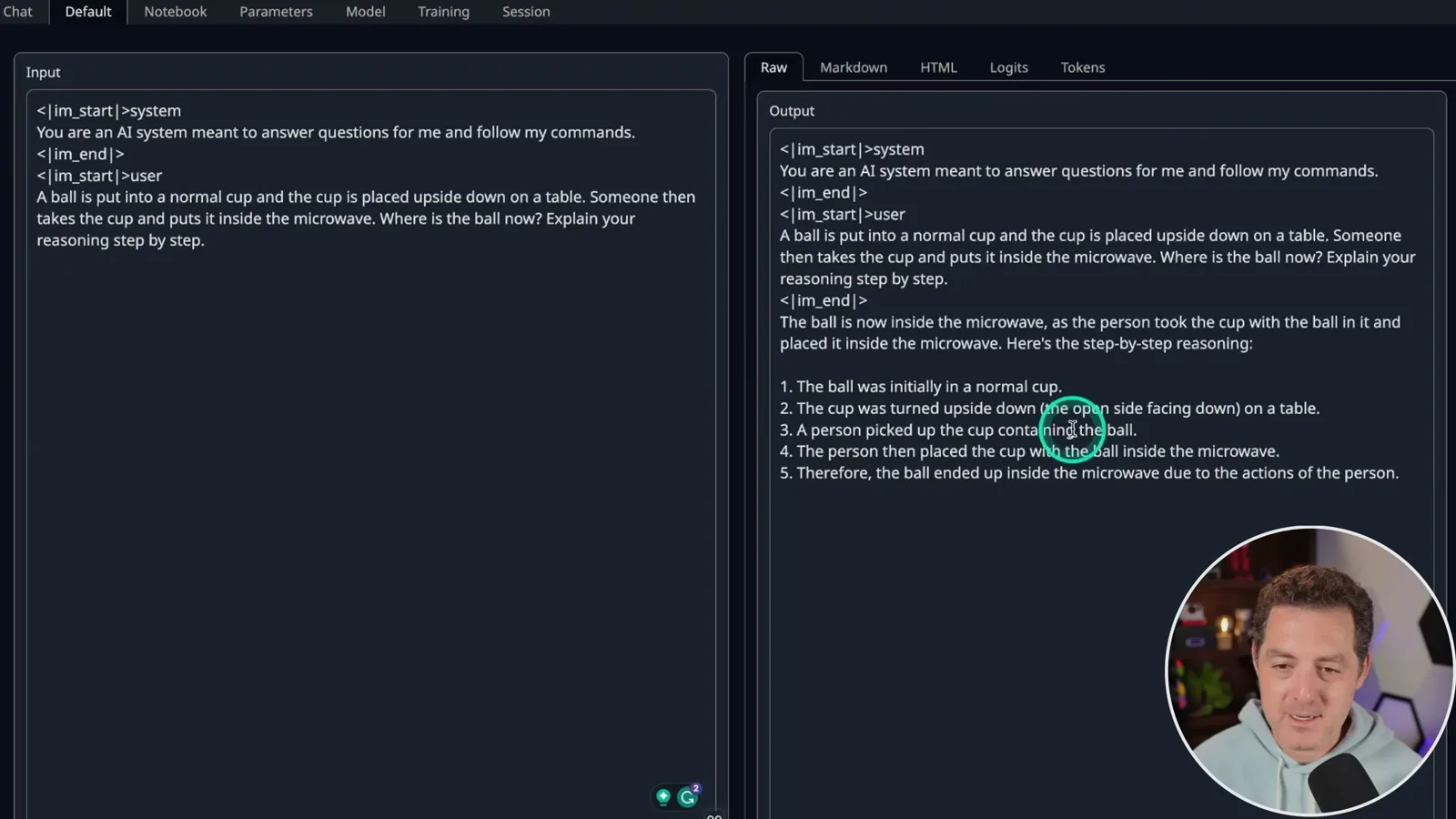
In a final spatial puzzle, a ball is placed in a cup, the cup is inverted on a table and then moved to a microwave. The model says the ball goes with the cup. I accept the possibility that it is stuck, although under the ordinary assumption that it falls free the ball remains on the table; the prompt leaves some physical details unstated.
Overall I am impressed by this small variant, particularly its creative writing and some coding responses, though my examples include clear instruction-following and reasoning failures. I am excited about the prospect of smaller models enabling local assistants on phones. That is a future possibility, not a phone demonstration or proof that a model contains all human knowledge.
Más de este canal
 34:21EN
 Matthew Berman· 27 oct 2026Matthew Berman Examines Anthropic’s IPO Filing, AI Growth and GovernanceMatthew Berman, Sam Altman · Forward FutureThe presenter reviews the S-1’s financial metrics, compute strategy and voting structure while questioning the tension between rapid AI development and safety.
 0:26ENMatthew Berman· 25 oct 2026Sam Altman on Human Values and Problem-Solving in an AI WorldSam Altman · OpenAIIn a short interview excerpt, Altman considers the enjoyment of solving hard problems and the human role in interpreting results.
 0:36ENMatthew Berman· 25 oct 2026Kimi K3.1 and a Rubik’s Cube Solver DemonstrationMatthew Berman · Forward FutureMatthew Berman shows a scrambled virtual cube being solved and gives the Kimi K3.1 test a favorable assessment.
 0:21ENMatthew Berman· 24 oct 2026An AI-Generated Kimi Benchmark Chart Used Invented ScoresMatthew Berman · Forward FutureMatthew Berman asks for a graph of Kimi K3.1 Pro benchmarks, then discovers that the displayed figures are illustrative placeholders.
 25:50ENMatthew Berman· 24 oct 2026Kimi K3.1 Pro Tested: Strong 3D Demos, Uneven Results and Competitive PricingMatthew Berman · Forward FutureMatthew Berman tests the open-weight model on coding, 3D rendering and visual explanations, then compares benchmark results and prices.
 32:20ENMatthew Berman· 23 oct 2026Who Is Local AI For? The Costs, Trade-offs and a Hybrid FutureMatthew Berman · Forward FutureMatthew Berman weighs data control and independence against hardware cost, setup complexity and inference speed.