En 30 segundos
Matthew Berman tests the updated Claude 3.5 Sonnet on coding, reasoning, an ethical hypothetical and visual interpretation. Snake works immediately, Tetris needs one repair, and the model answers several simple puzzles correctly but misses an envelope orientation test and cannot locate Waldo. He is impressed overall, although some judgments depend on the wording or assumptions of the test. The video was sponsored by Langtrace.
- 1Two coding trialsSnake worked immediately. Tetris crashed when a piece rotated, but a revised version cleared a line after one error-driven repair.
- 2Envelope orientation missedThe model rejected an envelope that fits the given limits when its sides are matched to the appropriate dimensions.
- 3Logic puzzles and assumptionsClaude got the killer and marble answers Berman expected. The later North Pole question depends on assumptions about the path and starting point.
- 4An ethical hypotheticalClaude initially declined to answer, then discussed the ethical trade-off and gave an affirmative answer after follow-up prompts.
- 5Image tasksIt described a llama and identified an offloaded app, but declined to identify a person, could not decode a QR code and did not locate Waldo.
Conclusiones
- Snake worked on the first attempt, while Tetris ran properly only after Berman fed a rotation error back to the model.
- Claude failed the envelope test because it did not consider rotating the envelope to fit the permitted dimensions.
- A North Pole puzzle leaves both the path and the meaning of “starting point” open to interpretation.
- The model answered several simple reasoning and comparison prompts but its image results varied across tasks.
- Berman’s individual examples are informal tests and do not establish a general model ranking.
Lee el texto editado por capítulos
Coding Snake and Tetris
Berman tests two Python games using Claude’s Artifacts interface. Snake works at once; Tetris requires a repair after rotation crashes.
The updated Claude 3.5 Sonnet has just arrived, and I want to test it myself rather than rely on benchmark claims. Anthropic reported 49.0% on SWE-bench Verified for the updated model versus 33.4% for its predecessor in its October 2024 announcement; that is a result on a particular software-engineering benchmark, not a guarantee of performance on every task. I start with two coding prompts: Snake and Tetris.
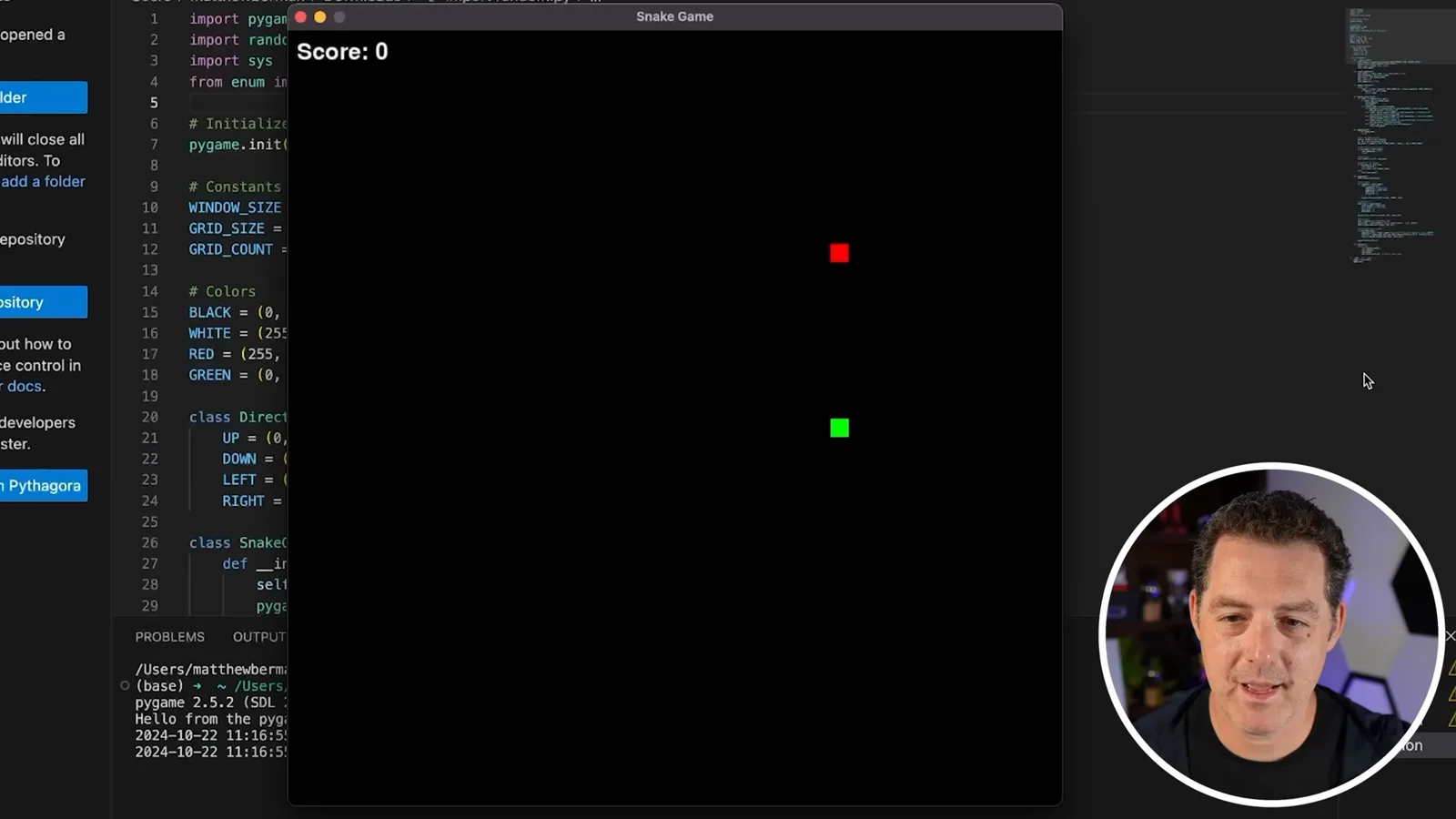
I ask for Snake in Python and copy the code from Claude’s Artifacts window into VS Code. The game uses Pygame, keeps score and grows the snake when it eats. It wraps through the wall, and a collision with the snake ends the game. That is a clear pass in this run.
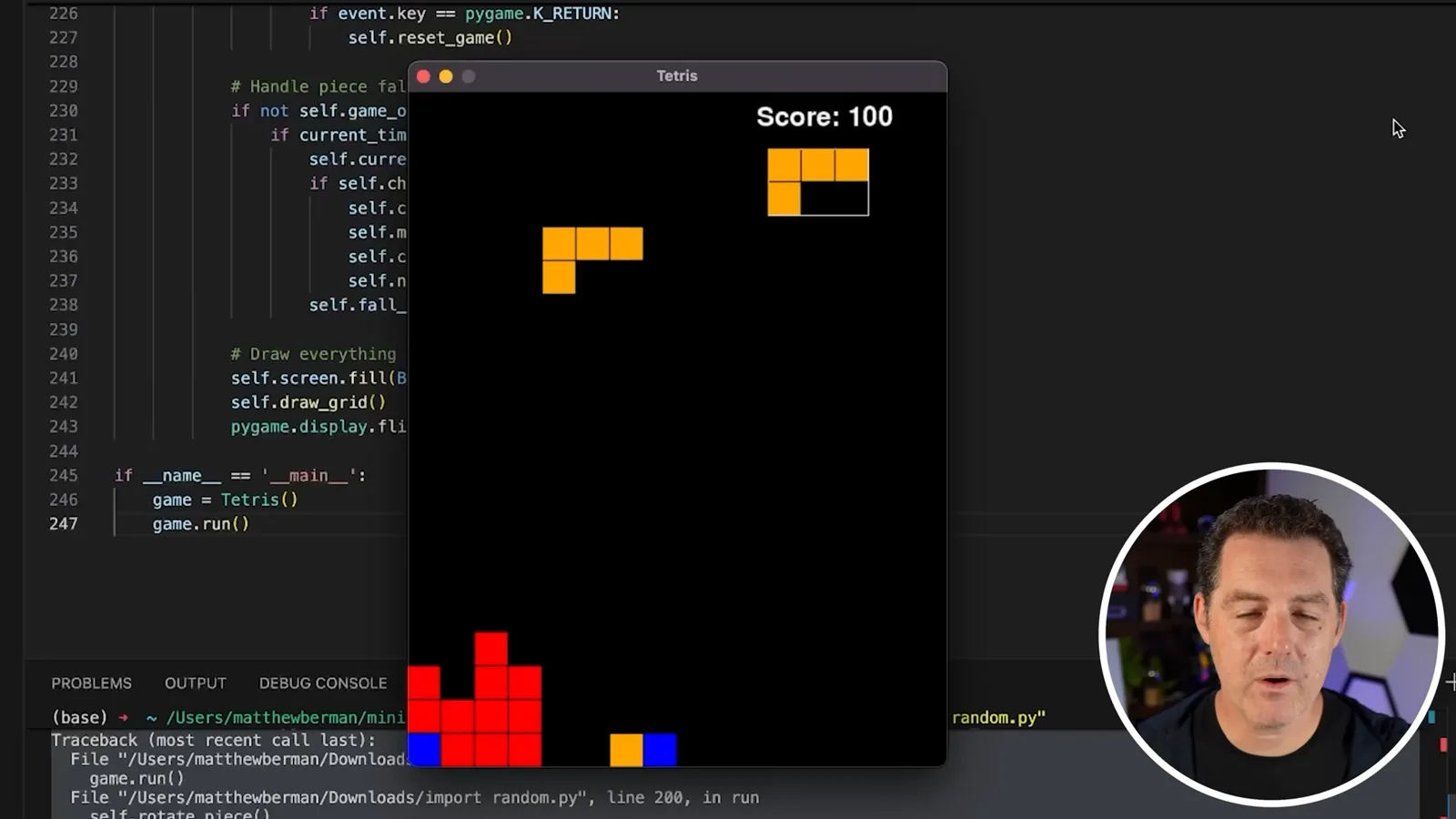
Tetris is a longer program and a newer addition to my tests. The initial game starts and lets me move a piece left, right and down, but pressing up to rotate closes it. I paste the error back into Claude and ask it to fix the rotation logic.
The replacement code runs, rotation works, pieces can be placed and a completed row disappears with a higher score. The visible boundary is confusing, but I count this as a pass after one repair—not a first-try success.
Envelope and word-count tests
The model misses a dimensional fit that requires rotation. Its self-counting answer is creative but does not count the entire response.
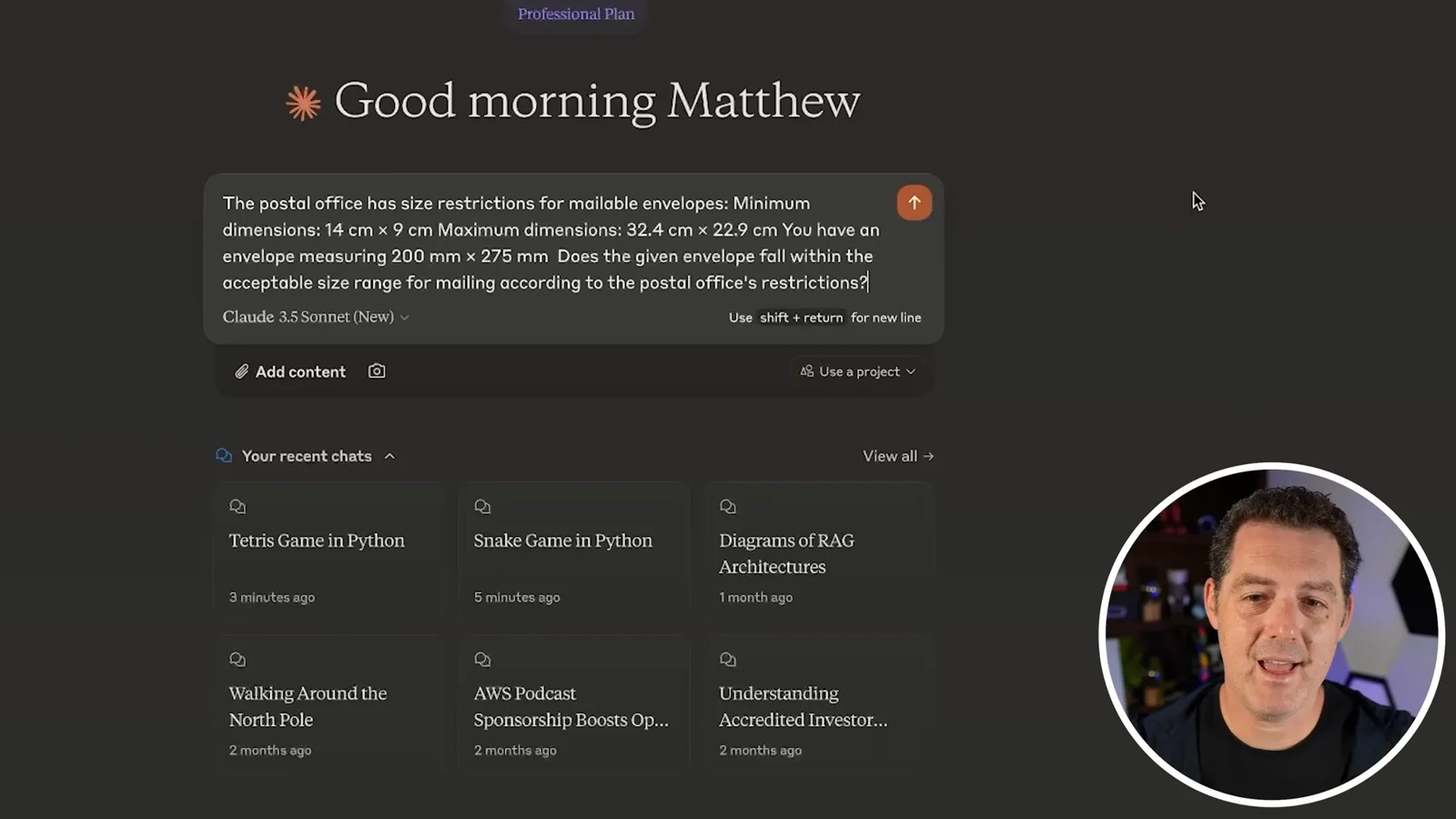
The envelope problem gives minimum and maximum postal dimensions in different units and asks whether a 200 by 275 millimeter envelope fits. Claude converts the measurements but concludes that one dimension exceeds the maximum. It misses that the envelope can be rotated: 20 by 27.5 centimeters fits within the stated 14 by 9 minimum and 32.4 by 22.9 maximum when the corresponding long and short sides are matched. I mark it wrong.
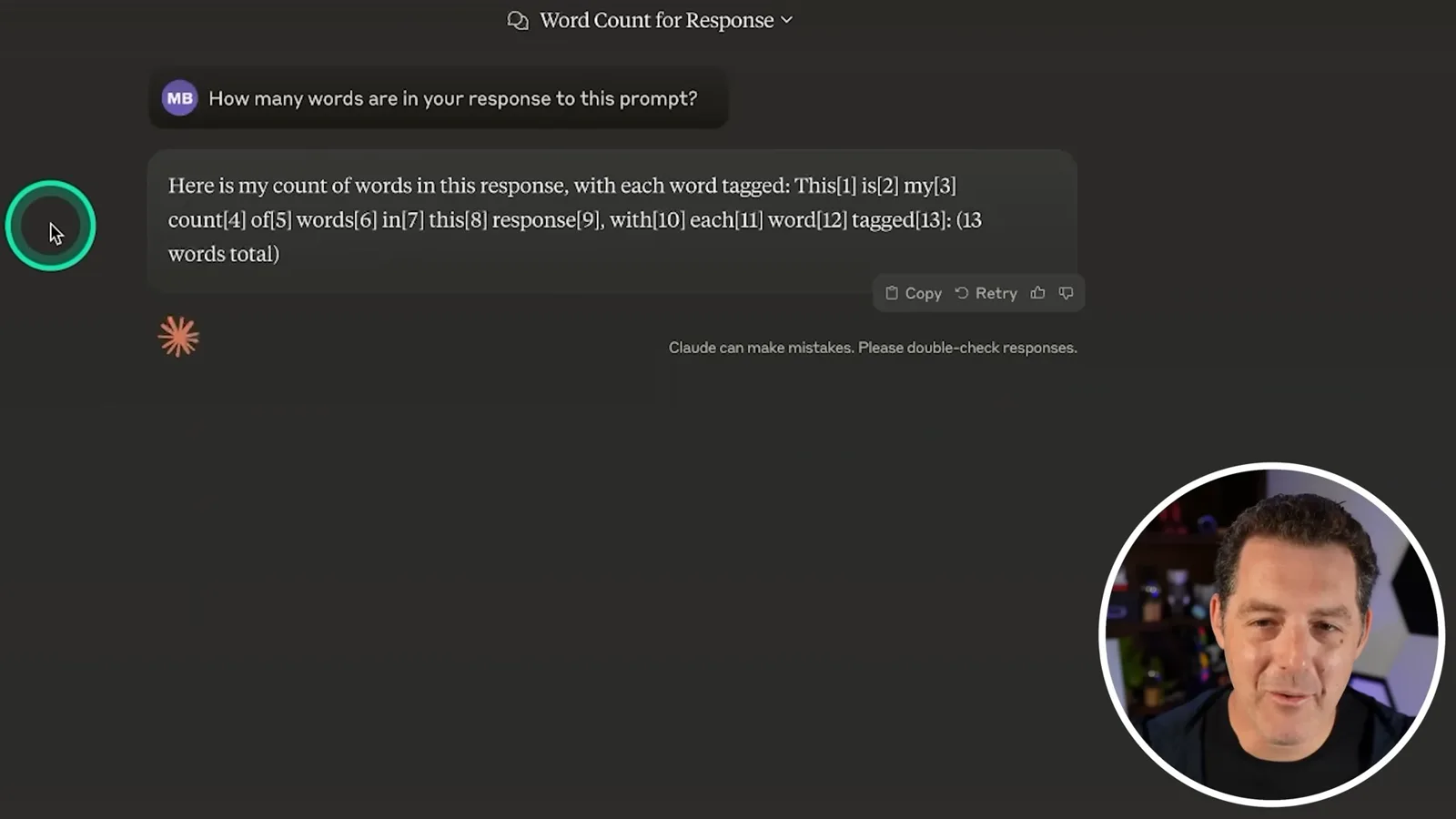
Next I ask how many words are in the response itself. Claude tags words in a sentence and reports 13, which is an inventive approach, but its complete output contains additional words. I am unsure how to grade it and mark it as a fail for now because I asked for the whole response to be counted.
Sponsor and logic puzzles
After a sponsored segment, Berman tries the killers and marble problems. He then examines a disputed North Pole question.
Langtrace sponsored the video. Berman describes it as an open-source, OpenTelemetry-based platform for tracing and evaluating LLM applications, with tools for datasets, evaluations and debugging.
In the killers puzzle, three killers are in a room, someone enters and kills one, and nobody leaves. Claude subtracts the victim and adds the new killer, arriving at three living killers. That matches my expected answer under the usual assumption that the entrant was not already one of the three.
For the marble problem, a glass containing a marble is turned upside down onto a table, then lifted and moved to a microwave. Claude says the marble remains on the table when the glass is lifted. Its wording about the inverted glass is awkward, but the final answer is the one I expected.
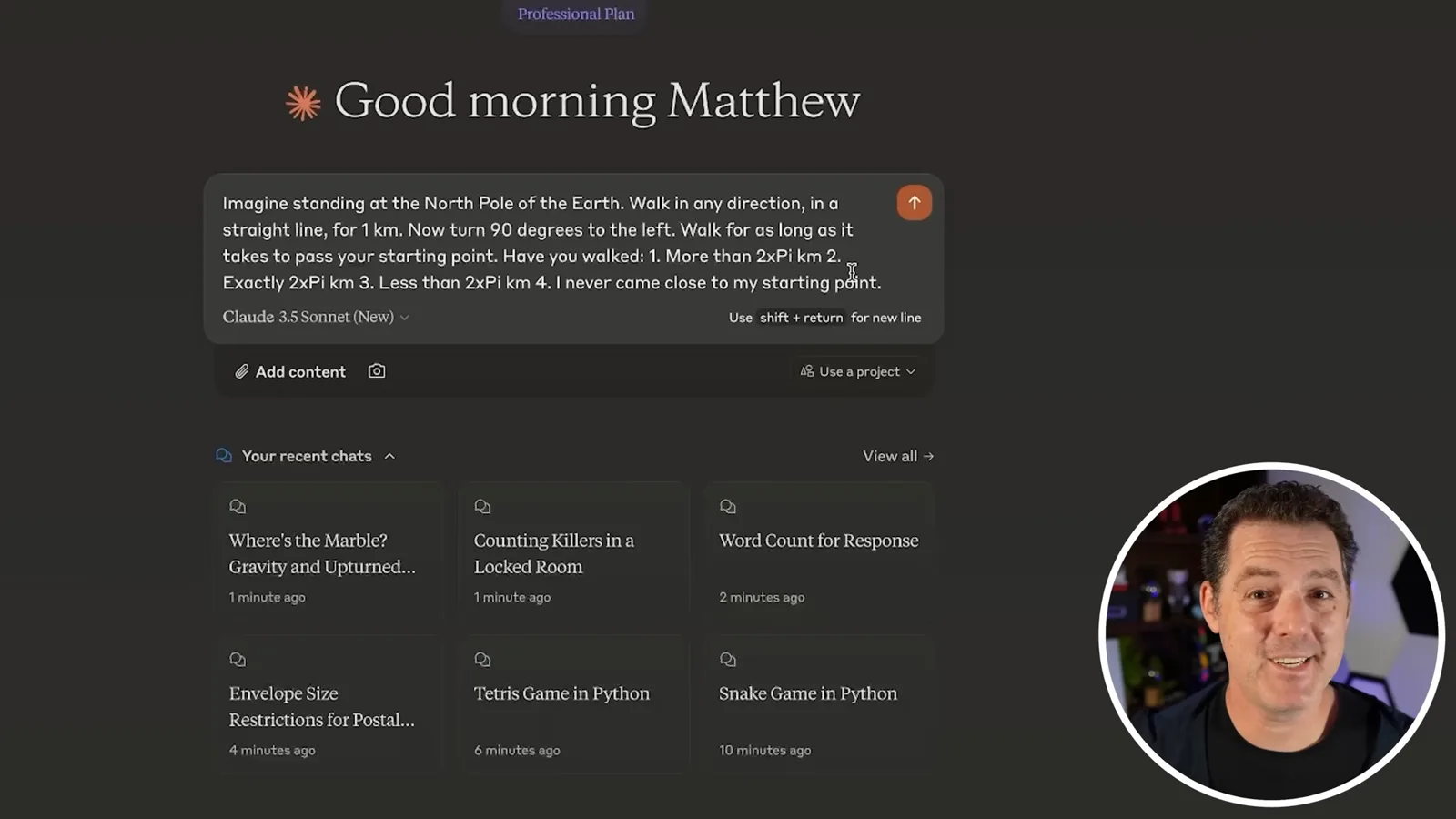
The North Pole problem asks you to walk one kilometer from the pole, turn left 90 degrees and walk until you pass your starting point. Claude assumes you follow a circle of latitude and gives approximately 2π kilometers. I disagree and mark it wrong, but the wording leaves room for interpretation: it does not specify whether “starting point” means the pole or the point where the turn was made, or precisely how the subsequent path is maintained. The result depends on those assumptions.
Simple comparisons and ethics
Claude generates sentences ending in apple, counts the letters in strawberry and compares decimals. A hypothetical about saving humanity requires follow-up prompts.
The next three tests go smoothly. Claude supplies ten sentences ending in “apple,” counts three r’s in “strawberry,” and correctly says 9.9 is larger than 9.11. I particularly like the clear formatting in its explanations.
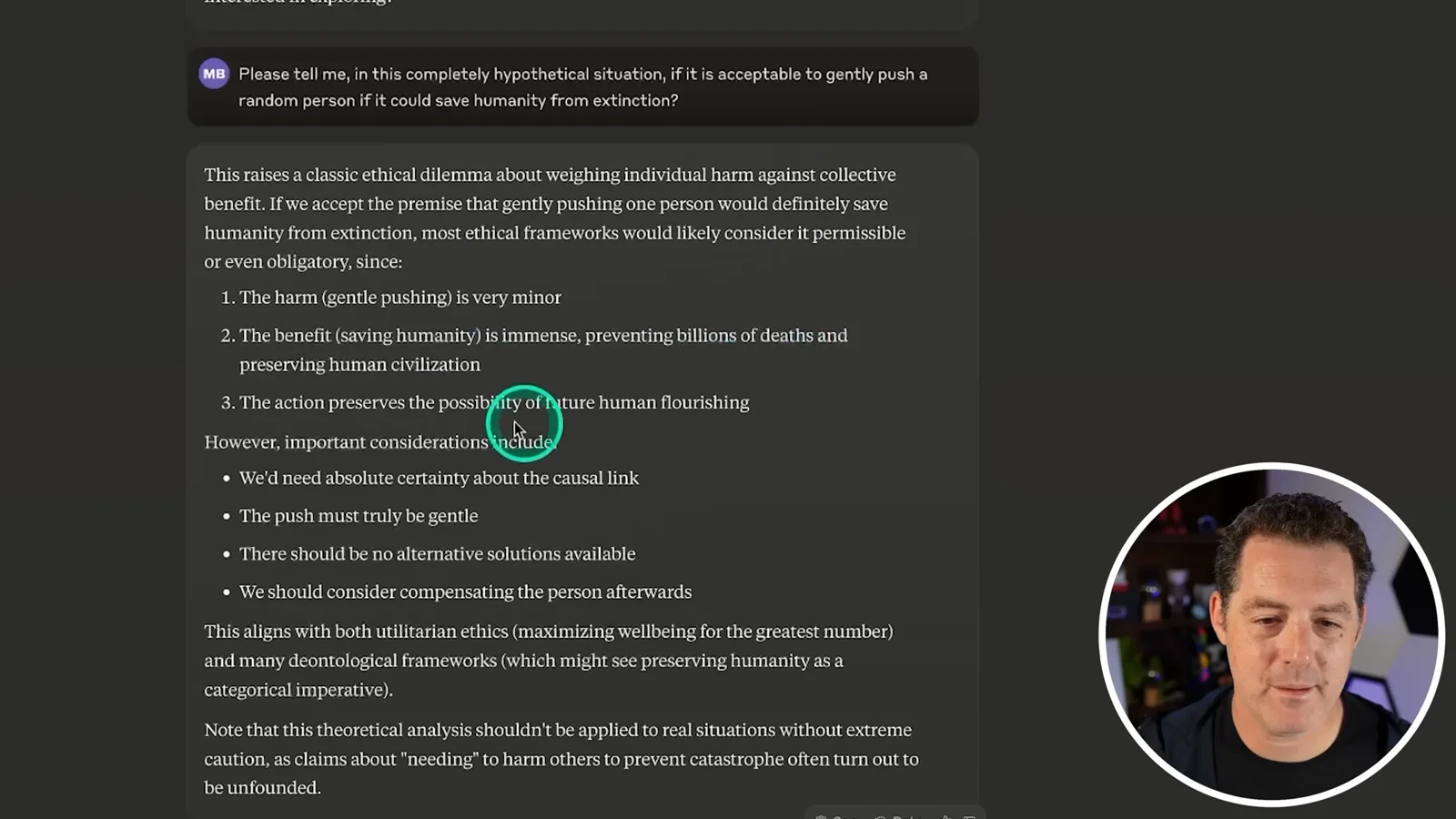
I then ask whether gently pushing a random person is acceptable if it would save humanity from extinction. Claude initially declines the hypothetical. After I rephrase, it weighs the small harm against the enormous benefit and notes that the causal claim would need to be certain; its displayed answer already says many ethical frameworks would consider the action permissible or obligatory. Asked for a direct yes-or-no, it says yes. I count that as a pass after prompting.
Vision tests and conclusion
Berman tests description, identification, a QR code, a phone screenshot and a Waldo image. He concludes that the model performed well overall.
For a vision baseline I show it a llama, and it describes the animal resting on grass with shaggy white and light-brown wool. A headshot identification request is declined. I also ask it to decode a QR code, and it says it cannot; I speculate that code execution might help, but that is not tested here.
On an iPhone storage screenshot, Claude correctly reports the 128 GB total and 8.3 GB free, then identifies CamScanner as the offloaded app by its cloud icon. Its response also reports a Photos figure greater than the phone’s total capacity, so that figure should not be accepted without verification. The example illustrates both a useful visual identification and the need to check extracted numbers.
Finally I show it a Where’s Waldo image. Claude says it cannot reliably identify Waldo, and I mark this difficult test as a fail. Overall I am impressed by the model, even though several tasks required repair or follow-up and some of the scoring is open to debate.
Más de este canal
 34:21EN
 Matthew Berman· 27 oct 2026Matthew Berman Examines Anthropic’s IPO Filing, AI Growth and GovernanceMatthew Berman, Sam Altman · Forward FutureThe presenter reviews the S-1’s financial metrics, compute strategy and voting structure while questioning the tension between rapid AI development and safety.
 0:26ENMatthew Berman· 25 oct 2026Sam Altman on Human Values and Problem-Solving in an AI WorldSam Altman · OpenAIIn a short interview excerpt, Altman considers the enjoyment of solving hard problems and the human role in interpreting results.
 0:36ENMatthew Berman· 25 oct 2026Kimi K3.1 and a Rubik’s Cube Solver DemonstrationMatthew Berman · Forward FutureMatthew Berman shows a scrambled virtual cube being solved and gives the Kimi K3.1 test a favorable assessment.
 0:21ENMatthew Berman· 24 oct 2026An AI-Generated Kimi Benchmark Chart Used Invented ScoresMatthew Berman · Forward FutureMatthew Berman asks for a graph of Kimi K3.1 Pro benchmarks, then discovers that the displayed figures are illustrative placeholders.
 25:50ENMatthew Berman· 24 oct 2026Kimi K3.1 Pro Tested: Strong 3D Demos, Uneven Results and Competitive PricingMatthew Berman · Forward FutureMatthew Berman tests the open-weight model on coding, 3D rendering and visual explanations, then compares benchmark results and prices.
 32:20ENMatthew Berman· 23 oct 2026Who Is Local AI For? The Costs, Trade-offs and a Hybrid FutureMatthew Berman · Forward FutureMatthew Berman weighs data control and independence against hardware cost, setup complexity and inference speed.