En 30 segundos
In this March 2026 short, Matthew Berman describes NVIDIA’s autonomous-driving models and simulation tools, a Mercedes demonstration and the potential to generate driving scenarios. He predicts broad deployment and argues openness will make systems safe. Those are expectations, not demonstrated outcomes: individual components have distinct licenses, a demonstration is not a safety validation, and synthetic data does not replace all real-world testing.
- 1NVIDIA’s announcementBerman predicts broad autonomous-vehicle adoption following NVIDIA’s open development tools.
- 2Models and a vehicle demoHe describes an open framework and a Mercedes demonstration; individual components and commercial systems have distinct terms.
- 3Data and simulationHe contrasts real-world fleet data with synthetic driving scenarios for training and testing.
- 4The safety claimBerman suggests openness guarantees safety, but that conclusion requires independent evaluation and evidence.
Conclusiones
- At CES 2026 NVIDIA announced Alpamayo models, simulation tools and datasets for autonomous-driving development.
- A Mercedes demonstration in San Francisco is an example of a test drive, not proof of general safety or unrestricted driverless service.
- Open code, model weights and commercial vehicle platforms can have different licenses and access terms.
- Synthetic scenarios can supplement development and testing, including rare situations, but require validation against real-world conditions.
- Waymo driverless service and Tesla FSD (Supervised) have different operating models and should not be treated as equivalent.
- Open availability alone does not establish that an autonomous-driving system is safe.
Lee el texto editado por capítulos
The NVIDIA and Mercedes announcement
Berman discusses NVIDIA’s autonomous-driving portfolio and a Mercedes demonstration. He predicts widespread deployment.
Matthew Berman discusses NVIDIA CEO Jensen Huang’s 2026 autonomous-driving announcement and predicts a rapid spread of autonomous vehicles. NVIDIA announced its Alpamayo portfolio of models, datasets and simulation tools at CES in January 2026. Whether and when such tools lead to widespread deployment remains uncertain.
Berman compares the development to Waymo and Tesla. These are different types of operations: Waymo provides driverless ride-hailing in designated service areas, while Tesla’s FSD (Supervised) requires an attentive driver and does not make the vehicle fully autonomous. The short does not provide a controlled comparison of their performance.
He describes NVIDIA’s release as a free, fully open-source autonomous-driving stack available to everyone. NVIDIA makes specific models and simulation components available, but their licenses differ, and the commercial DRIVE vehicle platform should not be assumed to be entirely free or unrestricted. For example, the original Alpamayo model card described non-commercial use with commercial licensing on request; terms can change by version.
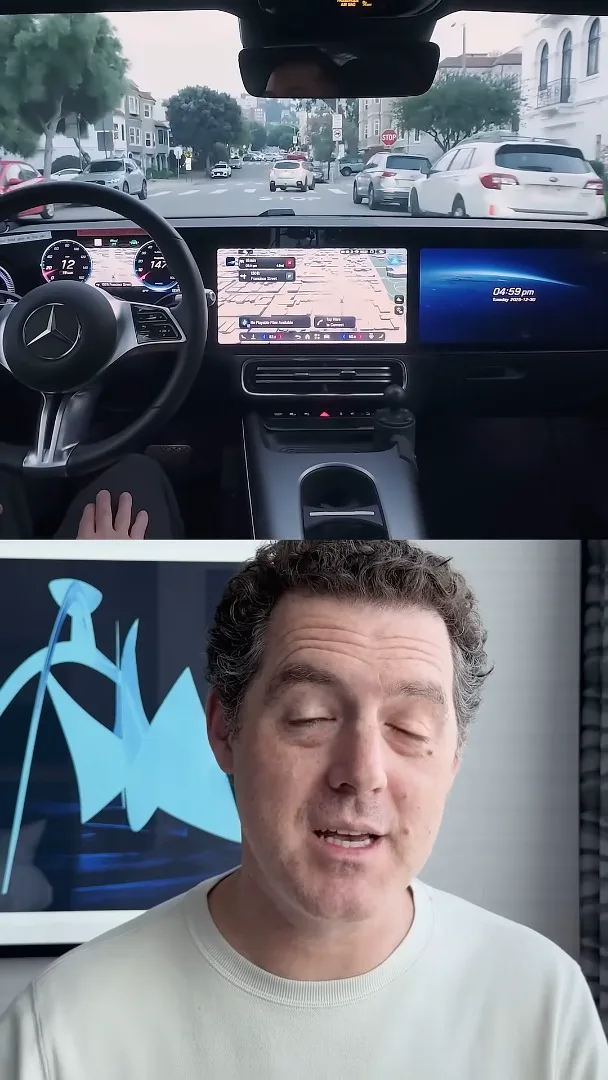
Berman points to a Mercedes demonstration driving in San Francisco shown at CES and praises its performance. NVIDIA described plans for an Alpamayo-based system on its DRIVE platform in the Mercedes-Benz CLA. A selected demonstration does not establish the system’s complete operating conditions, regulatory approval or safety across all roads.
Synthetic data and safety
He describes generating common and rare driving scenarios. Openness and simulation alone do not establish real-world safety.
Berman argues that Waymo and Tesla benefit from extensive real-world driving data, then highlights NVIDIA’s ability to generate simulated scenarios. Simulation can represent ordinary conditions, weather changes and rare events such as a crash ahead, giving developers more opportunities to train or evaluate systems.
He suggests that an open-source approach will make the system safe. Openness can enable inspection and research, but it is not a safety guarantee; simulation and synthetic data must be validated, and real-world performance, operational limits and independent evidence matter. His claim that NVIDIA or Mercedes lack real-world data entirely is not established in the short.
Más de este canal
 34:21EN
 Matthew Berman· 27 oct 2026Matthew Berman Examines Anthropic’s IPO Filing, AI Growth and GovernanceMatthew Berman, Sam Altman · Forward FutureThe presenter reviews the S-1’s financial metrics, compute strategy and voting structure while questioning the tension between rapid AI development and safety.
 0:26ENMatthew Berman· 25 oct 2026Sam Altman on Human Values and Problem-Solving in an AI WorldSam Altman · OpenAIIn a short interview excerpt, Altman considers the enjoyment of solving hard problems and the human role in interpreting results.
 0:36ENMatthew Berman· 25 oct 2026Kimi K3.1 and a Rubik’s Cube Solver DemonstrationMatthew Berman · Forward FutureMatthew Berman shows a scrambled virtual cube being solved and gives the Kimi K3.1 test a favorable assessment.
 0:21ENMatthew Berman· 24 oct 2026An AI-Generated Kimi Benchmark Chart Used Invented ScoresMatthew Berman · Forward FutureMatthew Berman asks for a graph of Kimi K3.1 Pro benchmarks, then discovers that the displayed figures are illustrative placeholders.
 25:50ENMatthew Berman· 24 oct 2026Kimi K3.1 Pro Tested: Strong 3D Demos, Uneven Results and Competitive PricingMatthew Berman · Forward FutureMatthew Berman tests the open-weight model on coding, 3D rendering and visual explanations, then compares benchmark results and prices.
 32:20ENMatthew Berman· 23 oct 2026Who Is Local AI For? The Costs, Trade-offs and a Hybrid FutureMatthew Berman · Forward FutureMatthew Berman weighs data control and independence against hardware cost, setup complexity and inference speed.