En 30 segundos
Thariq Shihipar demonstrates a captioned-video workflow and explains the exploration behind it. He discusses goal-oriented loops, evolving specifications, separate verification for subjective work, leaner context and the importance of learning system limitations.
- 1Match the loop to the feedbackA measurable goal and a subjective creative task call for different verification approaches.
- 2A captioned-video prototypeA first prompt produces captions and overlays, but transcription and placement still need correction.
- 3Explore the unknownsAn explainer on transcription limitations helps shape the workflow and its review.
- 4Separate creation from reviewThariq proposes a rubric and independent verification for multiple video shorts.
- 5Shorter context, clear reasonsHe describes an 80% reduction in the system prompt and suggests explaining nonabsolute preferences.
Conclusiones
- Choose an exit condition or verification method suited to the task.
- Treat planning as iterative exploration of unknowns, not a single handoff.
- Prototype cheaply, record implementation surprises and revise the specification when needed.
- Use a rubric and separate review for subjective work while recognizing the extra compute and remaining bias.
- Trim unnecessary instructions while preserving genuine requirements.
Lee el texto editado por capítulos
Loops and a video demonstration
Thariq compares goals and workflows and shows an initial video result.
Anthropic's Thariq Shihipar discusses agent loops, planning and video workflows with Peter Yang. He demonstrates a small captioned-video pipeline and explains the exploration that preceded it. The episode is sponsored by Wispr Flow.
Thariq describes loops as ways to organize feedback and longer-running work. He distinguishes a goal with an exit condition from workflows that can split work and verification among agents. The choice depends on the task: a measurable latency target has a different feedback signal from a subjective design review.
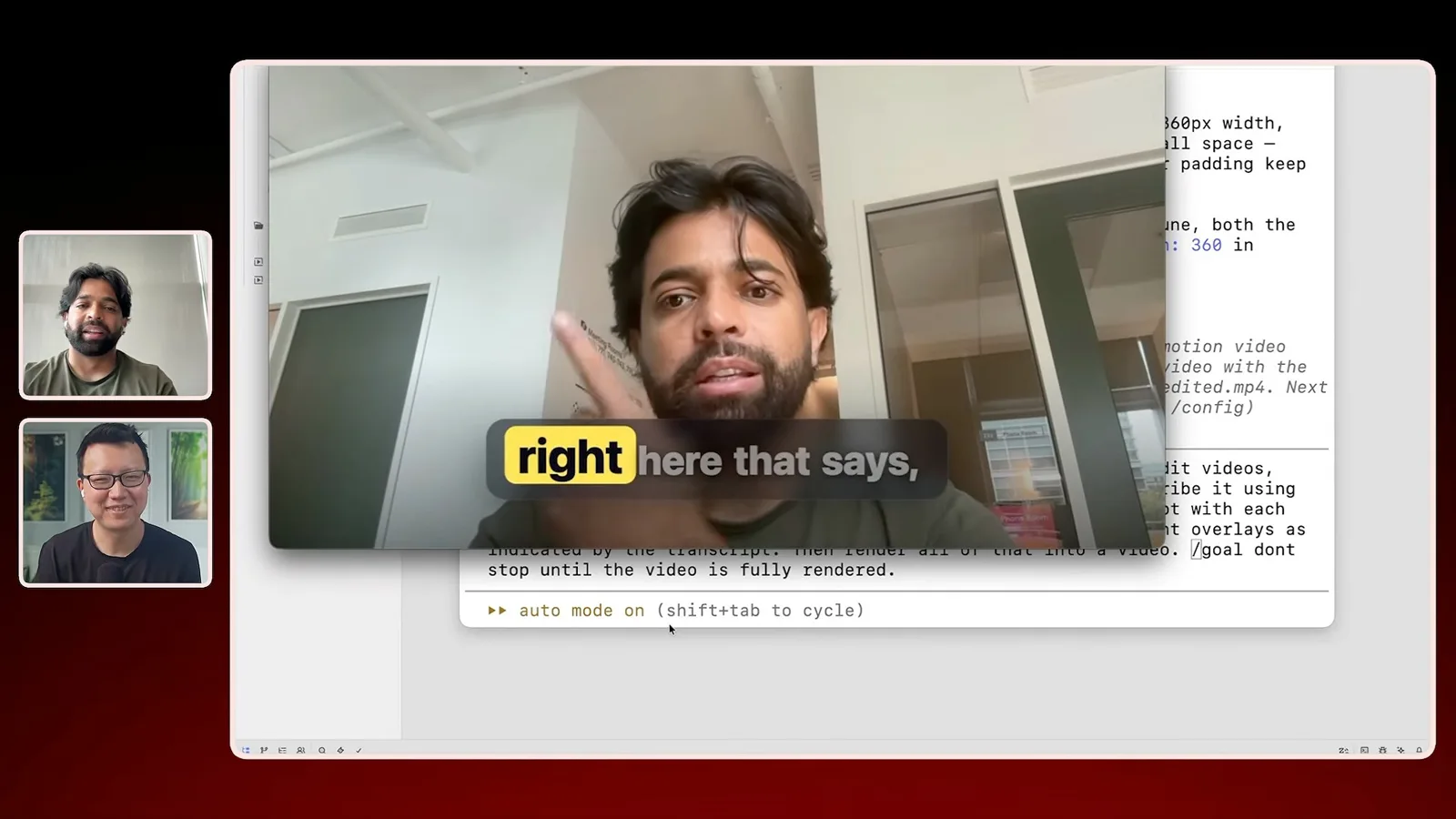
For the demonstration, he records a short clip and asks the agent to transcribe it with Whisper, create word-highlighted captions and overlays with Remotion, and render the result. A first output appears from one prompt, but his name is transcribed incorrectly and the overlay placement still needs work.
Planning as exploration
Transcription research, visual prototypes and implementation notes expose unknowns.
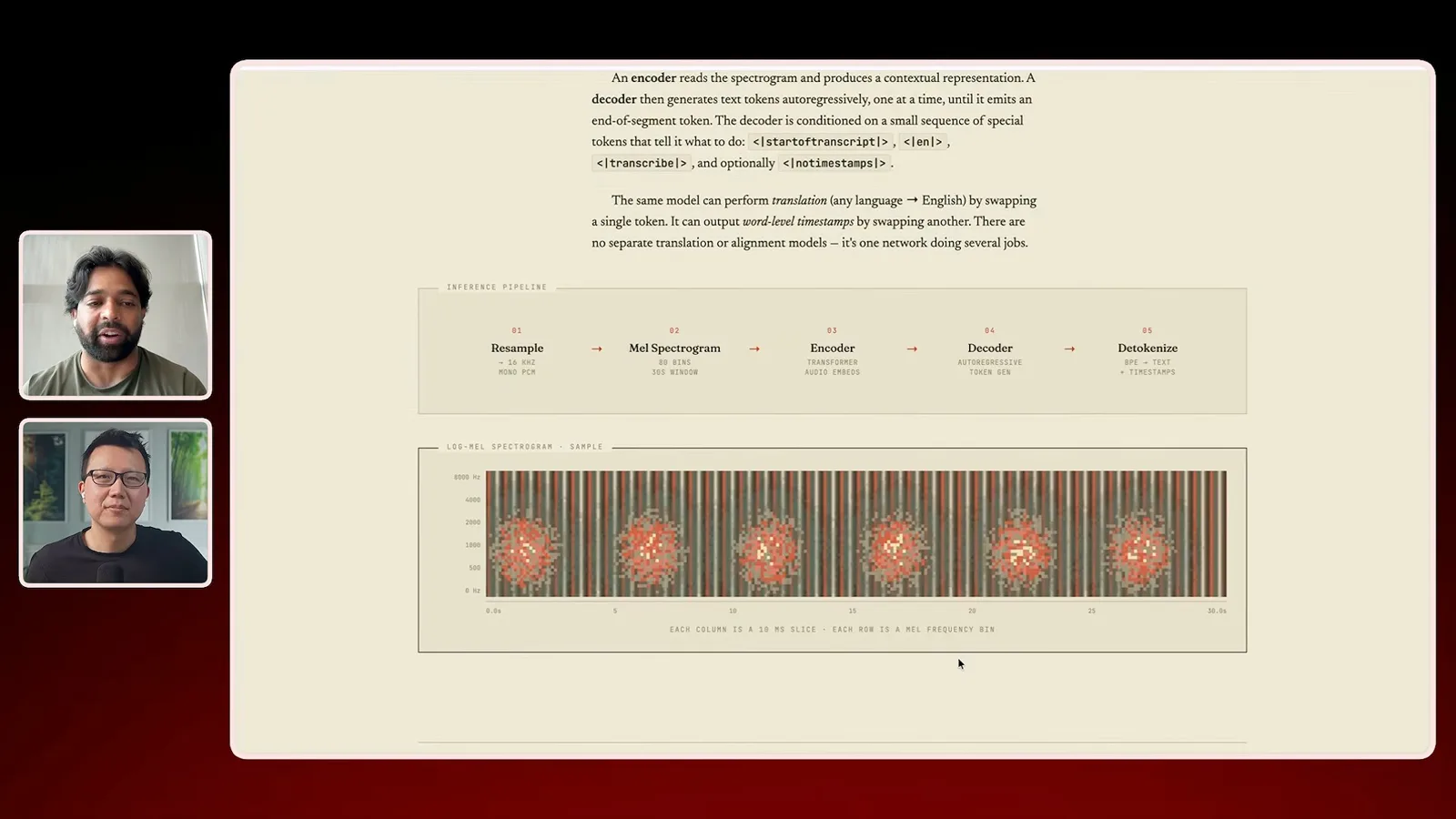
Thariq stresses that the prompt was preceded by exploration. He asks for an HTML explainer on transcription, including possible failure modes such as hallucinated words during silence or split words. Learning those limitations helps him decide how to design the workflow and review its output.
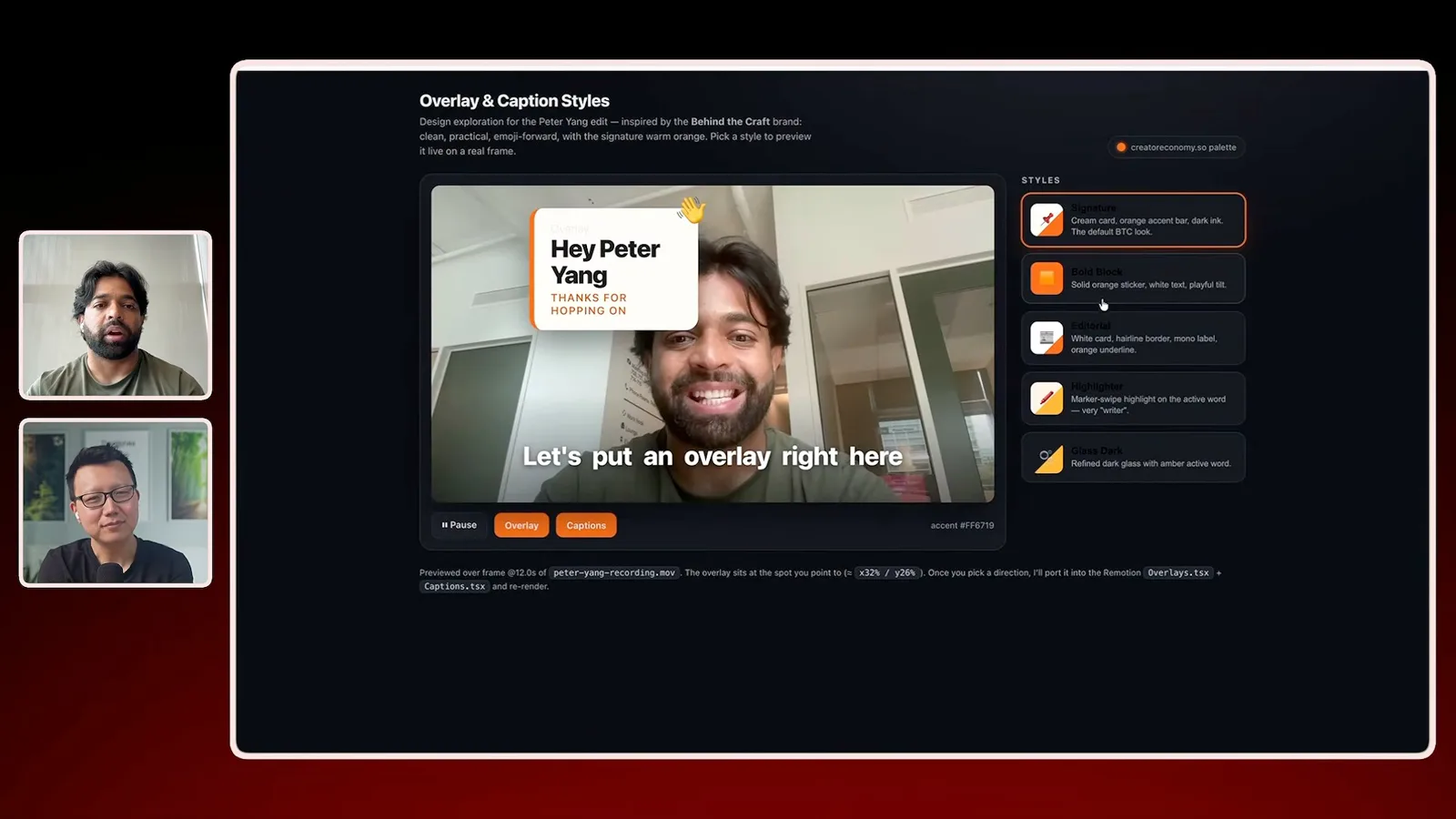
He also generates visual alternatives for captions and overlays from a style reference. Seeing options helps him decide what he wants. He treats prototypes and readable explanations as planning tools and warns that a long plan has little value if nobody reads the important parts.
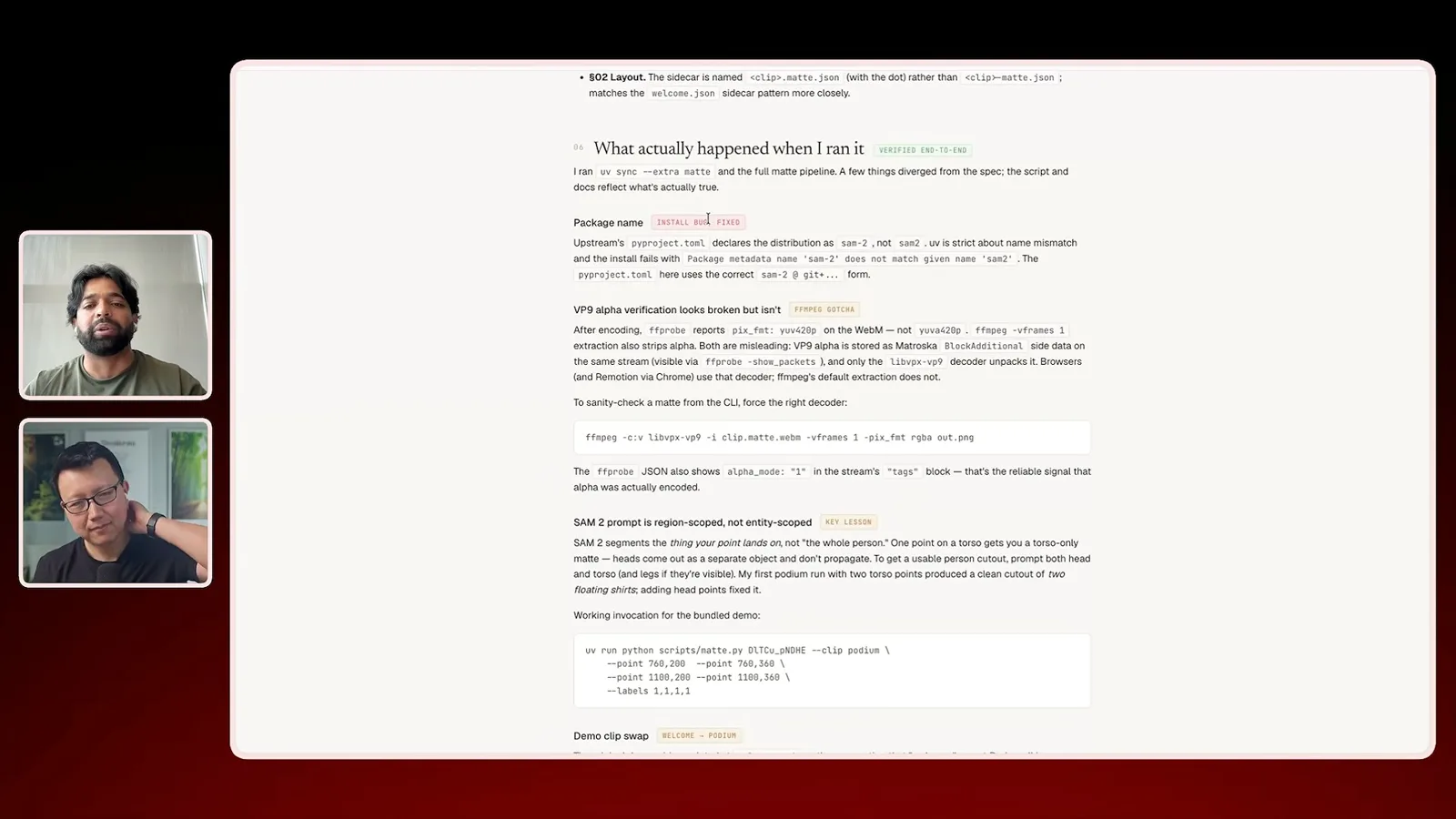
Planning continues through implementation: start with a human request, explore, refine mockups or explanations, and ask the agent to record unexpected implementation findings. Those findings can lead to a changed specification. A small prototype can test a direction before a more expensive implementation.
Workflows and independent review
The guests discuss collaboration, reusable tools and verifying subjective clips.
Thariq describes using Claude in Slack for background and collaborative work while focusing on one main task in Claude Code. He says different people use different combinations, and notes that treating an agent as an employee is a useful but incomplete metaphor.
Yang shows his podcast-production skills, which generate text, thumbnails and short clips. Thariq suggests that reusable scripts and a persistent workspace can complement a skill, so the agent does not have to reconstruct every tool from scratch.
For multiple shorts, Thariq proposes a coordinator that selects clips, separate agents that produce them, and a rubric for verification. He says a separate reviewer may be less lenient than a model checking its own output, but the workflow uses more compute and does not guarantee unbiased evaluation.
Focus, context and learning
Thariq discusses attention, system instructions and technical understanding.
To manage attention, he tries to concentrate on one primary project rather than running many threads without focus. He notes that a rushed instruction can cost time later, and the right amount of parallel work depends on the person and task.
Thariq says the team shortened Claude Code's system prompt by 80%. His view is that newer models may need fewer examples and that explaining the reason for a preference can work better than an unnecessarily absolute instruction. He still recognizes that genuine hard constraints can be useful.
Finally, he encourages learning enough about a system to identify unknowns and tradeoffs. Rather than merely asking an agent to produce a result, he uses explainers to understand what is possible and where tools can fail. His stated goal is to become better as well as faster.
Más de este canal
 46:40EN
 Peter Yang· 8 nov 2026Pódcast · 2 vocesAshley Alexander: How AI Helps Me Care for My Parents With CancerInvitado: Ashley Alexander · Presenta: Peter YangA caregiver uses AI to prepare for appointments, organize records and ask better questions—while keeping doctors at the center of treatment.
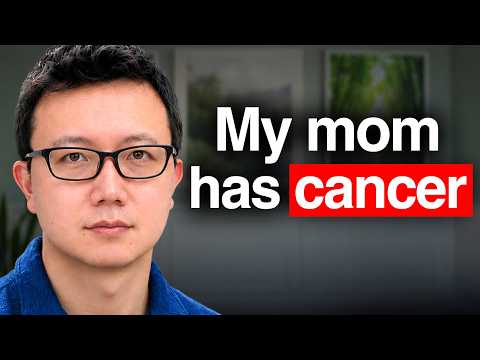 17:50ENPeter Yang· 4 nov 2026PódcastPeter Yang’s Five Steps for Using AI to Help Care for His MotherYang uses a shared care brief and organized records to navigate appointments, while making time for family.
 15:03ENPeter Yang· 3 nov 2026PódcastHow Peter Yang Used an AI Phone Agent to Negotiate His Internet BillAn AI call negotiated a lower price and faster service, but Yang still had to approve the change himself.
 33:09ENPeter Yang· 1 nov 2026Pódcast · 2 vocesJaclyn Konzelmann: When AI Can Build More, Choose What Deserves to ExistInvitado: Jaclyn Konzelmann · Presenta: Peter YangGoogle Labs pairs short strategy documents with prototypes, user co-creation and lessons from experiments that end.
 13:05ENPeter Yang· 28 oct 2026PódcastPeter Yang Tests Genie 4: Convincing Worlds, Unfinished GameplayFive live demonstrations show scenes that respond to prompts and sound, alongside inconsistent actions and limited game mechanics.
 1:06ENPeter Yang· 26 oct 2026PódcastPeter Yang on Setting Up Payroll for a One-Person BusinessIn a paid partnership, Yang describes the paperwork he encountered and a payroll product integrated with a business account.