En 30 segundos
On October 11, 2024, Matthew Berman reviews Tesla’s “We, Robot” event, discussing the Cybercab prototype, a proposed Robovan, Optimus robots and Musk’s projected prices and timelines. The event was held on a controlled studio lot, not an open-road safety test. Later reporting and a Tesla engineer confirmed that Optimus received some human assistance; Tesla subsequently reported Cybercab production and deployment in its Austin fleet. The video includes a Langtrace sponsorship.
- 1A prototype at a studioBerman admires the Cybercab design and event demonstration, which took place in a controlled environment.
- 2Projected costsMusk estimated future operating costs around $0.20 per mile and $0.30–$0.40 including additional costs; these are projections, not fares.
- 3Timelines and supervisionMusk proposed unsupervised operation in 2025 and Cybercab production in 2026; actual features and operating conditions vary.
- 4Robovan conceptThe larger vehicle was presented as a future passenger or goods transport concept with capacity of up to 20 people.
- 5Idle vehicle computingMusk floated the possibility of distributed inference using unused onboard compute, rather than announcing a proven service.
- 6Optimus human assistanceLater reporting and a Tesla engineer disclosed assistance during the event, so the social interactions should not be treated as fully autonomous.
Conclusiones
- The Cybercab shown in 2024 had no steering wheel or pedals and was demonstrated on a studio lot; the event did not establish safety in all real-world conditions.
- Musk’s 2024 price, operating-cost and production figures were forecasts rather than proven economics or available purchase terms.
- Tesla reported starting Cybercab production in 2026 and later deploying vehicles in its Austin Robotaxi fleet; a company deployment is not proof of widespread customer delivery.
- Tesla’s Full Self-Driving (Supervised) requires an attentive driver and is distinct from a driverless service.
- Optimus robots were real prototypes, but a Tesla engineer later acknowledged human assistance at the event and reporting described remote help with interactions.
- The Robovan, distributed inference service and low-cost Optimus were presented as future plans or possibilities, not completed consumer products.
Lee el texto editado por capítulos
Cybercab at the studio showcase
Berman reviews the prototype’s design and vehicles shown at the Warner Bros. lot. The showcase is a controlled demonstration.
I review highlights from Tesla’s October 10, 2024 “We, Robot” event, where Elon Musk introduced a robotaxi concept and humanoid robots. I am enthusiastic about the presentation, but a staged showcase and Musk’s predictions should be separated from proven deployment and performance.
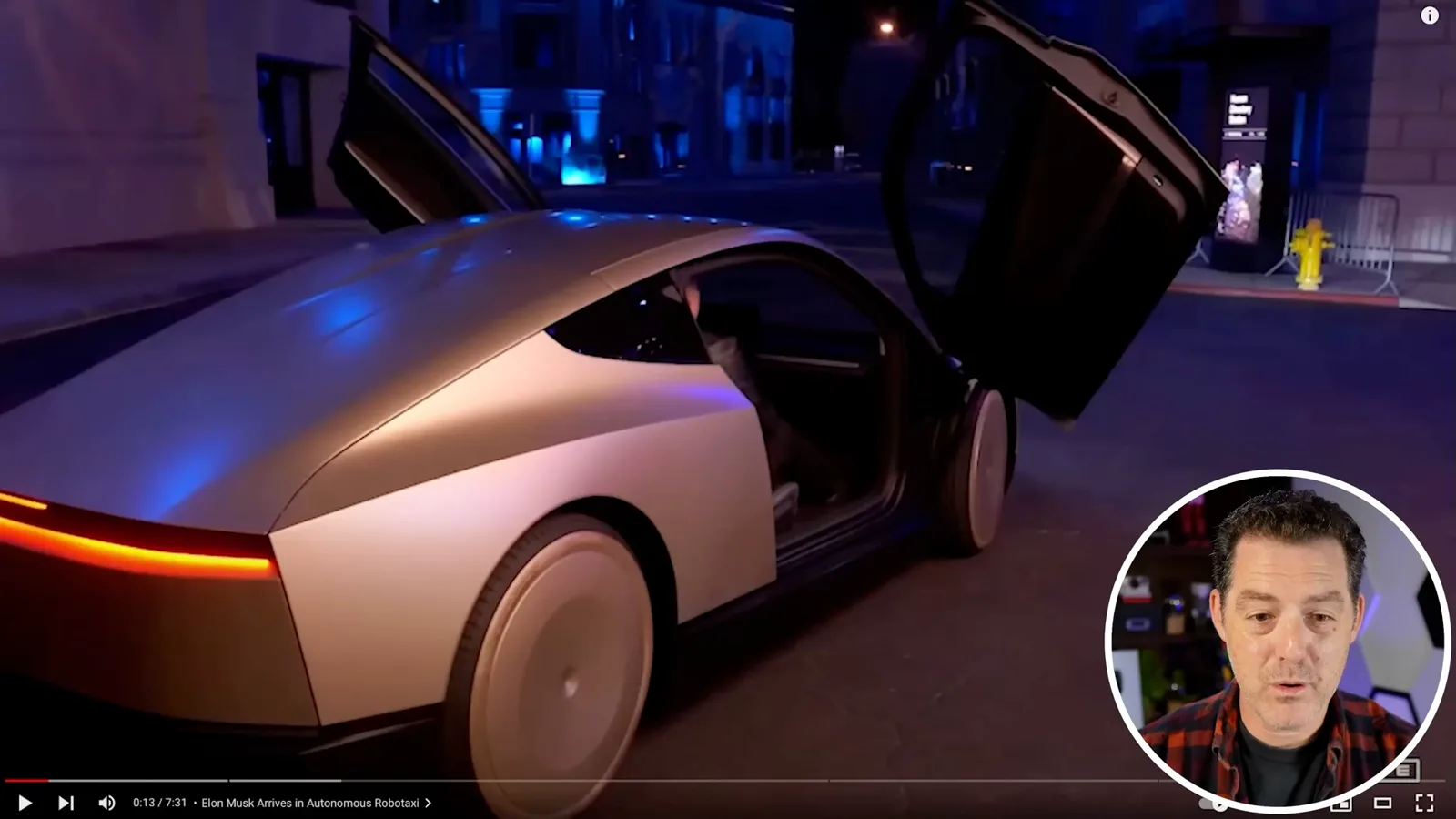
The Cybercab prototype has two seats and no steering wheel or pedals. I like its futuristic styling, including its light bar and upward-opening doors, while acknowledging that I cannot confirm its body materials or whether the prototype design will remain unchanged.
Tesla staged the event at the Warner Bros. studio lot, where cars moved through a controlled, movie-set environment. Musk said there were 20 Cybercabs and 50 autonomous cars in total. Those claims and the footage describe the event, not a comprehensive public-road safety test.
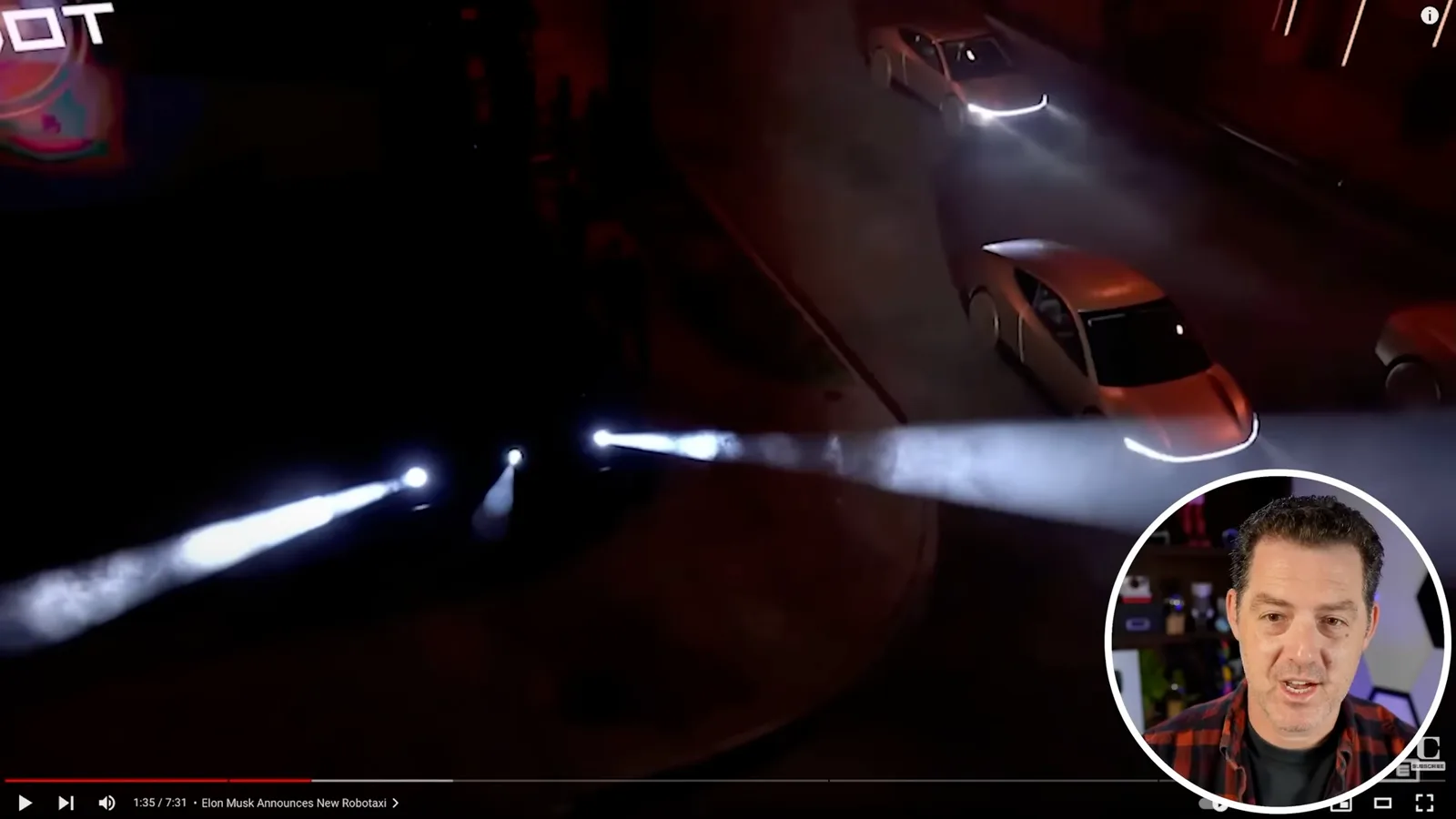
I am impressed by the lighting and staging, including a visual effect in front of the car. I cannot tell whether that effect would be part of a production vehicle, and the demonstration alone does not establish how every vehicle was operated in all conditions.
The video is sponsored by Langtrace, an observability platform for language-model applications. The described integrations, tracing features and time-limited discount are sponsor claims, not independent evaluation.
Costs, ownership and timelines
Musk offers cost and deployment projections, while Berman imagines shared ownership and wireless charging. Later developments and supervised driving limitations provide context.
Musk argues that cars are used only a fraction of the time and imagines an autonomous fleet offering transport more often. I find the idea compelling: the potential for an owner to offer rides depends on regulatory approval, utilization, maintenance, insurance, platform terms and actual costs.
At the event Musk estimated roughly $0.20 per mile in future operating costs and $0.30–$0.40 including additional costs, comparing it with bus costs. These are forward-looking estimates rather than measured fares or a complete, independently verified comparison.
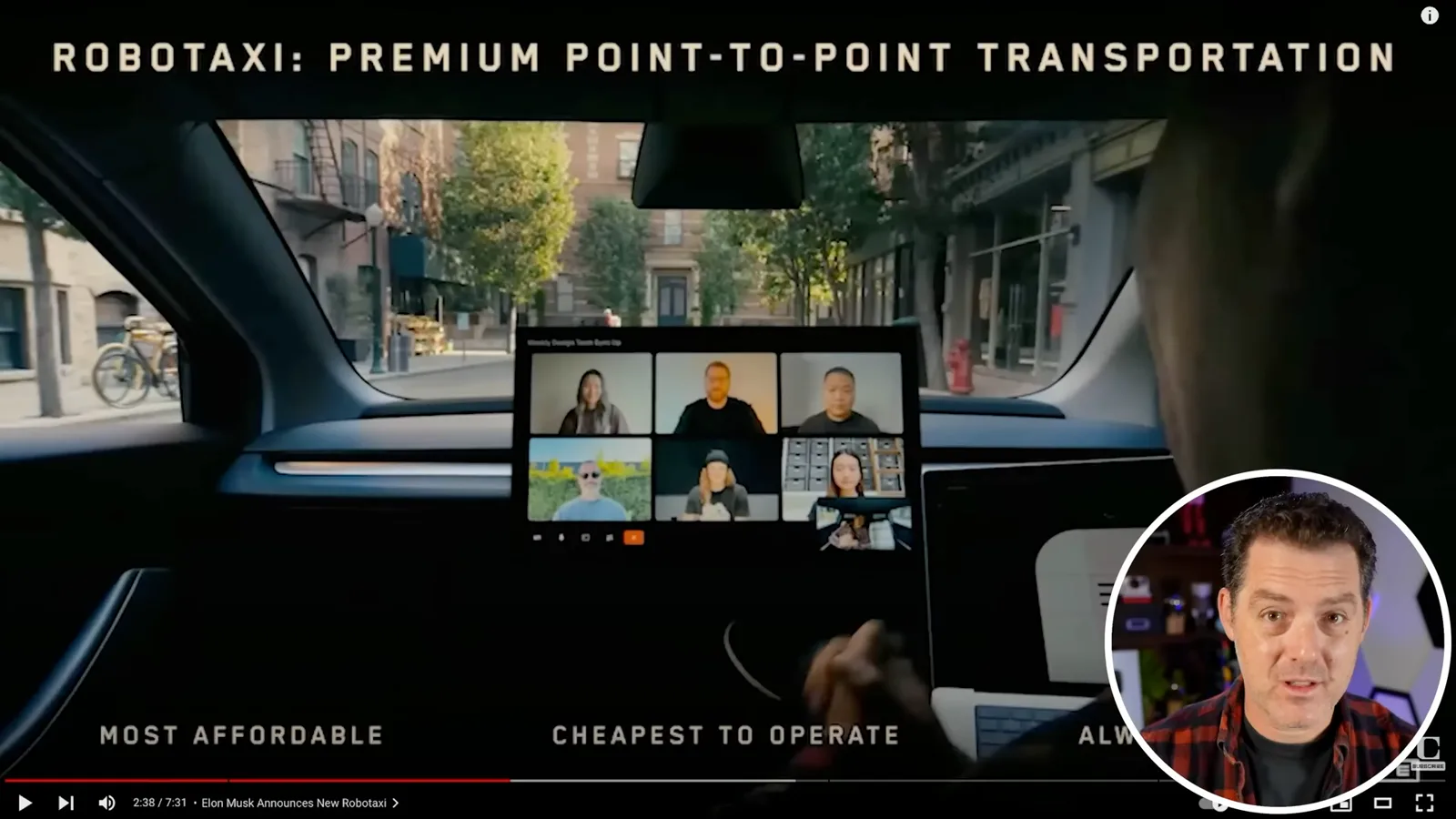
Tesla’s presentation shows passengers working, reading or relaxing while traveling. I describe the concept as a private living room on wheels; it represents a proposed experience, not permission for drivers to stop paying attention in existing supervised systems.
Musk said people would be able to buy a Cybercab and projected a price below $30,000. I consider whether private owners could earn money by sending a car out for rides, but the eventual price, ownership terms and returns were not established by the event.
Musk predicted unsupervised Full Self-Driving for Model 3 and Model Y in Texas and California in 2025 and Cybercab production in 2026, while acknowledging his past optimism on timing. These were forecasts; availability and operating conditions must be checked for each service and location.
Tesla’s [Full Self-Driving (Supervised) guidance](https://www.tesla.com/support/fsd) requires an attentive driver ready to take over. It should not be confused with a separately operated driverless Robotaxi service, and the event does not authorize inattentive use of supervised features.
In later developments, Tesla reported in its [second-quarter 2026 update](https://ir.tesla.com/_flysystem/s3/sec/000162828026049213/tsla-20260722-gen.pdf) that Cybercab production had begun, and in its [third-quarter update](https://ir.tesla.com/_flysystem/s3/sec/000162828026066738/tsla-20261021-gen.pdf) that deployment into its Austin Robotaxi fleet had started. Those statements do not establish broad individual customer deliveries or the original price prediction.
Musk also describes inductive charging without a plug, and the presentation depicts automated cleaning. I imagine a vehicle returning to a service center between rides; the presentation does not establish the efficiency, price or operating reliability of a finished end-to-end system.
Robovan and distributed compute
The event introduces a larger passenger concept and a possible use for idle vehicle computers. Neither proposal establishes a commercial product or proven economics.
Tesla then displays the Robovan, a larger concept with a retro-futurist appearance that I compare to Art Deco trains. Musk says it could carry up to 20 people or be configured for goods. That is a proposed design and capacity, not proof of a deployed passenger service.
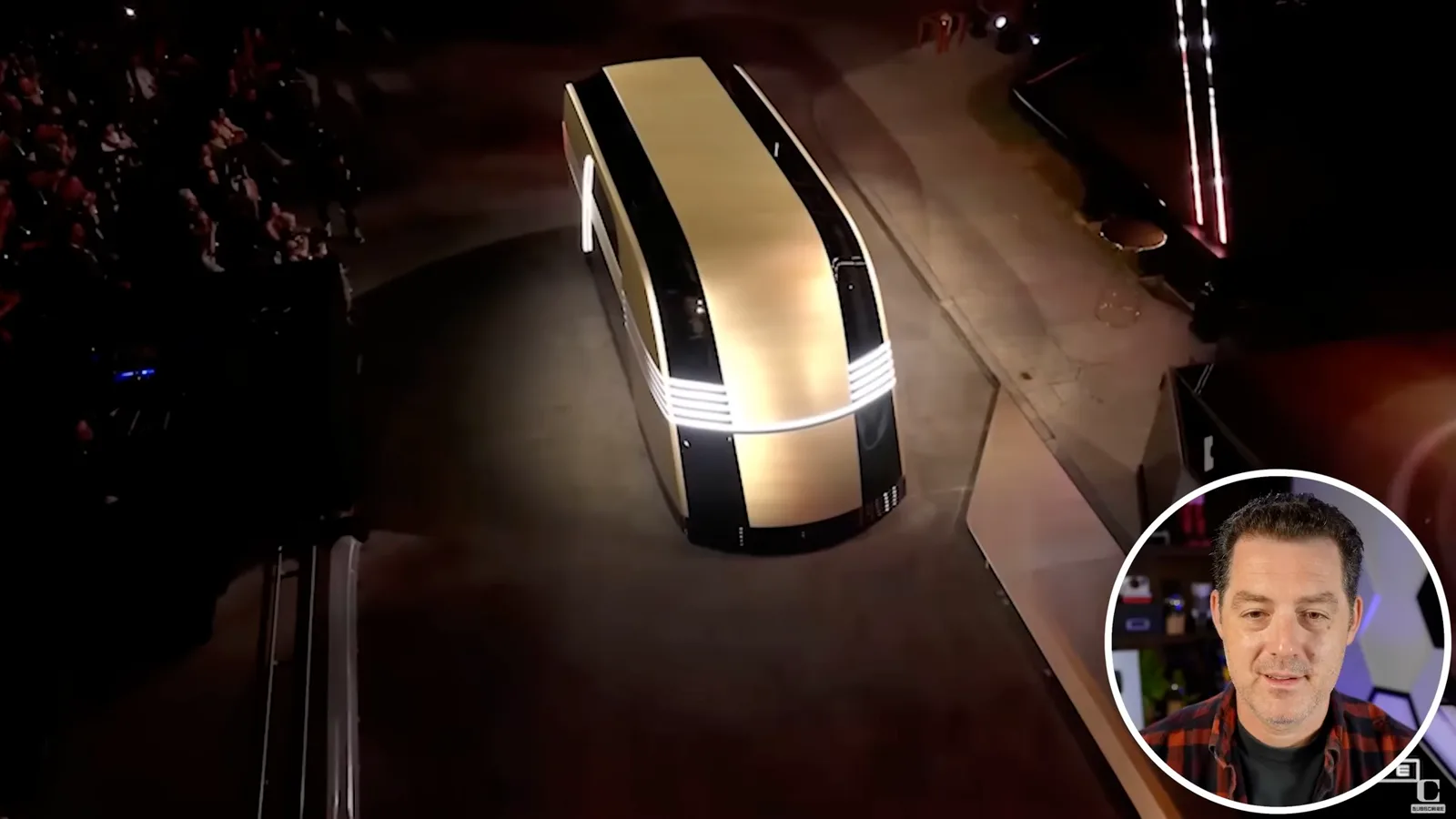
Musk suggests the larger vehicle could lower per-person transportation costs, and I imagine use by a sports team or in a city. His cents-per-mile figure is a projection, dependent on occupancy, capital, maintenance and operating conditions.
I note that Waymo was already operating driverless services in multiple cities and that Tesla is not the first company to pursue robotaxis. My description of a high success rate is not a quantitative safety comparison between the companies.
Musk also floated an AWS-like opportunity: over-specifying onboard computing so idle vehicles might provide distributed AI inference. I am excited by the idea, but it was a potential future business, not a demonstrated service with established customer terms or returns.
Optimus and market reaction
Berman praises the humanoid prototypes and reacts to Tesla’s stock move. Subsequent disclosures clarify human involvement at the event.
Musk connects the vehicle technology to Optimus, Tesla’s humanoid robot, and the presentation shows prototypes walking and interacting. I contrast them with Tesla’s earlier performer in a robot suit and express excitement about robots serving drinks and speaking with guests.
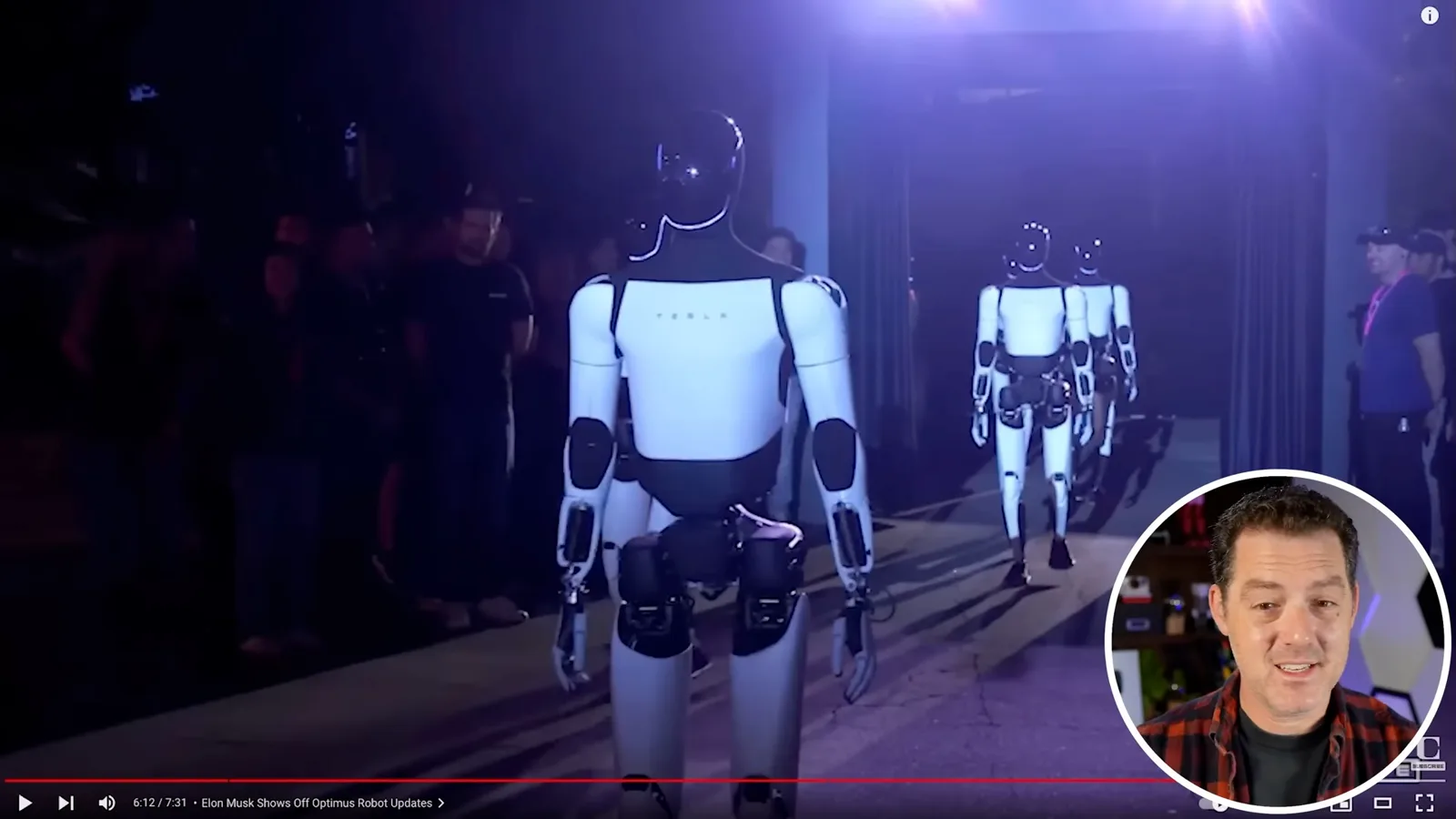
Important later context: [reporting based on people familiar with the event](https://techcrunch.com/2024/10/14/tesla-optimus-bots-were-controlled-by-humans-during-the-we-robot-event/) described remote human assistance for many interactions, while walking could occur without external control. A Tesla engineer subsequently acknowledged the robots were human-assisted to some extent. The physical robots were real, but the event did not establish fully autonomous conversation or all demonstrated tasks.
Musk predicts that an Optimus robot might eventually cost $20,000–$30,000 at scale. I speculate that such a price could lead to widespread adoption, but the price, functionality, timeline and market size were future claims, not confirmed retail availability.
I note that Tesla shares fell nearly 8% the day after the event and question the market reaction. My confidence that Musk will deliver is an opinion, not investment advice or proof that every announced product and timeline will be achieved.
I close by asking viewers what they thought of the robotaxi, Robovan and robots. The presentation offered an ambitious vision; real-world safety, operating costs and human assistance require separate evidence.
Más de este canal
 34:21EN
 Matthew Berman· 27 oct 2026Matthew Berman Examines Anthropic’s IPO Filing, AI Growth and GovernanceMatthew Berman, Sam Altman · Forward FutureThe presenter reviews the S-1’s financial metrics, compute strategy and voting structure while questioning the tension between rapid AI development and safety.
 0:26ENMatthew Berman· 25 oct 2026Sam Altman on Human Values and Problem-Solving in an AI WorldSam Altman · OpenAIIn a short interview excerpt, Altman considers the enjoyment of solving hard problems and the human role in interpreting results.
 0:36ENMatthew Berman· 25 oct 2026Kimi K3.1 and a Rubik’s Cube Solver DemonstrationMatthew Berman · Forward FutureMatthew Berman shows a scrambled virtual cube being solved and gives the Kimi K3.1 test a favorable assessment.
 0:21ENMatthew Berman· 24 oct 2026An AI-Generated Kimi Benchmark Chart Used Invented ScoresMatthew Berman · Forward FutureMatthew Berman asks for a graph of Kimi K3.1 Pro benchmarks, then discovers that the displayed figures are illustrative placeholders.
 25:50ENMatthew Berman· 24 oct 2026Kimi K3.1 Pro Tested: Strong 3D Demos, Uneven Results and Competitive PricingMatthew Berman · Forward FutureMatthew Berman tests the open-weight model on coding, 3D rendering and visual explanations, then compares benchmark results and prices.
 32:20ENMatthew Berman· 23 oct 2026Who Is Local AI For? The Costs, Trade-offs and a Hybrid FutureMatthew Berman · Forward FutureMatthew Berman weighs data control and independence against hardware cost, setup complexity and inference speed.