En 30 segundos
In this October 2025 explainer, Matthew Berman describes how AI data centers train and serve models, why power density and cooling matter, and how construction affects communities. He reviews backup generators and examples of heat reuse and cloud infrastructure. The video includes a Dell Technologies sponsorship; several forecasts and energy comparisons require context because they depend on the year, workload and site.
- 1The physical cloudRacks, switches, storage, power and cooling turn a data center into a facility for computing and serving information.
- 2Training and inferenceTraining builds model parameters through intensive computation; inference serves requests, with demand varying over time.
- 3Electricity demandThe Department of Energy’s 2024 estimate and 2028 scenario range concern all US data centers, not AI alone.
- 4Density and coolingDense accelerator racks require careful power delivery and heat removal, often including liquid cooling.
- 5Building and sitingLand, grid access, permitting, construction, local tax revenue and water all influence where facilities can be built.
- 6Backup and environmental choicesDiesel generators, water management and heat reuse create tradeoffs that vary by site.
Conclusiones
- AI data centers combine accelerators, networking, storage, power distribution, cooling and physical security.
- Training and inference have different workloads, while actual energy per query varies substantially by model and task.
- A 2024 US Department of Energy report estimated data centers used 4.4% of US electricity in 2023 and projected 6.7–12% in 2028.
- Cooling choices affect both water and electricity use; closed-loop cooling does not necessarily mean zero total water consumption.
- Communities must consider power reliability, water, backup-generator emissions, construction jobs and long-term revenue.
Lee el texto editado por capítulos
The infrastructure behind a prompt
Berman describes data centers as the physical cloud. He discusses the pace of planned investment and the components inside.
When you submit a prompt to ChatGPT, the response comes from physical computing infrastructure. Data centers house servers, power equipment and cooling in buildings rather than in an abstract cloud. Their size and configuration differ, but the largest AI facilities can require substantial investment and electricity.
Investment plans illustrate the scale of the buildout. [OpenAI’s January 2025 Stargate announcement](https://openai.com/index/announcing-the-stargate-project/) stated an intention to invest $500 billion over four years, with $100 billion initially; it did not announce a multi-trillion-dollar Stargate commitment. In September 2025 NVIDIA said it intended to invest up to $100 billion in OpenAI progressively as systems were deployed, not that the full amount had already been paid.
Think of a data center as a factory for computation. Server racks contain CPUs, GPUs or other accelerators, while high-speed networking connects machines and storage holds data. A facility also needs electrical distribution, backup systems, cooling and physical and digital security. It resembles a computer in its basic components, though the engineering challenges change dramatically with scale.
AI development has added demand for accelerators and high-density facilities. Matrix multiplication is an important operation in many models, performed at enormous scale, though AI also uses other operations and can run on different hardware. Large generative models can require far more computation than some specialized applications, but the ratio depends on the task and configuration.
Energy, training and inference
AI workloads rely heavily on matrix operations. Training and serving have different profiles, and per-query energy estimates depend on the workload.
I cite estimates of 2.9 watt-hours for a ChatGPT query and 0.3 watt-hours for a conventional search, as well as a comparison between generating an image and charging a phone. These are illustrative estimates, not universal constants: model size, response length, hardware, utilization and the method of accounting all affect results. Later [IEA analysis](https://www.iea.org/reports/key-questions-on-energy-and-ai/executive-summary) notes that simple-query efficiency has improved while reasoning and video can be much more intensive. This video includes a Dell Technologies sponsorship.
Training is the compute-intensive process of building and improving a model; an individual training run has a beginning and end. Inference happens when a deployed model processes a request and produces an output. Services may operate around the clock, but their load varies, and the hardware and electricity needs depend on how each workload is served.
Power density and cooling
Rising load and dense racks affect power distribution and cooling design. Water and electricity tradeoffs depend on the facility.
Power is a central constraint. The [US Department of Energy’s 2024 report](https://www.energy.gov/articles/doe-releases-new-report-evaluating-increase-electricity-demand-data-centers) estimated that data centers consumed 4.4% of US electricity in 2023 and projected 6.7–12% in 2028 under different scenarios. These figures cover all data centers, not AI alone; a scenario range is not a measured future outcome.
I cite a PJM forecast of roughly 30 gigawatts of additional peak demand by 2030 and compare that magnitude to tens of millions of households or about thirty one-gigawatt plants. These are rough capacity comparisons, not a direct conversion to annual energy consumption: demand varies over time and plants do not always operate at their nameplate output.
AI clusters can concentrate dense loads near particular substations. Choosing a site therefore involves working with utilities on generation, transmission, connection timing and local capacity. Increasing demand can create reliability and cost challenges; planning can mitigate those risks but does not guarantee that no community will ever experience disruption.
Racks are the frames that hold servers and accelerators. I describe high-end AI racks around 80–120 kilowatts and discuss a possible future 600-kilowatt rack; these are examples and projections, not universal specifications. As power density rises, facilities may need stronger electrical distribution, structural support and different maintenance practices.
More power becomes more heat that must be removed. Some high-density systems circulate liquid close to chips, moving heat to a larger cooling system. Automatic thermal protection can throttle or shut down equipment if cooling fails; melting silicon is not the expected immediate outcome. The video includes footage from a Cerebras facility visit.
Cooling is a tradeoff rather than a single best design. Liquid cooling can efficiently move heat from dense equipment, while air cooling and dry heat rejection can reduce direct site water use in suitable conditions. A closed loop recirculates its coolant, but other parts of the heat-rejection or electricity supply chain can still consume water; performance depends on climate and system design.
I cite a typical water-use-effectiveness figure of 1.9 liters per kilowatt-hour and Google’s 2023 Council Bluffs water consumption of about a billion gallons as illustrations. Such figures depend on boundaries, climate and site; they should not be applied to every data center. Local water availability, community input and transparent reporting matter when selecting a design.
Construction and local impacts
A project moves from siting through engineering, permits and commissioning. Communities weigh taxes and construction jobs against resource use.
Construction starts with land, power and fiber access, then proceeds through engineering, permits, construction, testing and commissioning. I suggest 18–30 months for a hyperscale project, with individual phases overlapping; actual schedules vary widely. The rapid initial deployment of xAI’s Colossus is an unusual example and should not be treated as a directly comparable end-to-end schedule for all facilities.
A large campus can span hundreds of acres and require extensive foundations, equipment and cooling. Security practices may include perimeter barriers, controlled entry, badges, cameras and restricted server rooms. The exact measures and staffing differ between operators and sites rather than following one universal checklist.
Northern Virginia is a major data center market. I cite Loudoun County’s reported tax contribution to its general fund and note that other markets include Phoenix, Chicago, Oregon and Ohio. Tax revenue, grid access, land, water and local policy all matter. Construction can create many temporary jobs, while permanent operating employment may be much smaller and varies by facility.
Backup, reuse and the larger market
Backup generation and heat reuse are part of the infrastructure. Berman closes with cloud providers, grid planning and water-use myths.
Many large facilities use diesel generators for backup, including the equipment shown during the Cerebras visit. They can also run during routine testing and maintenance, not only emergencies, and their emissions affect local air quality. Operators are exploring alternatives such as batteries, gas turbines and hydrogen, while nuclear power can be part of a broader electricity supply strategy.
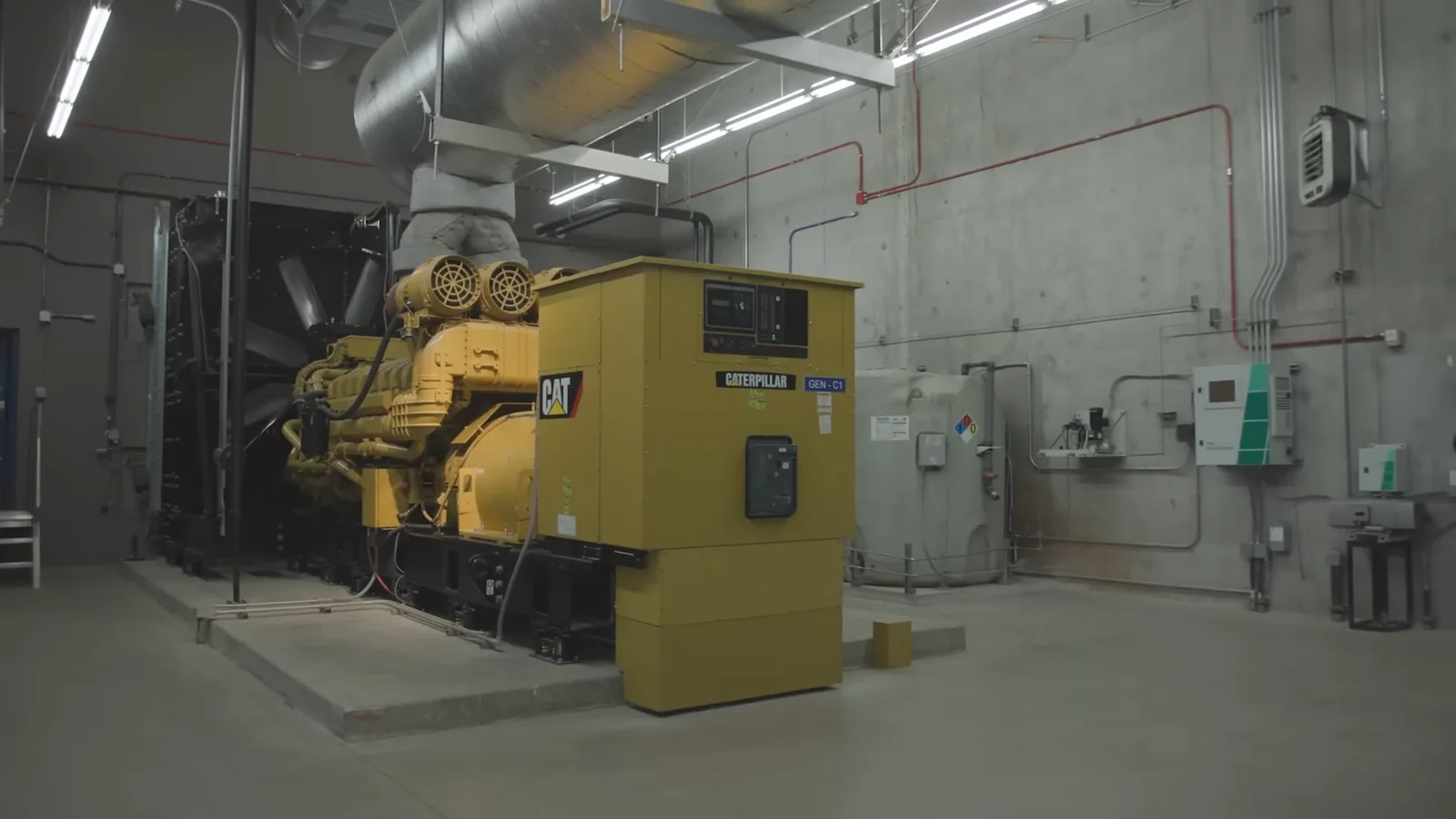
I argue that good projects start with power planning, work with utilities, disclose water use and engage local communities. Heat reuse can also help: I cite Meta’s Danish data center sending heat to a district heating system. Closed-loop cooling, dry cooling and renewable electricity can all be useful choices when evaluated in the context of the site.
Major cloud providers including Amazon, Microsoft and Google operate large networks of data centers, alongside firms such as Oracle and CoreWeave. I cite 2025 market shares and investment plans to illustrate their scale; market shares depend on the definition and period, and corporate capital spending is not necessarily all dedicated to AI data centers.
Grid operators plan for large new loads, but saying that data centers cannot contribute to outages or community disruption is too categorical. Outcomes depend on system capacity, timing and local conditions. Likewise, backup generators are not normally intended to run continuously, but they are tested, and water consumption ranges from low-water designs to evaporative cooling. The practical challenge is to build capacity while addressing local electricity, air and water impacts.
Más de este canal
 34:21EN
 Matthew Berman· 27 oct 2026Matthew Berman Examines Anthropic’s IPO Filing, AI Growth and GovernanceMatthew Berman, Sam Altman · Forward FutureThe presenter reviews the S-1’s financial metrics, compute strategy and voting structure while questioning the tension between rapid AI development and safety.
 0:26ENMatthew Berman· 25 oct 2026Sam Altman on Human Values and Problem-Solving in an AI WorldSam Altman · OpenAIIn a short interview excerpt, Altman considers the enjoyment of solving hard problems and the human role in interpreting results.
 0:36ENMatthew Berman· 25 oct 2026Kimi K3.1 and a Rubik’s Cube Solver DemonstrationMatthew Berman · Forward FutureMatthew Berman shows a scrambled virtual cube being solved and gives the Kimi K3.1 test a favorable assessment.
 0:21ENMatthew Berman· 24 oct 2026An AI-Generated Kimi Benchmark Chart Used Invented ScoresMatthew Berman · Forward FutureMatthew Berman asks for a graph of Kimi K3.1 Pro benchmarks, then discovers that the displayed figures are illustrative placeholders.
 25:50ENMatthew Berman· 24 oct 2026Kimi K3.1 Pro Tested: Strong 3D Demos, Uneven Results and Competitive PricingMatthew Berman · Forward FutureMatthew Berman tests the open-weight model on coding, 3D rendering and visual explanations, then compares benchmark results and prices.
 32:20ENMatthew Berman· 23 oct 2026Who Is Local AI For? The Costs, Trade-offs and a Hybrid FutureMatthew Berman · Forward FutureMatthew Berman weighs data control and independence against hardware cost, setup complexity and inference speed.