En 30 segundos
Matthew Berman describes AI-assisted efforts to recreate features of existing software and points to the open-source Reverse Engineer Anything project. He imagines combining selected features into customized applications. His claims that an entire suite has been recreated, that the results are effectively free, and that the process is categorically legal go beyond what the video establishes.
- 1Creative software recreatedBerman points to projects resembling Adobe applications and predicts that users may avoid paying for software. The video does not establish that the complete Adobe suite has been reproduced.
- 2Observe, build and compareHe describes an AI iteratively copying observed behavior rather than seeing the original source. A visual match does not establish functional equivalence.
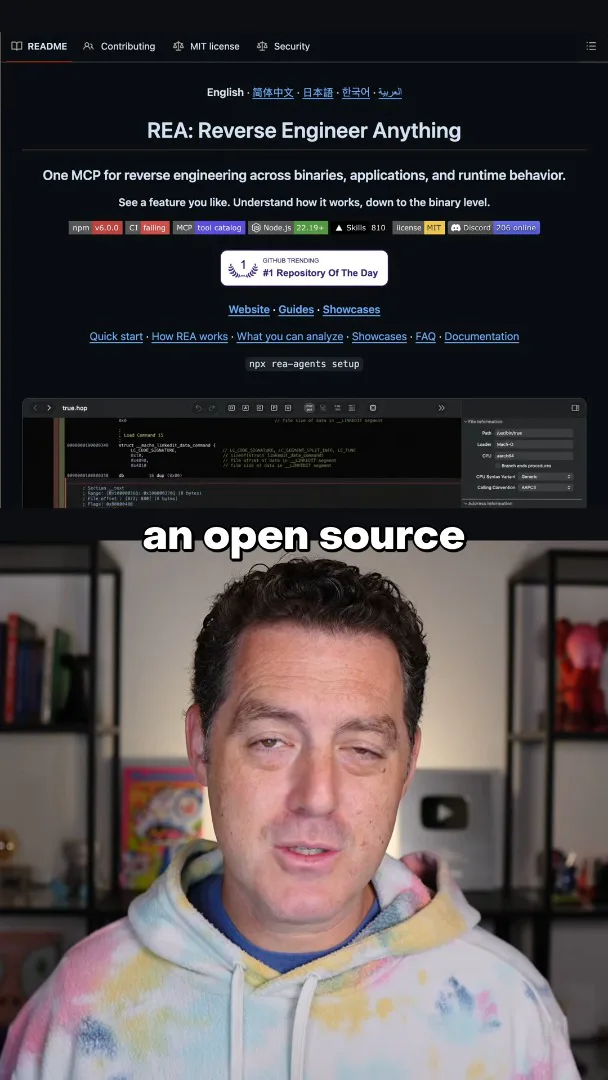
- 3An open-source toolBerman points to Reverse Engineer Anything, a tool for reverse engineering. Its presence in the discussion does not establish that it produced the other projects shown.
- 4Software tailored to the userHe imagines combining only desired features with new ones, like a mashup of games. This is a prediction, not evidence that such applications will be free to build or maintain.
Conclusiones
- Berman describes an iterative approach in which an AI observes a feature, builds an approximation and compares the result with the original.
- Reverse Engineer Anything is an open-source reverse-engineering tool; the video does not establish that it built the creative applications shown.
- Recreating an interface or selected features does not by itself prove full product parity.
- The legality and cost of a particular implementation depend on its methods, rights, jurisdiction and practical resources.
Lee el texto editado por capítulos
Recreating creative applications
Berman claims that AI is enabling free recreations of Adobe software. The breadth, cost and legality of these projects are not established by the video.
You might never pay for software again, I suggest. I point to projects resembling Photoshop, Premiere and other Adobe applications and describe them as free recreations. The clip does not establish that the entire suite has been reproduced or that the alternatives match every feature.
Iterative reverse engineering
He describes an AI observing and rebuilding features, then introduces an open-source reverse-engineering project. The tool is separate from the creative applications shown.
The process I describe is iterative: an AI looks at a feature, tries to rebuild it without seeing the original source code, compares the result with the original, and keeps adjusting. I call this reverse engineering and point to an open-source project, Reverse Engineer Anything, that explores how to do it. The project's tool and the creative applications shown are distinct; this video does not demonstrate that the tool created those applications.
Custom software mashups
Berman imagines combining desired features and inventing new ones. He sees a future of software made specifically for each user.
Think of video-game mashups, such as Mario in Elden Ring or Minecraft in GTA. Now imagine taking only the Photoshop features you need and adding features that do not exist yet: software built specifically for you. I call it basically free, but development, computing and maintenance can still cost money. My claim that this is completely legal is too broad: the answer depends on the methods, applicable intellectual-property and contract rules, and jurisdiction.
Más de este canal
 34:21EN
 Matthew Berman· 27 oct 2026Matthew Berman Examines Anthropic’s IPO Filing, AI Growth and GovernanceMatthew Berman, Sam Altman · Forward FutureThe presenter reviews the S-1’s financial metrics, compute strategy and voting structure while questioning the tension between rapid AI development and safety.
 0:26ENMatthew Berman· 25 oct 2026Sam Altman on Human Values and Problem-Solving in an AI WorldSam Altman · OpenAIIn a short interview excerpt, Altman considers the enjoyment of solving hard problems and the human role in interpreting results.
 0:36ENMatthew Berman· 25 oct 2026Kimi K3.1 and a Rubik’s Cube Solver DemonstrationMatthew Berman · Forward FutureMatthew Berman shows a scrambled virtual cube being solved and gives the Kimi K3.1 test a favorable assessment.
 0:21ENMatthew Berman· 24 oct 2026An AI-Generated Kimi Benchmark Chart Used Invented ScoresMatthew Berman · Forward FutureMatthew Berman asks for a graph of Kimi K3.1 Pro benchmarks, then discovers that the displayed figures are illustrative placeholders.
 25:50ENMatthew Berman· 24 oct 2026Kimi K3.1 Pro Tested: Strong 3D Demos, Uneven Results and Competitive PricingMatthew Berman · Forward FutureMatthew Berman tests the open-weight model on coding, 3D rendering and visual explanations, then compares benchmark results and prices.
 32:20ENMatthew Berman· 23 oct 2026Who Is Local AI For? The Costs, Trade-offs and a Hybrid FutureMatthew Berman · Forward FutureMatthew Berman weighs data control and independence against hardware cost, setup complexity and inference speed.