En 30 segundos
Matthew Berman reviews AI news from July 2024, including Mark Zuckerberg's vision for glasses, a Llama 3 405B preview, Runway Gen-3, robotics and model routing. He also raises questions about AI companionship and speculates about future software. Predictions, company demonstrations and benchmark results are presented in their original historical context.
- 1A vision for AI glassesZuckerberg outlines displayless glasses, heads-up displays and a future full-field holographic experience.
- 2AI companions and concernBerman discusses anecdotal reports of heavy Character.AI use and possible effects on loneliness.
- 3Cultured skin on robotsA research demonstration uses anchors to attach living engineered tissue to a robotic surface.
- 4Routing for costLMSYS reported cost reductions on specific tests by routing requests between stronger and cheaper models.
Conclusiones
- Zuckerberg described a possible progression from displayless AI glasses to interactive holographic displays.
- A research team demonstrated cultured skin attached to a robotic surface, not a completed human-skinned humanoid.
- Personal reports of problematic Character.AI use raise questions but cannot establish prevalence or clinical outcomes.
- RouteLLM reported benchmark-specific cost savings relative to GPT-4 alone while retaining 95% of its measured benchmark performance.
- Claims about AI replacing software and developers are predictions, not demonstrated outcomes.
Lee el texto editado por capítulos
Glasses, Llama and generative video
Zuckerberg outlines possible glasses categories. Berman discusses a Llama preview and Runway's video demonstrations.
In this July 2024 roundup, I start with a clip of Mark Zuckerberg discussing the future of Meta's AI glasses. As a fan of the Ray-Ban Meta glasses, I am interested in the range he describes: displayless glasses for AI, recording, music and calls; a heads-up display for messages and visual answers; and, eventually, a premium full-field holographic display. These are his proposed directions, not products or capabilities established by the clip.
Zuckerberg imagines people meeting as interactive holograms, even playing cards together. I think that is where augmented reality is headed, although the timetable and practicality remain uncertain. I also mention reports that Apple was shifting attention toward a cheaper, smaller headset; after buying the Vision Pro, I find that I rarely use it.
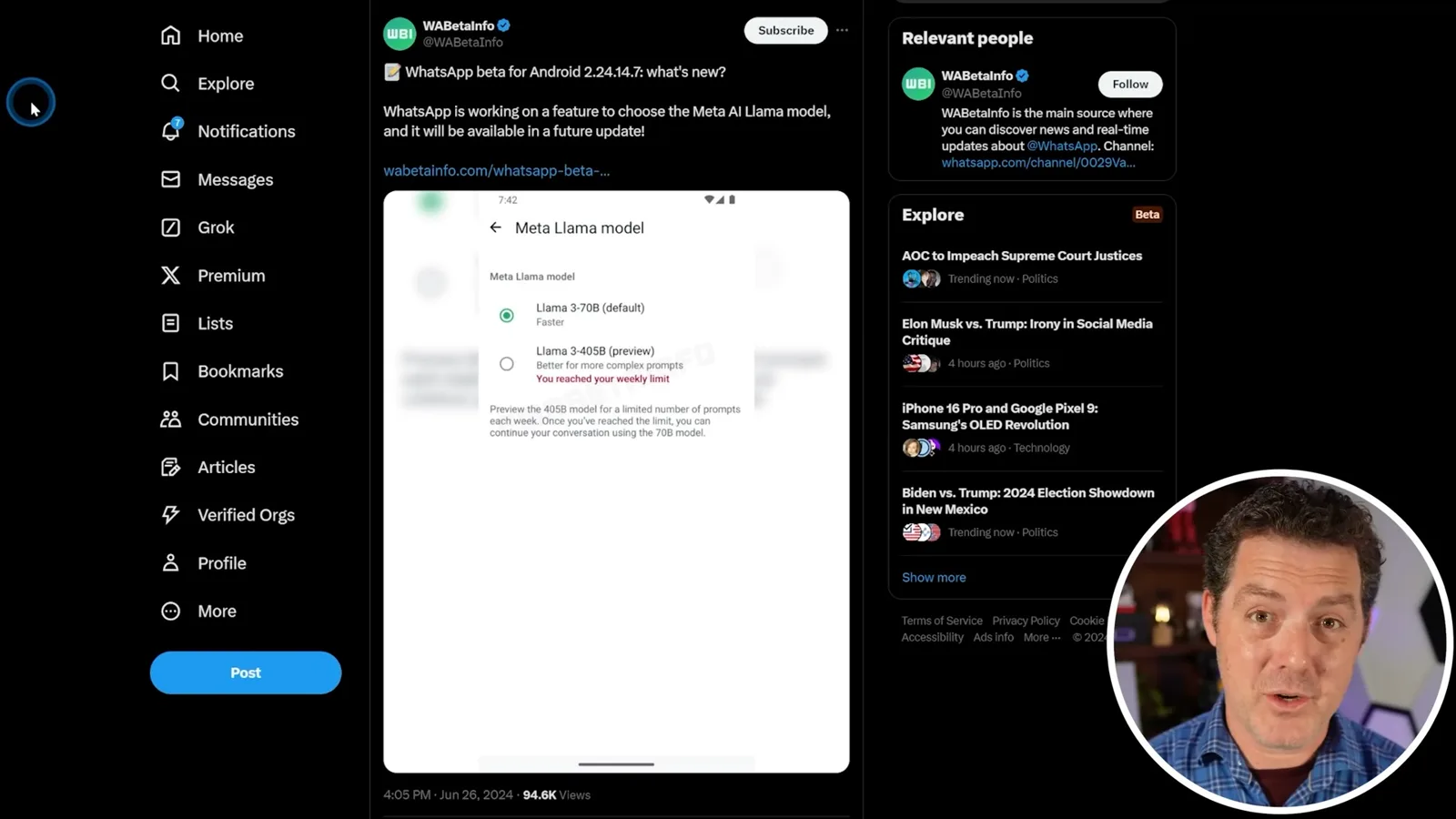
A screenshot shared by WABetaInfo shows a WhatsApp beta interface with Llama 3 70B as the default and a 405B preview for more complex prompts. In early July 2024 I take this as a sign that Meta's larger model could be close. I expect it to narrow the gap with frontier models, though 405 billion parameters would make local deployment demanding even with quantization. This was a preview and a prediction at the time.
Runway's Gen-3 Alpha text-to-video model has become publicly available, and I show examples from its demonstrations. I am excited by the quality and speculate that entire television episodes, films and eventually interactive video games could be generated by AI. The examples are demonstrations, not proof that complete productions are already feasible.
Companionship and model data
Berman discusses anecdotes about Character.AI and speculates about social effects. He also reviews concerns about AI-generated training data and a Grok 2 release prediction.
I turn to Character.AI after seeing Reddit posts in which users describe difficulty limiting their use. AI role-playing has not personally interested me, but the accounts raise a question about compulsive use, especially among younger users. These posts are anecdotes, not a representative study or clinical diagnoses, so they cannot establish how common addiction is or its effects.
My concern is that AI companionship might help someone feel less lonely in the short term while potentially displacing human relationships over time. That is a hypothesis rather than a demonstrated outcome; the effects could differ by person and context. I ask viewers who use Character.AI what they get from it and whether they have experienced problematic use.
I discuss a warning about a 'human centipede' effect in model training: when AI-generated text fills the internet, models trained on it may receive increasingly derivative data. Elon Musk said xAI was working to filter model-generated material from training data and predicted an August release for Grok 2. At the time, that was a company leader's projection, and I note that his release schedules have not always held.
Robotic skin and a factory demonstration
An experimental skin attachment technique elicits a strong reaction. Berman then shows Figure's company demonstration involving BMW.
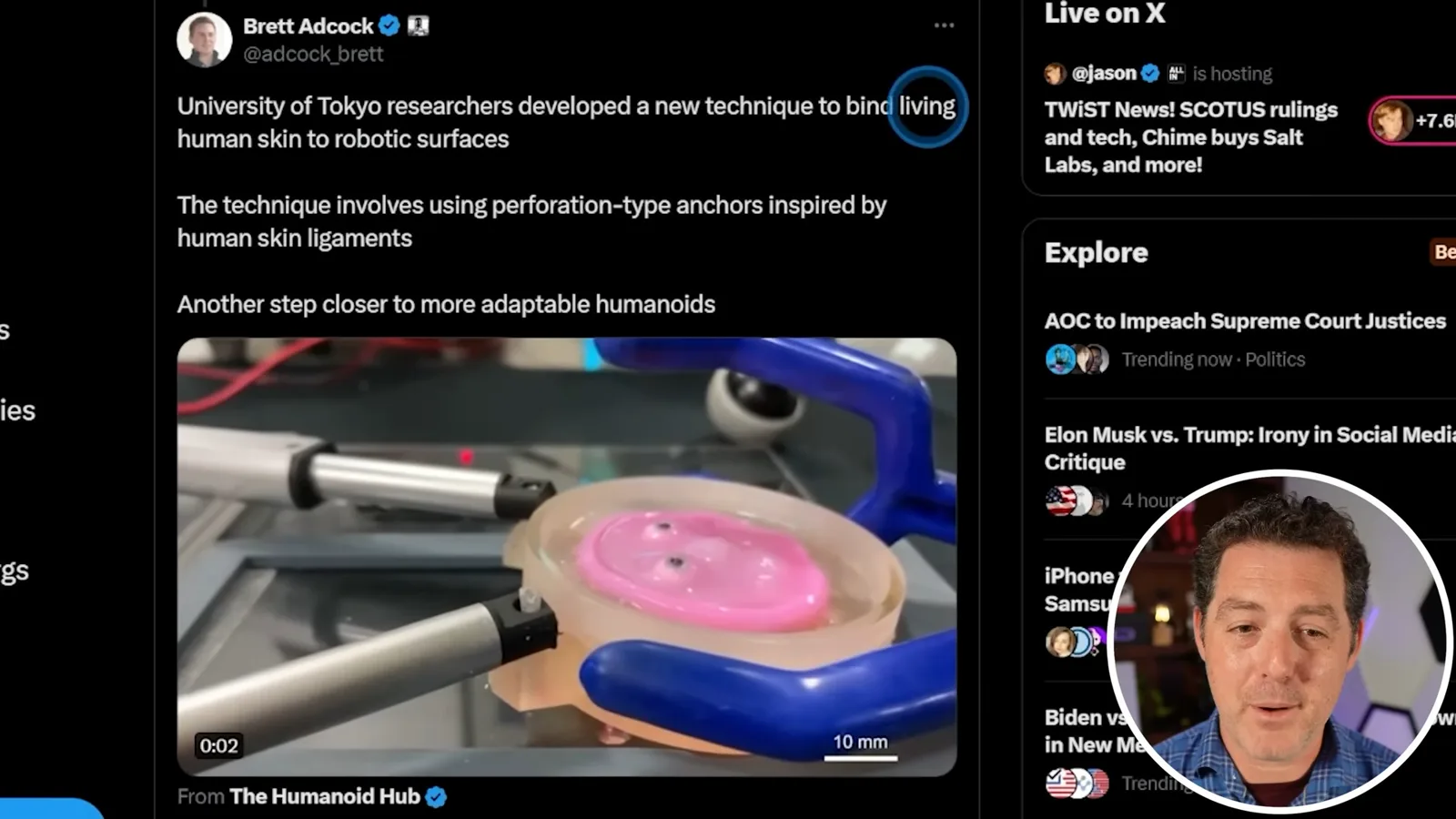
A University of Tokyo research demonstration shows a method of attaching living engineered skin tissue to a robotic surface using anchors inspired by skin ligaments. I find the smiling face unsettling and compare the idea to science fiction. This is an experimental technique using cultured tissue, not a demonstration of a fully human-skinned humanoid robot.
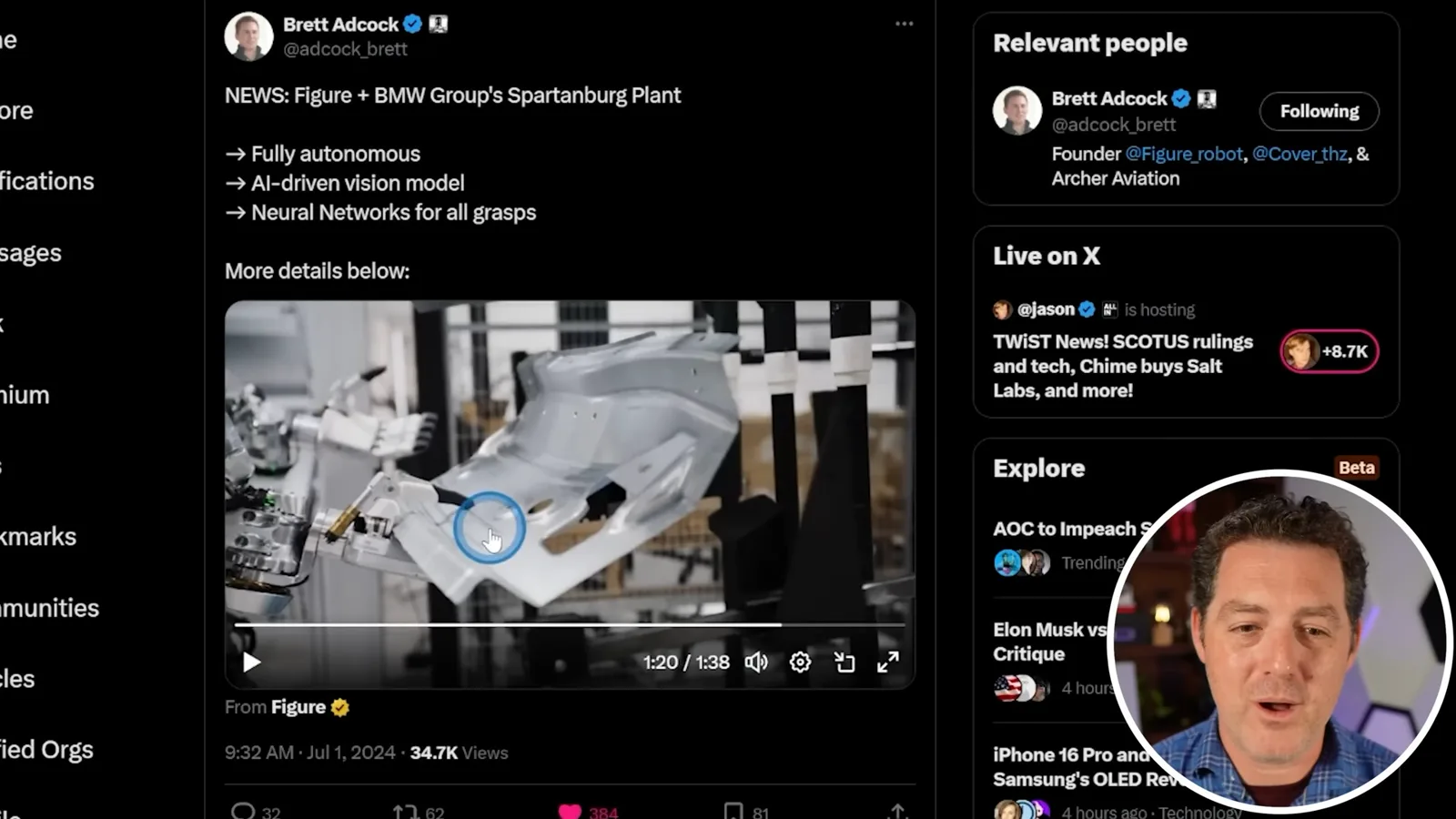
Figure's Brett Adcock shared a demonstration connected with BMW's Spartanburg plant. His post described an autonomous system with AI-driven vision and neural networks for grasping; the clip shows a robot manipulating an automotive part. I see it as an interesting sign of progress, while the edited company demonstration alone does not establish general factory performance or reliability.
A neural-network computer and routing
Karpathy's hypothetical computer prompts a discussion of software's future. LMSYS's RouteLLM offers a practical routing approach with reported benchmark savings.
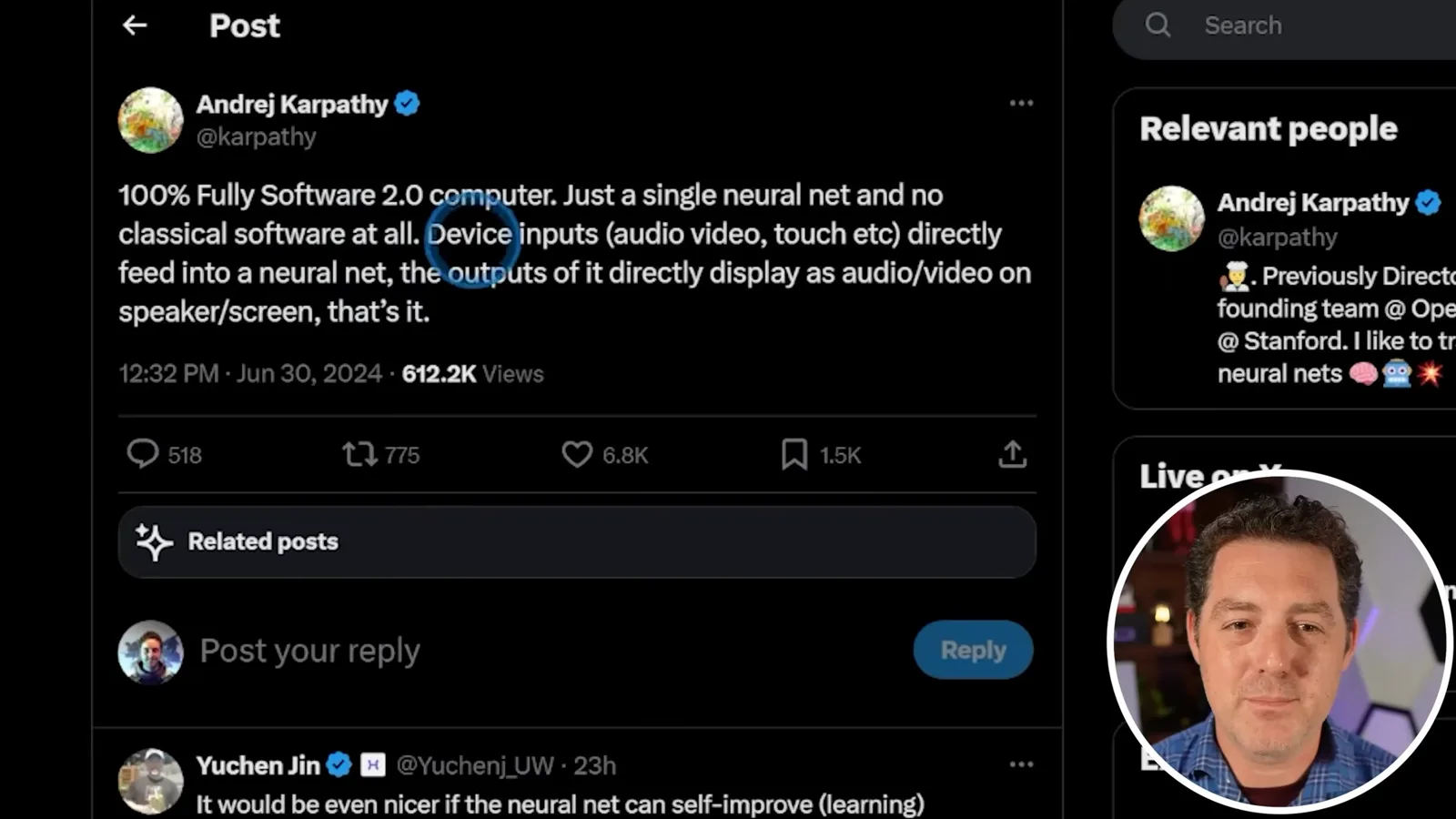
Andrej Karpathy describes a hypothetical 'Software 2.0' computer: a single neural network would receive inputs such as audio, video and touch and directly produce outputs. I connect this to my own view that models could dynamically generate or simulate software in response to requests. I speculate that this might change the work of developers, and eventually that AI might guide its own research; neither prediction is an established outcome.
Karpathy suggests that a system could learn from its context and later fine-tune when idle. Asked about Doom, he suggests the network might simulate it. The broader idea is an interface that produces the requested experience on demand, but the post is a thought experiment, not evidence that such a general computer has been built.
LMSYS's RouteLLM tackles a more immediate problem: not every prompt needs the most expensive model. A router trained using human preference data can send simpler queries to a cheaper model and harder ones to a stronger one. In the team's reported evaluation, routing reduced costs by over 85% on MT-Bench and 45% on MMLU relative to using GPT-4 alone while retaining 95% of GPT-4's measured performance on those benchmarks.
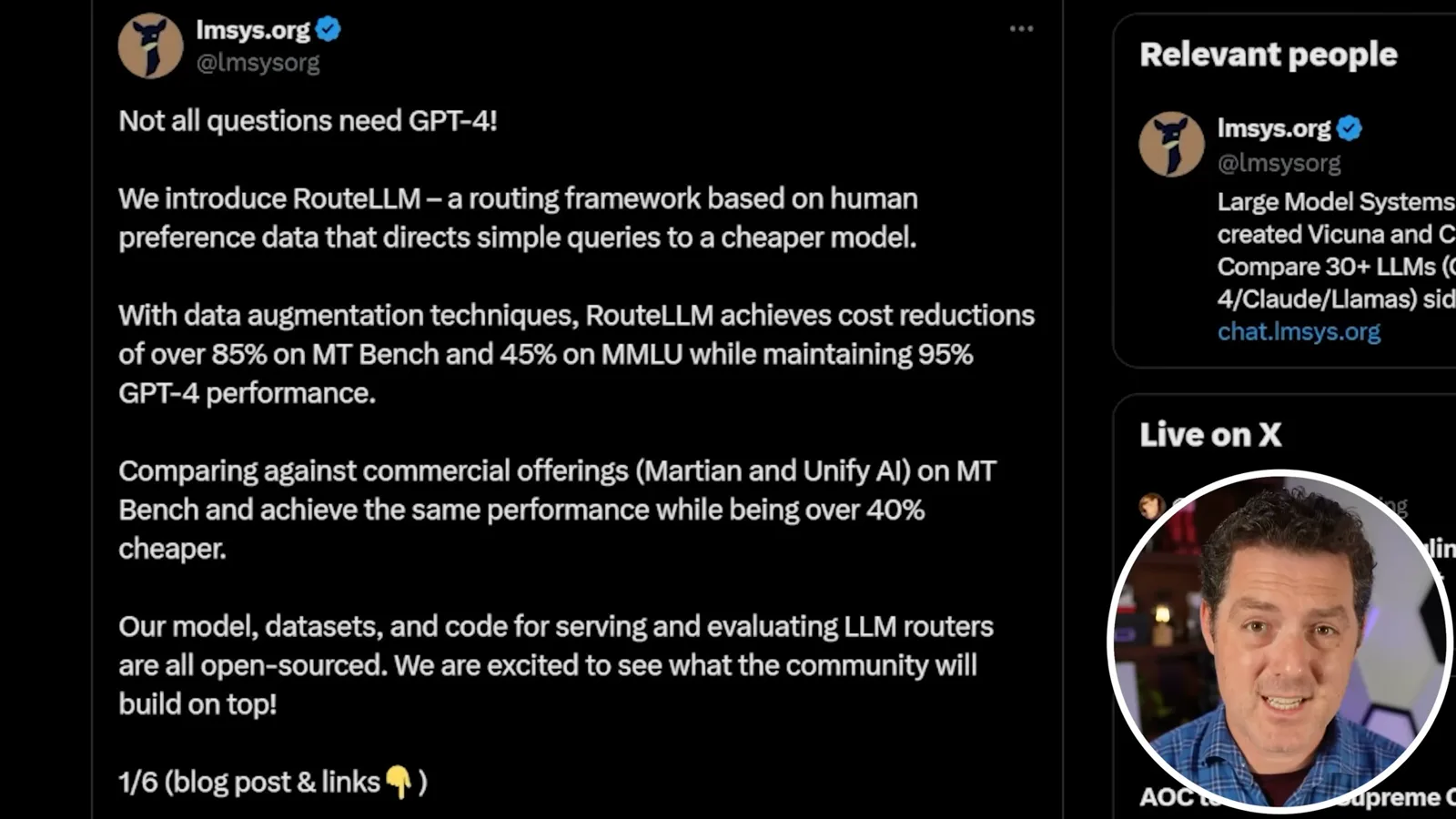
I like the possibility of routing some requests to efficient local models for privacy and lower latency while sending harder ones to a frontier model. The reported RouteLLM results do not themselves establish an on-device deployment or guarantee GPT-4-level quality for every query. LMSYS also reported a comparison with commercial routers on MT-Bench and released its code and data, which I plan to explore in a separate video.
Más de este canal
 34:21EN
 Matthew Berman· 27 oct 2026Matthew Berman Examines Anthropic’s IPO Filing, AI Growth and GovernanceMatthew Berman, Sam Altman · Forward FutureThe presenter reviews the S-1’s financial metrics, compute strategy and voting structure while questioning the tension between rapid AI development and safety.
 0:36ENMatthew Berman· 25 oct 2026Kimi K3.1 and a Rubik’s Cube Solver DemonstrationMatthew Berman · Forward FutureMatthew Berman shows a scrambled virtual cube being solved and gives the Kimi K3.1 test a favorable assessment.
 25:50ENMatthew Berman· 24 oct 2026Kimi K3.1 Pro Tested: Strong 3D Demos, Uneven Results and Competitive PricingMatthew Berman · Forward FutureMatthew Berman tests the open-weight model on coding, 3D rendering and visual explanations, then compares benchmark results and prices.
 32:20ENMatthew Berman· 23 oct 2026Who Is Local AI For? The Costs, Trade-offs and a Hybrid FutureMatthew Berman · Forward FutureMatthew Berman weighs data control and independence against hardware cost, setup complexity and inference speed.
 1:03:37ENMatthew Berman· 23 oct 2026Matthew Berman’s Team Tests Kimi K3.1 on Animation, Games, and ChartsMatthew Berman, Alex, Brian · Forward FutureA live team AMA turns into an informal test of Kimi K3.1, from personal-agent workflows to motion graphics, a browser game, and a benchmark chart.
 0:53ENMatthew Berman· 22 oct 2026Sam Altman on AI and the Discovery of New KnowledgeSam Altman · OpenAIAltman expects progress in mathematical discovery to extend to biology, materials and energy.