En 30 segundos
More than 300 million people ask ChatGPT health questions each week, OpenAI health product leader Ashley Alexander says. She sees an opportunity to combine patients’ records and other context with help preparing for appointments and arranging follow-up, while working with health systems on how clinicians receive that information. Alexander argues that adoption also depends on making tools affordable and easy to use; she says ChatGPT is not a replacement for doctors and does not need to be prescribed as a medical intervention.
- 1More than 300 million people ask health questions weeklyAlexander says that figure reflects demand for help understanding health. OpenAI has also launched record connections, a clinician product and an enterprise offering.
- 2Many health questions arise outside ordinary clinic hoursAlexander says roughly seven in ten health conversations occur outside an estimated 8-to-5 window, when people may have limited access to a clinician.
- 3Record connections are producing demand across the health data systemShe says partners handling patient record access saw unusually high volumes after the U.S. rollout. Her next goal is to turn contextualized information into useful action.
- 4An agent can help turn a follow-up into a scheduled appointmentAlexander describes a system checking her calendar and an available laboratory appointment, then asking for confirmation before booking.
- 5Preparation can bring travel and lab information into a short visitAlexander says her assistant highlighted elevated LDL results and noticed her Rwanda trip, prompting a discussion with her physician about travel preparations.
- 6Better access depends on product design as well as modelsAlexander says even older models can deliver more value if products are easier to set up, affordable and clear about security and privacy.
- 7Alexander does not view the product as a medical prescriptionShe says ChatGPT is not diagnosing or treating people and is not a replacement for physicians. Her priority is reducing the time and cost required for people to use it.
Conclusiones
- Alexander says over 300 million people ask ChatGPT health questions each week, and about seven in ten health conversations happen outside ordinary clinic hours.
- Connected records can provide context, but information must be presented in a form clinicians can use during limited appointments.
- Alexander describes using an agent to prepare questions and arrange follow-up rather than make medical decisions.
- She sees affordability, usability and institutional coordination as major barriers to broader adoption.
- OpenAI’s clinician product is free for verified clinicians, according to Alexander.
Lee el texto editado por capítulos
A year of rapid growth in health questions
Alexander describes why she moved into healthcare products and reports more than 300 million weekly users asking health questions. She outlines consumer, clinician and enterprise products.
Ashley Alexander says she joined OpenAI’s health work after years of wanting to apply product-building skills to problems in healthcare. As a patient in the United States, she found misaligned incentives and unequal access to information frustrating, and saw an opportunity to build technology that reaches people at scale.
Alexander says more than 300 million people now come to ChatGPT with health questions each week. During her first year, OpenAI launched ways to connect medical records and wearable data, a product for clinicians, and an enterprise offering. She says eight leading U.S. institutions have been publicly announced as partners.
The hosts note that health became a common use early in the development of language models. They discuss research on health questions and access to care, suggesting that for some people the alternative to an AI conversation is not an immediate consultation but asking an acquaintance or getting no answer at all.
What people and clinicians seek from AI
The hosts discuss demand when care is hard to access and their experience with clinician tools. Alexander says many health questions arise after clinic hours.
One host describes using the free ChatGPT for Clinicians product and values citations and the ability to work with more than text. Alexander says OpenAI leadership supported giving clinicians access to a frontier model, and says verification uses a U.S. National Provider Identifier. She asks clinicians to provide feedback as the product develops.
Alexander says about seven in ten health-related conversations occur outside an estimated normal clinic window of 8 a.m. to 5 p.m. She relates this to her experience caring for young children: questions about feeding, sleep and other concerns often arise when a physician is not readily available.
A host argues that patients are adopting consumer AI faster than health systems typically change. Healthcare organizations have reasons to move carefully around safety and effectiveness, but he expects patient demand to put pressure on enterprises to adapt.
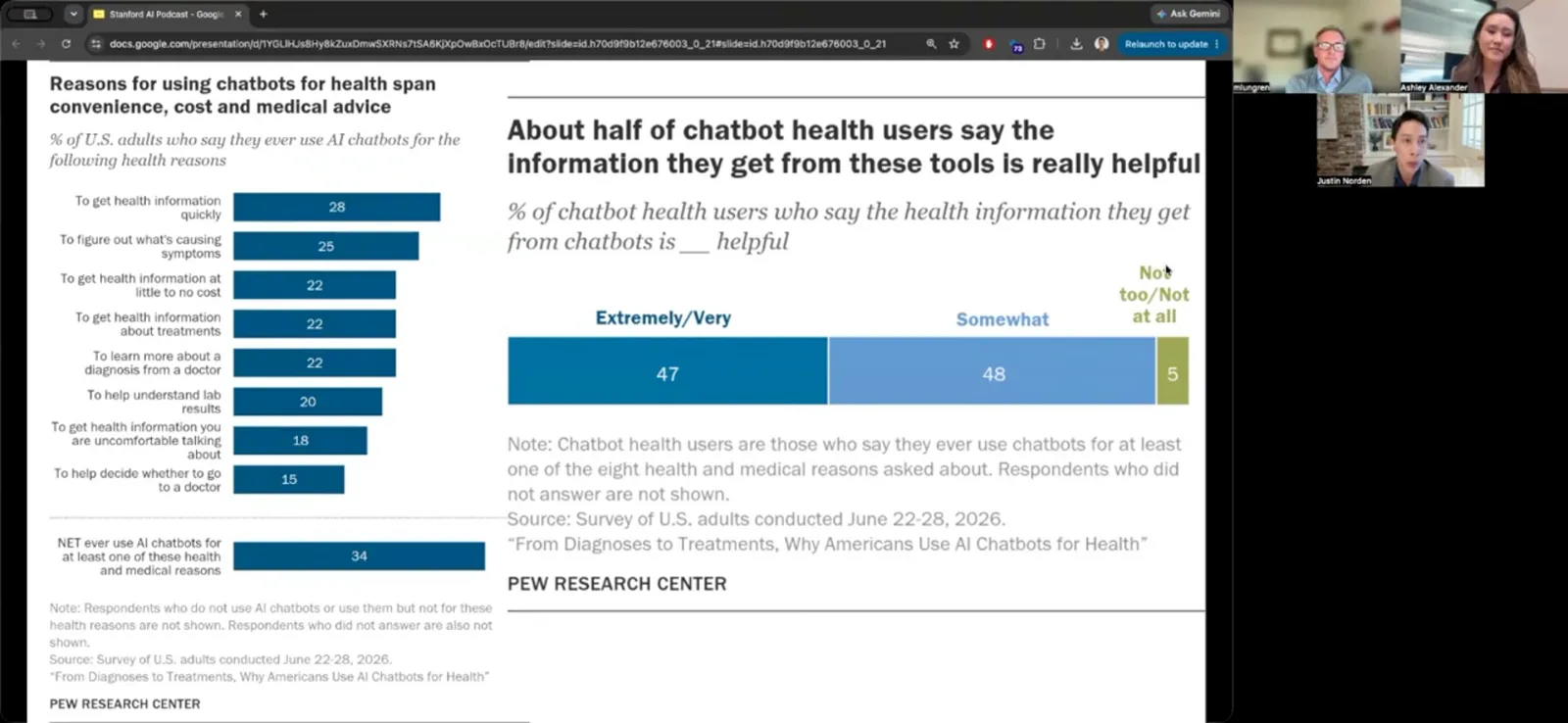
The hosts refer to a Pew survey in which roughly a third of respondents reported using a chatbot for a health concern. They discuss usefulness as reported by patients as well as model benchmarks, and describe using the tools to prepare a more informed question before seeking another clinician’s input.
From connected records to timely action
Alexander reports growing record access and describes agents that could help prepare for care and schedule follow-up. The hosts discuss friction in navigating appointments.
Alexander says OpenAI broadly rolled out medical-record connections in the United States during the summer. Partners responsible for providing access to records reported volumes they had not previously seen, she says. She interprets this as evidence of longstanding demand from people who want to understand their own health data.
Connecting information is a starting point, Alexander says: its value depends on whether it helps someone take an action that improves health. She wants assistants to anticipate relevant information rather than wait for a perfectly phrased question, for example by considering travel, sleep and a planned workout together.
She describes an agent helping her arrange follow-up laboratory work by comparing her calendar, location and available appointments, then asking whether she wants it booked. Her aim is to reduce the administrative work between a recommendation and the action a person chooses to take.
A host compares this proactive role with a trainee who anticipates the needs of a clinical team. He describes the difficulty of arranging an MRI for his son despite his own access to medical professionals. Records and assistants that surface useful questions could reduce some of that friction, he suggests.
Another host says he tested an agent by asking it to organize preventive appointments for his children and check the family calendar. He says it succeeded, while emphasizing that he was not asking it to make medical decisions. He asks how health systems can prepare for patients arriving with increasingly capable assistants.
Connecting patient preparation with health systems
OpenAI is working with health systems on how clinicians might receive patient information. Alexander describes preparing for a visit with lab results and travel plans.
Alexander says OpenAI is talking with health systems about both enterprise tools and patient-generated information. A practical question is how to deliver what patients have gathered in a form that helps clinical staff despite limited visit time. She invites institutions to help design that experience.
She gives an example from her own annual appointment. Her assistant had access to laboratory results through a health integration and highlighted high LDL values to discuss with her physician. It also noticed an upcoming trip to Rwanda from her calendar and suggested raising travel-health preparation during the visit.
Alexander says the physician was able to address travel vaccination and medication during that appointment. She hopes that packaging the information in advance made a visit of less than 15 minutes easier, and sees potential for connecting details a medical record might not contain, such as a forthcoming trip.
Closing the gap between capability and adoption
The speakers discuss uneven adoption outside technology circles. Alexander emphasizes usable setup, affordability and privacy; the hosts ask how systems might encourage use.
Alexander asks the hosts how AI capabilities can reach more people outside technology communities. She notes that subscription adoption is still low in her anecdotal view and cautions that the cited estimates have uncertainty. A technically engaged community may see a very different level of use from the wider public.
She calls the gap between existing model capability and what users receive a product opportunity. Even models several generations old could provide more value through better design. Her test is whether a family member can set up the product without her explaining each step.
Alexander recounts watching her mother-in-law connect and try the health product. She says an accessible, guided pathway matters for people who may not know where their records are or feel comfortable downloading and uploading them. The pathway must also make security and privacy clear to users.
She says the clinician offering is free and describes a desire to broaden access responsibly, potentially internationally. The barriers she highlights include monetary cost and the usability effort required to bring relevant health information into the experience.
The hosts exchange examples of older relatives finding voice conversations more approachable. Alexander says she has heard of people responding to health information when it was framed in a way that made sense to them. She sees value in making ongoing explanations available when a clinician or coach cannot spend unlimited time with each person.
A host argues that some healthcare problems are basic workflow problems that might have been automated before language models but were difficult to address across organizations. In his view, AI can focus attention on scheduling and other tasks; institutions and consumers still need coordination and education to use the tools fully.
The hosts ask when there might be enough evidence for a health system to prescribe use of such tools, and how much routine follow-up could eventually reduce healthcare costs. One host suggests regulation is a larger barrier than capability, before inviting Alexander to close.
Alexander says she does not think the product needs to be prescribed as a medical intervention. She says it is not intended to diagnose or treat people or replace doctors. In her account, the increase from 130 million to more than 300 million weekly people asking health questions in less than six months reflects existing demand.
Her priority is to remove friction so that the time, effort and money people must invest are low enough for ongoing use. She says the goal is to help people feel more informed and involved in their health, and hopes the work can improve outcomes and access at population scale.
Más de este canal
 58:52EN
 Stanford Online· 17 nov 2026Cynthia Bailey: Define What an AI Agent Can Do and When It Must StopCynthia Bailey · Stanford UniversityConnectors let models act through other apps; explicit permissions, human checks and stopping conditions determine how safely they do it.
 1:09:27ENStanford Online· 17 nov 2026Cynthia Bailey: Keep Testing AI After You ShipCynthia Bailey · Stanford UniversityOld test data can miss changed user behavior. Bailey shows how independent review, post-launch checks and better data expose AI risks.
 1:18:55ENStanford Online· 16 nov 2026Michael Ryan: More AI agents can make a task harderMichael Ryan · Stanford UniversityParallel agents can explore more, but coordination costs and conflicting work can make a single agent more effective.
 1:18:54ENStanford Online· 15 nov 2026AI Agent Memory: What to Store, Retrieve and ForgetMichael Ryan · Stanford UniversityMichael Ryan compares agent memory architectures and shows why remembering more does not always improve decisions.
 1:16:51ENStanford Online· 14 nov 2026Michael Ryan: Choosing Agent Patterns by Control Flow and ContextMichael Ryan · Stanford UniversityStanford’s CS329Z explains workflow patterns, reasoning-action loops, and ways to keep an agent’s context focused.
 1:17:14ENStanford Online· 13 nov 2026DSPy, LangGraph and the engineering around an AI agentMichael Ryan · Stanford UniversityMichael Ryan compares agent frameworks through a calendar demo, then shows why evaluation, recovery and tracing matter.