En 30 segundos
At the first Model 3 handover in 2017, Elon Musk said Tesla had made 50 production cars: 30 for customers and 20 for engineering validation. The announced standard model would start at $35,000 with 220 miles of range; a longer-range version offered 310 miles. Musk warned that scaling would mean months of “production hell”: around 10,000 unique parts, a car factory and a battery factory all had to work together, and one missing component could hold up the line.
- 1A smaller car needed room without extra manufacturing complexityMusk describes using a rear glass design to preserve headroom, while reducing the part count compared with the Model S to make the car easier and less expensive to build.
- 2The next challenge was scaling production, not just designing a carMusk expected at least six months of difficult manufacturing work and asked employees to help expand output at Fremont.
- 3One delayed part can slow an entire production lineMusk says the Model 3 has around 10,000 unique parts supplied worldwide. Without enough inventory, disruption to any one component can interrupt the production ramp.
- 4Factories and suppliers had to move in stepBattery packs and drive units from Nevada, car assembly in Fremont and suppliers needed to work together. Musk stated an initial goal of 5,000 cars a week and hoped for 10,000 the following year.
- 5The announced standard model started at $35,000The 2017 presentation gave 220 miles of range for the standard car and 310 miles for the long-range model. The projected slide also listed the long-range price as $44,000.
- 6Thirty of the first 50 cars went to customersMusk says the remaining 20 were reserved for engineering validation. He estimated that a new Model 3 order at the time would arrive toward the end of the following year.
Conclusiones
- At the 2017 event, Tesla announced a $35,000 standard Model 3 with 220 miles of range and a 310-mile long-range version.
- Musk said the production rate would depend on the slowest or least fortunate component in a supply chain of about 10,000 unique parts.
- The initial weekly production target was 5,000 cars, with Musk hoping to approach 10,000 the following year.
- Of 50 cars made that month, Musk said 30 were for customers and 20 for engineering validation.
Lee el texto editado por capítulos
The first Model 3 handover begins in Fremont
Tesla designer Franz von Holzhausen welcomes the employees and guests. Musk arrives at the factory event to present the car and hand over the first vehicles.
Tesla designer Franz von Holzhausen welcomes guests and employees in Fremont and at the Gigafactory, as well as people watching online. He thanks the teams that worked on the car and introduces Elon Musk.
Musk points out that the image behind him is projected onto the factory itself, using a projector powered by a Model S. He says the people in the audience include those who designed, engineered and built the Model 3.
Design a smaller car that is easier to build
Musk explains the clean interior and the rear glass intended to preserve headroom. He says reducing parts was important to affordability and manufacturing, while safety remained a design priority.
Musk thanks the design team and says it paid attention to the car’s interior and exterior details, including ones customers might not notice. The team aimed for a simple, clean interior. He expects cars to become increasingly autonomous, changing how often occupants need to look at an instrument panel.
Musk says the Model 3, S and X then being produced had cameras, ultrasonic sensors, radar and computing hardware that he believed would support full autonomy. He describes a future in which passengers could spend their time watching a movie or talking with friends.
Because the Model 3 is smaller than the Model S, the team needed to preserve interior space in a smaller exterior. Musk says it adapted an idea from the Model X’s glass canopy, placing glass toward the rear of the Model 3 to preserve headroom and give passengers a view.
The Model S is difficult to build, Musk says, so the Model 3 needed fewer parts while remaining light and affordable. He also presents safety as the first priority and shows a comparison with another car in a crash demonstration.
The production ramp depends on every part
Musk expects a difficult manufacturing ramp and explains how a worldwide supply chain can slow output. Fremont, the Nevada battery factory and suppliers must all stay in step.
Building large numbers of cars would be the major challenge over the next six to nine months, Musk says. He warns employees to expect at least six months of what he calls production hell, and says he looks forward to working through it alongside them.
Musk describes the scale of the Fremont factory and says its eventual capacity could include 500,000 Model 3s and roughly 100,000 Model S and X vehicles. Asked when customers will get their cars, he says Tesla intends to ramp production as quickly as possible.
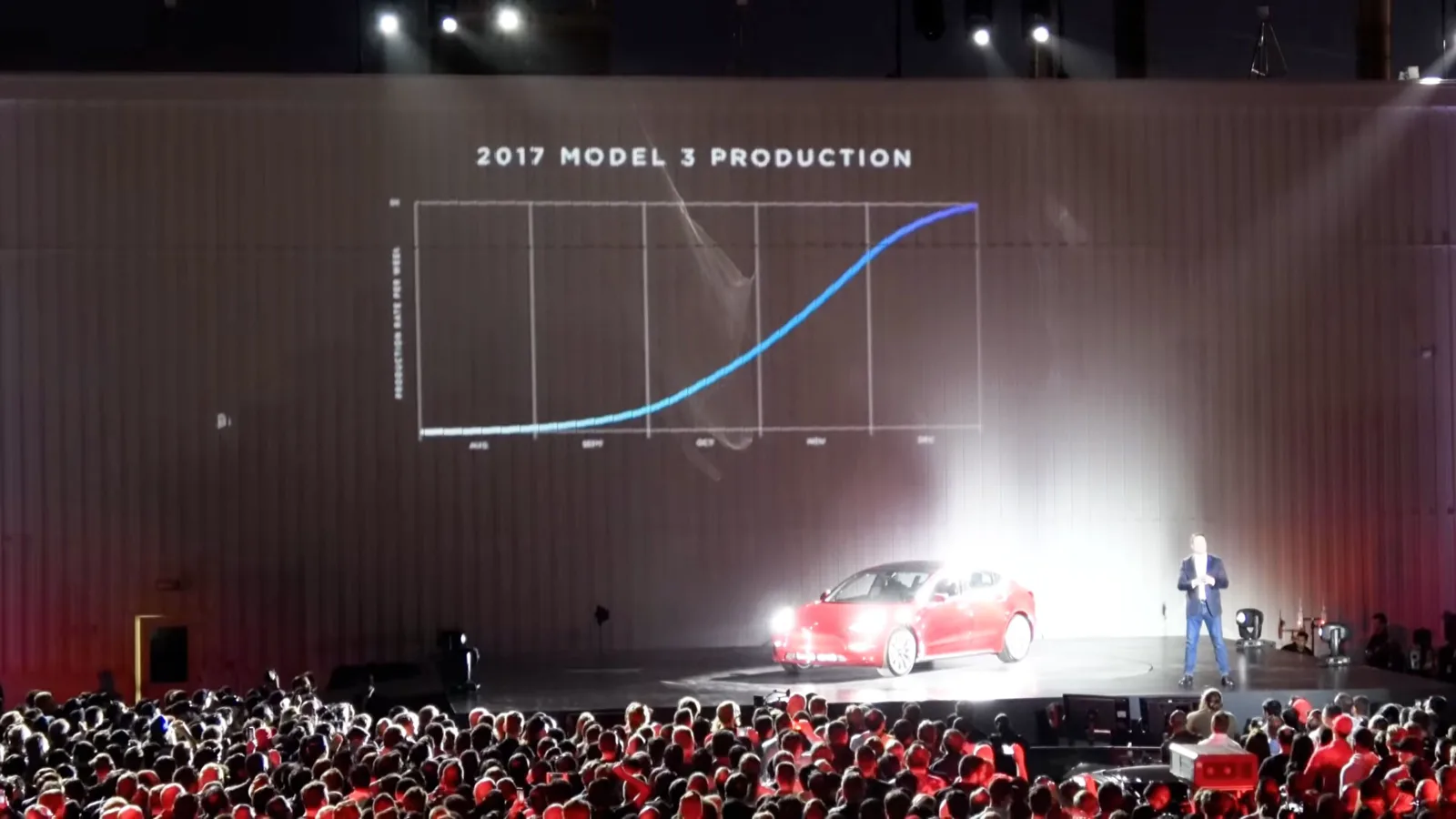
A Model 3 has about 10,000 unique parts, Musk says, with roughly two-thirds sourced in North America and the rest elsewhere. If a supply chain is not sufficiently buffered, a disruption affecting any one component can slow or interrupt the line. The production rate is limited by the slowest or least fortunate part.
Musk then turns to the Nevada Gigafactory, which makes battery packs and powertrains. He shows the team there and says the battery factory, the car factory and the supply chain must work in step. His initial target is 5,000 cars per week, with a hope of approaching 10,000 the following year.
Charging, range and the first customer cars
Musk outlines the charging expansion and the two announced vehicle configurations. He hands over the first customer cars and explains the delivery queue.
On charging, Musk says Tesla plans to triple the number of Superchargers by the end of the following year and expand coverage across major regions. He distinguishes ordinary charging wherever electricity is available from Superchargers, which are intended for faster charging.
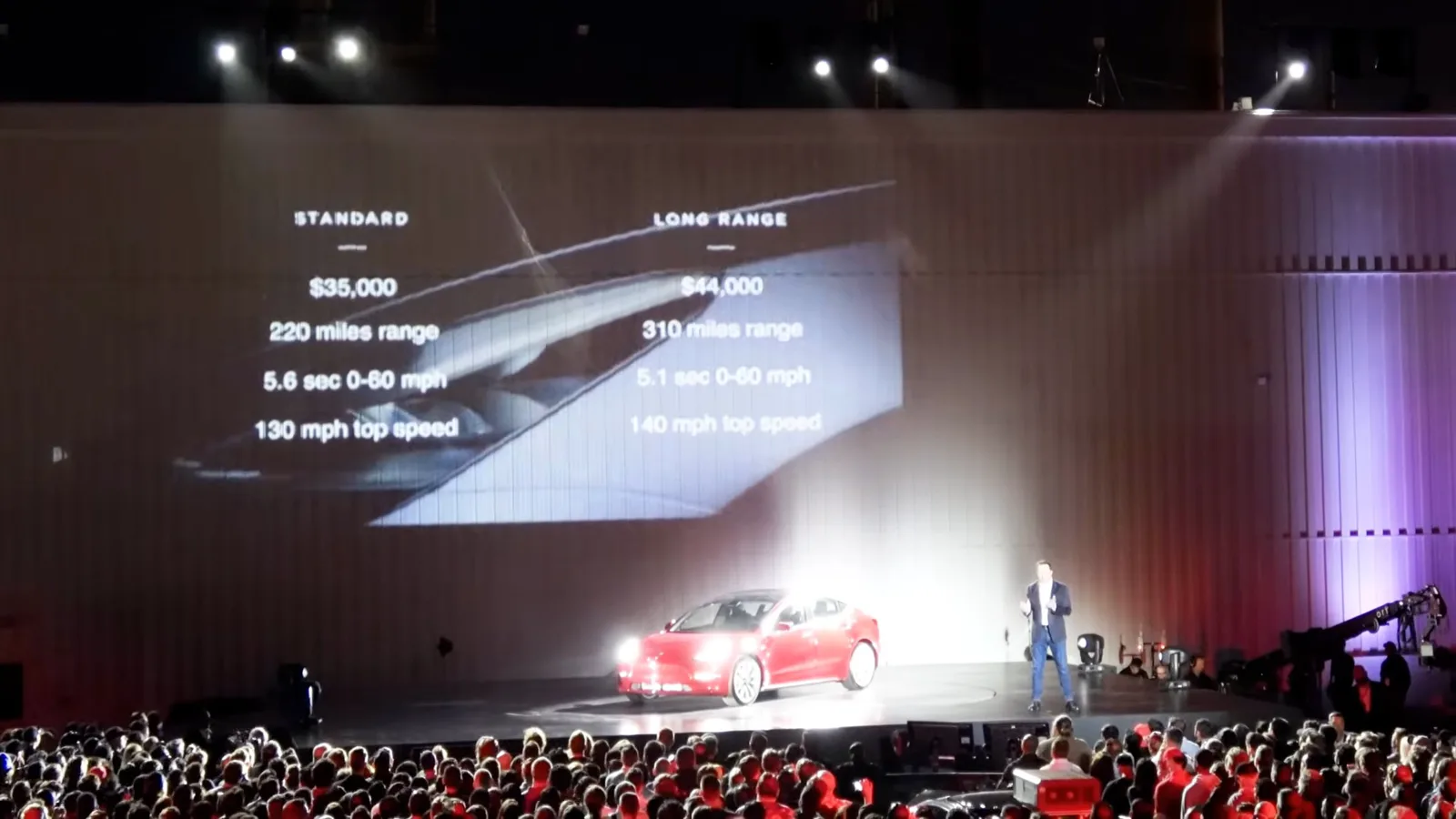
The 2017 presentation lists two Model 3 variants. The standard car is shown at $35,000 with 220 miles of range, a 5.6-second zero-to-60-mph time and a 130-mph top speed. The long-range car is shown at $44,000 with 310 miles of range, 5.1 seconds to 60 mph and a 140-mph top speed.
Musk brings out the first customer cars. He says Tesla made 50 production cars that month: 20 would be used for engineering validation, and the other 30 would go onto the road with customers.
He thanks people who waited outside stores to reserve a Model 3 and says Tesla is working to deliver as soon as possible. For someone ordering at the time of the event, he estimates delivery toward the end of the following year; he says the Model S and X can be delivered sooner.
Musk thanks Model S and Model X buyers, saying the money made from those vehicles goes toward building the Model 3. He also thanks the employees and longtime supporters who made the handover possible.