En 30 segundos
Matthew Berman reviews NVIDIA’s CES 2025 announcements and Huang’s vision for agents, physical AI and robotics. The video includes NVIDIA product claims and Berman’s predictions; NVIDIA funded part of his trip, and he discloses investments in Not Diamond and CrewAI.
- 1Neural graphicsThe keynote combined conventional rendering with AI generation; comparisons depend on the scene and settings.
- 2Three scaling approachesHuang describes pretraining, post-training and test-time computation as separate levers.
- 3Agents and toolsNVIDIA envisions AI systems coordinating retrieval, tools and multiple models to respond to requests.
- 4CosmosA world-model platform was presented for generating synthetic scenarios for robotics and autonomous driving.
- 5Project DIGITSThe compact AI computer was announced at a $3,000 starting price and later named DGX Spark.
Conclusiones
- NVIDIA presented pretraining, post-training and test-time computation as distinct ways to scale AI.
- Cosmos was introduced as a platform for creating synthetic world scenarios for physical AI, not proof of perfect physical simulation.
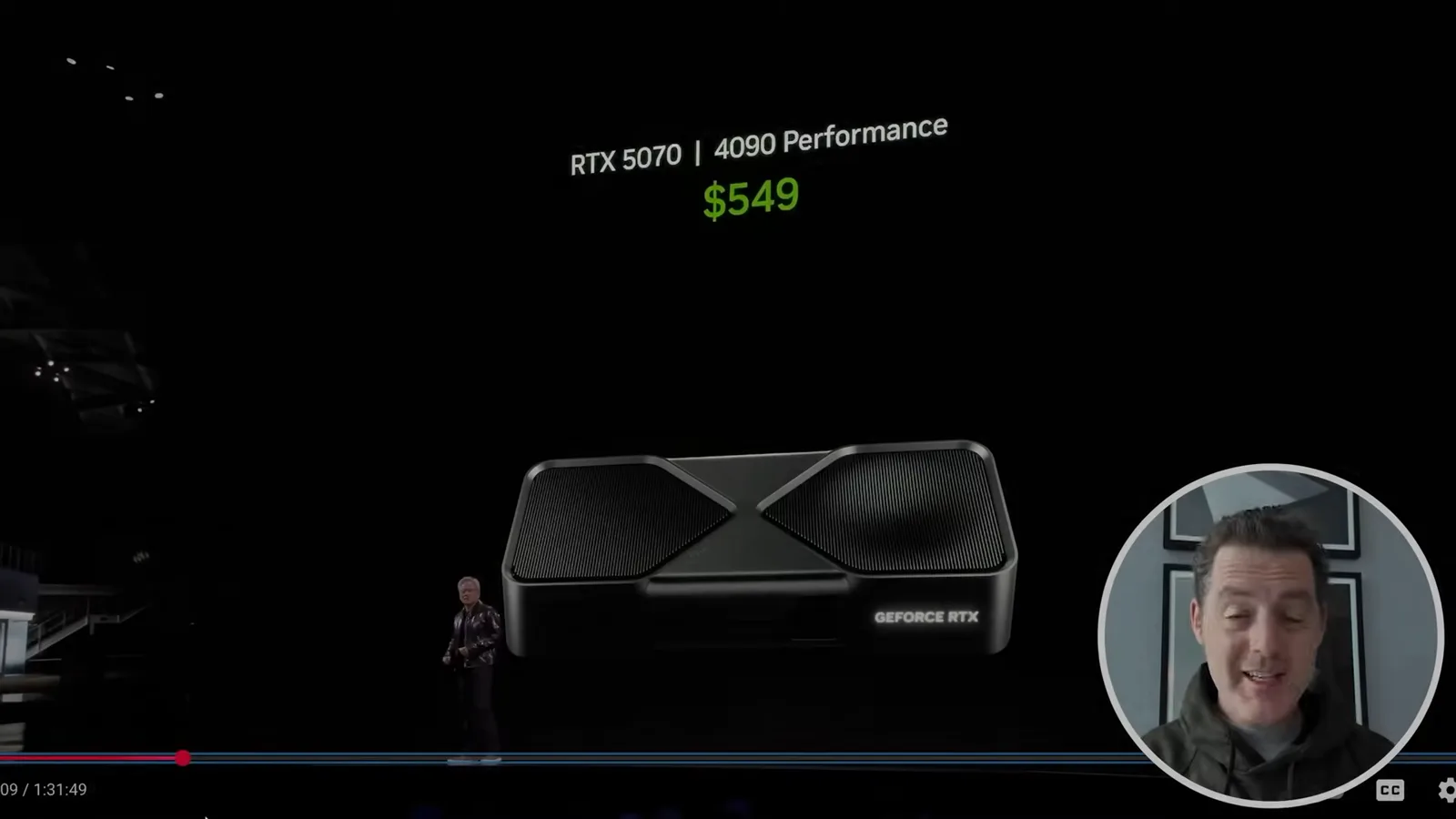
- RTX 5070 comparisons depend on rendering features and workload, and the quoted $549 was a historical starting price.
- Project DIGITS used GB10 and 128 GB of unified memory; NVIDIA announced a $3,000 starting price, correcting the lower estimate in the video.
- Berman disclosed travel support from NVIDIA and investments in Not Diamond and CrewAI.
Lee el texto editado por capítulos
CES and the agent vision
Berman recounts NVIDIA’s keynote and discloses that the company paid part of his travel. He outlines his predictions for agents and future software.
I attended NVIDIA CEO Jensen Huang's CES 2025 keynote, which covered agents, world models, autonomous driving, robotics and new hardware. NVIDIA invited me and paid for part of my trip, but did not pay me to make this video.
Huang traced AI's progress from AlexNet and image classification through perception and generative AI to agentic and physical AI. I thought 2025 would be the year of agents: language models combined with memory, tools, browsing and access to information so they can perform tasks. That was my prediction, not a measured adoption result.
I also offered a more speculative view of computing: rather than conventional applications, perhaps an AI could generate interactions on demand over underlying data. Many programmers expect a combination of AI and traditional software; my alternative is a forecast, not a demonstrated replacement for the application layer.
Neural graphics and Blackwell GPUs
A graphics demonstration and RTX 50 announcement illustrate NVIDIA’s approach to AI-assisted rendering. Performance comparisons depend on the settings and features used.
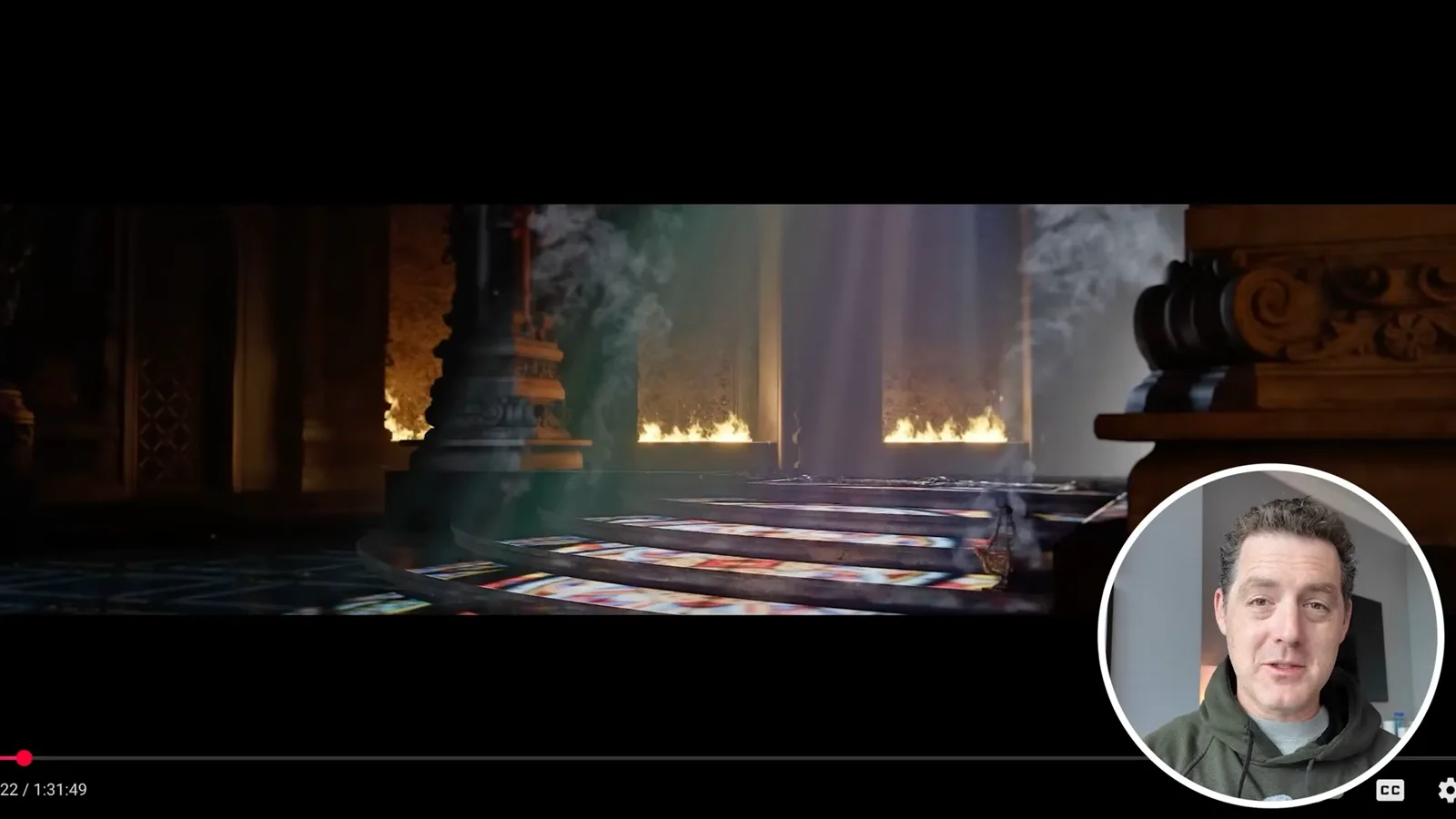
Huang showed a real-time graphics demo combining conventional rendering and neural generation. I was impressed by the claim that AI generated much of the visual output. My discussion blurred generated pixels and generated frames: the percentage is a claim about a particular rendering setup, not a universal property of every frame or game.
NVIDIA introduced its Blackwell GeForce RTX 50 series. At the keynote the RTX 5070 was advertised at a $549 starting price and compared with RTX 4090 performance. That is a historical launch price and a vendor comparison involving AI rendering features; it does not establish equivalent native performance across all games, latency or workloads.
Three kinds of scaling
Huang describes pretraining, post-training and additional computation at inference. Berman discusses their implications and data constraints.
Huang framed AI progress around three areas of scaling: pretraining, post-training and test-time computation. Pretraining uses data, model capacity and compute to build general capabilities. Scaling relationships are empirical and depend on data, architecture, evaluation and resource constraints; they are not guarantees that every model improves indefinitely.
I discussed the pressure to collect high-quality training data and the possibility that AI-generated material will increasingly enter the web. Whether derivative data helps or harms a future model depends on its quality and use. Huang also asserted that the world's data production was rapidly increasing; that estimate was not independently established in this video.
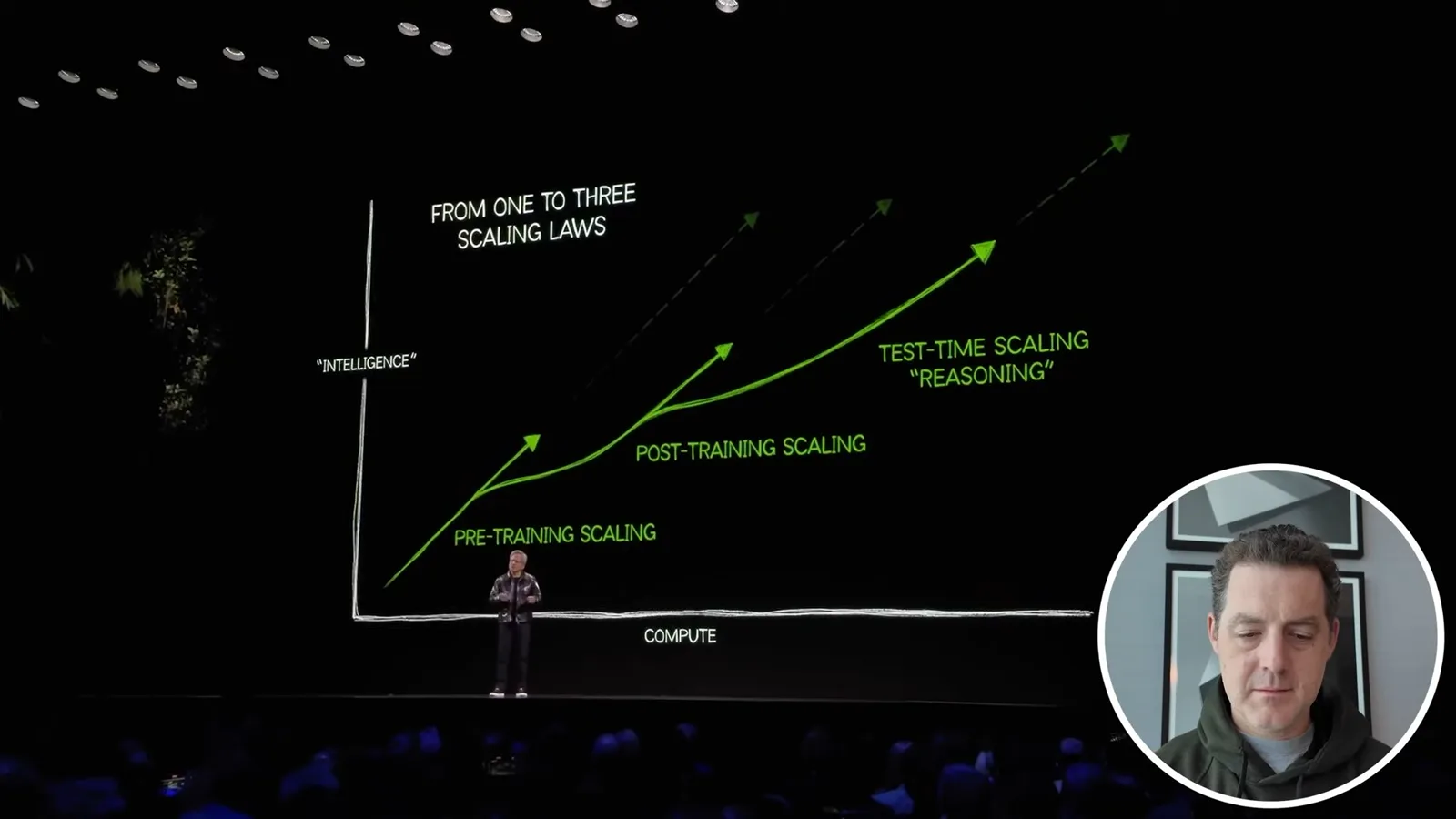
Huang described post-training techniques including reinforcement learning from human feedback, AI feedback and synthetic data. A model can be refined for domains or tasks after pretraining. I compared feedback to a coach, while noting the actual process is more involved than the analogy.
For tasks with verifiable answers, a system may practice and use feedback to improve. I mentioned AlphaGo's extensive self-play and its famous move against Lee Sedol as an illustration. The example helps explain the intuition; it does not mean every language-model task has an easy automatic verifier.
The third category is test-time scaling: spending more computation when answering rather than changing the model's parameters during training. Huang described breaking down problems, generating alternatives and evaluating them. I was excited by reasoning models such as o1 and o3, but additional computation does not ensure a correct answer on every task.
Huang also showed a large Grace Blackwell system. I reflected on the progress from early transistors to enormous modern systems, and mentioned the transistor count displayed during the keynote. Such a system comprises multiple components; the video should not be read as claiming that 130 trillion transistors sit on one chip.
Agents and enterprise models
Huang explains multi-step AI systems using retrieval and tools. Berman discloses investments in two companies he mentions.
For enterprise agents, Huang described systems that may combine language models, retrieval, web access, documents, calculators and chart generation. Instead of one immediate answer, a request can trigger several steps and models. He expects this to increase inference demand, a forecast aligned with NVIDIA's commercial interest in selling compute.
I predicted that agents would enter the workforce in large numbers, with orchestration coordinating models and tools. I disclosed that I invest in Not Diamond and CrewAI, examples I mentioned in this context. The architecture is a possibility for useful work, not evidence that every agent is autonomous or reliable.
NVIDIA also introduced its Nemotron model family for enterprise uses, describing variants with different capability and latency trade-offs. Smaller models can be suitable for local use, while larger variants require more resources. These are NVIDIA's product positioning and the options described at the event, not an independent accuracy ranking.
Cosmos, simulation and robotics
NVIDIA presents world models and synthetic scenarios for physical AI. The demonstrations do not establish exact physical fidelity or the simulation hypothesis.
The next announcement was NVIDIA Cosmos, a world foundation model platform intended to support physical AI. Huang and NVIDIA described models that accept text, image or video prompts and generate video-like world states. The presentation linked the work to robotics and autonomous-vehicle development.
NVIDIA's demonstration showed a pipeline involving world models, tokenizers and accelerated data processing. It proposed using Omniverse to construct physics-based scenarios and Cosmos to generate visual variations such as changes in weather, lighting and surroundings. These are intended workflows and promotional demonstrations, not independent validation of every generated scene's physics.
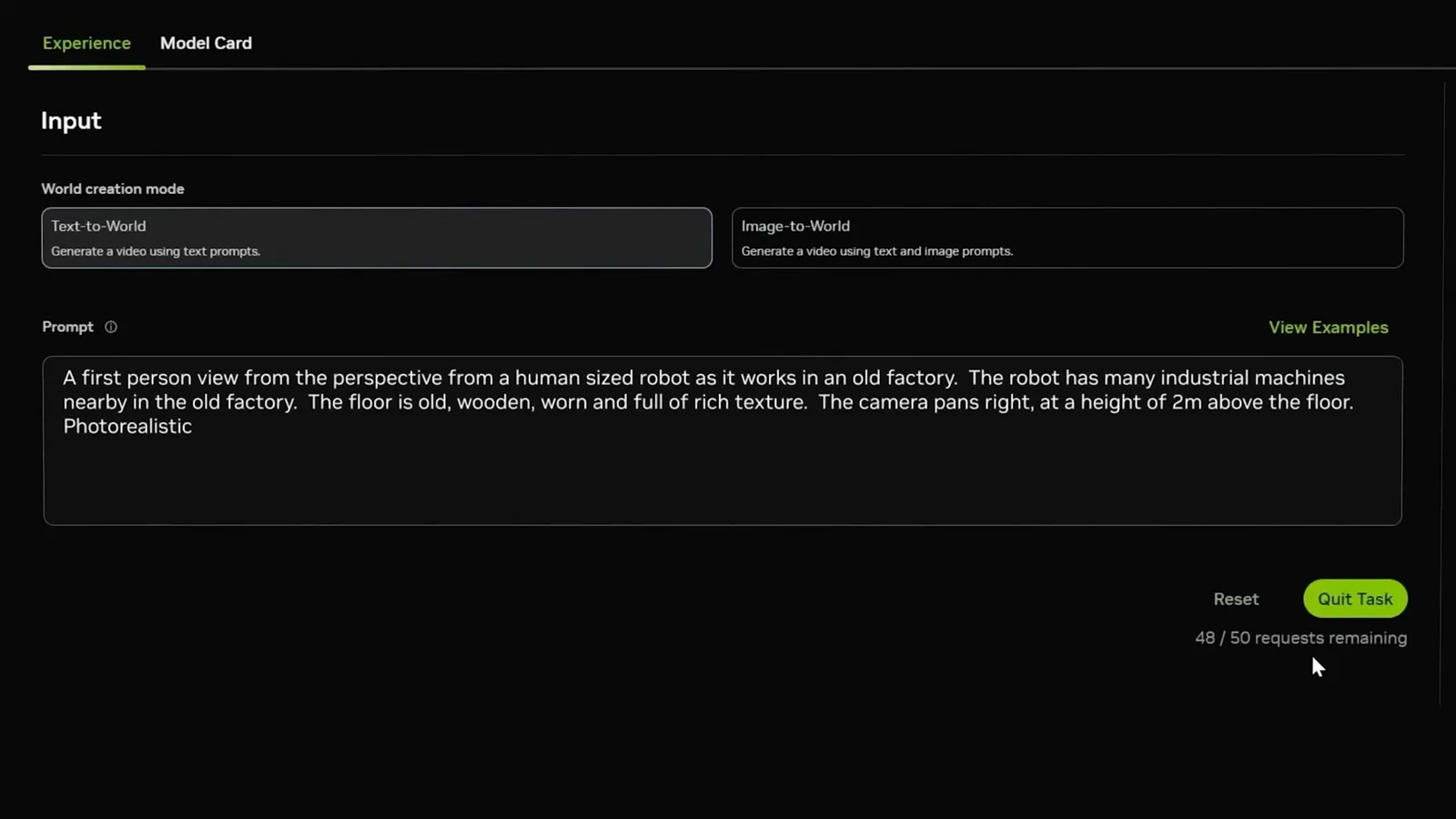
The pitch is that synthetic environments could help create data for training and testing robots and vehicles, including uncommon situations that are difficult to collect. I contrasted that with companies that already gather large amounts of real-world driving data. Synthetic data can supplement collection, but the demo does not prove it eliminates the need for real-world validation.
The video described generating alternative futures to help select actions. I associated this with simulation theory, but a model generating imagined scenes does not prove that our universe is simulated, nor that it can enumerate every possible future or predict the physical world perfectly.
Huang suggested that factories could use digital twins to explore future scenarios and select actions against performance goals. That is a vision for a workflow, not evidence that every digital twin exactly reproduces a real factory. The same simulation tools were presented as relevant to autonomous driving and robotics.
Huang predicted that a breakthrough moment for general robotics was near. He pointed to ongoing humanoid projects and argued that software agents, self-driving cars and humanoid robots could use environments already built for people. I found the prospect exciting, while the timing and size of the eventual market remain predictions.
Project DIGITS
Huang introduces a compact Grace Blackwell AI computer, later named DGX Spark. NVIDIA announced a $3,000 starting price at CES, correcting Berman’s lower estimate.
Huang's final announcement was a small personal AI computer called Project DIGITS. He recalled the first DGX-1 delivered to OpenAI in 2016 and described the goal of placing AI development hardware on a desk rather than requiring a full data-center installation.
The device was presented as a Linux workstation running NVIDIA's AI software stack and able to connect to another computer or network. I was enthusiastic about local AI and privacy. Local operation can reduce some data exposure, but privacy depends on software configuration and how the system is used.
Inside was the GB10 Grace Blackwell Superchip, developed with MediaTek on the CPU side, with a Grace CPU connected to a Blackwell GPU. The displayed specifications included 20 Arm cores, 128 GB of unified memory, up to 4 TB of storage and a claimed 1 PFLOP of FP4 AI compute. Peak low-precision throughput is not a direct measure of every real application.
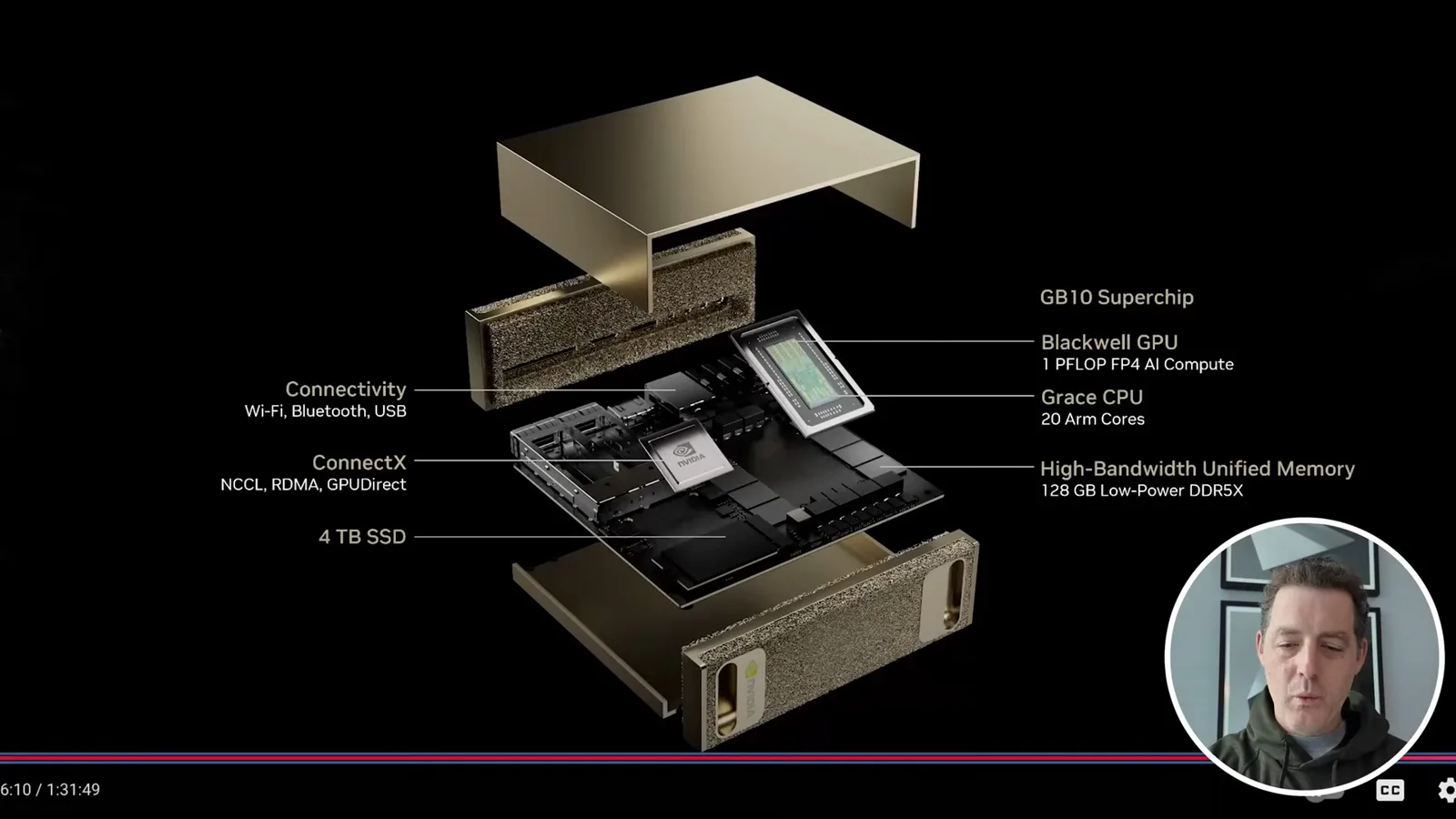
At the keynote, NVIDIA targeted availability around May 2025 and described connecting two systems using ConnectX networking. The device was subsequently named DGX Spark. Launch plans and specifications are historical statements, and actual performance depends on models, quantization, software and workload.
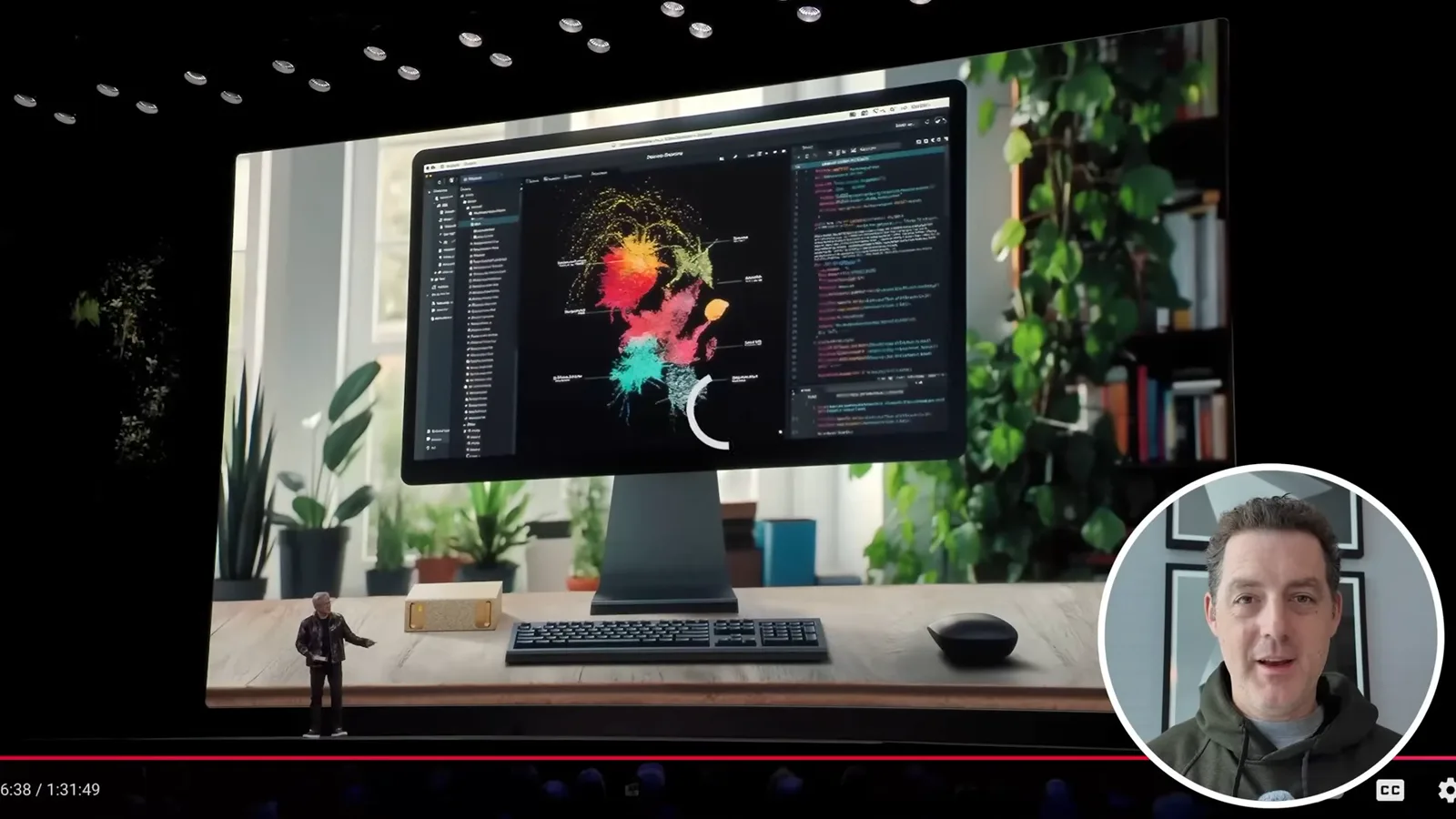
NVIDIA said a single Project DIGITS system could run models up to 200 billion parameters and two linked systems up to 405 billion. Those are capacity claims under appropriate configurations, not a promise of speed or quality. I guessed a $2,000–$2,500 price, but NVIDIA's January 2025 announcement stated a starting price of $3,000; that launch figure is not a current quote.
I finished the keynote excited about local AI and planned to explore more of CES. Across the announcements, it is useful to distinguish NVIDIA's demonstrations and forward-looking claims from independent tests and from my own predictions.
Más de este canal
 34:21EN
 Matthew Berman· 27 oct 2026Matthew Berman Examines Anthropic’s IPO Filing, AI Growth and GovernanceMatthew Berman, Sam Altman · Forward FutureThe presenter reviews the S-1’s financial metrics, compute strategy and voting structure while questioning the tension between rapid AI development and safety.
 0:36ENMatthew Berman· 25 oct 2026Kimi K3.1 and a Rubik’s Cube Solver DemonstrationMatthew Berman · Forward FutureMatthew Berman shows a scrambled virtual cube being solved and gives the Kimi K3.1 test a favorable assessment.
 25:50ENMatthew Berman· 24 oct 2026Kimi K3.1 Pro Tested: Strong 3D Demos, Uneven Results and Competitive PricingMatthew Berman · Forward FutureMatthew Berman tests the open-weight model on coding, 3D rendering and visual explanations, then compares benchmark results and prices.
 32:20ENMatthew Berman· 23 oct 2026Who Is Local AI For? The Costs, Trade-offs and a Hybrid FutureMatthew Berman · Forward FutureMatthew Berman weighs data control and independence against hardware cost, setup complexity and inference speed.
 1:03:37ENMatthew Berman· 23 oct 2026Matthew Berman’s Team Tests Kimi K3.1 on Animation, Games, and ChartsMatthew Berman, Alex, Brian · Forward FutureA live team AMA turns into an informal test of Kimi K3.1, from personal-agent workflows to motion graphics, a browser game, and a benchmark chart.
 0:53ENMatthew Berman· 22 oct 2026Sam Altman on AI and the Discovery of New KnowledgeSam Altman · OpenAIAltman expects progress in mathematical discovery to extend to biology, materials and energy.