En 30 segundos
Theo Browne discusses Linux vulnerabilities, npm supply-chain incidents, and the possibility that AI changes the pace of security work. His proposals for broader early disclosure and temporarily staged fixes have important transparency and licensing trade-offs; the incidents he cites are not all established as AI-driven. The article references [Jeff Kaufman’s disclosure analysis](https://www.jefftk.com/p/ai-is-breaking-two-vulnerability-cultures) and [Mozilla’s defensive research](https://hacks.mozilla.org/2026/05/behind-the-scenes-hardening-firefox/).
- 1Disclosure involves trade-offsPrivate coordination provides preparation time, while public fixes and shorter embargoes can reach more defenders sooner.
- 2A small patch-analysis experimentThe source reports single runs without a control group; it illustrates a possibility rather than proving model reliability.
- 3Separate incidents from AI attributionThe TanStack compromise shows supply-chain risk, but the video does not establish that AI caused it.
- 4Earlier downstream coordinationTheo proposes trusted recipients, with unresolved questions about access, leaks, and fairness.
- 5Plan for recoveryOffline and offsite backups are more useful when restoration is tested and credentials are protected.
- 6Patch according to riskUrgent security fixes and newly released dependencies can require different response speeds.
Conclusiones
- A public patch and a deployed fix are different milestones.
- AI-assisted review can help defenders and attackers, but individual incidents need evidence for attribution.
- Disclosure timing balances preparation, early warning, and the risk of independent discovery.
- Backups should include protected copies and tested restoration.
- Patch urgency and supply-chain review should be evaluated according to the specific risk.
Lee el texto editado por capítulos
A faster security landscape
Theo introduces several distinct security incidents and warns that AI may accelerate discovery and exploitation. The incidents do not all have an established AI link.
Recent reports cover Linux privilege-escalation vulnerabilities, compromised npm packages, a curl issue, and a GitHub vulnerability. I find the pace alarming, but these are different incidents with different causes and impacts. Their appearance together does not establish that AI discovered or exploited each one.
My concern is that AI may accelerate both vulnerability discovery and exploitation, changing the time available for maintainers and users to respond. This is an argument about risk, not proof that every system is already compromised or that attackers can automatically exploit every defect.
Disclosure cultures under pressure
Linux vulnerability reports illustrate the tension between coordinated disclosure and quietly shipping fixes. Timing varies by project and risk.
Copy Fail and subsequent related Linux reports illustrate why local privilege escalation matters: a vulnerable system may allow a process with limited privileges to gain greater access. Exposure depends on the kernel, configuration, distribution, and patch status. Consult your distribution's advisory rather than assuming every Linux installation has the same status.
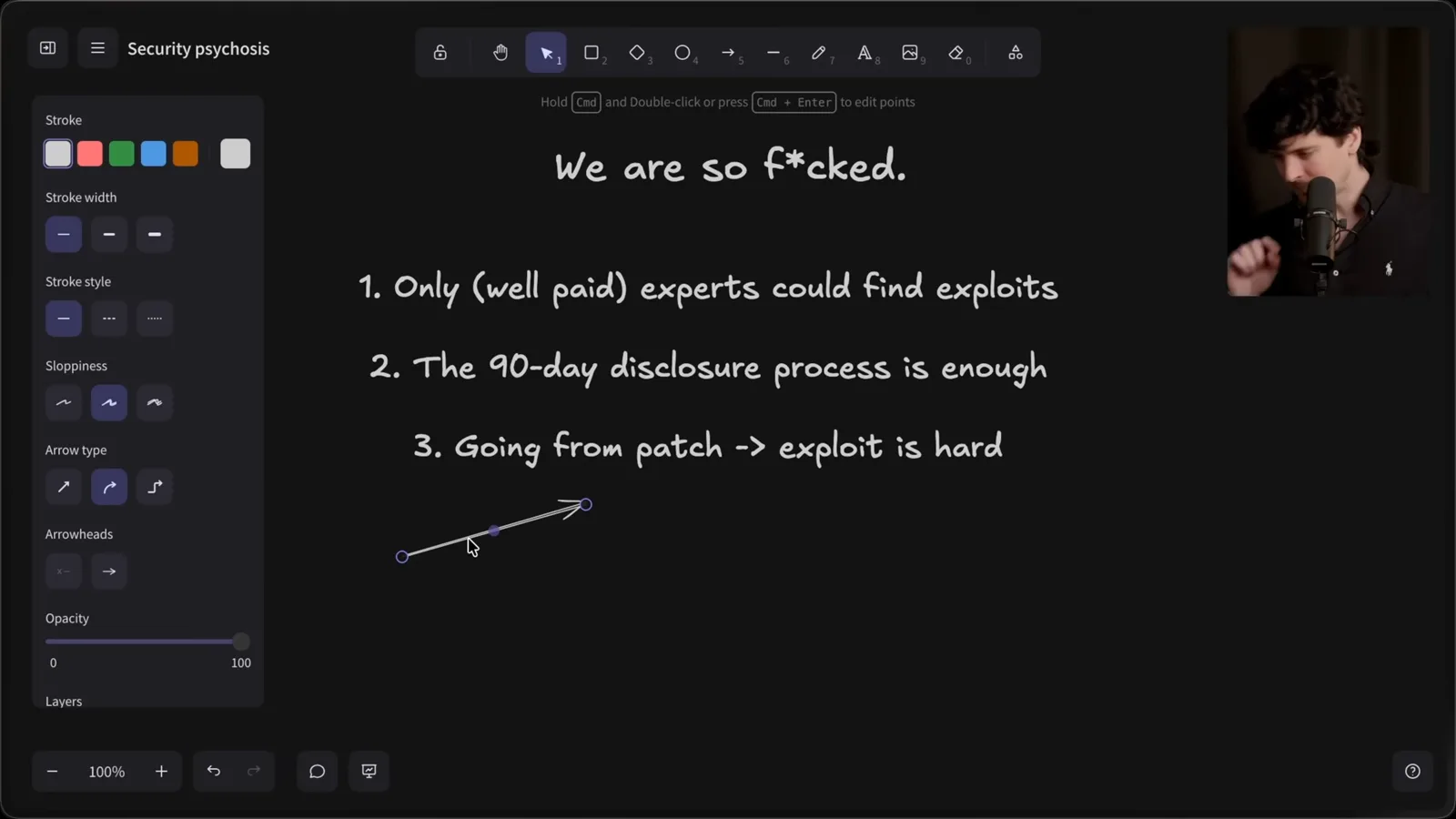
I think the volume of security reports is straining older assumptions about how long discovery and remediation take. In particular, I question whether only specialists can find serious flaws, whether long coordinated-disclosure windows always help, and whether recognizing an exploitable fix in public code remains difficult.
Coordinated disclosure generally means reporting a vulnerability privately and allowing time for a fix before public details are released. Windows such as 90 days are common in some policies, not a universal rule. The trade-off is giving defenders time while recognizing that someone else may independently discover the same issue.
Another tradition is to fix bugs openly and quickly without highlighting their security implications. That can get a patch moving, but once a change is public, observers may infer what it fixes. It has never guaranteed secrecy; AI-assisted review may alter the cost and speed of analyzing changes.
Jeff Kaufman describes tension between these approaches in a follow-up to Copy Fail. A fix was shared publicly while the security impact was restricted, then another observer recognized and disclosed the implications. Kaufman notes a separate independent report nine hours after the first report; that timing alone does not establish AI involvement.
Kaufman argues that both quiet public fixes and lengthy embargoes face challenges, and suggests considering shorter embargoes. I share the concern, but there is no single duration that is safe for every project: a shorter window may help warn defenders sooner while leaving less time to prepare and distribute fixes.
Reading patches and distributing fixes
A small model experiment suggests public changes can reveal security implications. Theo discusses the time needed for downstream updates.
The post describes a small illustrative test: three models were asked whether a commit looked like a security fix. All identified it when given the full commit; on the diff alone their assessments differed. The author cautions that these were single runs with no control group, so they do not establish reliable comparative performance.
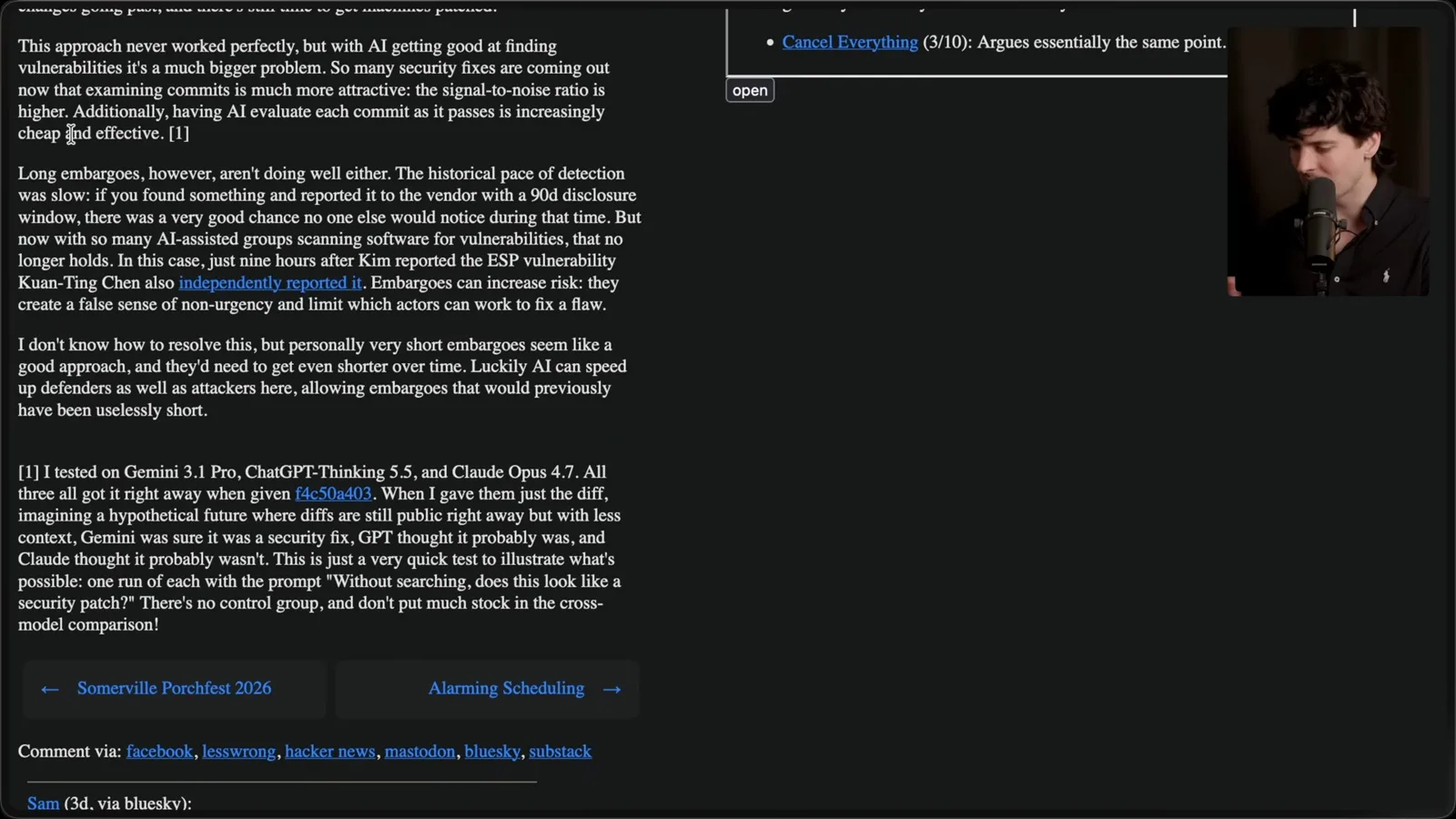
I worry that automation could help people prioritize suspicious commits for further investigation, potentially reducing the time between a fix and attempts to exploit unpatched systems. Identifying a suspicious change is not the same as reliably producing a working exploit, and the video does not measure that conversion rate.
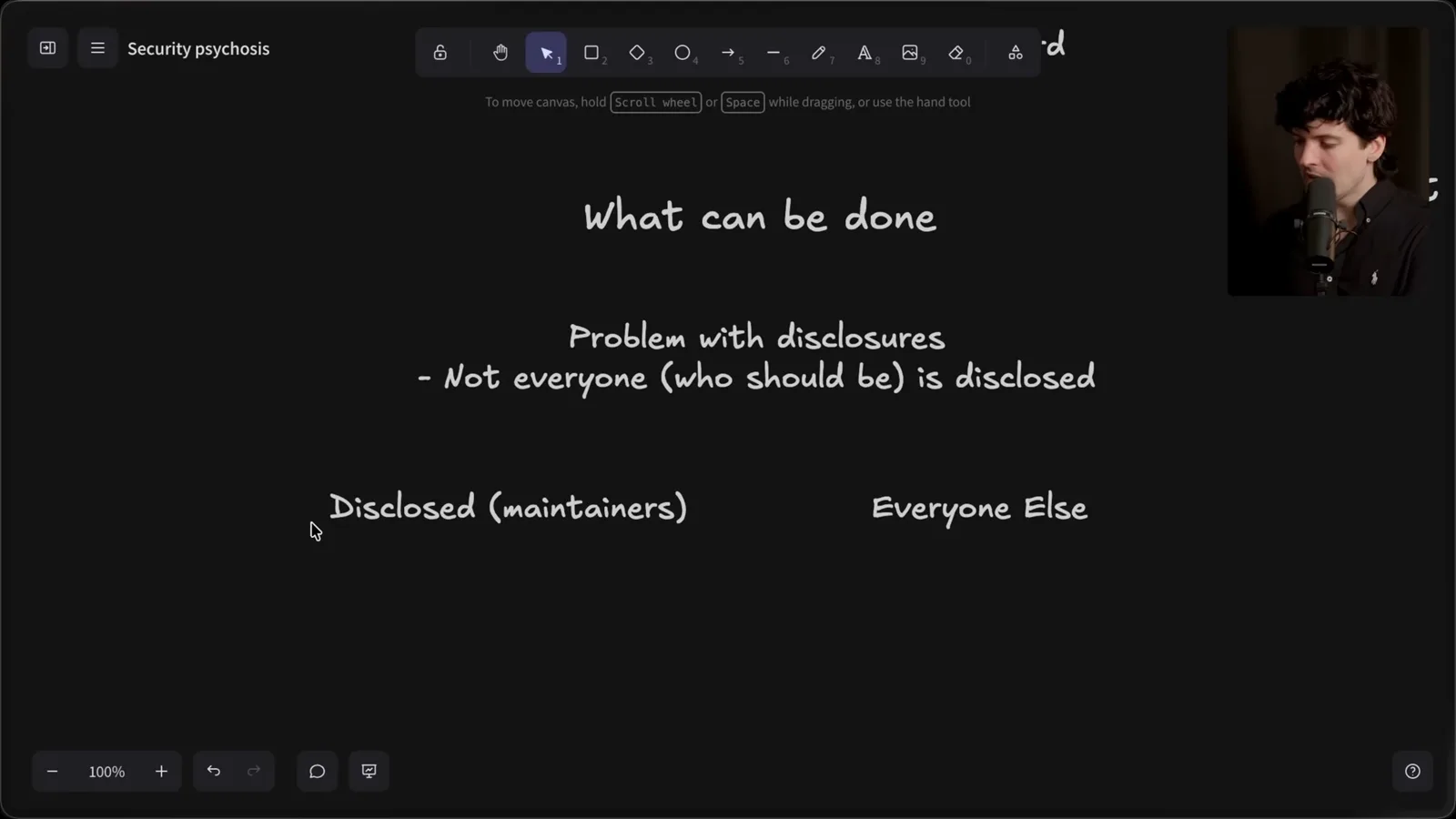
A patch reaching an upstream project is not the same as every device receiving it. Distributors must assess, integrate, test, and ship updates; users then have to install them. Disclosure arrangements vary by project and vendor, so it is too broad to say distribution maintainers are never included before publication.
Supply-chain risk and responses
Theo discusses the TanStack incident and proposes earlier access for trusted downstream actors. The proposal has significant governance and security trade-offs.
The TanStack npm incident is a separate example of supply-chain risk. Malicious package versions were published through an attack on the publishing workflow. AI may lower the cost of parts of security work, but the video offers no evidence that AI caused this particular compromise.
I am concerned about the effects on schools, hospitals, developers, and ordinary users if attacks become faster or easier to scale. The severity varies by system, and forecasts of widespread compromise are uncertain. Still, organizations can plan for both prevention and recovery instead of relying on perfect prevention.
I propose broadening early disclosure to a trusted group of downstream maintainers and operators so they can prepare updates before details become public. That might reduce some delays, but it raises hard questions about who qualifies, how to protect the information, how smaller projects participate, and whether a larger group increases leak risk.
Temporarily staged changes
Theo sketches a private staging and later disclosure process. Licensing, transparency, and review require further analysis.
I also suggest temporarily staging some security changes privately before releasing their source, then notifying trusted distributors and making the changes public after deployment has progressed. This is a proposal for discussion, not an established best practice. It needs careful analysis of licenses, reproducible builds, independent review, and the trust required for closed changes.
As an analogy, I speculate about why a company might keep experimental features private while publishing a stable version of its software. That does not establish the actual motives of any particular team. Selective openness might help some coordination, but it can also weaken transparency and exclude affected communities.
In my imagined rollout, maintainers would assess an issue, prepare a fix, alert trusted downstream distributors, and disclose the change more broadly later. The difficult part is not merely adding a private branch: participants need an equitable, secure process and must respect the relevant license obligations.
I recognize that this approach is complex and temporary at best. I frame the choice starkly in the video, but it is not necessarily a binary between my proposal and abandoning open source. Other approaches to disclosure, review, distribution, and secure development deserve consideration.
Backups and family preparation
Theo focuses on recovery, offline copies, and verifying unusual requests. Planning for compromise is not evidence that it occurred.
For personal resilience, I think about protecting access to data as well as preventing leaks. Assume compromise is possible and plan recovery accordingly; that does not mean there is evidence all of your data has actually been stolen. The key question is what happens if the only available copy is destroyed or encrypted.
I am making multiple backups, including copies that are offline or disconnected between updates and copies in another location. A backup is useful only if it can be restored, so testing recovery and protecting backup credentials also matter. Choose the schedule and storage based on the data's importance and how much loss is acceptable.
Talk to family about impersonation and emergencies. A familiar voice or caller ID alone may not establish identity; agree on a way to verify unusual requests through a trusted channel. I also suggest identifying important records and making accessible backups, including paper copies where appropriate.
What could change the outlook
He considers a decline in discoveries and better defensive tooling. He closes with secure design and risk-based patching.
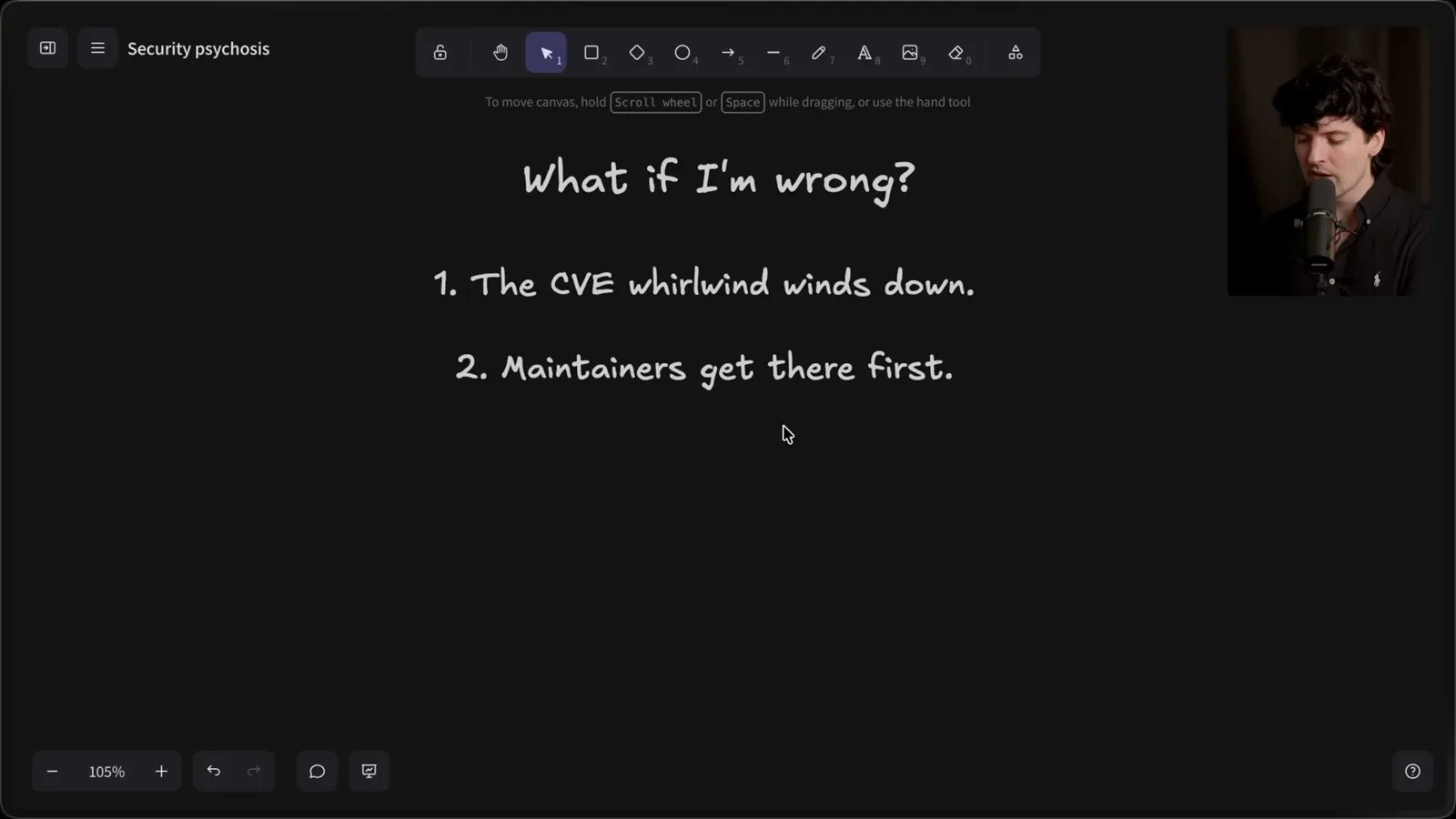
I ask what would change my mind. One possibility is that a burst of discoveries clears a backlog of older defects and the rate later falls. Counts of published CVEs alone cannot establish whether the underlying software is becoming less secure: reporting practices, scope, and discovery capacity also affect the numbers.
Another hopeful possibility is that maintainers find and fix more problems before attackers do. AI-assisted analysis can help defenders, but it also requires expertise to verify findings and the resources to act. Mozilla and curl maintainers have described both useful AI-assisted findings and the human work needed to assess them.
I point to OpenAI's Daybreak announcement as one example of offering defensive vulnerability analysis to projects. Availability and access conditions can change. The larger idea is to help maintainers harden software proactively, not to assume a scan alone makes it secure.
Secure-by-design measures can also reduce classes of bugs: memory-safe languages can prevent many memory-safety errors, and authorization boundaries should be enforced where data is accessed. Neither choice eliminates every vulnerability; existing systems, configuration, dependencies, and human review still matter.
I urge people to keep operating systems and important software patched, while evaluating dependency updates for both security fixes and supply-chain risk. A fixed delay for every package is not universally safe: an urgent exploited vulnerability may require immediate action, whereas newly published dependencies may warrant extra review.
I still believe open source matters. The goal is to improve how we trust, review, distribute, and update code, while giving maintainers the support they need. Security involves trade-offs, and faster tools make careful coordination and recovery planning more important.
Más de este canal
 38:47EN
 Theo - t3․gg· 28 oct 2026Theo’s Long-Running Agent Experiments: Verification, Compute and CostTheo Browne · Ping LabsA skateboard game and two compiler projects show how repeated checks and flexible compute can sustain agent work—and how expensive those loops can become.
 36:07ENTheo - t3․gg· 27 oct 2026Theo on Token Costs, Coding Agents, and the Price of AI CapabilityTheo Browne · Ping LabsA viral estimate of Lauren's AI spending prompts a closer look at cache pricing, benchmarks, and the changing work of coding agents.
 30:37ENTheo - t3․gg· 26 oct 2026Theo’s Three Skills for Reviewing and Shipping with Coding AgentsTheo Browne · Ping LabsHow sol-loop, full-send and full-stop encode review, verification and different levels of merge authority.
 0:43ENTheo - t3․gg· 23 oct 2026Theo Distinguishes Security Vulnerabilities from Active AttacksTheo Browne · Ping LabsA short explanation of why disclosed software flaws and reported attacks are different kinds of security news.
 29:22ENTheo - t3․gg· 22 oct 2026Theo on Security Vulnerabilities, Stolen API Keys and AITheo Browne · Ping LabsA look at the gap between vulnerability disclosure and patching, and a speculative account of why stolen inference keys may be valuable.
 31:13ENTheo - t3․gg· 20 oct 2026Theo on Why Smarter Models Help More Than DevelopersTheo Browne · Ping LabsFrom game modifications to compiler experiments, Theo revisits his assumptions about who benefits from more capable AI.