En 30 segundos
In February 2025, Matthew Berman reviews Sam Altman’s proposed roadmap for GPT-4.5 and GPT-5 and argues for a simpler interface that routes requests to the right model and tools. The article distinguishes those historical plans from later releases, including the separate launch of o3.
- 1A confusing model pickerBerman shows the range of model and tool choices available to his Pro account in February 2025.
- 2Routing by taskHe proposes choosing a model and tools automatically and discloses an investment in Not Diamond.
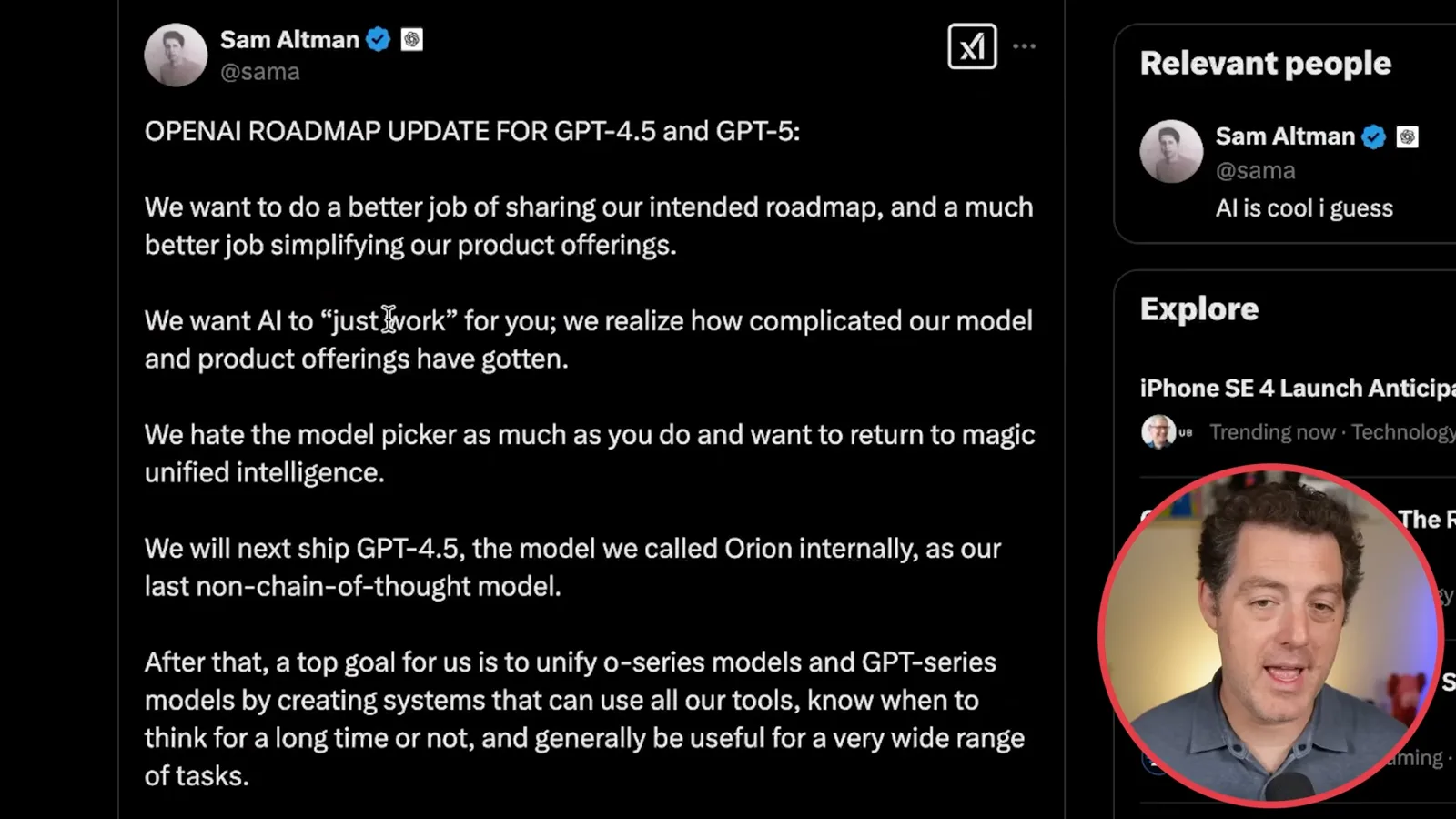
- 3The GPT-4.5 planAltman identified Orion as GPT-4.5 and outlined an intended move toward systems that combine model and tool capabilities.
- 4A roadmap that changedThe February plan said o3 would not be standalone, but OpenAI subsequently released it separately.
- 5Historical upload and limit updateOpenAI announced ChatGPT upload support and a higher o3-mini-high Plus limit; those details describe 2025.
Conclusiones
- Berman wants users to describe a task rather than select among many models and tools.
- He describes model routing and discloses a small investment in Not Diamond.
- Altman’s February 2025 plan proposed unifying GPT and o-series capabilities and integrating tools.
- The roadmap said o3 would not be standalone, but OpenAI released o3 separately in April 2025.
- Historical tier and usage-limit claims should not be read as current product terms.
Lee el texto editado por capítulos
Why simplify the model picker
Berman finds the number of models and separate tools confusing. He wants a single interface that interprets the request.
In February 2025, Sam Altman shared an intended roadmap for GPT-4.5 and GPT-5. I am especially pleased that OpenAI wants to simplify its products: in my Pro account the model picker contains GPT-4o, o1, o3-mini, high-reasoning variants and other options. That historical menu is only one part of a larger set of choices.
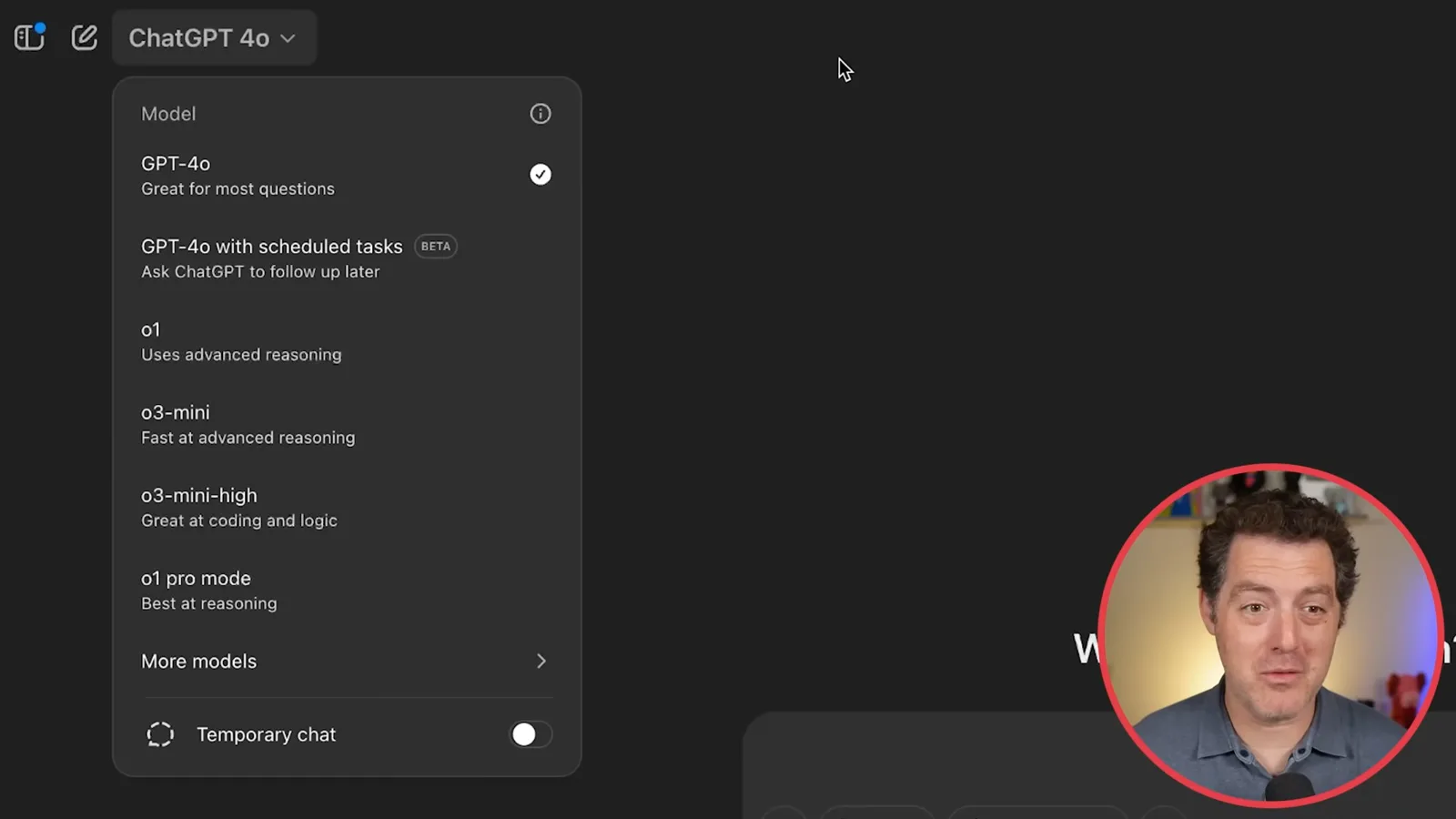
There are also separate products for Sora and Operator, and separate controls for web search and deep research. It is not obvious how those choices interact with a selected model. I would rather have one interface that understands the prompt and decides which capabilities are needed.
Routing models and tools
He explains how a router can choose models according to a task and optimization goals. He discloses his investment in Not Diamond.
Even if the industry ultimately uses many different models, ordinary users should not have to choose one for every prompt. A model router can direct a query to an appropriate model; for example, Not Diamond routes requests according to priorities such as price, speed or quality. I am a small investor in Not Diamond, which is important context for my interest in that example.
Imagine a system that identifies when a request needs current web data, a deeper research project or a browser task, then selects the appropriate tool. Altman's post acknowledges that OpenAI's offerings had become complicated and says the company wants a more unified experience. That was a goal at the time, not a guarantee that every tool would work automatically for every request.
GPT-4.5 and GPT-5 roadmap
Berman reviews Altman’s February 2025 plan for unified capabilities. The later standalone o3 release differed from that plan.
Altman said the next release would be GPT-4.5, internally called Orion, and described it as the company's last non-chain-of-thought model. He said a subsequent goal was to bring the GPT and o-series approaches together in systems that can use tools and decide when to spend longer reasoning.
I welcome that direction: a user should not need to decide separately whether a prompt needs extended reasoning, search, vision, voice, image generation or another tool. The experience can look like one assistant even if the underlying system has multiple components.
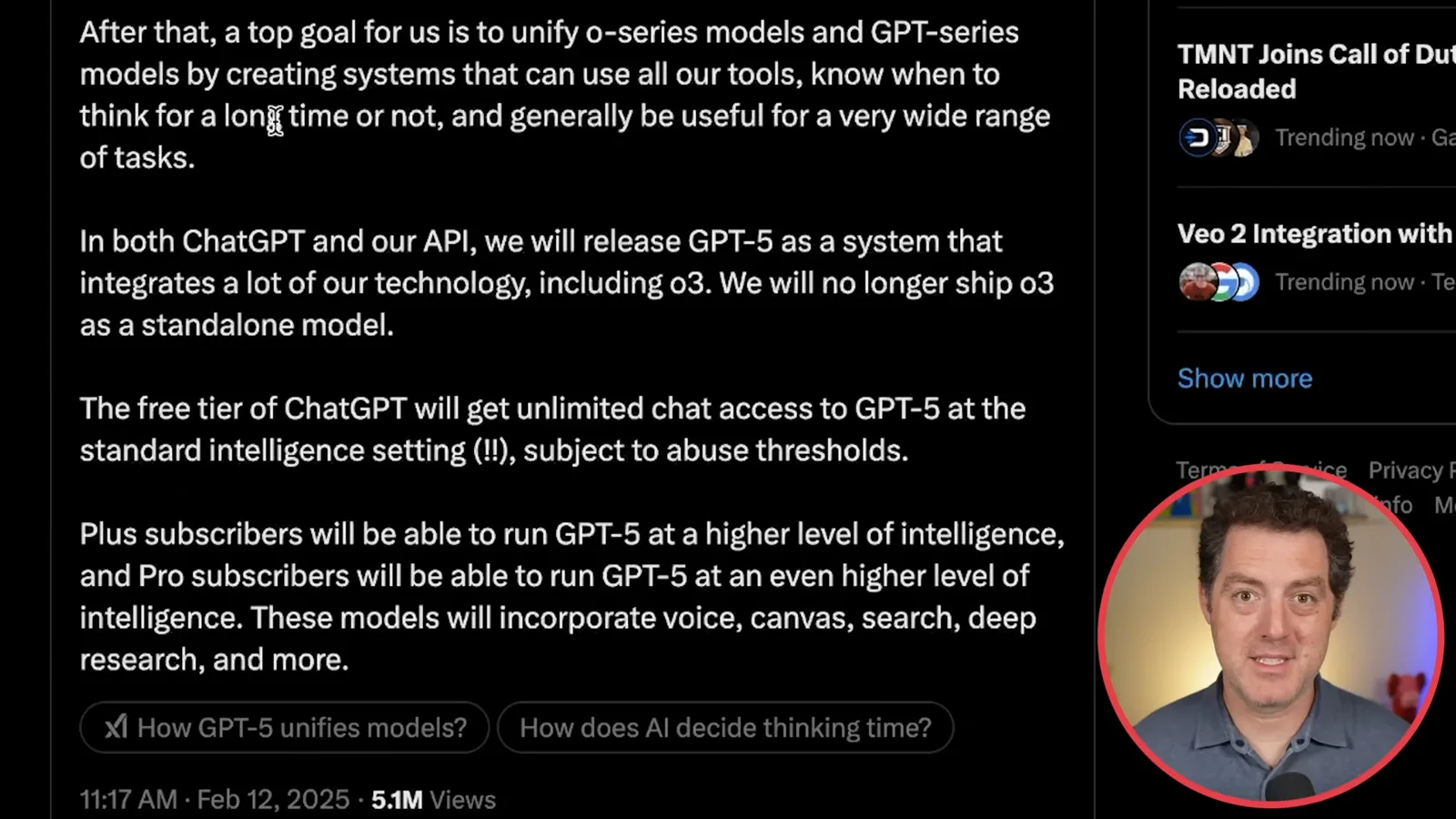
Altman's February roadmap said GPT-5 in ChatGPT and the API would integrate technologies including o3, and that o3 would not ship separately. Plans changed: OpenAI [released o3 separately in April 2025](https://openai.com/index/introducing-o3-and-o4-mini/), then [introduced GPT-5 in August](https://openai.com/index/introducing-gpt-5/) as a system with fast and deeper-reasoning models and a router. The video captures the earlier plan rather than current product availability.
Proposed tiers and product updates
He discusses proposed free, Plus and Pro access, while noting uncertainty around the roadmap. He closes with a historical upload and usage-limit announcement.
The roadmap also proposed unlimited free-tier GPT-5 chat at a standard intelligence setting, subject to abuse thresholds, with higher intelligence levels for Plus and Pro subscribers. I question why free users should have to think about settings and am unsure what those thresholds would mean. These were February 2025 plans, not a description of today's plan limits.
I compare the proposed tiers to buying a computer with a faster chip or more memory: the free tier would get the standard experience and paid tiers more capability. I suspect higher tiers might also get higher usage limits, but that is my inference. Altman listed voice, canvas, search and deep research among the intended capabilities.
Asked about timing, Altman answered 'weeks / months,' which I find imprecise. OpenAI also announced that o1 and o3-mini in ChatGPT supported file and image uploads and that the Plus limit for o3-mini-high had risen sevenfold to up to 50 per day. That announcement concerns the ChatGPT experience at the time; upload support alone does not establish native image input for every model or API configuration.
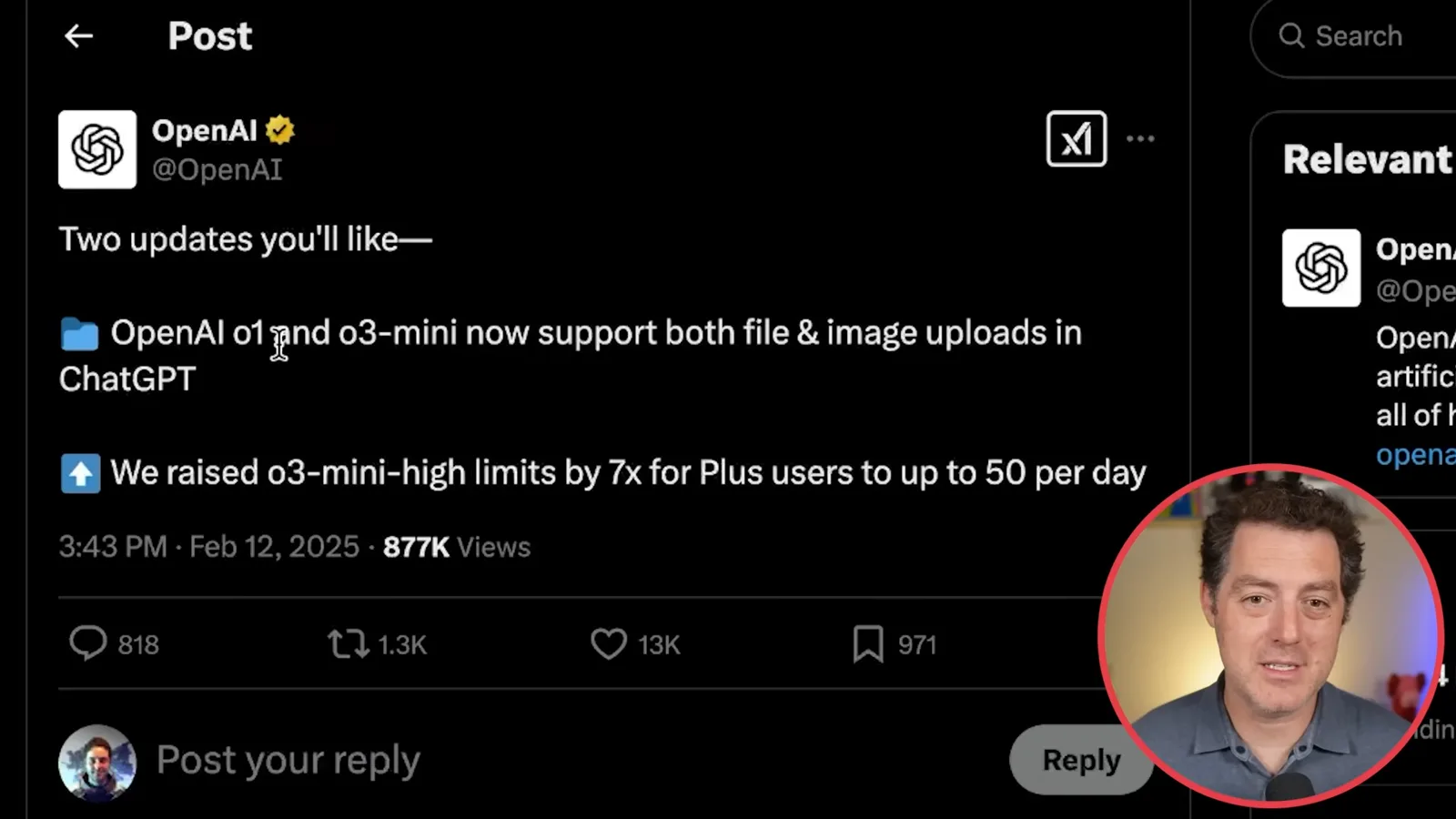
I welcome more access to reasoning and higher historical usage limits. A coherent experience across the web, mobile and desktop would make the product easier to use, though the specific model choices and limits described here have since changed.
Más de este canal
 34:21EN
 Matthew Berman· 27 oct 2026Matthew Berman Examines Anthropic’s IPO Filing, AI Growth and GovernanceMatthew Berman, Sam Altman · Forward FutureThe presenter reviews the S-1’s financial metrics, compute strategy and voting structure while questioning the tension between rapid AI development and safety.
 0:36ENMatthew Berman· 25 oct 2026Kimi K3.1 and a Rubik’s Cube Solver DemonstrationMatthew Berman · Forward FutureMatthew Berman shows a scrambled virtual cube being solved and gives the Kimi K3.1 test a favorable assessment.
 25:50ENMatthew Berman· 24 oct 2026Kimi K3.1 Pro Tested: Strong 3D Demos, Uneven Results and Competitive PricingMatthew Berman · Forward FutureMatthew Berman tests the open-weight model on coding, 3D rendering and visual explanations, then compares benchmark results and prices.
 32:20ENMatthew Berman· 23 oct 2026Who Is Local AI For? The Costs, Trade-offs and a Hybrid FutureMatthew Berman · Forward FutureMatthew Berman weighs data control and independence against hardware cost, setup complexity and inference speed.
 1:03:37ENMatthew Berman· 23 oct 2026Matthew Berman’s Team Tests Kimi K3.1 on Animation, Games, and ChartsMatthew Berman, Alex, Brian · Forward FutureA live team AMA turns into an informal test of Kimi K3.1, from personal-agent workflows to motion graphics, a browser game, and a benchmark chart.
 0:53ENMatthew Berman· 22 oct 2026Sam Altman on AI and the Discovery of New KnowledgeSam Altman · OpenAIAltman expects progress in mathematical discovery to extend to biology, materials and energy.