En 30 segundos
Matthew Berman discusses a March 2024 report that Microsoft and OpenAI were considering a data-center project that could cost up to $100 billion and include a supercomputer called Stargate. He connects the report to demand for AI chips, competition among model providers, electricity supply and the concentration of computing resources. The 2024 plan was reported by The Information, not a confirmed company announcement. In 2025 OpenAI announced a later Stargate venture with a different funding structure; its relationship to the earlier proposal is not established in the video. Berman’s market and infrastructure predictions are opinions, not established outcomes. OpenAI’s [January 2025 announcement](https://openai.com/index/announcing-the-stargate-project/) describes the later venture and its initial funders.
- 1Compute as a future commodityBerman discusses Sam Altman’s prediction that compute could become extremely valuable as AI use expands.
- 2Reported Stargate proposalThe Information reported a possible Microsoft–OpenAI project costing up to $100 billion and targeting 2028. Its estimates and timing were tentative.
- 3Chips and powerBerman argues that AI data centers need both computing hardware and electricity, and considers nuclear power as one possible future arrangement.
- 4Demand depends on priceIn an interview excerpt, Altman argues that cheaper compute would encourage more uses while expensive compute would be reserved for higher-value tasks.
- 5Infrastructure constraintsElon Musk predicts bottlenecks in electrical transformers and power supply; these are his forecasts, not verified outcomes.
- 6Competition for resourcesBerman points to Meta’s announced hardware plans and argues that computing capacity may also help companies attract researchers.
Conclusiones
- The $100 billion figure and 2028 target were tentative details from a 2024 media report, not a completed project or an official announcement.
- Berman separates potential AI value into chips, infrastructure, models and applications, arguing that chips were capturing much of the value in 2024.
- Sam Altman predicts demand for compute will vary with price and identifies energy, data centers and chip supply as constraints.
- Elon Musk predicts shortages of transformers and electricity, but the clip does not establish that these shortages would occur on his timeline.
- Co-locating data centers and nuclear power is a possible scenario discussed by Berman, not a verified plan or guarantee of security.
- Claims about model commoditization, investment returns and market concentration are the presenter’s analysis and predictions.
Lee el texto editado por capítulos
Why compute matters
Berman discusses reported chip-funding ambitions and Nvidia’s rise. He lays out his view of value across chips, infrastructure, models and applications.
Sam Altman has suggested that compute could become a currency of the future. I think the idea is worth considering if AI comes to play a larger role in the economy. In April 2024, I am examining a report about a proposed Microsoft–OpenAI data-center project called Stargate, and why its scale matters.
Reports have also described Altman exploring extremely ambitious funding for chip manufacturing, with figures as high as $7 trillion discussed. That is a reported fundraising ambition, not money known to have been raised. I interpret the focus on chips as a response to the cost and availability of the hardware needed to train and run models.
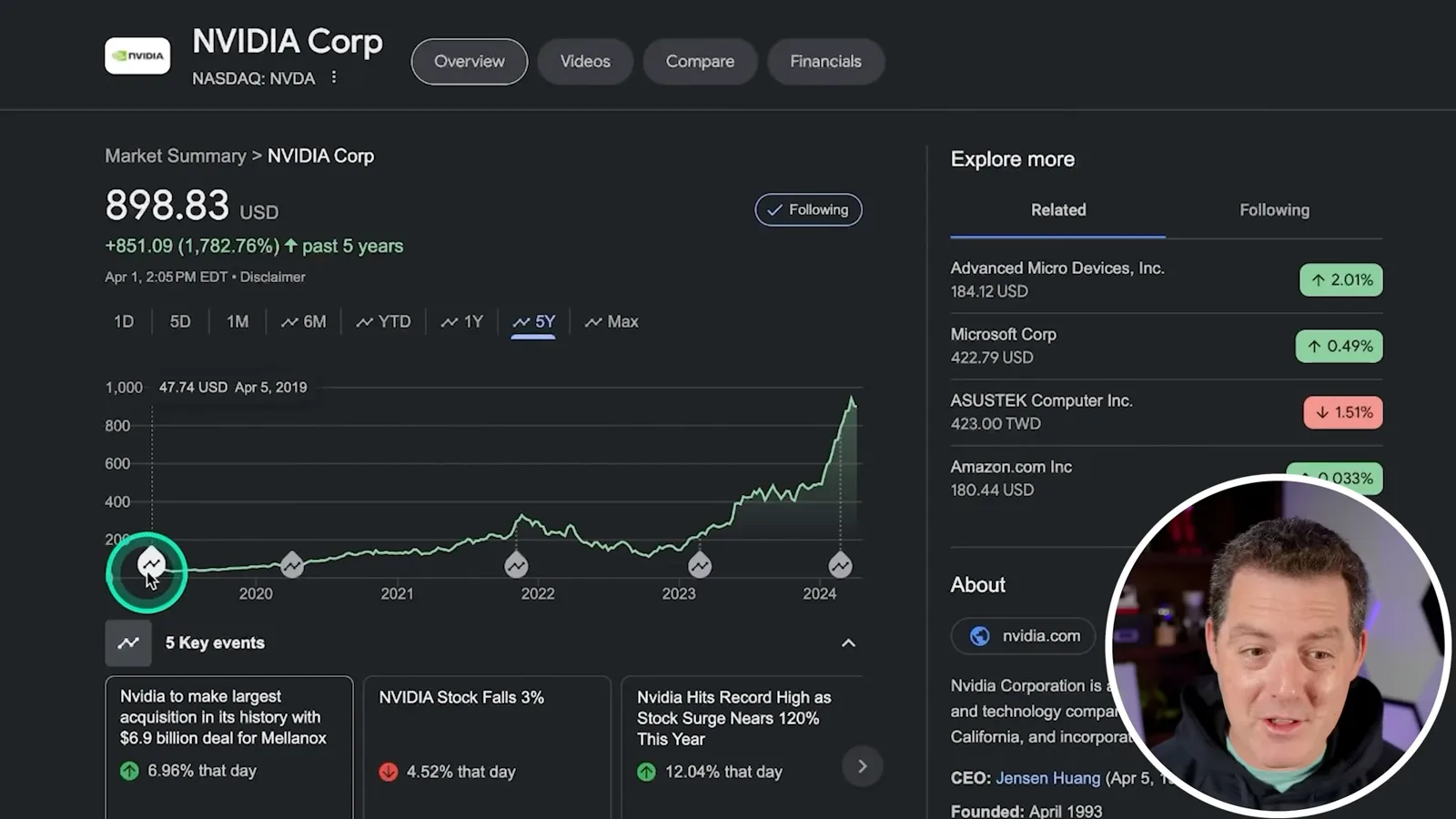
I look at Nvidia’s stock-price rise through early 2024 and attribute much of the excitement to demand for AI chips. Historical market prices and rankings change, and the growth has multiple drivers. My concern for model companies is that buying scarce infrastructure can pressure margins as competition increases.
I divide the AI industry into four broad layers: chips, infrastructure, models and applications. Chips are the processors; infrastructure includes monitoring and other developer tools; models supply capabilities; and applications put them in the hands of businesses and consumers. These categories overlap, but they help explain where I see value accumulating.
In my view, competition from open-weight and proprietary models may make the model layer more commoditized, while chips capture a lot of value. I point to the models available at the time as examples. That is my commercial interpretation, not proof that all models are interchangeable or that model providers cannot create lasting value.
The reported Stargate plan
He reviews a 2024 media report describing a tentative multi-phase Microsoft–OpenAI data-center proposal. The cost, financing and dates are reported estimates.
The Information [reported in March 2024](https://www.theinformation.com/articles/microsoft-and-openai-plot-100-billion-stargate-ai-supercomputer/) that Microsoft and OpenAI were considering a data-center project that could cost as much as $100 billion, including a supercomputer called Stargate with a possible 2028 launch. The report described preliminary estimates and private discussions; it was not a company announcement or a confirmed construction budget.
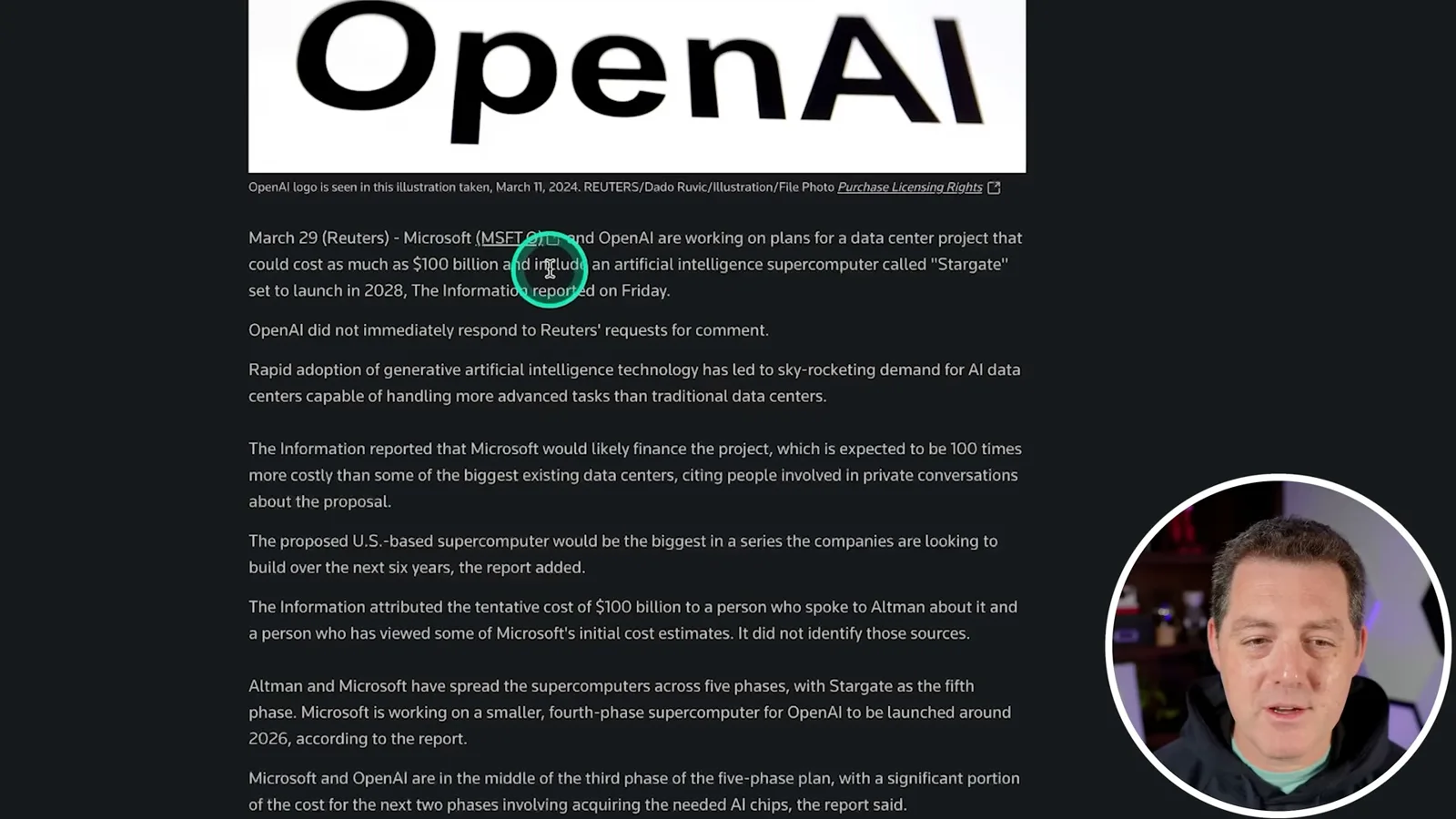
The report said Microsoft would likely finance the project and described Stargate as the fifth phase of a broader plan. A smaller fourth-phase system was reportedly targeted around 2026, with the companies then in phase three. These were reported intentions, not evidence that the systems or financing were finalized.
I see the proposal as part of an infrastructure race and think Microsoft is investing heavily to avoid missing the next technology wave. I also question the companies’ relationship and oversight. My statement in the video that Microsoft owned 49% of OpenAI should not be treated as a verified description of control or of their complex partnership.
Electricity and chip competition
Berman considers the power demands of AI infrastructure, possible nuclear power and competing chip architectures. His grid and security scenarios are speculative.
For AI infrastructure, I keep returning to two inputs: chips and electricity. I show an illustration of large data centers alongside nuclear power plants as one possible future arrangement. I speculate about grid pressure and security benefits from distributed facilities, but those outcomes depend on the site and grid; the illustration is not evidence of an approved project or a guarantee against attacks.
Nvidia was a major chip supplier in the market I am describing, but I also discuss potential competitors such as Groq and its inference-focused LPU architecture. My claim that GPUs cannot match its speed is a generalization: comparisons depend on the model, hardware, workload and measurement.
Altman and Musk on constraints
Interview clips present their views on compute demand, electrical equipment and power. Berman asks how individuals and companies might respond.
In an interview excerpt, Altman argues that compute demand is unlike a fixed market for replacement phones. At a lower price, he expects people to use more intelligence for tasks such as processing email as well as research; at a higher price, they might reserve it for fewer purposes. He identifies energy, data-center construction, supply chains and chip fabrication as challenges.
I connect that argument to the need for more energy capacity, then play an Elon Musk interview excerpt. Musk predicts that electrical step-down transformers will become a bottleneck after AI chips, followed by electricity shortages. His timeline is a forecast rather than a demonstrated result; electrical transformers and AI transformer models are different things despite sharing a name.
I ask how someone could respond if compute becomes more valuable. I mention investing in companies and wonder whether a personal GPU might appreciate, but I do not know the answer. These comments are speculation, not evidence of future returns.
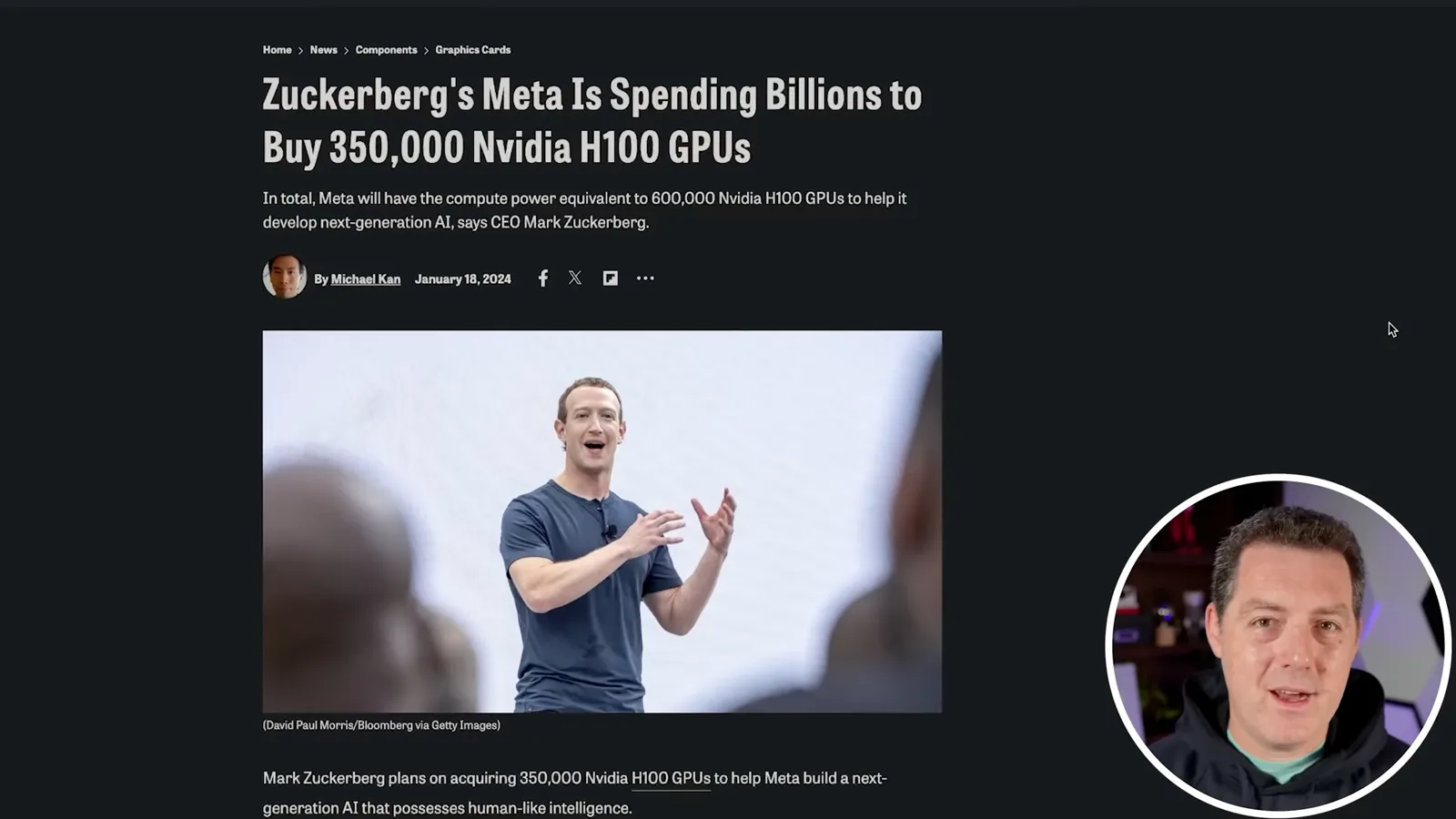
Other companies were also pursuing compute capacity. I point to Meta’s 2024 plan to acquire 350,000 Nvidia H100 GPUs and argue that access to powerful systems may help attract AI researchers as well as support model development. Planned purchases do not by themselves establish delivery or utilization.
The race for compute and talent
Berman discusses Meta’s hardware plans and Google’s chips. He concludes by questioning the economic effects of concentrated computing power.
Google also develops its own TPUs, and Groq founder Jonathan Ross previously worked on Google’s TPU effort. I end by worrying that a race among already large companies could concentrate economic power. The outcome is uncertain, but access to chips, energy and talent is central to the competition I see developing.
Más de este canal
 34:21EN
 Matthew Berman· 27 oct 2026Matthew Berman Examines Anthropic’s IPO Filing, AI Growth and GovernanceMatthew Berman, Sam Altman · Forward FutureThe presenter reviews the S-1’s financial metrics, compute strategy and voting structure while questioning the tension between rapid AI development and safety.
 0:36ENMatthew Berman· 25 oct 2026Kimi K3.1 and a Rubik’s Cube Solver DemonstrationMatthew Berman · Forward FutureMatthew Berman shows a scrambled virtual cube being solved and gives the Kimi K3.1 test a favorable assessment.
 25:50ENMatthew Berman· 24 oct 2026Kimi K3.1 Pro Tested: Strong 3D Demos, Uneven Results and Competitive PricingMatthew Berman · Forward FutureMatthew Berman tests the open-weight model on coding, 3D rendering and visual explanations, then compares benchmark results and prices.
 32:20ENMatthew Berman· 23 oct 2026Who Is Local AI For? The Costs, Trade-offs and a Hybrid FutureMatthew Berman · Forward FutureMatthew Berman weighs data control and independence against hardware cost, setup complexity and inference speed.
 1:03:37ENMatthew Berman· 23 oct 2026Matthew Berman’s Team Tests Kimi K3.1 on Animation, Games, and ChartsMatthew Berman, Alex, Brian · Forward FutureA live team AMA turns into an informal test of Kimi K3.1, from personal-agent workflows to motion graphics, a browser game, and a benchmark chart.
 0:53ENMatthew Berman· 22 oct 2026Sam Altman on AI and the Discovery of New KnowledgeSam Altman · OpenAIAltman expects progress in mathematical discovery to extend to biology, materials and energy.