En 30 segundos
Matthew Berman presents Fastino Labs’ Pioneer Agent, a closed-loop system for adapting small language models to particular tasks. He highlights the potential to reduce the work of fine-tuning and discloses that Fastino sponsored the video. The researchers report improvements on specific benchmarks and simulated production-style tasks; those results do not establish universal self-improvement, guaranteed deployment speed, or superiority over frontier models on every task.
- 1Small models and fine-tuningBerman explains that smaller models can be specialized, while the feasibility of local inference depends on hardware and model size.
- 2An automated loopPioneer Agent aims to diagnose failures, prepare data, train and evaluate models; it is an optimization system, not proof that AI can solve everything.
- 3Research resultsFastino’s paper reports gains on eight specified cold-start benchmarks and evaluates production-like scenarios using synthetic inference logs.
- 4Sponsored product claimsBerman discloses Fastino sponsorship and describes ease of deployment, fine-tuning and model access; the clip does not independently test these claims.
Conclusiones
- Pioneer Agent automates steps in adapting small language models, including evaluation, data preparation and retraining.
- The paper reports gains on particular cold-start benchmarks and a synthetic-log evaluation, not all tasks or real production environments.
- Cold-start experiments use a task description; the paper’s production-mode setup uses labeled failures.
- A specialized small model may be useful on a narrow task, but quality and cost comparisons depend on the task and configuration.
- Fastino sponsored the video, and its deployment and ease-of-use statements are product claims.
Lee el texto editado por capítulos
Pioneer Agent and the fine-tuning loop
Berman introduces small models and the proposed automated adaptation process. He points to benchmark results from Fastino’s paper.
Fastino Labs has published research on Pioneer Agent, a system intended to automate parts of fine-tuning small language models. I find the prospect of AI-assisted optimization exciting, especially because configuring and evaluating a model can be difficult. This is a specific adaptation workflow, not evidence that AI autonomously solves every problem.
Small language models can sometimes run on a laptop or phone, depending on their size and hardware. Some have downloadable weights and can be customized for a particular task. Availability of weights does not necessarily mean the full model, training data and software are unrestricted or open source.
Pioneer Agent is described as a closed loop that diagnoses areas for improvement, prepares training data, trains and checks the result. The [Fastino paper](https://arxiv.org/abs/2604.09791) distinguishes cold-start mode, beginning with a natural-language task description, from production mode, which uses a deployed model with labeled failures. It is not simply a guarantee that ordinary use automatically improves every model.
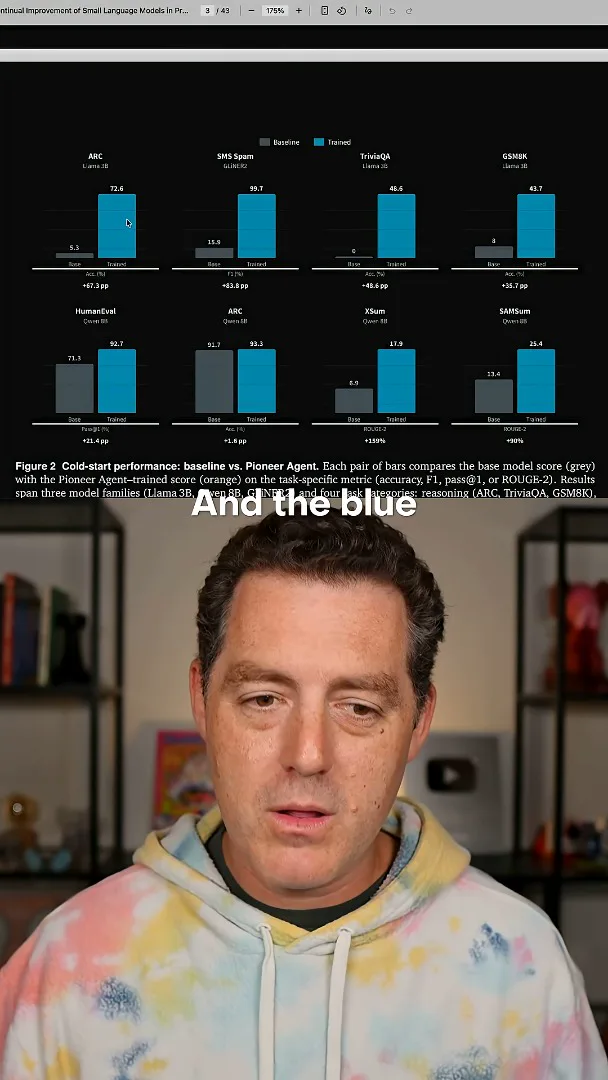
I show a chart comparing base and trained models. The researchers report gains of 1.6 to 83.8 points across eight specific cold-start benchmarks, with metrics differing by task. Their AdaptFT-Bench uses synthetic inference logs, and their two production-style evaluations are based on public benchmark tasks; the results do not establish performance in every real deployment.
A sponsored product overview
Berman discloses Fastino’s sponsorship and describes the Pioneer product. Its speed, cost and comparison claims are not independently tested in the video.
Fastino sponsored this video. I say Pioneer can make fine-tuning accessible without a user starting with labeled data and may help a small model perform well on a particular use case. The paper’s cold-start setting can begin with a description, but its production-mode evaluation uses labeled failures, and quality still depends on data, evaluation and task.
I also suggest that specialized models can sometimes outperform larger frontier models at lower cost, and describe deployment in under 30 seconds and access to models including Opus and GPT through Pioneer. Those are task-dependent or product claims; this short does not show a controlled frontier-model comparison, cost analysis or timed deployment.
Más de este canal
 34:21EN
 Matthew Berman· 27 oct 2026Matthew Berman Examines Anthropic’s IPO Filing, AI Growth and GovernanceMatthew Berman, Sam Altman · Forward FutureThe presenter reviews the S-1’s financial metrics, compute strategy and voting structure while questioning the tension between rapid AI development and safety.
 25:50ENMatthew Berman· 24 oct 2026Kimi K3.1 Pro Tested: Strong 3D Demos, Uneven Results and Competitive PricingMatthew Berman · Forward FutureMatthew Berman tests the open-weight model on coding, 3D rendering and visual explanations, then compares benchmark results and prices.
 32:20ENMatthew Berman· 23 oct 2026Who Is Local AI For? The Costs, Trade-offs and a Hybrid FutureMatthew Berman · Forward FutureMatthew Berman weighs data control and independence against hardware cost, setup complexity and inference speed.
 1:03:37ENMatthew Berman· 23 oct 2026Matthew Berman’s Team Tests Kimi K3.1 on Animation, Games, and ChartsMatthew Berman, Alex, Brian · Forward FutureA live team AMA turns into an informal test of Kimi K3.1, from personal-agent workflows to motion graphics, a browser game, and a benchmark chart.
 0:53ENMatthew Berman· 22 oct 2026Sam Altman on AI and the Discovery of New KnowledgeSam Altman · OpenAIAltman expects progress in mathematical discovery to extend to biology, materials and energy.
 0:22ENMatthew Berman· 21 oct 2026A Robot Bodyguard Video Shows Dramatic Rescue ScenariosMatthew Berman · Forward FutureMatthew Berman reacts to a short robot demonstration depicting fighting and vehicle-rescue scenarios.