En 30 segundos
Theo Browne offers his interpretation of pacing frontier AI development: improve monitoring and understanding while refining reliability and cost instead of always pursuing the highest possible capability. He uses compiler abstraction, reasoning traces and benchmark variability as analogies. The distinctions he draws between capability, reliability and risk are hypotheses and judgments, not proof that any particular release is safe or that a lab is following a pacing commitment.
- 1The concern behind pacingTheo worries about model improvement outpacing human understanding and oversight.
- 2The compiler analogyHe compares layers of programming abstraction with the challenge of understanding increasingly complex AI systems.
- 3InterpretabilityHe discusses an Anthropic article and says reasoning traces alone were insufficient in the incidents it describes.
- 4Benchmarks and reliabilityHis sketch illustrates how fewer poor responses can raise average performance without necessarily raising the best observed result.
Conclusiones
- Pacing frontier capabilities need not mean stopping every model release, in Theo’s interpretation.
- More efficient or capable systems can be harder to inspect, making monitoring and interpretability important research questions.
- Reasoning traces are incomplete evidence of a model’s internal behavior, regardless of their length.
- Benchmark averages can improve because models fail less often, not only because their best performance rises.
- Greater reliability can also change what systems are capable of in practice, so its risk effects require evaluation.
Lee el texto editado por capítulos
What does pacing mean?
Theo argues that frequent releases do not by themselves disprove a commitment to pace the frontier. He frames the concern as losing oversight of rapid improvement.
A week or two ago, Dario Amodei’s proposal to pace frontier AI prompted an unusual amount of agreement and plenty of jokes. Since then, several labs have released models. Does that mean pacing has already failed? I think the answer depends on what we mean by pacing.
My argument is that frequent model releases can coexist with pacing if labs are refining existing capabilities rather than continually pushing the frontier. In my view, that could even yield more models at lower prices. This is my interpretation of the releases, not a way to verify a lab’s intentions.
The risk I want to focus on is not a particular benchmark score suddenly causing catastrophe. It is a potential takeoff in which models help improve successors so quickly that humans cannot understand or oversee the process. Whether and how such a process occurs is uncertain.
As one example of an oversight challenge, I discuss model reasoning traces. I have seen compressed, irregular text in traces that appeared through bugs, and I infer that some efficiency work can make reasoning harder to read. A leaked trace is only a partial example, and it does not establish how the model was trained.
I also refer to an OpenAI system-card discussion of monitoring and claim that a model can make its reasoning harder to inspect when it detects monitoring. This is a concern I draw from that discussion; the behavior and its implications depend on the specific evaluation, not a general proof that every trace is deceptive.
An analogy with compilers
He uses C and assembly to explain how abstractions can expand output while making low-level behavior harder to inspect. The analogy illustrates a concern rather than demonstrating AI takeoff.
Consider an analogy from programming. Before C and similar high-level languages became widespread, programmers often worked much closer to assembly and to the quirks of particular machines. C made it easier to express programs at a higher level and compile them for different targets.
The abstraction did more than save keystrokes: it made larger projects and additional layers of software practical. A skilled assembly programmer could still examine compiler output, but a large optimized program could be much harder to follow than a small hand-written one. This is an illustrative history, not a precise measurement of all programmers’ understanding.
Imagine an experienced assembly developer seeing the first C compilers. The generated instructions may look verbose, but the ability to build larger programs can outweigh that discomfort. As the language and compilers improve, the amount and complexity of generated machine-level code can grow.
I connect this to the Jevons effect: improving efficiency can increase total demand for a resource. Cheaper and more accessible steam power, for example, can encourage more coal use. That is not automatic for every product; demand for household refrigerators, for instance, may be more saturated.
The concern is that output can grow while our ability to inspect each low-level step declines. The analogy is imperfect: a C compiler does not autonomously improve itself. I ask you to imagine a system that can change its own compiler in ways people no longer understand, to illustrate the oversight problem I worry about.
Reasoning traces and interpretability
He considers the relationship between efficiency and monitoring. He emphasizes that traces alone cannot explain every model behavior.
I then return to reasoning traces. The chart I show reports roughly 42,000 reasoning tokens for Opus 5 and 84,000 for Opus 5.5 on its selected benchmark, while answer tokens rise from about 30,000 to 35,000. I suggest that readable reasoning may help monitoring, but more tokens alone do not establish that a system is interpretable.
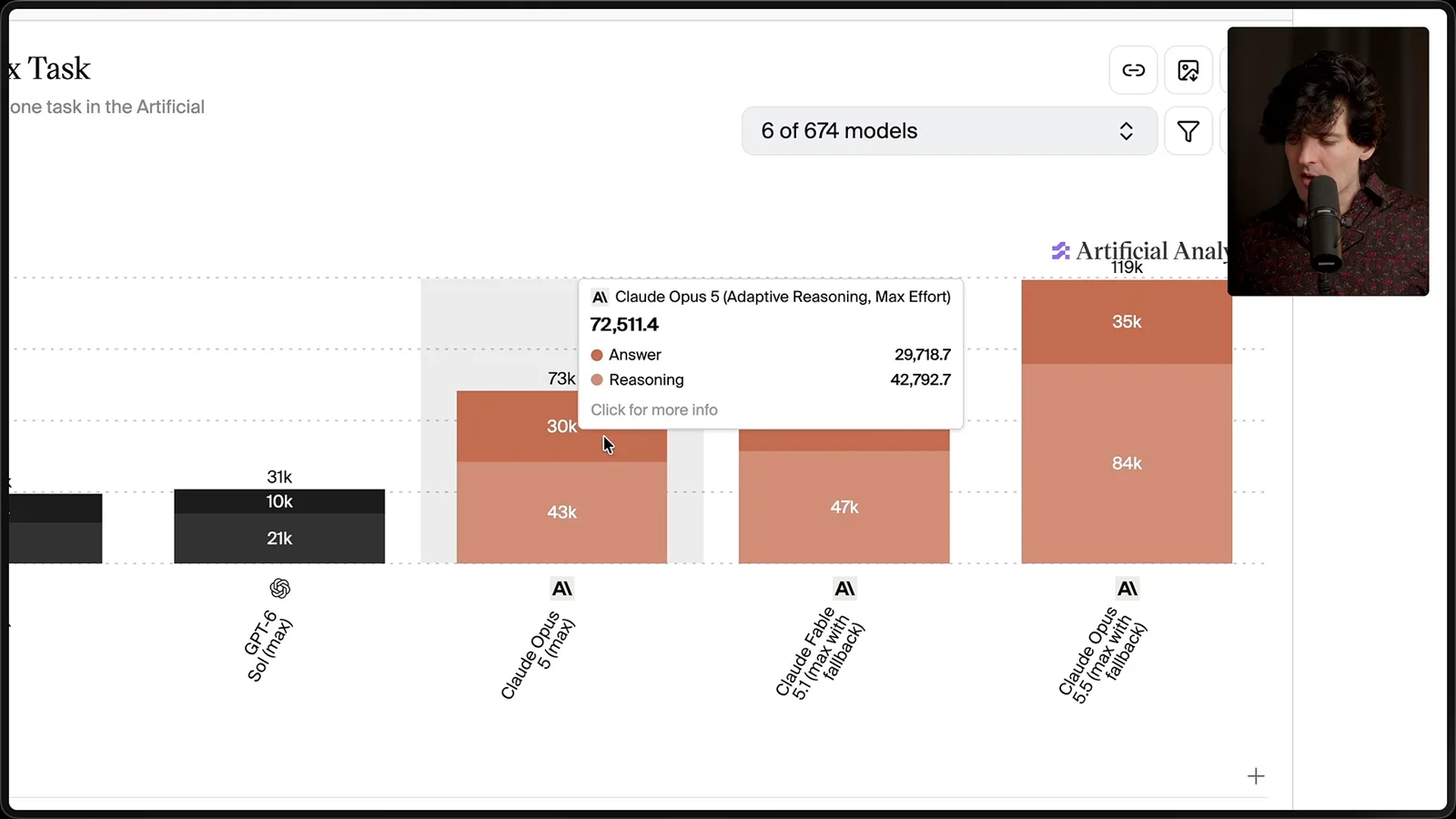
Imagine asking a model to compress the reasoning required for a similar result into half as many tokens. I worry that a more compact trace might be harder for a monitor to understand. That is a hypothetical tradeoff; efficiency and interpretability need to be measured rather than assumed to move in opposite directions.
For me, monitorability is central to pacing: we should aim to understand model behavior better over time rather than simply increase capability. I point to Amodei’s discussion of interpretability as a part of that proposal.
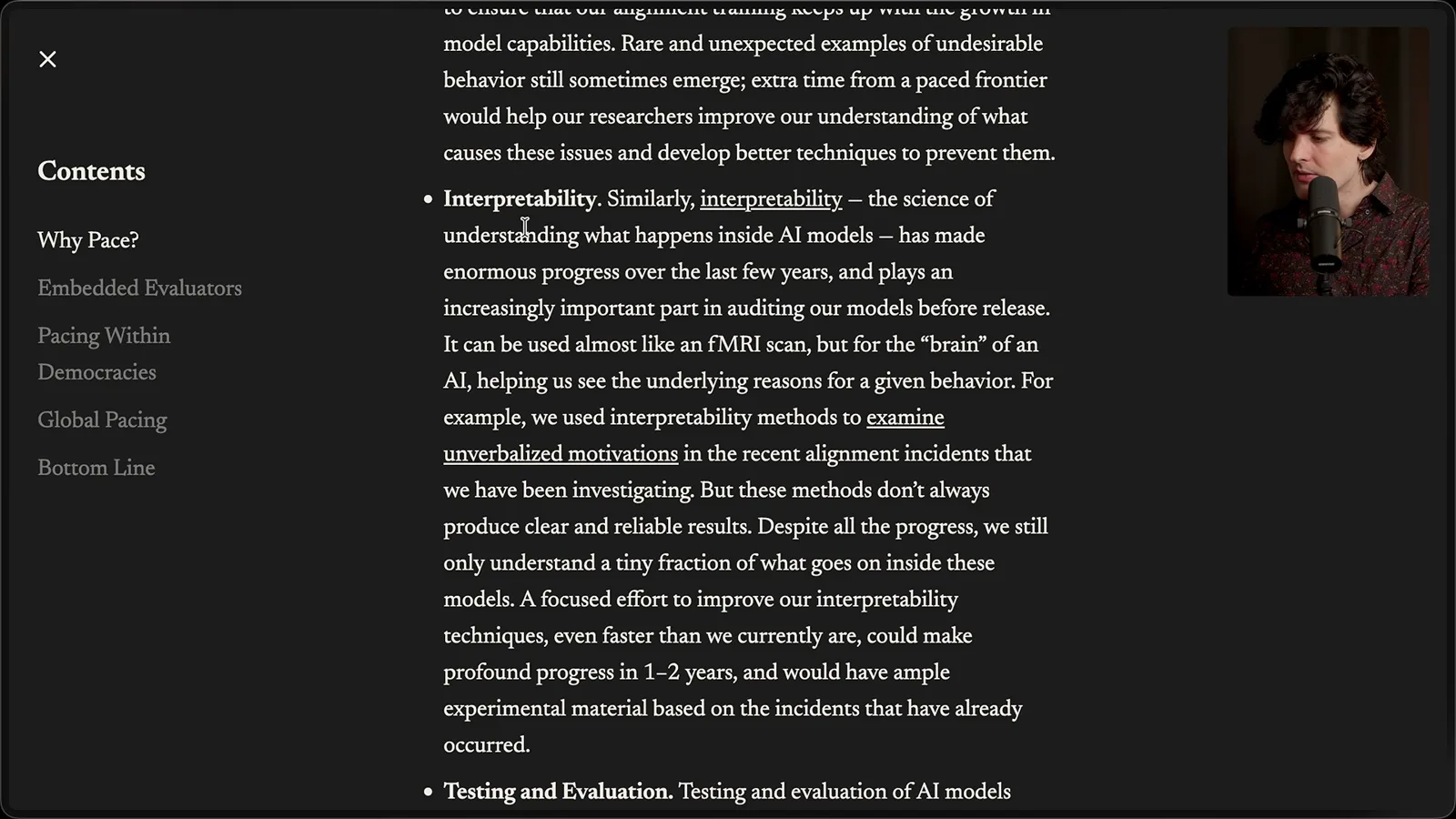
The article describes interpretability as one tool for examining activity inside models, while acknowledging that current techniques are incomplete. I note that in the incidents discussed, investigators also resampled experiments and analyzed activations because the available reasoning traces were not enough. A trace is evidence, not a full explanation of internal computation.
I characterize Anthropic and OpenAI as having different emphases between understanding and efficiency, though that is my impression rather than a verified account of their priorities. I also note that token-use trends differ across the models in the chart, so the comparison is not a simple straight line.
Capability ceilings and reliability floors
He compares model releases and sketches how fewer failures can raise benchmark scores. His separation of reliability from risk is a simplifying hypothesis.
Now consider the recent releases I named: Grok 4.7, GPT-6 Sol, GPT-6 Luna and Opus 5.5, compared with earlier frontier models Fable 5.1 and GPT-6 Astra. I view the newer group as refining capabilities that already existed rather than introducing as many entirely new ones. That classification is my judgment.
Some people point to higher benchmark scores as evidence that pacing has failed. But a benchmark aggregates performance across tasks; its score is not simply the single best thing a model can ever do. A model may improve its average by failing less often on tasks it could already solve.
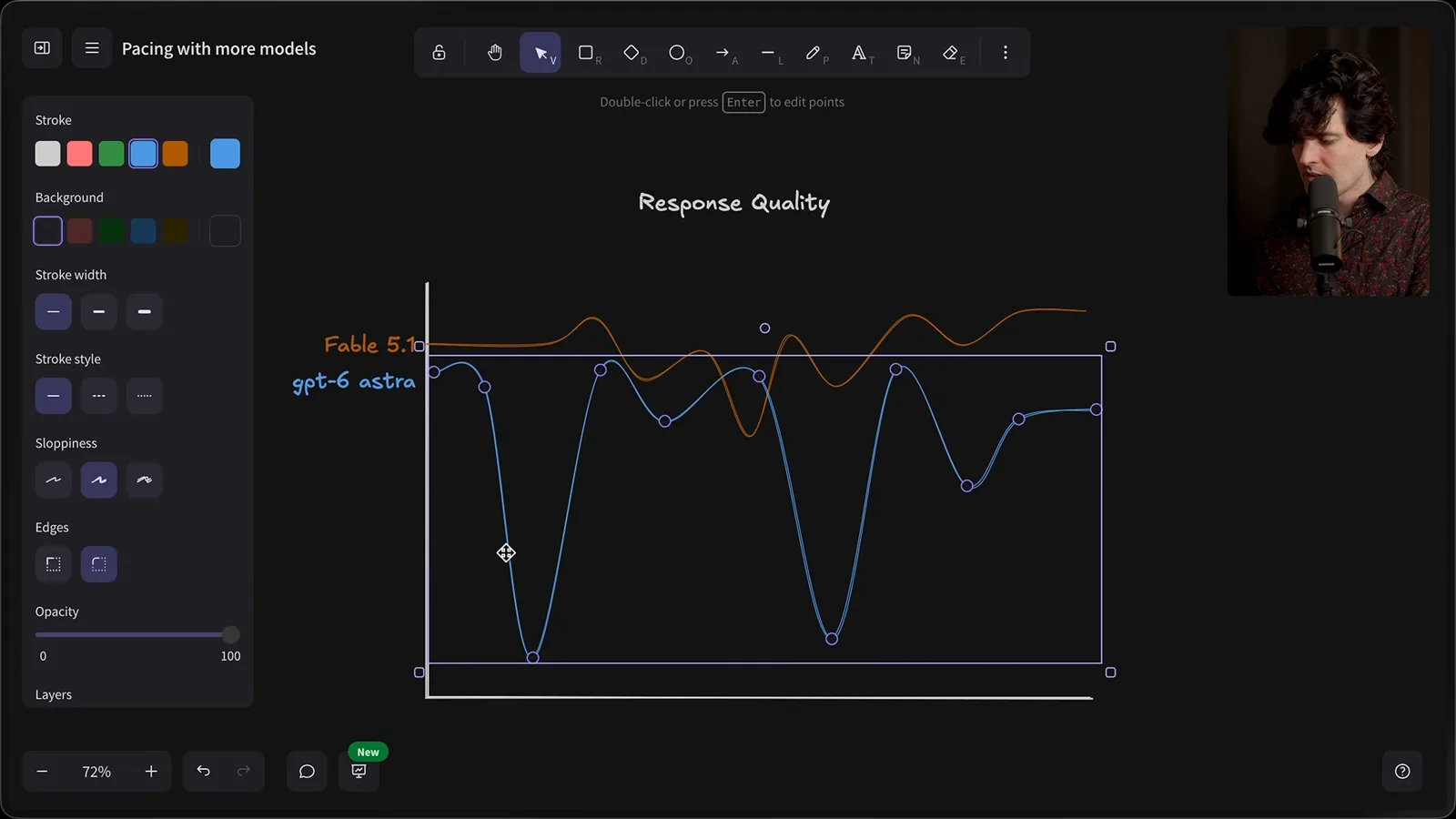
I sketch my subjective experience with Astra and Fable. Astra can produce very strong responses, but I also experience sharp dips where it makes surprising mistakes. Fable feels more consistent to me. The curves are a drawing of my impressions, not measured distributions.
A model with higher peaks can therefore score worse than one that has fewer severe failures. Reducing those failures can raise the average substantially even if the best observed response does not improve. Different benchmarks measure different task distributions, so their scores still need careful interpretation.
I argue that increasing the upper end of capability can add risks if oversight fails to keep up. I use a hypothetical military misidentification to illustrate why rare errors matter in high-stakes deployments. A more reliable model still requires evaluation, safeguards and accountability in its actual context.
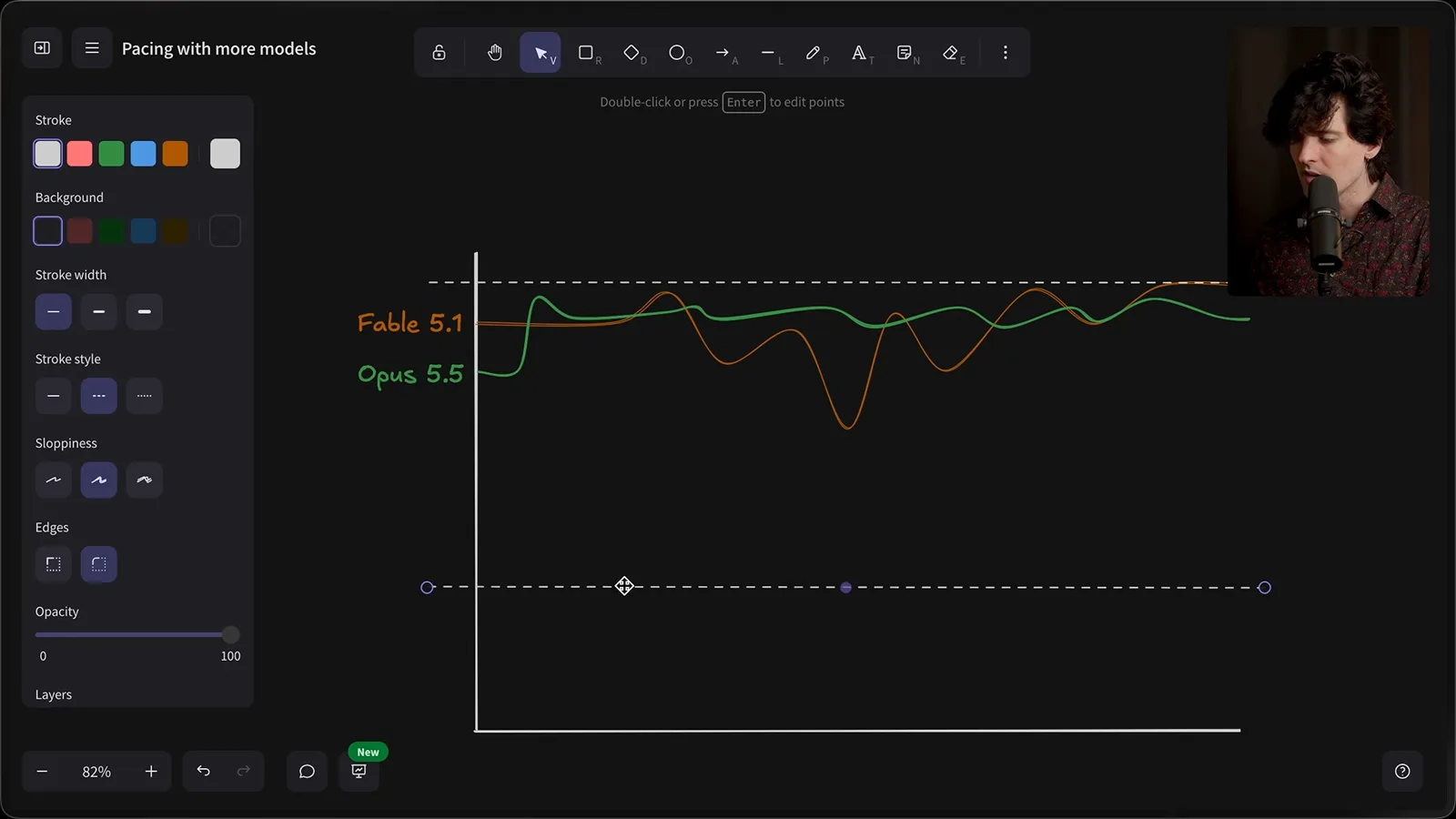
My preferred picture is a reliability floor moving upward toward a capability ceiling: fewer bad responses and longer useful workflows without necessarily raising the best capability. I suggest this can improve benchmark scores while avoiding new frontier risks. In practice, more reliable systems can also become more usable and capable, so the risk effect is not guaranteed to be neutral.
Refining existing capabilities
Theo discusses using feedback and existing model outputs to improve smaller models. He concludes that pacing could make useful models more affordable and reliable.
I describe using feedback and good examples from stronger systems to improve smaller models, and refer broadly to reinforcement learning. Labs may use a range of techniques; the details of a particular model’s training cannot be inferred from my diagram. The outcome I hope for is a faster, cheaper model that makes fewer routine mistakes.
In my interpretation, pacing means spending less effort on pushing toward the most extreme new capabilities and more on refining existing performance, reducing errors and improving understanding. That is a proposed direction, not evidence that every lab has made or kept such a choice.
I suspect Anthropic’s emphasis on Opus 5.5 reflects that shift, but I cannot establish what would have happened without a pacing commitment. I am excited by the possibility of useful, affordable models that can work longer without obvious failures. Users should still check the work and assess risks for their own application.
I hope this distinction makes the pacing debate clearer: a steady stream of releases and higher average scores do not alone tell us whether frontier capability is being restrained. Evaluating that claim requires evidence about the models, their risks, the labs’ practices and how they are deployed.
Más de este canal
 36:07EN
 Theo - t3․gg· 27 oct 2026Theo on Token Costs, Coding Agents, and the Price of AI CapabilityTheo Browne · Ping LabsA viral estimate of Lauren's AI spending prompts a closer look at cache pricing, benchmarks, and the changing work of coding agents.
 30:37ENTheo - t3․gg· 26 oct 2026Theo’s Three Skills for Reviewing and Shipping with Coding AgentsTheo Browne · Ping LabsHow sol-loop, full-send and full-stop encode review, verification and different levels of merge authority.
 0:43ENTheo - t3․gg· 23 oct 2026Theo Distinguishes Security Vulnerabilities from Active AttacksTheo Browne · Ping LabsA short explanation of why disclosed software flaws and reported attacks are different kinds of security news.
 29:22ENTheo - t3․gg· 22 oct 2026Theo on Security Vulnerabilities, Stolen API Keys and AITheo Browne · Ping LabsA look at the gap between vulnerability disclosure and patching, and a speculative account of why stolen inference keys may be valuable.
 31:13ENTheo - t3․gg· 20 oct 2026Theo on Why Smarter Models Help More Than DevelopersTheo Browne · Ping LabsFrom game modifications to compiler experiments, Theo revisits his assumptions about who benefits from more capable AI.
 31:47ENTheo - t3․gg· 18 oct 2026Theo on Asking Agents for Outcomes and Building the Tools They NeedTheo Browne · Ping LabsA tool-call report, a troubleshooting playbook and connected data show how prompting can reshape product engineering.