En 30 segundos
Matthew Berman sketches his personal OpenClaw setup after weeks of experimentation. He describes using multiple AI models, personal and business information, and a shared database approach across several skills. The short video provides an overview rather than an installation guide or independent evaluation of the system.
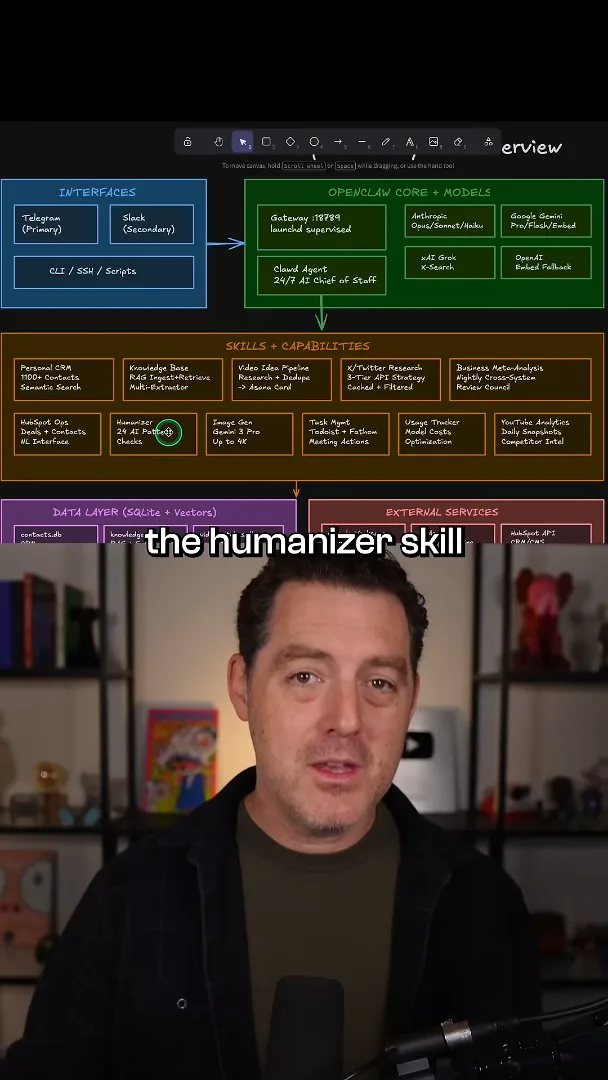
- 1System overviewBerman shows a diagram of the system, including interfaces, models, skills, data and external services.
- 2Multiple modelsHis setup includes Anthropic’s Opus, Sonnet and Haiku, as well as Google Gemini.
- 3Personal and business workflowsHe lists a personal CRM, knowledge base, video idea pipeline, social research and business analysis.
- 4Output style and shared dataBerman uses a Humanizer skill for natural-sounding text and a standardized hybrid database approach across skills.
Conclusiones
- Berman connects his OpenClaw system to personal information and several research workflows.
- His setup uses Anthropic’s Opus, Sonnet and Haiku models alongside Google Gemini.
- He uses a Humanizer skill to shape output style and a standardized hybrid database approach across skills.
Lee el texto editado por capítulos
An OpenClaw system overview
Berman introduces his personal setup and a diagram of its components. He lists the models and workflows he uses.
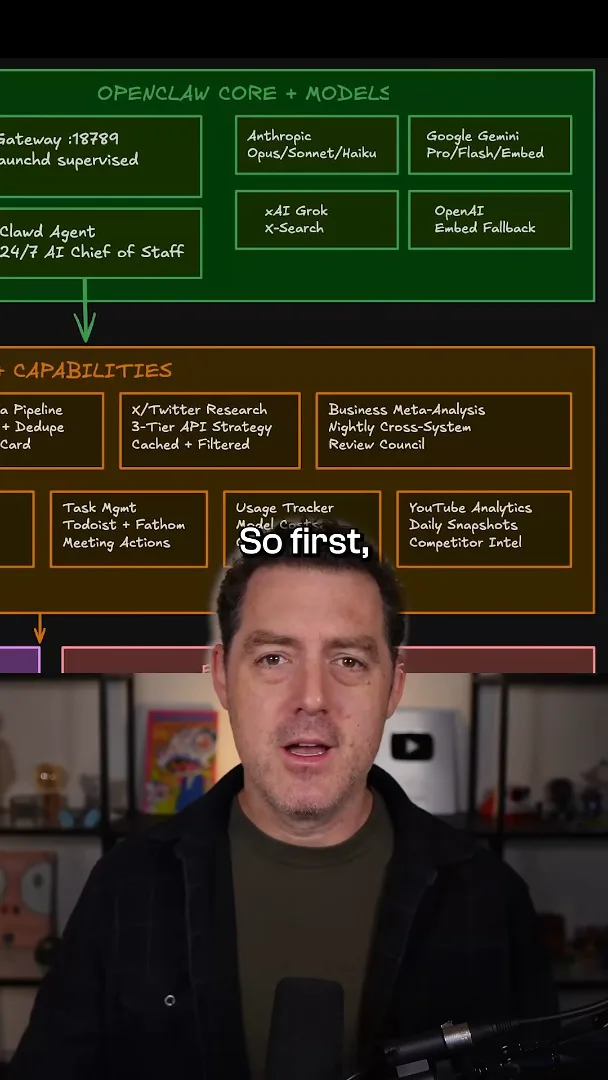
I have put a great deal of my life on this machine and spent countless hours over the last few weeks exploring what I can do with OpenClaw. Here is a high-level overview of my setup. It looks complicated, but the diagram brings together how I talk to the system and the information and workflows connected to it.
The system includes my knowledge base, food journal, scheduled cron updates, and video research. I use several models: Anthropic’s Opus, Sonnet, and Haiku, plus Google Gemini for a range of tasks. The diagram also shows interfaces, other model services, skills, a data layer, and external services.
I use OpenClaw as a personal CRM and knowledge base, as well as for a video idea pipeline, X/Twitter research, and business meta-analysis. I apply a Humanizer skill to make generated text sound more human, with no em dashes. I have also standardized a way to create a hybrid database and use it across several skills.
Writing style and shared database
He describes a Humanizer skill for output style. He also mentions a standard hybrid database approach used across skills.
Más de este canal
 34:21EN
 Matthew Berman· 27 oct 2026Matthew Berman Examines Anthropic’s IPO Filing, AI Growth and GovernanceMatthew Berman, Sam Altman · Forward FutureThe presenter reviews the S-1’s financial metrics, compute strategy and voting structure while questioning the tension between rapid AI development and safety.
 0:26ENMatthew Berman· 25 oct 2026Sam Altman on Human Values and Problem-Solving in an AI WorldSam Altman · OpenAIIn a short interview excerpt, Altman considers the enjoyment of solving hard problems and the human role in interpreting results.
 0:36ENMatthew Berman· 25 oct 2026Kimi K3.1 and a Rubik’s Cube Solver DemonstrationMatthew Berman · Forward FutureMatthew Berman shows a scrambled virtual cube being solved and gives the Kimi K3.1 test a favorable assessment.
 0:21ENMatthew Berman· 24 oct 2026An AI-Generated Kimi Benchmark Chart Used Invented ScoresMatthew Berman · Forward FutureMatthew Berman asks for a graph of Kimi K3.1 Pro benchmarks, then discovers that the displayed figures are illustrative placeholders.
 25:50ENMatthew Berman· 24 oct 2026Kimi K3.1 Pro Tested: Strong 3D Demos, Uneven Results and Competitive PricingMatthew Berman · Forward FutureMatthew Berman tests the open-weight model on coding, 3D rendering and visual explanations, then compares benchmark results and prices.
 32:20ENMatthew Berman· 23 oct 2026Who Is Local AI For? The Costs, Trade-offs and a Hybrid FutureMatthew Berman · Forward FutureMatthew Berman weighs data control and independence against hardware cost, setup complexity and inference speed.