En 30 segundos
In an October 2024 roundup sponsored by Mammouth, Matthew Berman discusses Swarm, NVIDIA hardware and models, nuclear energy, Adobe Firefly, World, robotics and other releases. The article distinguishes vendor claims, reports and forecasts from verified results, and corrects the descriptions of Power-over-Skin and US nuclear power.
- 1Experimental agent orchestrationSwarm demonstrates agent handoffs but its repository warns that it is unsupported and not intended for production.
- 2Blackwell systemsBerman discusses DGX B200 specifications and workload-specific speed claims.
- 3World identityThe Orb is intended to support proof of human identity; its data handling involves more than a simple blockchain description.
- 4New model comparisonsZamba2 and Ministral claims are tied to particular vendor tests and model terms.
- 5Power transferred over skinThe research relies on a powered transmitter; it does not draw its energy from the body itself.
- 6NotebookLM and WindowsThe roundup closes with historical Audio Overview and ChatGPT app rollout news.
Conclusiones
- OpenAI described Swarm as an experimental educational framework rather than a supported production system.
- Hardware and model benchmark comparisons apply to their specified workloads and configurations.
- World’s biometric and identity system cannot be reduced to a simple claim that iris data is stored on a blockchain.
- Power-over-Skin transfers power from a worn transmitter rather than generating it from the body.
- Product access, prices, forecasts and financial reports reflect October 2024.
Lee el texto editado por capítulos
Swarm and NVIDIA
Berman discusses OpenAI’s experimental agent framework, DGX B200 and Nemotron. Benchmark and hardware comparisons have specific conditions.
From New York, where IBM invited me to see its AI technology, I review a batch of announcements from October 2024. The video is sponsored by Mammouth. Product availability, prices and forecasts below describe that period rather than current offerings.
OpenAI has released Swarm, an open-source experimental framework for exploring multi-agent orchestration. Its repository describes it as educational, unsupported and not intended for production. I see it as another example of a platform provider moving into tools that developers might otherwise build themselves.
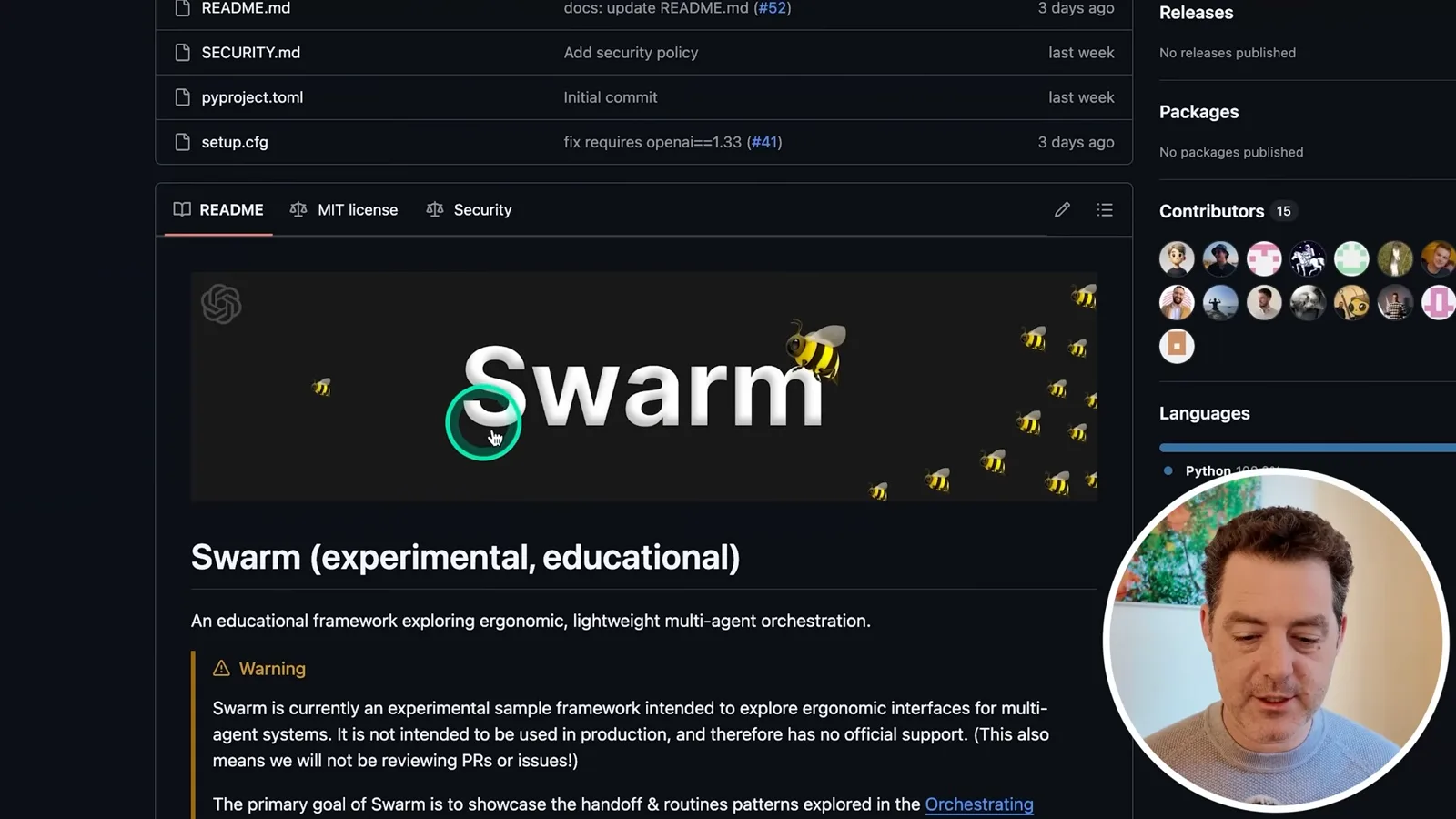
Swarm explores lightweight, customizable handoffs between agents. Unlike a hosted assistant service with built-in memory and retrieval, it runs mostly on the client and does not maintain state between calls. A weather example routes a request from a triage agent to a weather agent, which calls a tool and returns the result. Whether other models work depends on the integration; I have not tested that claim.
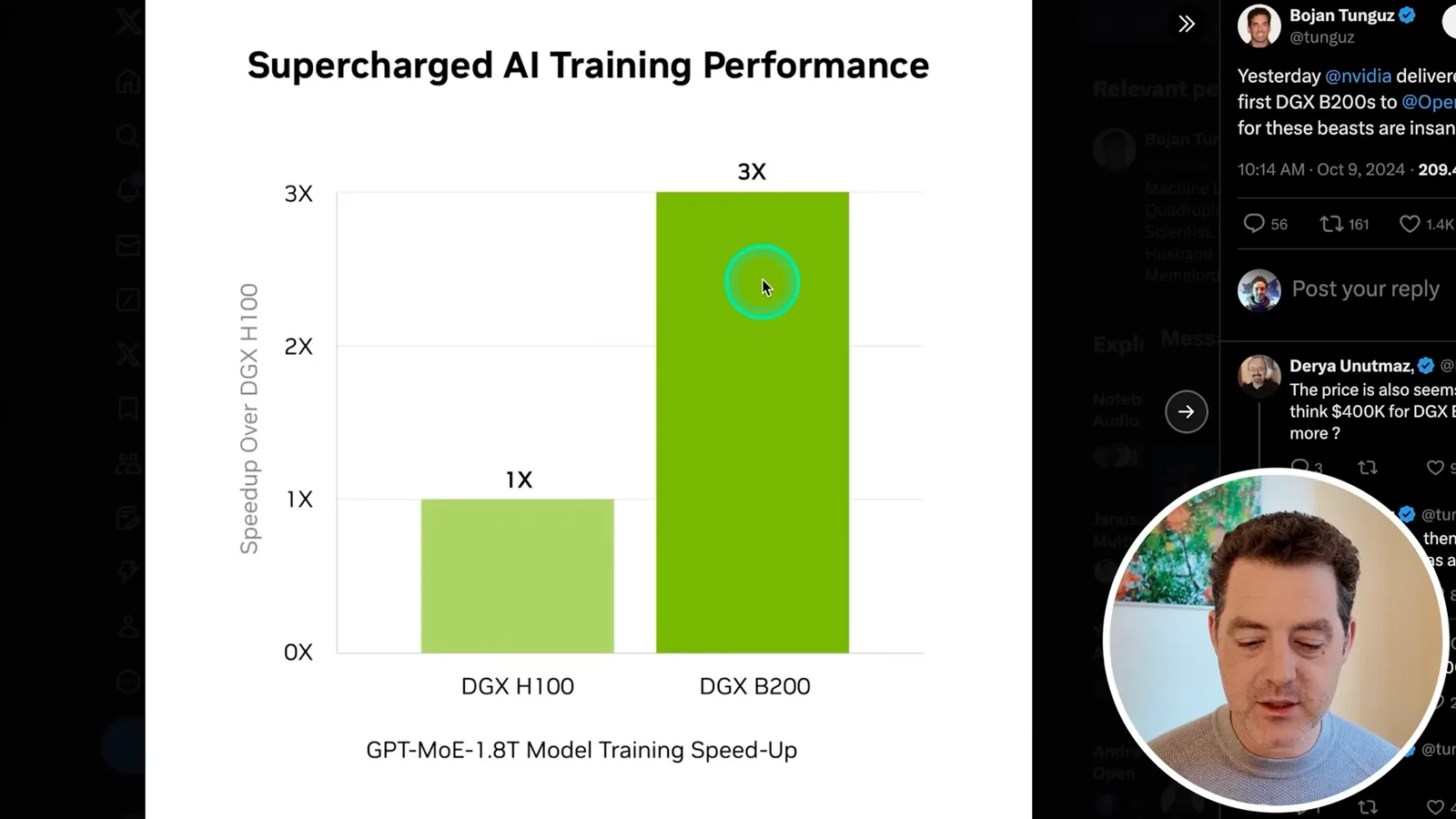
NVIDIA delivered an early DGX B200 system to OpenAI. I discuss a reported price around $400,000 and a system containing eight Blackwell GPUs, 1,440 GB of GPU memory, two Xeon CPUs and 4 TB of system memory. The displayed 3× training comparison is for a specified GPT-MoE workload against DGX H100; the cited 15× inference figure likewise depends on conditions, not every task.
NVIDIA also released Llama-3.1-Nemotron-70B-Instruct, a fine-tuned model. I have seen favorable benchmark claims and plan to test it myself. Reported comparisons against GPT-4o and Claude 3.5 Sonnet concern particular benchmarks and configurations, not a universal ranking.
Energy, media and identity
He covers Google’s nuclear agreement, Adobe Firefly and World’s identity system. Several claims require careful distinctions about safety and data handling.
Google announced an agreement to purchase power from Kairos Power’s planned small modular reactors to support energy demand, including AI. I favor nuclear investment but acknowledge I am not an expert. My claim that the US shut down all its nuclear plants after past accidents is incorrect: US nuclear plants continued operating.
Adobe announced Firefly video generation supporting text-to-video and image-to-video. Adobe described the model as designed for commercial safety based on its training-data approach; that is a company claim, not a guarantee about every output or legal use. I also mention Photoshop’s Generative Fill, which edits a selected area based on a prompt.
Worldcoin rebranded as World and introduced updates to its identity ecosystem. Its Orb scans a person’s iris as part of a proof-of-human system intended to help distinguish unique people from automated accounts. I say I recently interviewed founding member Saturnin Pugnet and discuss the project’s ambitions and potential uses.
My description that iris information is simply stored on a blockchain is incomplete. World announced personal custody in 2024 for data generated at the Orb, while its verification system uses additional cryptographic mechanisms. How biometric information is processed and protected is a separate question from whether a person can present a proof of human identity.
Models, startups and robotics
The roundup continues with video models, Sierra, OpenAI finances, Anduril and SpaceX. Berman also discusses a Microsoft researcher’s move.
Pyramid Flow SD3 is another video-generation release with publicly available material on Hugging Face. I welcome an alternative to announced systems that were not yet widely available. Its model, code and use terms should be checked separately rather than assuming every component has the same unrestricted license.
Sierra, co-founded by former Salesforce co-CEO Bret Taylor, was reportedly raising funding at a valuation above $4 billion. It sells customer-service agents, including voice applications. The valuation and financing details are reported negotiations from that time, not a verified final deal in this video.
A report projected OpenAI losses rising to $14 billion in 2026. I interpret the figure in light of investment in staff, models, partnerships and data, but it was a forecast rather than a realized result. My prediction that the company could keep raising money is an opinion, not a financial guarantee.
Anduril introduced Bolt, a family of portable autonomous aircraft with reconnaissance and munition variants. The company describes Bolt-M as a precision system in which an operator makes engagement decisions. I find the technology interesting; the clip is a product announcement, not independent evidence of its operational performance.
SpaceX demonstrated a Super Heavy booster catch using the launch tower’s arms. I discuss the potential for faster reuse, but my suggestion of refueling and relaunching within hours is an aspiration, not a turnaround demonstrated by that flight. Earlier expendable boosters also do not describe every previous SpaceX landing.
Microsoft researcher Sébastien Bubeck reportedly left for OpenAI, illustrating the movement of talent between close partners that also compete. My statement that Microsoft owned about half of OpenAI is not substantiated by the video and should not be treated as a verified ownership figure.
Edge models and product updates
Berman reviews Zamba2, SearchGPT, Ministral and Optimus. He ends with Power-over-Skin, NotebookLM and the Windows app.
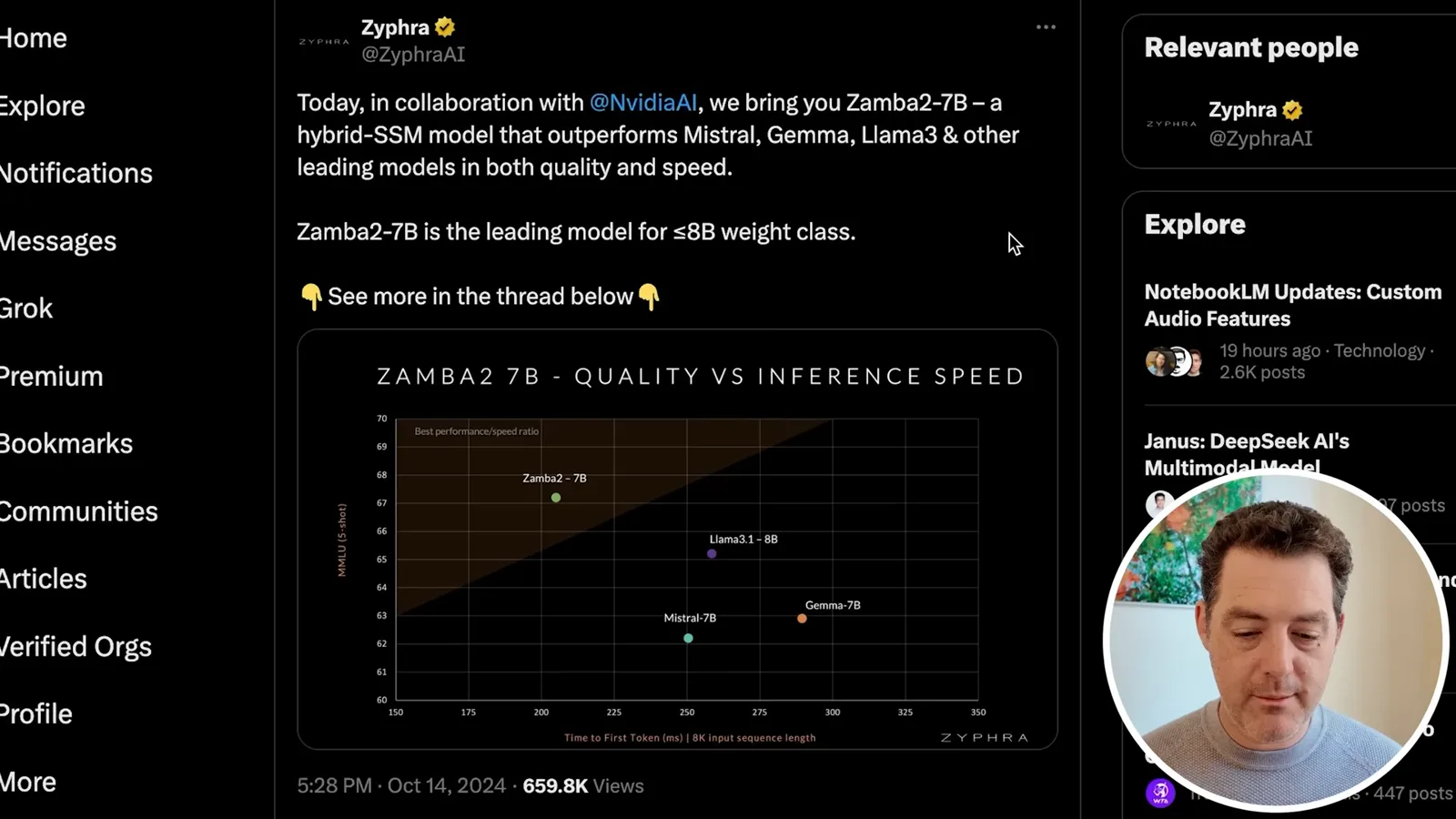
Zyphra announced Zamba2-7B, a hybrid state-space model, with a chart comparing MMLU and time to first token against selected models. The chart is a vendor comparison under specific conditions, not proof that it wins on every task. I remain cautious until I can test it myself.
I discuss indications that web search features from the SearchGPT experiment could be integrated into ChatGPT. That was an expectation based on the information available in October 2024, not evidence of availability for every user at the time.
Mistral introduced Ministral 3B and 8B for edge use. The announcement describes up to 128K context and an interleaved sliding-window attention pattern for the 8B model. I favor small specialized models for many tasks, although my estimate that 98% of uses do not need a frontier model is not measured here.
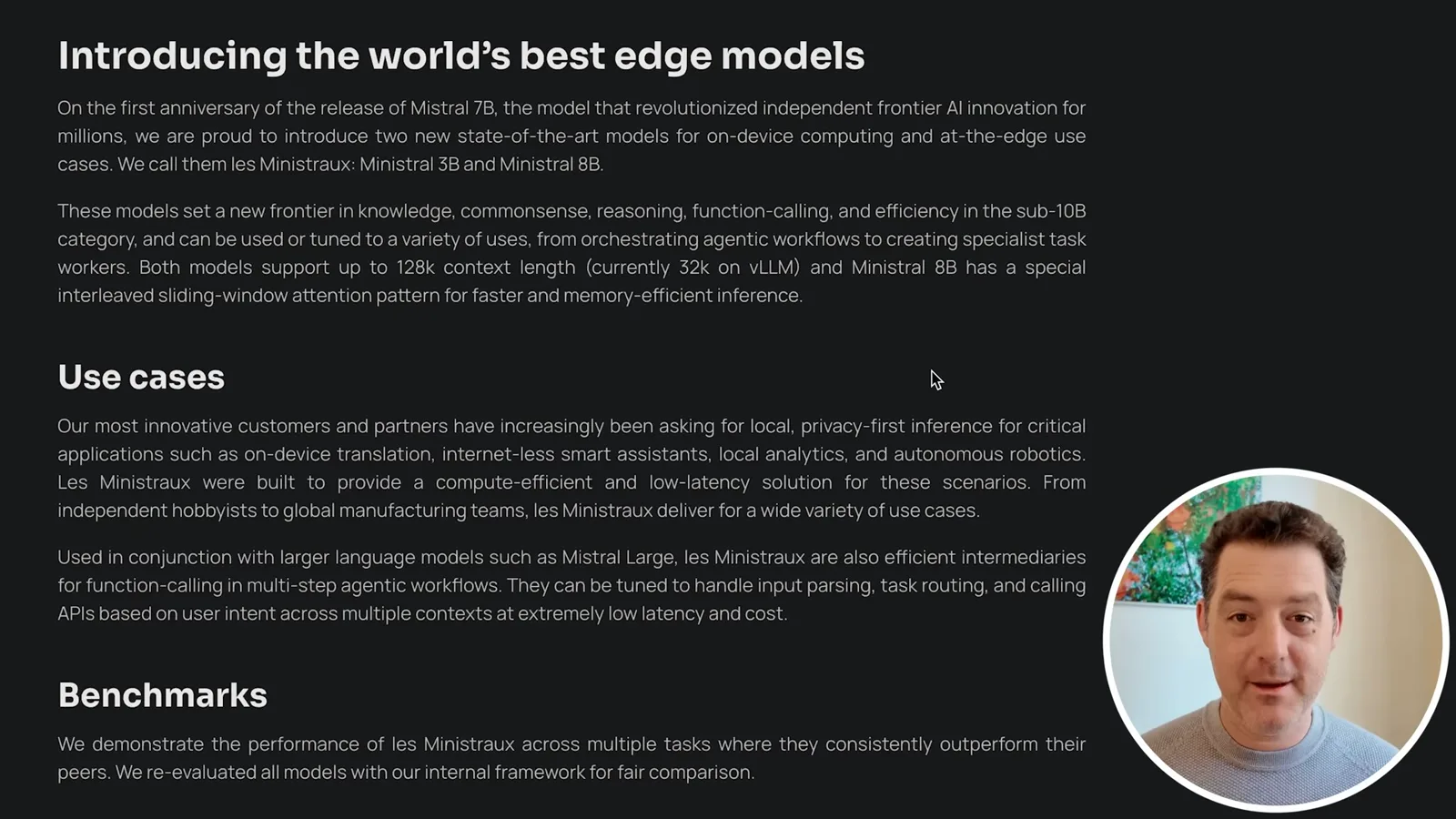
Mistral’s published benchmark tables and historical API prices suggest particular cost and performance tradeoffs; they do not establish superiority on all tasks. The models had distinct commercial and research terms, so access to weights and permitted uses must be checked for the relevant version.
After Tesla’s event, reports indicated that Optimus robots had human assistance in some interactions. A subsequent video showed navigation in a factory, which Tesla presented as autonomous. A demonstration of one activity does not establish that every event interaction or robot capability was fully autonomous.
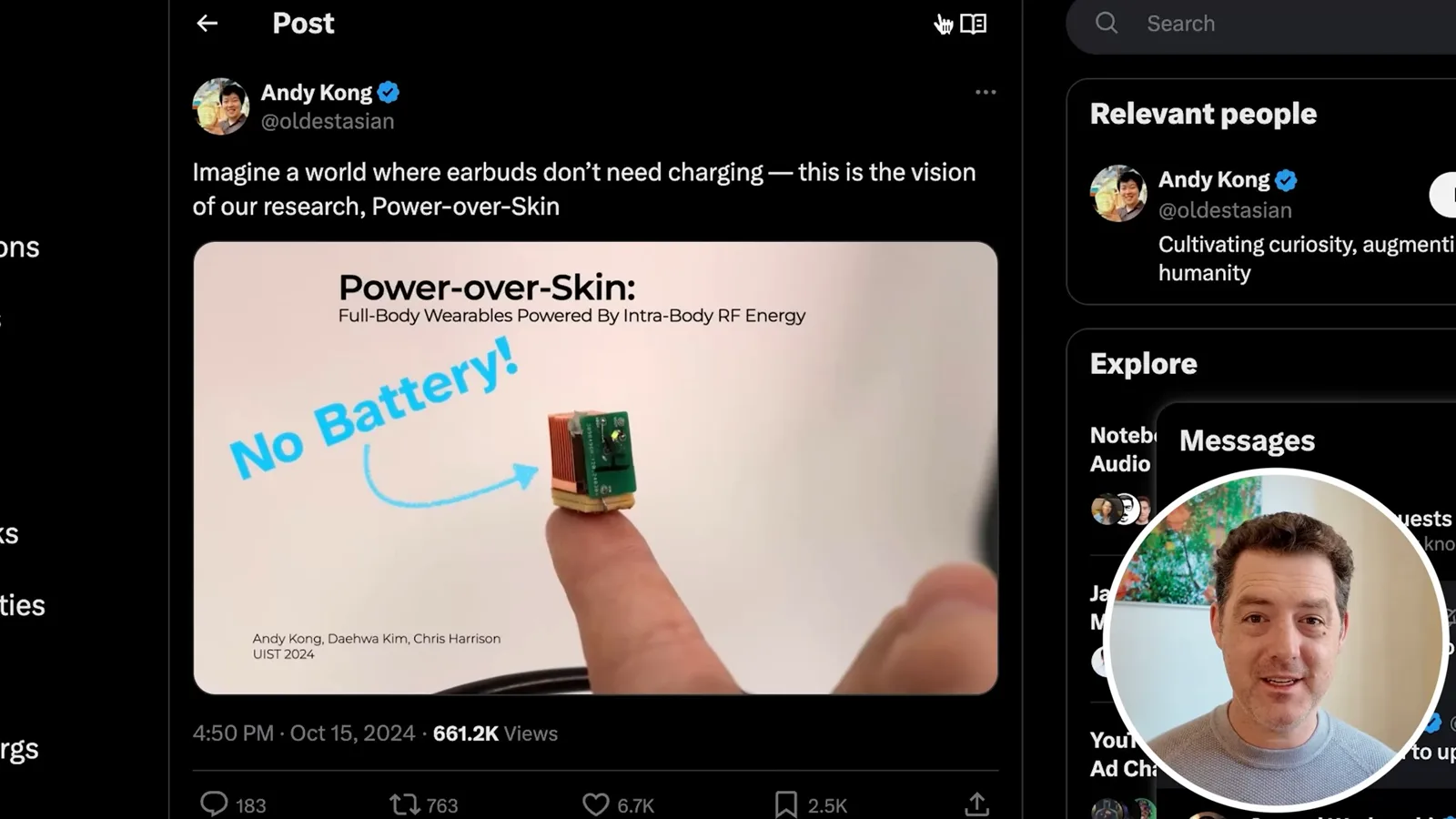
Power-over-Skin research imagines small wearables without their own batteries, including possible earbuds. I incorrectly describe this as using energy generated by the body: the researchers’ design transfers radio-frequency power through the body from a worn transmitter powered by another source. The project is research, not a demonstrated battery-free consumer earbud.
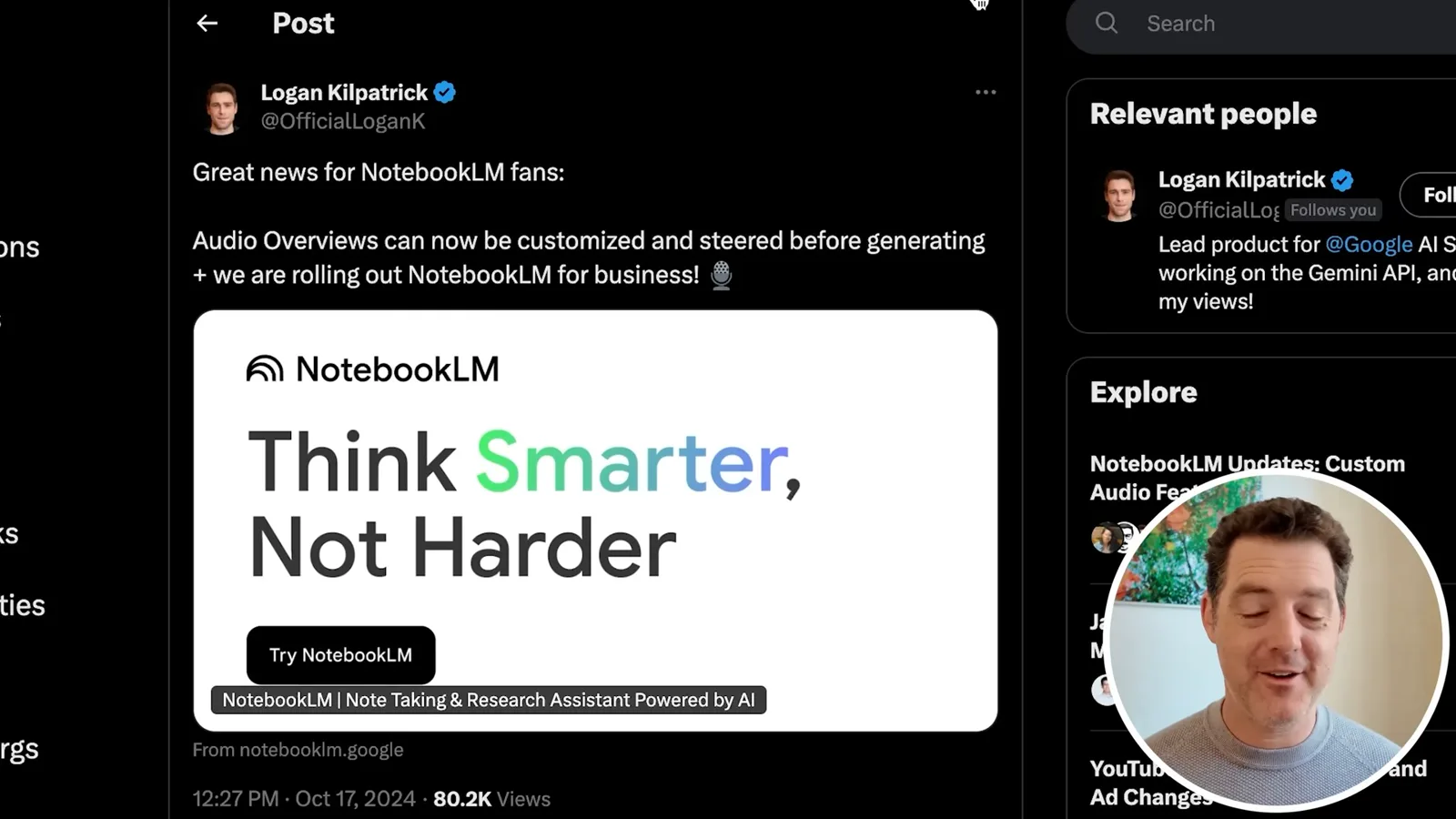
Google announced that NotebookLM Audio Overviews could be customized before generation and that a business offering was rolling out. I have not yet used the feature and am unsure how much I personally need audio summaries, though I recognize others find them useful.
Finally, paid ChatGPT users were receiving early access to a Windows app. I value native shortcuts for quickly starting a conversation and want easier access to ChatGPT or Perplexity on my phone. These rollout details reflect the time of the video.
Más de este canal
 34:21EN
 Matthew Berman· 27 oct 2026Matthew Berman Examines Anthropic’s IPO Filing, AI Growth and GovernanceMatthew Berman, Sam Altman · Forward FutureThe presenter reviews the S-1’s financial metrics, compute strategy and voting structure while questioning the tension between rapid AI development and safety.
 0:36ENMatthew Berman· 25 oct 2026Kimi K3.1 and a Rubik’s Cube Solver DemonstrationMatthew Berman · Forward FutureMatthew Berman shows a scrambled virtual cube being solved and gives the Kimi K3.1 test a favorable assessment.
 25:50ENMatthew Berman· 24 oct 2026Kimi K3.1 Pro Tested: Strong 3D Demos, Uneven Results and Competitive PricingMatthew Berman · Forward FutureMatthew Berman tests the open-weight model on coding, 3D rendering and visual explanations, then compares benchmark results and prices.
 32:20ENMatthew Berman· 23 oct 2026Who Is Local AI For? The Costs, Trade-offs and a Hybrid FutureMatthew Berman · Forward FutureMatthew Berman weighs data control and independence against hardware cost, setup complexity and inference speed.
 1:03:37ENMatthew Berman· 23 oct 2026Matthew Berman’s Team Tests Kimi K3.1 on Animation, Games, and ChartsMatthew Berman, Alex, Brian · Forward FutureA live team AMA turns into an informal test of Kimi K3.1, from personal-agent workflows to motion graphics, a browser game, and a benchmark chart.
 0:53ENMatthew Berman· 22 oct 2026Sam Altman on AI and the Discovery of New KnowledgeSam Altman · OpenAIAltman expects progress in mathematical discovery to extend to biology, materials and energy.