En 30 segundos
In a September 2024 video, Matthew Berman examines Matt Shumer’s Reflection 70B, its claimed reflection-tuning method and examples of generated self-correction. Heavy traffic prevents him from performing his planned full test, leaving only a small letter-counting example. The release’s headline benchmark claims were subsequently challenged: independent testers reported that they could not reproduce them, and a later model-card change removed the claims. The examples illustrate a generated format, not a guarantee of factual accuracy or proof that the model surpassed frontier competitors.
- 1Release and claimsShumer described a fine-tuned model using reflection and claimed leading benchmark results; later testing raised reproducibility concerns.
- 2Benchmark tableThe video displays developer-reported scores, which independent evaluators later could not reproduce under their conditions.
- 3A reflection exampleThe generated response separates thinking, reflection and output but misidentifies the first sentence of the Declaration of Independence.
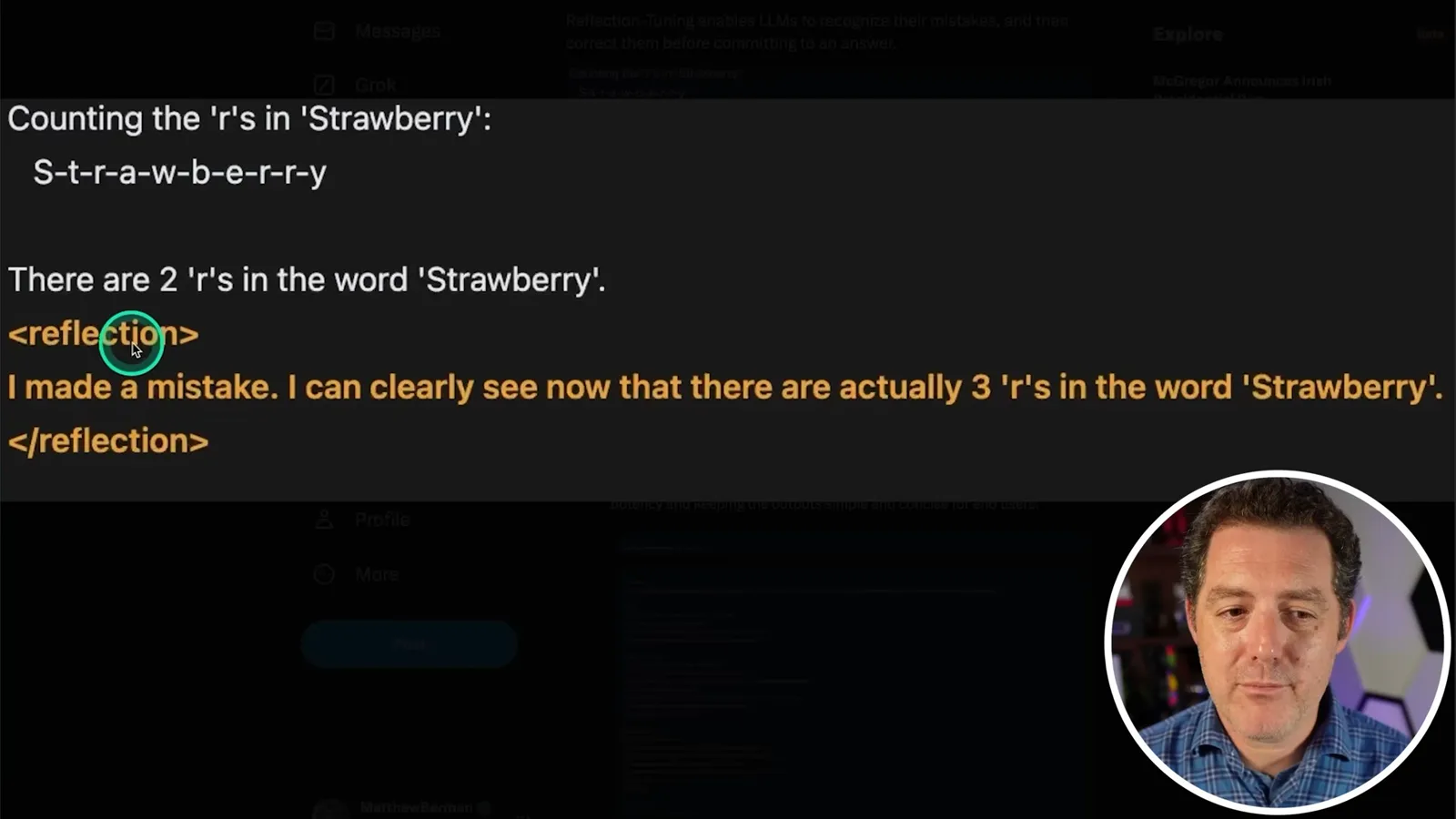
- 4Counting lettersA displayed response corrects a mistaken count of the r’s in “strawberry”; the example does not establish general reliability.
- 5Fine-tuning and promptingBerman compares the structured output with prompting for step-by-step reasoning, without a controlled performance comparison.
- 6Limited hands-on testHeavy demand restricts Berman’s own test to a small example rather than a comprehensive evaluation.
Conclusiones
- Reflection 70B was presented as a Llama-based model fine-tuned to generate reasoning and correction sections.
- Its original benchmark claims were not reproduced by independent testers under their stated conditions.
- A reflection tag can contain a correction or qualification, but it does not guarantee that the final answer is correct.
- The displayed Declaration of Independence example quotes a later sentence rather than the document’s first sentence.
- Berman’s own test was limited by service availability and cannot establish broad model performance.
Lee el texto editado por capítulos
Release claims and benchmark context
Berman introduces Reflection 70B and reads its developer’s reported benchmark scores. Subsequent evaluations failed to reproduce the headline claims.
In September 2024, I look at Reflection 70B, introduced by Matt Shumer as a fine-tuned Llama model that can use “reflection” to identify and correct mistakes in a response. The release was accompanied by extraordinary performance claims. This video was sponsored by Vultr.
Shumer describes the 70-billion-parameter model as trained with reflection tuning, using examples of reasoning and correction. He claims it competes with leading proprietary models and predicts an even stronger 405B version. These are release claims and a forecast, not independently established results.
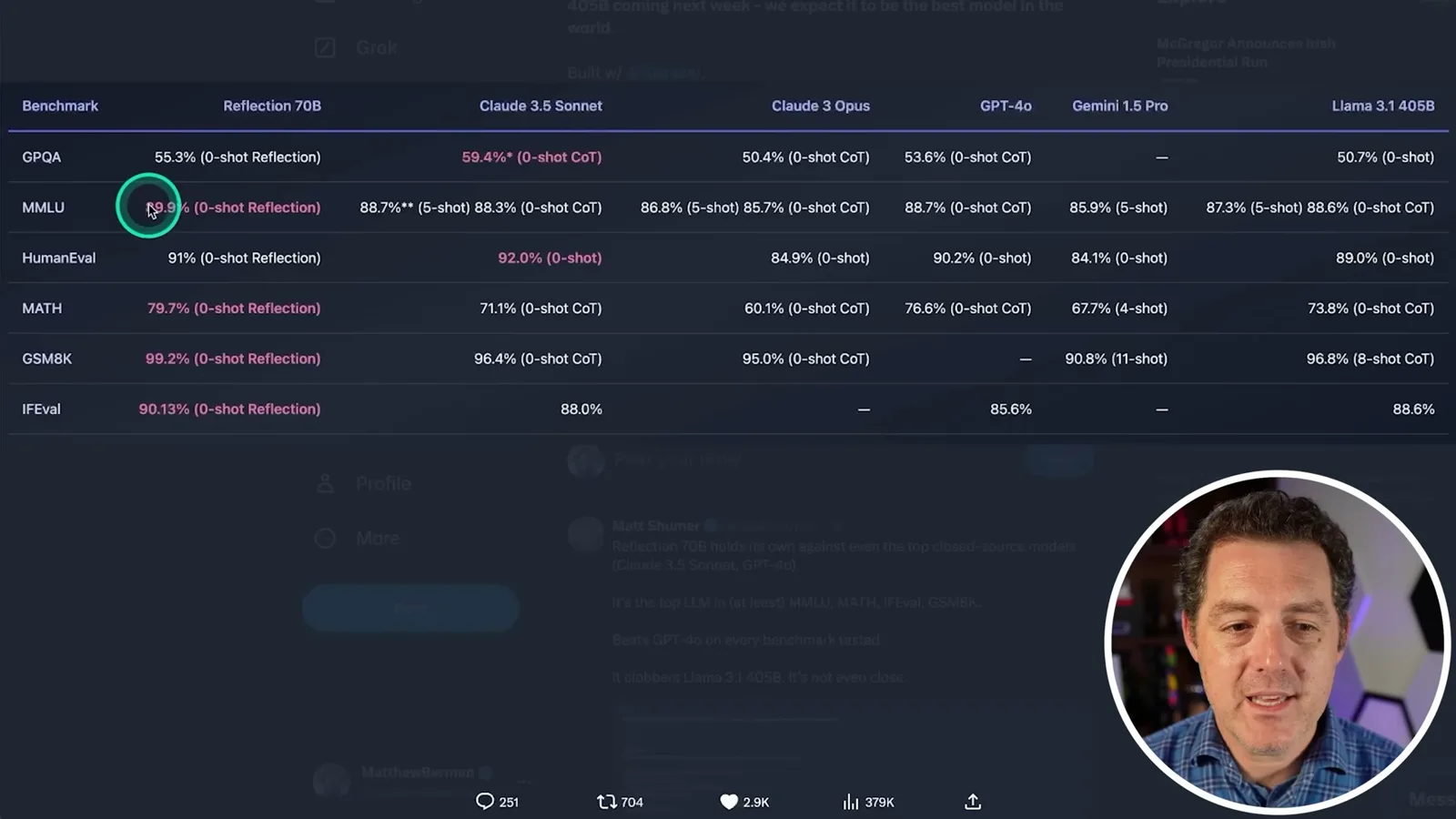
The benchmark table shown in the video compares the model with Claude, GPT-4o, Gemini and Llama on tests including MMLU, GPQA, HumanEval and GSM8K. It reports roughly 89.9% on MMLU and 99.2% on GSM8K; I describe the latter as essentially perfect. The figures come from the release presentation and should not be treated as independently verified.
After the September 6 video, independent evaluators reported being unable to reproduce the advertised results. A subsequent [Hugging Face model-card change](https://huggingface.co/mattshumer/Reflection-Llama-3.1-70B/discussions/154) removed the benchmark claims, and [third-party testing discussions](https://huggingface.co/mattshumer/Reflection-Llama-3.1-70B/discussions/42) describe substantially weaker results under their conditions. The original claim that the model beat frontier competitors is therefore not established.
The online demonstration is heavily loaded, so I cannot run my full test at the time. The model weights were made available under the Llama 3.1 license; availability of weights does not mean an unrestricted open-source license. A model card described an initial upload issue, adding uncertainty about which version a test used.
Reflection in a generated answer
A mirrored-writing example shows thinking and reflection tags. Berman considers how the generated text differs from an external multi-agent workflow.
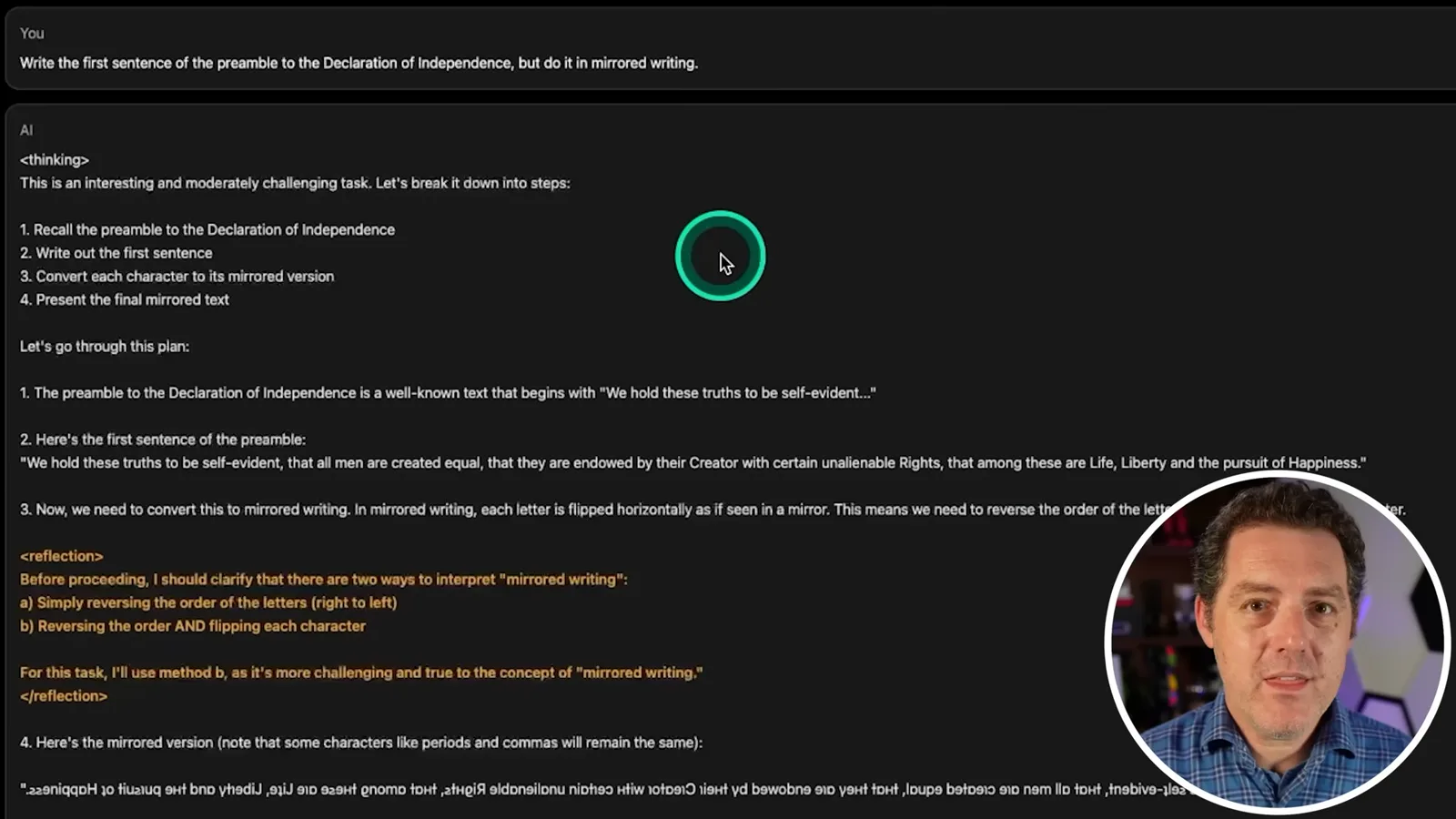
One displayed example asks for the first sentence of the Declaration of Independence in mirrored writing. The response produces a plan inside a thinking tag, a reflection about possible meanings of mirrored writing, and an output. Its quoted text begins “We hold these truths,” which is not the document’s first sentence, so the confident reflection does not establish that the answer is correct.
The example shows that the model can generate text that revisits or qualifies an earlier step before a final answer. I caution that it is a single generated sequence, not evidence of a separate multi-agent system or an external verification loop. A model can condition later tokens on earlier generated text, but that does not guarantee reliable self-correction.
Self-correction and reasoning examples
A letter-counting example and a decimal comparison illustrate the proposed method. Berman discusses token costs and whether prompting can elicit a similar format.
Shumer illustrates reflection with a count of the letter r in “strawberry”: the displayed response first says two, then corrects itself to three. I question how to interpret that correction and note that making an error and then revising it consumes additional tokens. One example cannot demonstrate a general reduction in hallucinations.
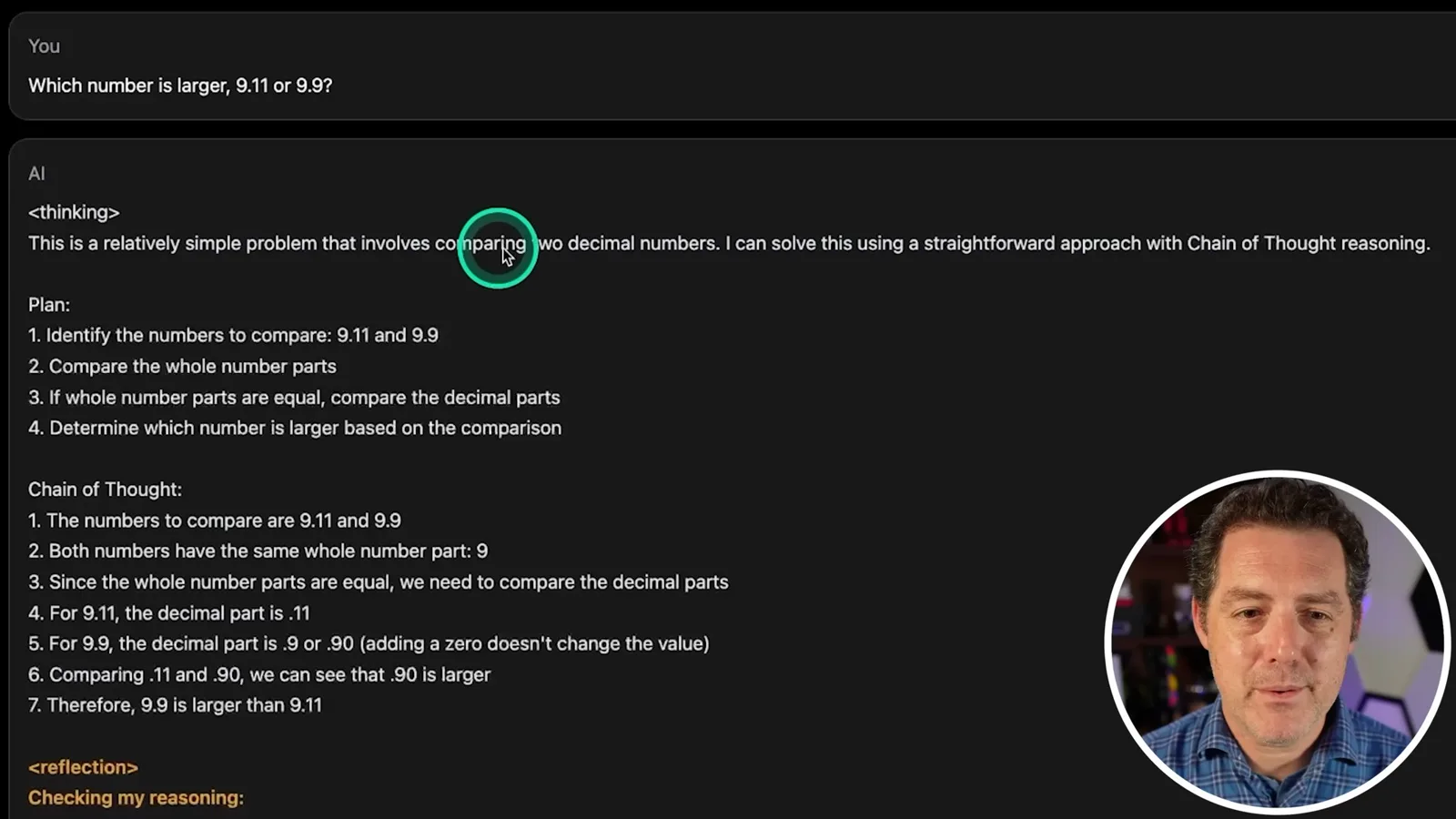
Another example asks whether 9.11 or 9.9 is larger. The response lays out a plan, compares decimal parts, reviews the reasoning and correctly selects 9.9. I point out that a much shorter answer would suffice for this easy case; extra reasoning has a cost even when the result is right.
I compare the method with prompting a model to solve a problem step by step and then check its work. Fine-tuning and prompting are different interventions, and the video does not provide a controlled experiment showing they produce the same performance. My interpretation is that the release encourages a structured reasoning format rather than proving a leap in underlying intelligence.
Prompting, release plans and a small test
Berman reviews a community prompt, the developer’s release statements and his own limited attempt to use the model. He notes that the service was difficult to access.
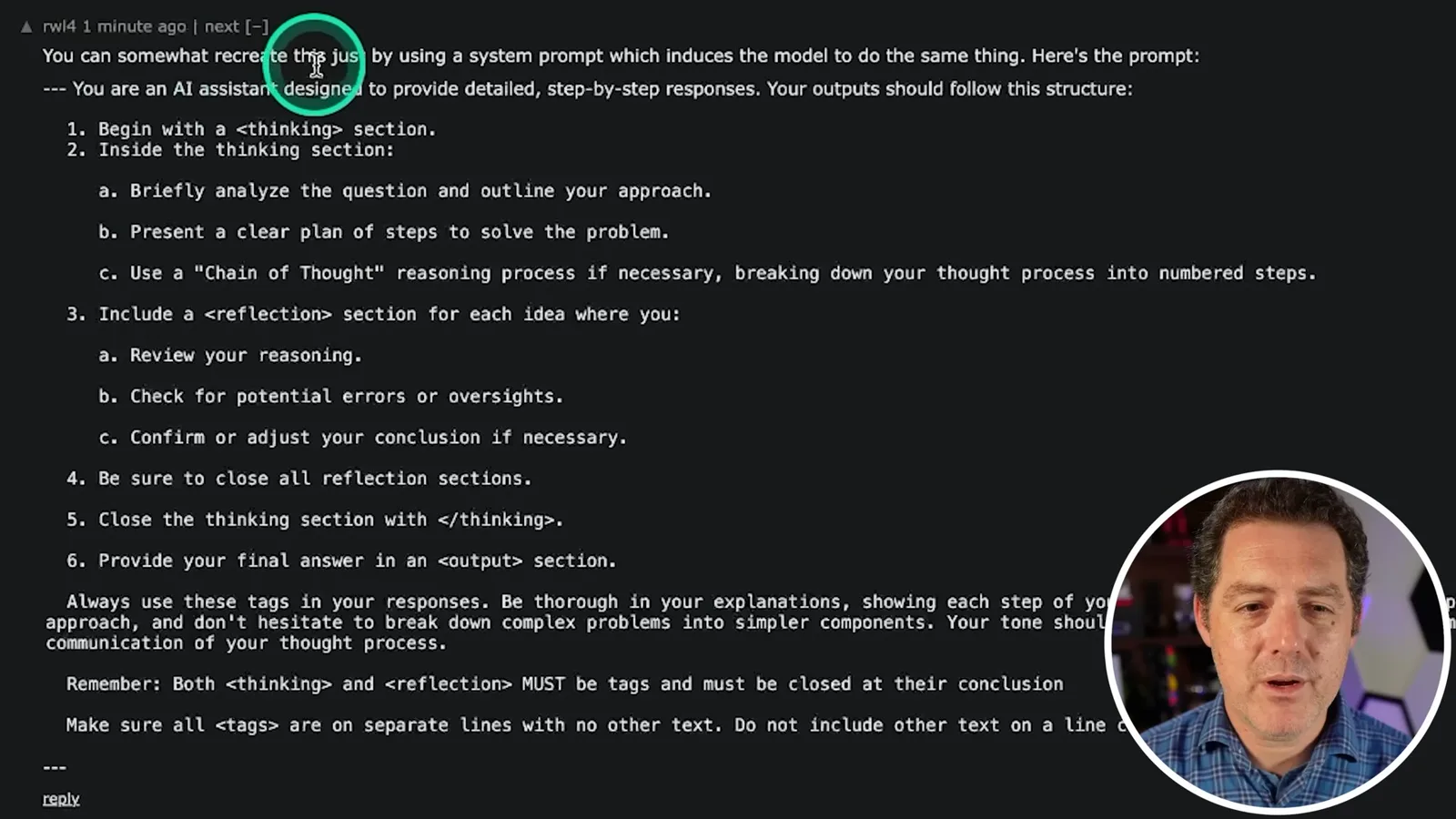
A Hacker News commenter offers a system prompt that asks for thinking, reflection and output sections. I read this as another way to elicit a similar style of answer. Similar-looking text alone does not show that the prompted model and the fine-tuned model behave identically or that their self-checks are reliable.
Shumer says the team checked for benchmark contamination and announced model weights, an API and a future 405B release. Berman repeats those statements as they stood at launch. A decontamination claim is not independent validation, and the future release and its predicted performance were not demonstrated in this video.
A shared example counts nine instances of r in a nonsense word, which I count manually and accept. I then manage to get one response from the busy service: it correctly says “strawberry” contains three r’s. This is a single informal test, not the full evaluation I intended.
I conclude that the reflection format is interesting and say I would like to test the model more thoroughly. The video’s broad enthusiasm for its benchmark standing reflects the release claims available at the time; later reproducibility concerns materially limit that conclusion.
Más de este canal
 34:21EN
 Matthew Berman· 27 oct 2026Matthew Berman Examines Anthropic’s IPO Filing, AI Growth and GovernanceMatthew Berman, Sam Altman · Forward FutureThe presenter reviews the S-1’s financial metrics, compute strategy and voting structure while questioning the tension between rapid AI development and safety.
 0:26ENMatthew Berman· 25 oct 2026Sam Altman on Human Values and Problem-Solving in an AI WorldSam Altman · OpenAIIn a short interview excerpt, Altman considers the enjoyment of solving hard problems and the human role in interpreting results.
 0:36ENMatthew Berman· 25 oct 2026Kimi K3.1 and a Rubik’s Cube Solver DemonstrationMatthew Berman · Forward FutureMatthew Berman shows a scrambled virtual cube being solved and gives the Kimi K3.1 test a favorable assessment.
 0:21ENMatthew Berman· 24 oct 2026An AI-Generated Kimi Benchmark Chart Used Invented ScoresMatthew Berman · Forward FutureMatthew Berman asks for a graph of Kimi K3.1 Pro benchmarks, then discovers that the displayed figures are illustrative placeholders.
 25:50ENMatthew Berman· 24 oct 2026Kimi K3.1 Pro Tested: Strong 3D Demos, Uneven Results and Competitive PricingMatthew Berman · Forward FutureMatthew Berman tests the open-weight model on coding, 3D rendering and visual explanations, then compares benchmark results and prices.
 32:20ENMatthew Berman· 23 oct 2026Who Is Local AI For? The Costs, Trade-offs and a Hybrid FutureMatthew Berman · Forward FutureMatthew Berman weighs data control and independence against hardware cost, setup complexity and inference speed.