En 30 segundos
Matthew Berman describes a simulated nematode and asks whether future technology could create a reality indistinguishable from our own. His claims that the worm is completely understood and humans are almost certainly simulated go beyond what the example establishes; the video ends mid-sentence.
- 1A small model organismBerman introduces the approximately one-millimeter nematode C. elegans and its 302-neuron nervous system.
- 2Mapping versus simulationHe describes the worm as fully mapped and simulated, but a neural wiring map does not establish complete biological or behavioral simulation.
- 3A philosophical hypothesisBerman suggests technology could one day produce convincing simulated worlds; that possibility does not establish that ours is simulated.
Conclusiones
- C. elegans is a small, well-studied nematode with a mapped nervous system.
- A computational model of a worm is an approximation and does not establish a complete simulation of its biology or behavior.
- The possibility of future simulations does not itself prove that humans live in one.
- Berman’s final question is cut off in the available video.
Lee el texto editado por capítulos
A simulated nematode
Berman presents a visual model of C. elegans and describes its size and nervous system. His claim of complete simulation is stronger than the evidence presented.
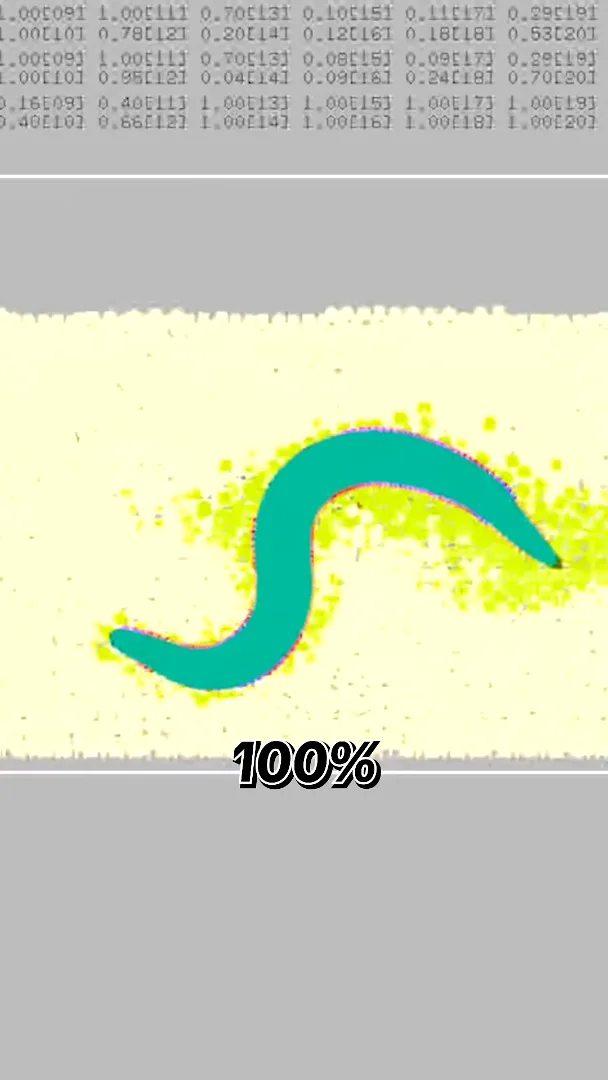
This video begins with a visual simulation of a worm. The species discussed is Caenorhabditis elegans, a small, transparent nematode about a millimeter long that lives in soil and is widely studied. Its relatively simple nervous system has 302 neurons in the adult hermaphrodite, making it a useful organism for investigating neural circuits.
I suggest that researchers have mapped the worm completely and can simulate how every neuron will react. That overstates what a wiring map and computational model establish: a model can represent neurons and their connections without reproducing every biological detail or predicting all behavior. The video does not identify or validate the particular simulation shown.
Could reality be simulated?
Berman links progress in AI and virtual reality to a hypothetical future simulation. The video ends before he finishes his question.
The example leads me to the simulation hypothesis: could the world we experience be running on someone else’s computer? I point to advances in artificial intelligence and virtual reality and imagine future simulations that people might not distinguish from their surroundings. This is a philosophical possibility, not evidence that we are almost certainly simulated. The video cuts off as I ask whether such a simulation might already exist.
Más de este canal
 34:21EN
 Matthew Berman· 27 oct 2026Matthew Berman Examines Anthropic’s IPO Filing, AI Growth and GovernanceMatthew Berman, Sam Altman · Forward FutureThe presenter reviews the S-1’s financial metrics, compute strategy and voting structure while questioning the tension between rapid AI development and safety.
 25:50ENMatthew Berman· 24 oct 2026Kimi K3.1 Pro Tested: Strong 3D Demos, Uneven Results and Competitive PricingMatthew Berman · Forward FutureMatthew Berman tests the open-weight model on coding, 3D rendering and visual explanations, then compares benchmark results and prices.
 32:20ENMatthew Berman· 23 oct 2026Who Is Local AI For? The Costs, Trade-offs and a Hybrid FutureMatthew Berman · Forward FutureMatthew Berman weighs data control and independence against hardware cost, setup complexity and inference speed.
 1:03:37ENMatthew Berman· 23 oct 2026Matthew Berman’s Team Tests Kimi K3.1 on Animation, Games, and ChartsMatthew Berman, Alex, Brian · Forward FutureA live team AMA turns into an informal test of Kimi K3.1, from personal-agent workflows to motion graphics, a browser game, and a benchmark chart.
 0:53ENMatthew Berman· 22 oct 2026Sam Altman on AI and the Discovery of New KnowledgeSam Altman · OpenAIAltman expects progress in mathematical discovery to extend to biology, materials and energy.
 0:22ENMatthew Berman· 21 oct 2026A Robot Bodyguard Video Shows Dramatic Rescue ScenariosMatthew Berman · Forward FutureMatthew Berman reacts to a short robot demonstration depicting fighting and vehicle-rescue scenarios.