En 30 segundos
In this interview published March 9, 2026, Matthew Berman speaks with SemiAnalysis founder and CEO Dylan Patel about coding agents, military AI, work, open models, infrastructure and the race toward superintelligence. Patel combines firsthand anecdotes with forecasts and disputed claims; the discussion does not independently establish the allegations or predictions.
- 1Agent spendingPatel describes heavy spending on coding agents and argues that the increase in productivity can outweigh its cost.
- 2Military AI disputeBerman and Patel discuss Anthropic, OpenAI and the US government, including their concerns about surveillance and autonomous weapons.
- 3Knowledge work changesPatel describes using agents to investigate companies and automate research, while arguing that workers will need to learn how to direct them.
- 4Models and infrastructureThe conversation turns to DeepSeek, model training and the difference between model weights and the software systems built around them.
- 5Distillation allegationsThey discuss Anthropic’s allegations about Chinese AI companies and disagree on the significance of using other models’ outputs.
- 6Capacity and capital expenditurePatel argues that the rush for AI infrastructure will continue, though his estimates and forecasts are uncertain.
Conclusiones
- Patel says coding agents have accelerated his firm’s work, though his spending and productivity figures are personal estimates.
- The speakers see military AI as a conflict between national-security use and safeguards against autonomous weapons and domestic surveillance.
- AI may raise output while reshaping employment and the distribution of income, but the scale and timing are uncertain.
- Model weights are only one part of an agent system; tools, instructions and orchestration also matter.
- Patel argues that data-center capacity and access to compute will remain central to competition among frontier model developers.
Lee el texto editado por capítulos
Introduction and predictions
Patel revisits earlier predictions and describes how coding agents are changing his business.
Matthew Berman welcomes Dylan Patel, founder and CEO of SemiAnalysis, back to discuss the fast-changing AI industry. Patel says coding agents have dramatically increased the speed of work at his firm. Their conversation spans the effects on jobs, the military use of models, competition with Chinese labs and the infrastructure needed to train and run AI.
Berman asks Patel to revisit predictions from a previous conversation. They discuss the reception of GPT-4.5 and developments at Scale AI after Meta’s investment. Patel uses those examples to reflect on how rapidly the industry has changed and how difficult it is to make a clean forecast when companies, products and competitive conditions shift.
The two turn to the prospects for junior programmers. Patel argues that models can now handle a growing share of tasks that once gave inexperienced developers their first professional opportunities. That does not mean that every engineering job disappears immediately, but it could make the path into the profession harder.
Patel says his company is using coding agents extensively. He describes individual engineers incurring exceptionally high daily bills, including examples of roughly $8,000 and $5,000, and weighs those costs against output. These are anecdotes about his team, not independent measures of typical costs or productivity.
The important question, Patel says, is whether the additional work produced is valuable enough to justify the compute bill. He suggests that a large annualized inference budget can make business sense if a small team can do work that would otherwise require substantially more people and time.
Berman describes his own use of AI tools and says friends at Cursor have supplied him with tokens. He has experimented with OpenClaw on tasks such as email and sales, while recognizing that giving an agent access to operational systems requires safeguards.
Their examples illustrate how the same models can be wrapped in tools that give them access to files, instructions and external services. Both speakers are enthusiastic about the speed of experimentation, although their experiences should not be treated as controlled comparisons of agent reliability.
Anthropic and the Department of War
The speakers debate military contracts, autonomous weapons and surveillance, separating public positions from their own speculation.
The discussion moves to the dispute involving Anthropic and the US Department of War. Berman says the government designated Anthropic a supply-chain risk, while OpenAI reached its own agreement. They debate the disagreement over restrictions on military use and how much the wording and implementation of a contract actually protect.
Patel argues that the sequence of government and company decisions matters. The speakers distinguish between the use of AI in classified systems and the much harder questions of whether a system can be used for domestic mass surveillance or lethal autonomous decisions without meaningful human control.
Patel discusses Anthropic’s earlier government work and questions the public presentation of the dispute. His interpretation of the companies’ motives is an opinion. The interview does not establish the private conversations or political calculations behind the decisions.
The speakers discuss OpenAI’s agreement and how a vendor’s stated limitations might operate in practice. A policy or contract is not the same thing as a complete technical description of how a model will be deployed, and they disagree about how reassuring particular public statements are.
Patel raises possible behind-the-scenes interactions as speculation, acknowledging uncertainty. The point of the exchange is the competitive and political context surrounding the deal, not proof that any particular private call or instruction occurred.
Berman asks what model the military might actually be using. Patel offers a tentative guess about an older Claude version and notes the constraints of classified environments. The version and deployment details are not established by the interview.
They discuss how model capability, classified access and infrastructure can differ from the consumer experience. A military system may rely on additional software, human procedures and data connections, so the name of the underlying model alone does not explain what decisions it can support.
Patel says these applications are still developing. Berman presses on the gap between an AI assisting a human and an autonomous weapon deciding to act; both treat that distinction as consequential even as they debate how government agreements should draw the line.
The conversation broadens to intelligence gathering and surveillance. Patel says he does not want the US government to develop a system of mass surveillance comparable to, or more capable than, what he associates with China. He sees the concentration of access to personal data as a separate concern from battlefield use.
Both speakers return to enforcement: a public commitment is useful only if its limits can be implemented and monitored. Their discussion describes possible risks and scenarios, rather than presenting evidence that a specific surveillance or weapons system has been deployed.
Patel questions the incentives of companies, governments and commentators in the dispute. Berman emphasizes the public’s difficulty in evaluating agreements when much of the relevant military operation is classified. Their conclusions about the participants’ intentions remain interpretations.
They consider the broader strategic tension: powerful AI can support national security while also making it easier to scale decisions that people may not be able to review. The debate turns on who controls the system, which uses are permitted and what oversight exists.
Happiness, inequality and work
They discuss social comparison, inequality and the possibility that AI will disrupt employment.
Berman asks about social unrest and AI’s impact on the balance between labor and capital. Patel argues that people’s sense of well-being depends not only on absolute living standards but also on how they compare themselves with others and whether they feel they are sharing in economic progress.
Patel describes a long period in which material conditions improved while many people became less satisfied with their position. He connects that perception to inequality and social media, which exposes people to carefully selected pictures of other people’s lives. This is his interpretation of a complex social trend.
The concern for AI is that even if productivity and total output rise, the benefits may be distributed unevenly. A society can have cheaper or better services and still experience resentment if workers lose bargaining power or see opportunity concentrated among a small group.
The speakers discuss firms using automation to change their workforces and the possibility that customers benefit from lower costs or better service. Patel’s point is that aggregate benefits do not automatically compensate the particular workers whose jobs or career paths are disrupted.
Patel offers autonomous ride-hailing as an example of how people may value a service differently once they use it. He compares Waymo with conventional ride-hailing and argues that a better experience can drive adoption even when the transition creates difficult questions for drivers.
Berman asks what happens if greater abundance is accompanied by less secure employment. They discuss income support and universal basic income as possible responses, while recognizing that cash alone may not address status, meaning or people’s sense of participation in society.
Patel emphasizes that happiness is relative and social, not just a function of the price of goods. Their discussion of future inequality and policy is a set of forecasts and arguments, not a demonstrated outcome of AI adoption.
AI agents and knowledge work
Patel describes delegating research and financial analysis to agents and changing how knowledge workers operate.
The conversation turns to knowledge work. Patel argues that capable agents are no longer useful only to software engineers: a person who understands a business question can direct a coding agent to gather information, analyze data and return a structured answer.
He describes an analytical workflow in which a user gives an agent a question, lets it launch additional agents and reviews the results. The skill is not merely writing a clever one-line prompt; it is setting the task, providing context, evaluating the work and iterating when the answer is incomplete.
Patel gives financial research as an example. He suggests that agents can compare company disclosures and earnings-call language, surfacing inconsistencies or changes for a human analyst to investigate. A change in language is a lead for scrutiny, not proof that a company or executive is lying.
He argues that a team can retain its domain expertise while delegating more implementation to software. People who understand what an analysis needs to establish can use an agent to explore approaches that previously required a programmer to write every step.
Patel says Claude Code is particularly strong for this kind of work at the time of the interview, but expects competing tools to spread. He distinguishes the base model from the surrounding system that gives it tools, instructions and a way to carry out extended tasks.
Berman and Patel consider the consequences for employees who do not adapt. Patel’s view is that learning to work with these systems matters across job categories, even as the tools and their relative performance are changing quickly.
Software businesses and the media
They consider SaaS, building products with AI, competition for attention and the politics of job displacement.
Berman asks whether software-as-a-service businesses are in danger. Patel says building a prototype has become easier, but the ability to produce a demo is not equivalent to operating a secure, scalable service with real customers, reliable data and ongoing support.
Patel describes someone at his company with deep data knowledge taking on more building work through AI. The example suggests that domain experts can create tools closer to their own needs, rather than waiting for every idea to pass through a separate engineering team.
The speakers contrast a small internal tool with a mature enterprise product. A model can write code, but bringing an application into production still requires judgment about architecture, maintenance and how it behaves under real workloads.
Patel says he is still hiring because faster execution also lets his firm pursue more business. He does not claim that all employers will respond the same way: AI can expand some teams’ ambitions while also allowing others to compete with fewer people.
They discuss data platforms and specialist services as potential targets for competition. Patel argues that the value of existing software businesses depends on the combination of their data, distribution and the difficulty of replacing the service, rather than simply on how much code they contain.
The same abundance applies to media. Patel tells Berman that AI makes content easier to produce and increases competition for attention; a growing channel can take audience share from other creators even as the total volume of content expands.
Berman and Patel discuss how creators might differentiate themselves when publishing becomes cheaper. Trust, distinctive judgment and access to information can matter more when an audience is surrounded by abundant, easily produced material.
Patel returns to his prediction of significant pressure on white-collar jobs. He expects companies and workers to face a transition before the distribution of gains is resolved. His description is a forecast, not a measurement of the number of jobs already lost.
They discuss how companies are directing resources into data centers, energy and computing. Patel interprets this spending as evidence of how seriously major firms take AI, although projections about future cash flow and investment depend on uncertain company decisions and demand.
Patel speculates about a political backlash against AI and possible changes in party coalitions. Berman and Patel consider the potential appeal of policies that protect displaced workers; neither presents a settled prediction about how voters or politicians will respond.
Open models and the agent stack
Patel discusses DeepSeek, compute access, model providers and the rapidly changing agent ecosystem.
The conversation shifts to Chinese models and the position of open-weight development. At the time of the discussion, DeepSeek V4 had not yet been released. Patel offers his expectations for its capabilities and the competitive pressure it could put on US developers.
Patel says he believes DeepSeek has had access to Nvidia Blackwell compute through capacity rented in Southeast Asia. This is his claim about the training infrastructure, not a verified account of the model’s training or evidence of a particular illicit shipment.
The speakers discuss whether access to advanced chips can be detected or restricted and how providers in different jurisdictions might supply compute. Patel’s account is speculative, and the interview does not document the source or ownership of the hardware he describes.
They compare the rapidly changing offerings from model labs, including context length, speed and pricing. Patel emphasizes that the best model for a task may change as providers release new versions and as the software around the model improves.
A key distinction is between an openly available model and the agent harness built around it. An agent combines a model with tools, memory, instructions and a way to orchestrate work; those components can be open or closed independently of the model weights.
Patel describes how agent systems can reuse skills and instructions across different models. That portability may let a user change the underlying model without discarding the entire workflow, although performance and reliability still depend on the particular model and tools.
The speakers discuss OpenClaw as an example of a fast-moving open ecosystem. Its appeal is the ability to connect a personal agent to useful services, but those connections also introduce permissions, security and prompt-injection risks.
Patel argues that a model’s capabilities and the quality of its surrounding system should be assessed separately. Building a better interface or workflow can make a model more useful, while training a stronger model requires substantial data and compute.
They compare how different labs use available computing resources. Patel says improvements in efficiency matter, but he also expects labs to use additional compute to improve models when they can. That is a competitive analysis rather than a universal rule about every training run.
Distillation allegations
The interview examines Anthropic’s claims about Chinese AI companies and the differences between distillation and training on public content.
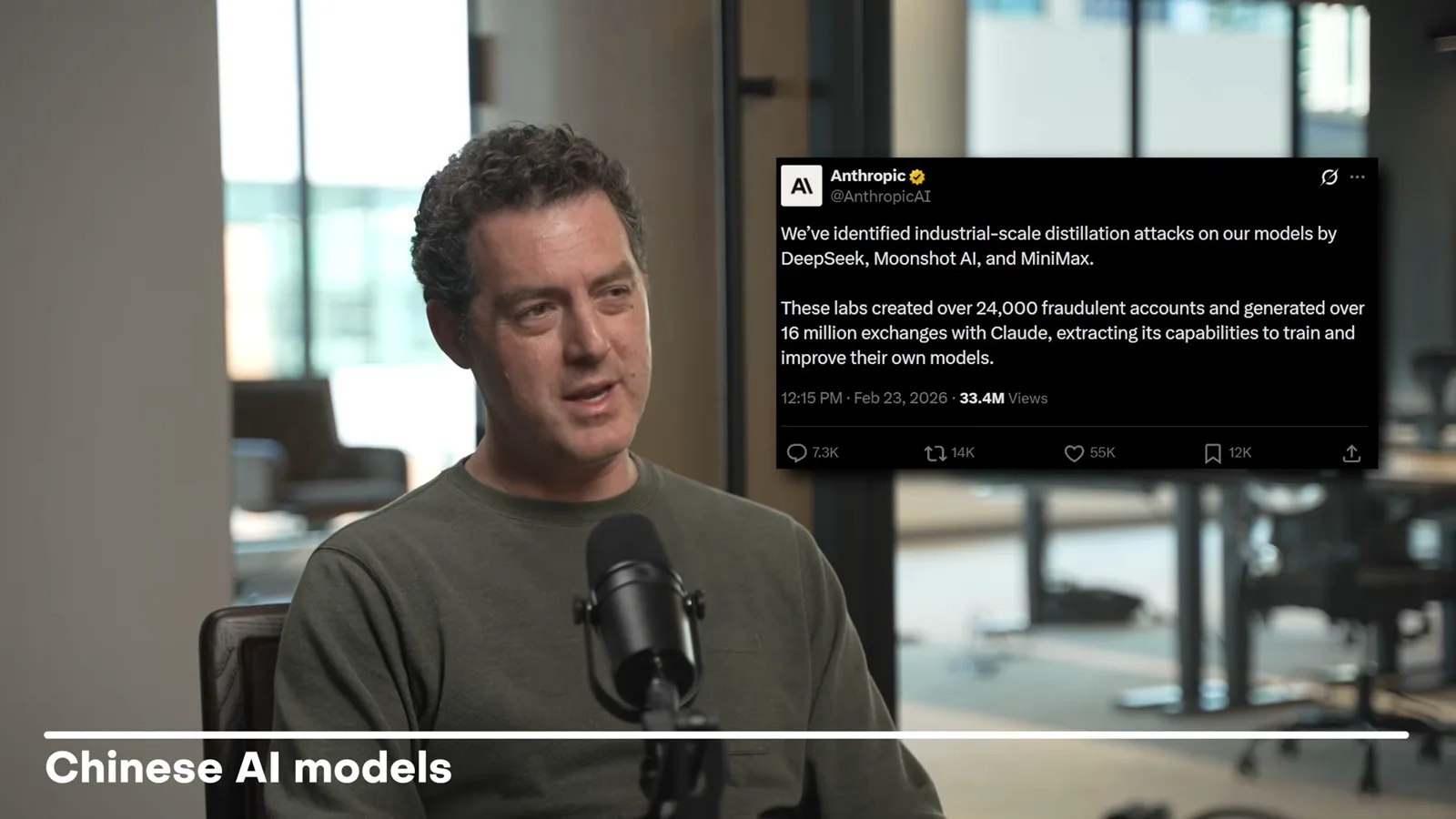
Berman brings up Anthropic’s February 2026 allegations that DeepSeek, Moonshot AI and MiniMax carried out industrial-scale distillation using Claude outputs. The displayed Anthropic page presents the company’s account; the interview does not independently verify the allegations or the identities behind the activity.
Patel and Berman discuss what distillation means: a developer uses outputs from one model as training data for another. They distinguish that practice from a model occasionally producing text in another language, which by itself would not establish where its training data came from.
The speakers disagree about how significant the alleged activity is and compare it with the use of public web material in training. They raise questions about terms of service, competitive advantage and attribution; similarities between the practices do not settle their legal or ethical status.
Patel says training data and method matter, but rejects the idea that every strong Chinese model can be explained away as a copy. Both discuss the difficulty of evaluating claims about training when outsiders cannot inspect a lab’s full data and process.
Open versus closed systems
The speakers compare local models, privacy, security and the economic advantages of cloud inference.
Berman asks about closed versus open systems. Patel says the open ecosystem is making an impact in agent software, even if the strongest models at that moment are often delivered as hosted services. He separates the openness of the model from the openness of the surrounding application.
Berman values running models locally for privacy and control. Patel agrees there are use cases for local inference but says a user has to account for the cost and capabilities of the necessary hardware, as well as the quality and speed of the model that can run on it.
They discuss the security of agents connected to email and other systems. Convenience can tempt users to grant broad access, while an instruction hidden in retrieved content may try to redirect the agent. Access controls and careful review are part of the practical trade-off.
Patel gives examples of expensive hardware assembled to run large models locally. He argues that a data center can serve many users and take advantage of batching, potentially offering better economics than leaving comparable equipment idle at each user’s home.
Berman’s preference for local execution reflects a different priority: keeping sensitive information under personal control. Patel responds that users and businesses will choose among privacy, latency, quality and cost rather than all converging on one deployment model.
The discussion turns to constraints in the hardware market. Patel expects demand for AI infrastructure to affect memory and other components, with consequences for device prices and the availability of compute. His price and demand outlook is a forecast.
They consider the competition among buyers for chips and capacity. A purchase decision depends on the budget and the value of the work being run, while vendors must allocate finite manufacturing and infrastructure resources among different markets.
Microsoft and the infrastructure race
Patel disputes the idea that slowing capital investment is prudent and discusses data-center constraints.
Berman asks about Microsoft CEO Satya Nadella’s comments on AI capital spending. Patel takes a more aggressive view, arguing that a company that fails to secure enough infrastructure could miss a major opportunity if demand continues to grow.
Patel distinguishes between plans for data centers and capacity that is actually built, powered and available. Announced investment figures can span multiple years, and projects depend on construction, chips, electricity and other constraints.
He argues that cheaper inference can expand the set of economically useful tasks rather than simply reduce total spending. His examples of falling costs refer to comparable work over time; they do not establish that every workload will become cheaper at the same rate.
The speakers acknowledge the possibility that AI investment could disappoint. Patel nevertheless says the demand he sees makes a sustained infrastructure buildout plausible. His assessment depends on future usage, financing, deployment and returns that are not yet known.
They return to the difficulty of adding capacity quickly. Even a company willing to spend heavily cannot instantly obtain power, facilities and hardware; the bottlenecks shape the speed at which new AI services can be offered.
Who wins the race?
Patel closes with a tentative prediction about the frontier labs and acknowledges the uncertainty.
Berman closes by asking who will win the race to artificial superintelligence. Patel revisits his earlier support for OpenAI and acknowledges that many people currently favor Anthropic. He treats his choice as a prediction in a rapidly changing competition, not a settled result.
The speakers note that another model release can quickly change perceptions of the leaders. Patel maintains his prediction while conceding the uncertainty; Berman thanks him for the discussion as the interview comes to a close.
Más de este canal
 34:21EN
 Matthew Berman· 27 oct 2026Matthew Berman Examines Anthropic’s IPO Filing, AI Growth and GovernanceMatthew Berman, Sam Altman · Forward FutureThe presenter reviews the S-1’s financial metrics, compute strategy and voting structure while questioning the tension between rapid AI development and safety.
 25:50ENMatthew Berman· 24 oct 2026Kimi K3.1 Pro Tested: Strong 3D Demos, Uneven Results and Competitive PricingMatthew Berman · Forward FutureMatthew Berman tests the open-weight model on coding, 3D rendering and visual explanations, then compares benchmark results and prices.
 32:20ENMatthew Berman· 23 oct 2026Who Is Local AI For? The Costs, Trade-offs and a Hybrid FutureMatthew Berman · Forward FutureMatthew Berman weighs data control and independence against hardware cost, setup complexity and inference speed.
 1:03:37ENMatthew Berman· 23 oct 2026Matthew Berman’s Team Tests Kimi K3.1 on Animation, Games, and ChartsMatthew Berman, Alex, Brian · Forward FutureA live team AMA turns into an informal test of Kimi K3.1, from personal-agent workflows to motion graphics, a browser game, and a benchmark chart.
 0:53ENMatthew Berman· 22 oct 2026Sam Altman on AI and the Discovery of New KnowledgeSam Altman · OpenAIAltman expects progress in mathematical discovery to extend to biology, materials and energy.
 0:22ENMatthew Berman· 21 oct 2026A Robot Bodyguard Video Shows Dramatic Rescue ScenariosMatthew Berman · Forward FutureMatthew Berman reacts to a short robot demonstration depicting fighting and vehicle-rescue scenarios.