En 30 segundos
On November 7, 2025, Matthew Berman and Nick Wentz discuss AI news and interview Higgsfield AI CEO Alex Mashrabov, OpenAI engineering leader Ben Goodger, CrewAI CEO João Moura and SemiAnalysis analyst Jeff Koch. Their conversations cover synthetic video marketing, the Atlas browser, enterprise agent deployment and a proposed new approach to chipmaking. The guests’ company metrics, product descriptions and forecasts reflect their statements at the time, not independent verification. Berman discloses a small early investment in CrewAI; Koch stresses that Substrate’s lithography and foundry ambitions remain commercially unproven.
- 1AI infrastructure commitmentsThe hosts discuss the OpenAI–AWS partnership and reported financing commitments, distinguishing annualized revenue from profit.
- 2Higgsfield and synthetic videoAlex Mashrabov describes brand use cases and says some campaigns saw double-digit percentage changes in CPM, not a verified doubling of sales.
- 3Inside AtlasBen Goodger explains the browser’s Chromium-based architecture, early agent workflows and product limitations.
- 4Enterprise agentsJoão Moura describes CrewAI’s business, customer use cases and the gap between prototypes and deployment; Berman discloses his investment.
- 5Substrate’s chipmaking proposalJeff Koch explains the proposed lithography technology and stresses that commercial high-volume production remains unproven.
Conclusiones
- Higgsfield sees synthetic video as a way to test marketing variations, while its claimed campaign metrics are company observations.
- Atlas combines a Chromium-based browser with AI assistance, but Goodger says its agent mode was an early research preview.
- Moura distinguishes building an agent prototype from deploying it with security, data controls, auditability and governance.
- Berman discloses an early investment in CrewAI while discussing its enterprise business with its founder.
- Substrate’s proposed lithography tool and foundry are ambitious; imaging examples do not prove high-volume manufacturing or the projected cost.
- The discussion of orbital data centers, AI infrastructure spending and future markets contains research proposals and forecasts rather than established outcomes.
Lee el texto editado por capítulos
AI infrastructure and the week’s news
The hosts discuss OpenAI’s compute deals, a disputed government-backstop comment and the Amazon–Perplexity disagreement. They distinguish reported plans from outcomes.
Matthew Berman and co-host Nick Wentz open the November 7, 2025 livestream with news and introduce guests from Higgsfield, OpenAI, CrewAI and SemiAnalysis. The program begins with several minutes of music before the discussion.
The hosts discuss the announced multi-year OpenAI–AWS partnership. Berman connects it to changes in OpenAI’s relationship with Microsoft and says OpenAI is seeking compute from multiple providers.
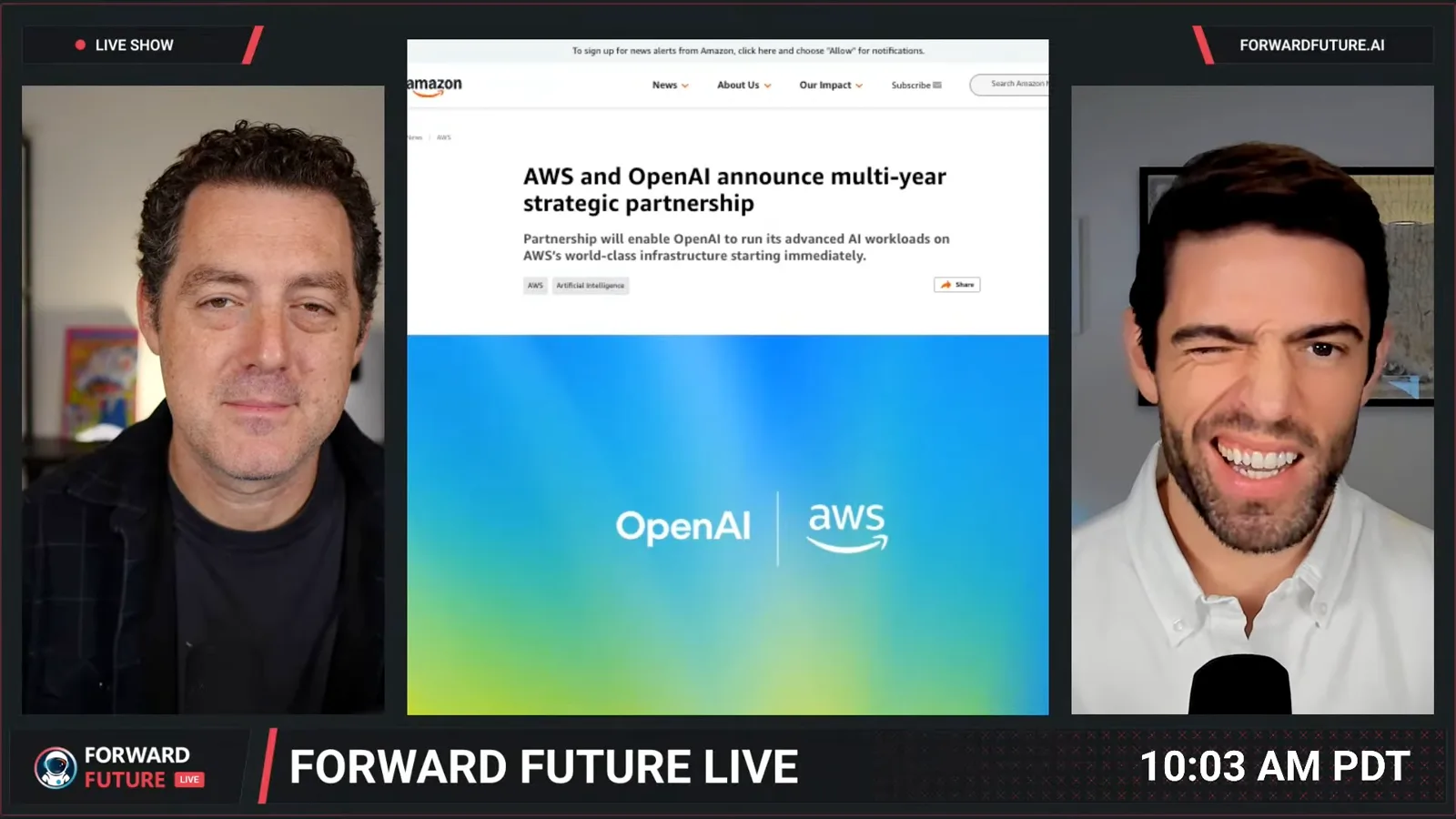
They cite an OpenAI revenue-run-rate forecast and very large reported infrastructure commitments. Berman emphasizes that annualized revenue is not profit; the commitments and projected future revenue are not equivalent to verified cash spent or realized earnings.
The hosts consider whether AI infrastructure investment resembles the dot-com bubble. They are bullish on long-term demand, although they acknowledge the possibility of a market correction. Their views are opinions about uncertain future returns.
They discuss OpenAI CFO Sarah Friar’s use of “backstop” and her subsequent clarification. The hosts quote her statement that OpenAI was not seeking a government backstop for its own infrastructure commitments and that her broader point concerned public and private roles in industrial capacity.
A displayed list bundles major infrastructure-related figures. The hosts also mention concerns about money circulating among investors, chip suppliers and customers; they admit the economics are difficult to untangle. Different proposed deals and investments should not simply be added as realized expenditure.
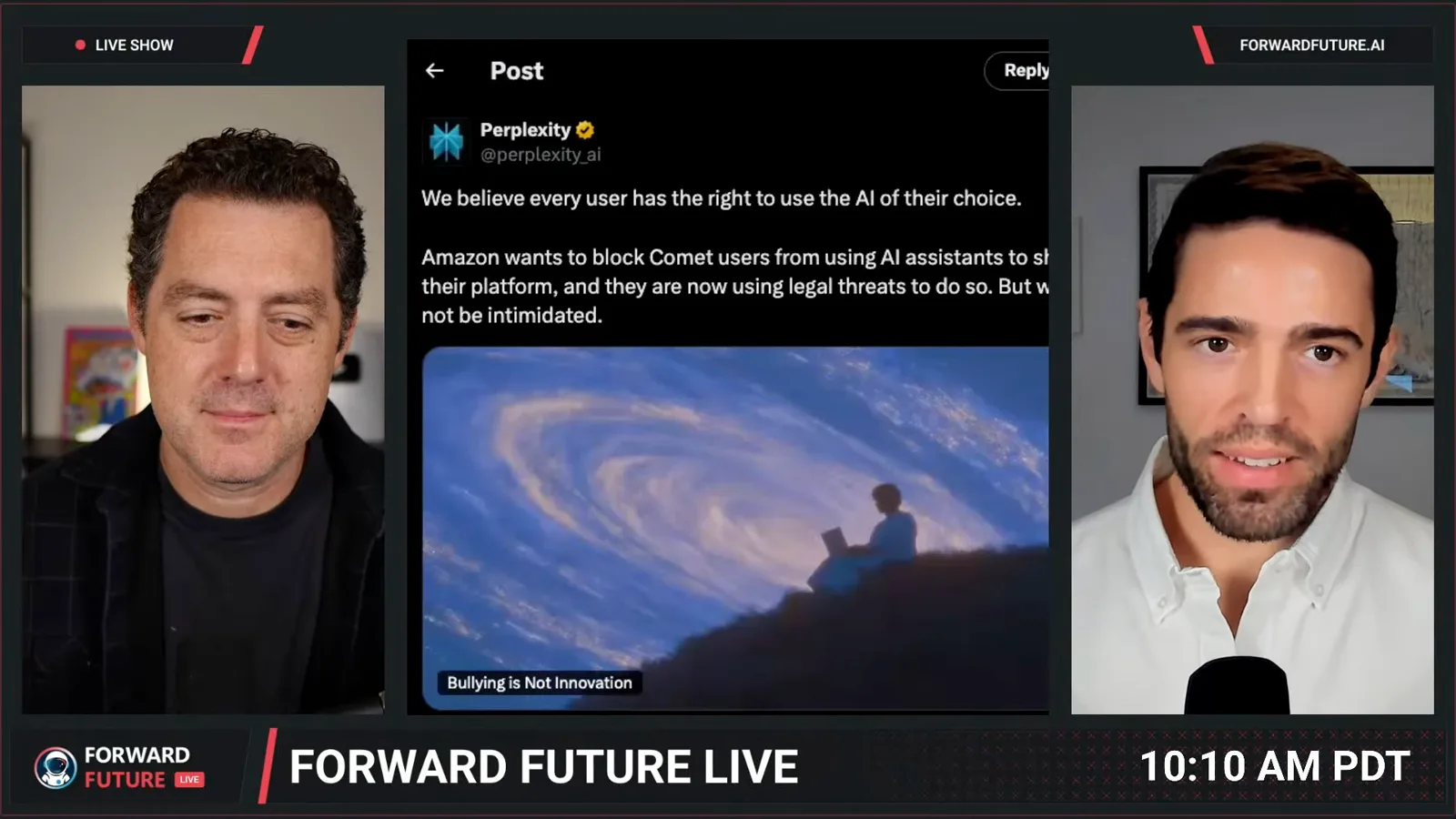
Perplexity says Amazon threatened legal action over Comet agents shopping on Amazon. The hosts discuss the user’s interest in delegating purchases and speculate about the effect on Amazon’s advertising and user data. The screen presents Perplexity’s account, and the hosts’ explanation of Amazon’s motives is their interpretation.
As they prepare to welcome Higgsfield’s founder, a connection problem delays the interview. They continue the news discussion while the production team works to restore the link.
Siri, Higgsfield and data centers in space
While resolving guest connection problems, the hosts discuss reporting about Apple and Gemini, a video tool and Google’s Suncatcher research. Their interpretations and predictions are not confirmed deployments.
The hosts discuss a report that Apple might use a custom Google Gemini model for Siri, reportedly on Apple’s private cloud and for a substantial annual fee. They debate whether it would be a temporary measure or a longer-term partnership; both are interpretations of a reported plan.
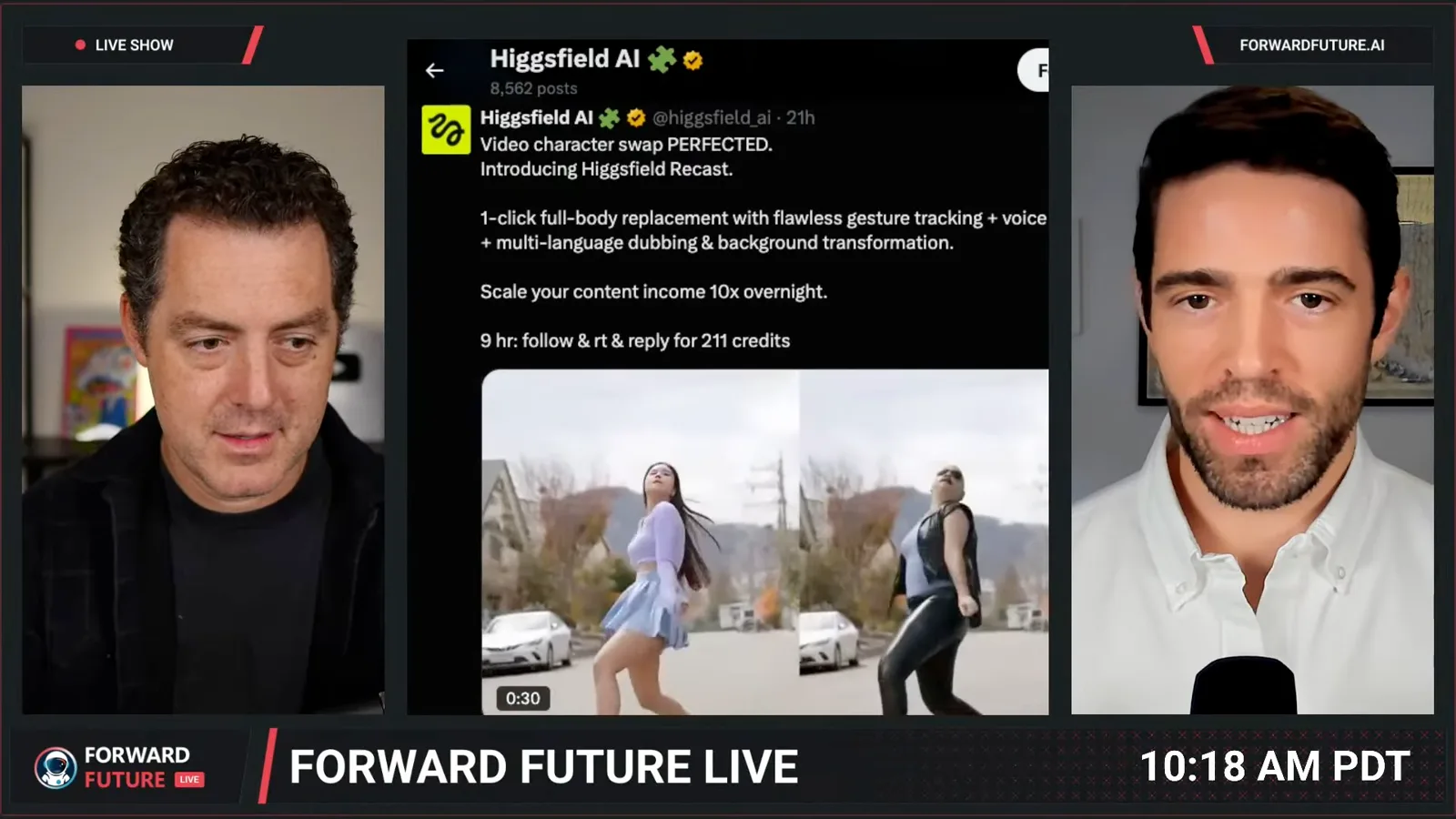
While waiting for the guest, they look at a Higgsfield Recast announcement showing a character replacement in video. The company describes features including gesture tracking, voice cloning and background changes; a selected demonstration does not establish flawless performance in all cases.
The hosts turn to Google’s Project Suncatcher, a research proposal for computing systems in space. They cite Google’s statement that Trillium TPUs were tested against simulated radiation and acknowledge that thermal management, orbital reliability and other engineering questions remain.
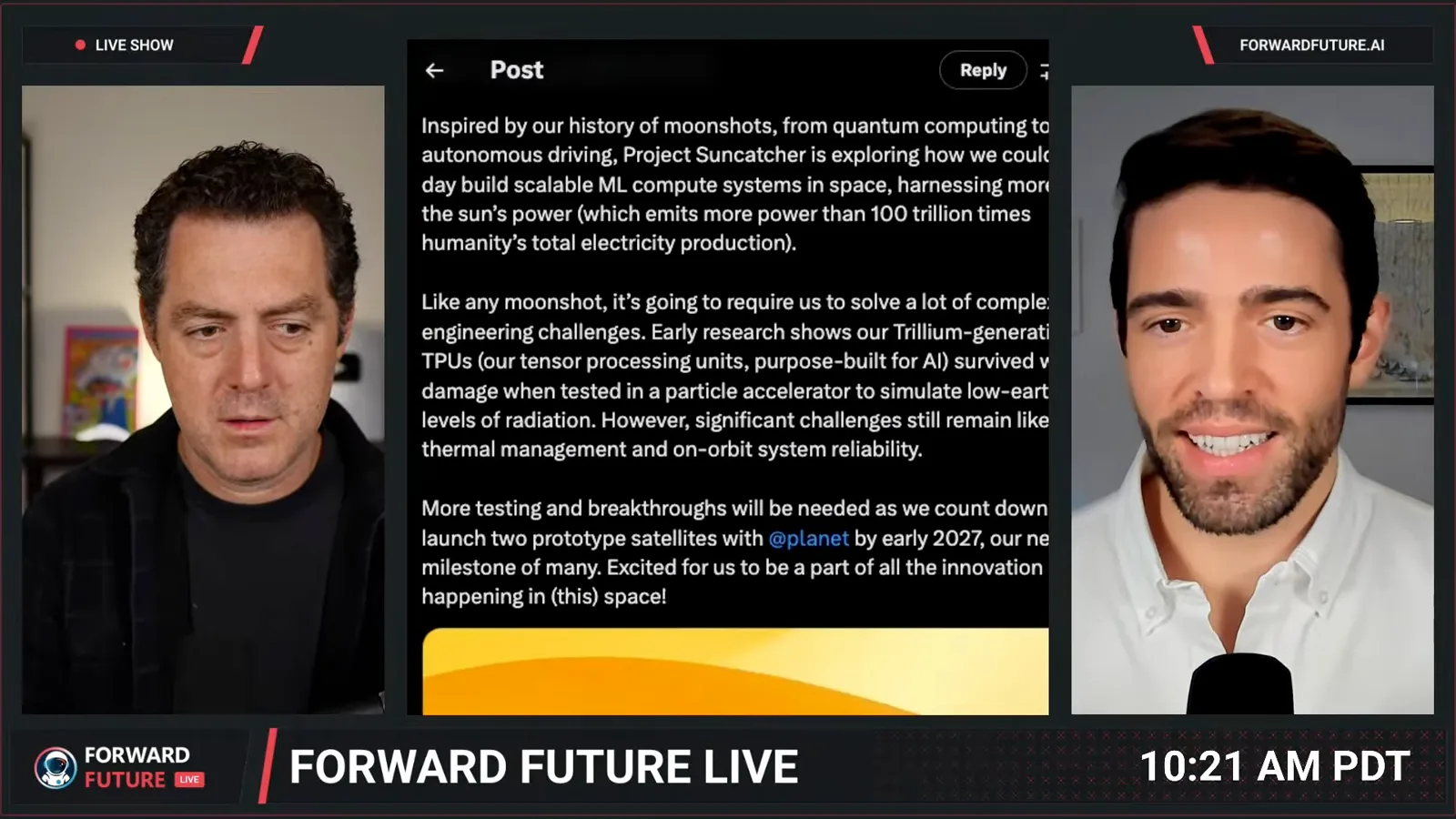
Berman describes closely spaced satellites exchanging data and the difficulty of maintaining a formation in orbit. The hosts also note that removing heat in a vacuum is challenging. The system is an early research concept, not a functioning orbital data center.
Alex Mashrabov on synthetic video marketing
The Higgsfield CEO describes generating and testing creative variations, his company’s tools and training costs. Claims about marketing performance and future adoption are attributed to him.
Higgsfield AI CEO and co-founder Alex Mashrabov joins after the connection is restored. He predicts that much social video will eventually be AI-generated and sees an opportunity for smaller businesses that need to publish frequently but lack large production teams.
Mashrabov says synthetic media could reduce the cost of making promotional content substantially. His cost comparison and his prediction about the future share of social video are company-side estimates, not measured outcomes across all advertisers.
Asked about movies and television, he is more cautious. He expects Hollywood to use a mix of live action and AI where appropriate but says he cannot confidently forecast their relative shares. Social media, in his view, puts particular pressure on speed and volume.
He says agencies are already using generative AI for storyboarding and describes Higgsfield’s storyboarding and team collaboration features. The aim is to help marketing teams pitch an idea quickly and maintain context around characters and settings.
The hosts ask whether longer underlying video models or software that stitches short clips will advance faster. Mashrabov instead highlights experimentation: he says teams can generate many variations to test characters, backgrounds and lighting.
Mashrabov reports double-digit percentage changes in CPM in some campaigns. When a host asks whether that means a doubling, he corrects the figure to roughly 10–20%; he also says evidence that such systems directly increase sales was still emerging. These are company observations, not independent causal results.
He describes synthetic spokespeople and AI avatars as popular use cases. Teams can also alter backgrounds, actors or products in a video, enabling more variants to be tested, though the practical performance of any campaign still depends on its execution.
Asked whether the hosts need an AI avatar, Mashrabov distinguishes their subject expertise and authentic long-form work from a small business seeking scalable promotional content. He expects authentic material to continue alongside synthetic content.
Berman asks why Higgsfield builds its own models as well as using other providers. Mashrabov argues that the larger opportunity is not merely generating video but improving marketing outcomes through post-training, experimentation and lower acquisition costs.
Mashrabov says his company spends millions of dollars per year on image-model work and argues that training frontier video models can require far more. He compares activity in US and Chinese labs; these cost and market estimates are his own assessment.
The group discusses access to GPUs and whether governments should support domestic AI infrastructure. Mashrabov claims GPU costs for his company’s scale are lower in China, while noting Higgsfield does not operate there. The comparison is his reported experience, not a universal price.
Asked which skills matter as video production becomes more accessible, Mashrabov separates performance marketing from distinctive creative work. He expects teams to test many variations while authentic creators continue to find audiences.
Kimi, retrieval and Ben Goodger on Atlas
The hosts discuss model and file-search news before Goodger explains Atlas, its Chromium integration and early agent use cases.
After a break, the hosts discuss Kimi K2 Thinking and cite benchmark figures shown in the announcement. They are impressed by open-weight models using tools during reasoning, but Berman says his own team had only begun testing the model.
They also discuss Google’s announced Gemini API file-search tool. Nick describes searching internal knowledge through Slack, while Berman wants a central searchable collection of articles, posts and videos. These are use cases they would like to improve, not a complete product evaluation.
Ben Goodger, an OpenAI engineering leader working on ChatGPT Atlas, joins the show. He says the browser was motivated by the idea of bringing conversational assistance along as people move across the web.
Goodger gives examples from his own use, including checking whether a pair of shoes was cheaper elsewhere and using a sidebar to interpret information in a patient portal. These are anecdotes; a generated interpretation is not a substitute for independent professional judgment.
He also describes asking agent mode to create a Google Form for user research. The hosts ask how ordinary users might discover such possibilities; Goodger says the team is still learning which workflows are useful and how best to surface assistance.
Goodger explains that Atlas uses Chromium and an integration layer called Owl. He says Chromium offers web compatibility and security foundations, while separating it from the rest of the application helps the team work on performance, development and agent features.
In his description, the model can synthesize input events such as a mouse click, which are passed through the integration layer to web content. The page receives an interaction resembling an ordinary input event. Goodger says this structure helps avoid unintended effects elsewhere in the browser.
Asked why OpenAI did not start with a new browser engine, Goodger says the team wanted to explore the ChatGPT-centered experience rather than rebuild the whole stack. He points to the lineage of browser projects built on earlier open-source work.
The hosts ask how publishers and websites might adapt to agent traffic. Goodger says the area is nascent, with possible ways for developers to make their sites easier for assistants to understand and operate. He does not offer a settled rule for the future web.
Goodger thinks agent traffic could eventually exceed human traffic, but expects people to keep browsing for learning, entertainment and decisions they want to make themselves. He sees agents as tools for taking away repetitive work rather than a reason to stop visiting the web.
Asked about agents proactively taking actions, he calls it a long-term vision with many steps still required. He stresses that Atlas agent mode was a research preview and that the initial product was an early stage in that journey.
Building and improving agentic browsing
Goodger discusses Codex-assisted development, product limitations and the work needed on speed, cost and trust. The hosts reflect on their own use.
Goodger says the team released early to learn from users and did not include every desired browser feature. At the time of the interview, a Windows version and multiple profiles were in development; he presents these as work in progress rather than existing features.
He describes using Codex to help build a tab-search feature. Goodger says he described the feature, iterated on interaction details with design feedback and passed code-review comments back to the tool. His reported few hours of work is one team member’s experience, not a general productivity benchmark.
The Atlas project began development at the start of 2025 after earlier prototypes. Goodger describes sharing an increasingly complete version with colleagues and friends before launching it a few weeks before the show.
On the main bottlenecks for agentic browsing, Goodger names speed, cost, access limits and, especially, trust that the assistant will take the right actions. He says both engineering optimization and model research are needed.
A model that tries several unsuccessful approaches before finding a solution adds latency. Goodger says better first-attempt accuracy and improvements across the browser-to-server stack could both reduce waiting time, while stressing that much work remains.
For enterprise use, he imagines assistants collecting data from several systems and preparing status updates or spreadsheets. Human judgment remains important, but he expects routine information transfer to become easier to automate.
Goodger is excited about personalization and browsing memories, giving the example of remembering a preferred airline. He imagines a browser that helps organize daily tasks, but treats that more proactive experience as a goal rather than a completed product.
After the interview, the hosts reflect on how difficult it is to discover when to use an agent. Nick prioritizes accuracy because repeated errors erode trust; Berman says he is particularly impatient with slow execution. Their preferences illustrate different product tradeoffs.
João Moura on enterprise agents
The CrewAI founder describes customer adoption, sales use cases, deployment barriers and model choices. Berman discloses an investment in the company.
The hosts welcome CrewAI founder and CEO João Moura. Nick says he previously worked with Moura, and Berman discloses a small early investment in CrewAI before discussing the company.
Moura says CrewAI began as an open-source agent framework in 2023 and expanded into a business helping enterprises build, deploy, monitor and orchestrate agents. The company describes working with 60% of Fortune 500 companies; the interview does not independently verify that figure or define the depth of each engagement.
He distinguishes widespread developer experimentation with the open-source framework from enterprise sales led by senior technology executives. He says sales cycles shortened and deal sizes grew as customers moved from tentative pilots to larger engagements; these figures are company-reported.
Moura describes a sales workflow that begins with a call transcript. Agents identify possible customer use cases, research one, build a demonstration and produce a video with a synthetic version of his face for the salesperson to share. He describes a roughly 50-minute turnaround in one account.
For a complex use case such as invoice reconciliation, Moura says the system researches unfamiliar details before producing a tailored demonstration. He does not claim the resulting prototype is automatically ready for the customer’s production environment.
Enterprise use cases differ because companies have different data and integrations, even within the same industry. Moura groups common work into back-office automation, go-to-market, logistics, customer support, coding and regulated document or identity processes.
The hosts ask about a prediction that future agents will do work humans never did. Moura distinguishes entirely new tasks, redesigned existing processes and new business lines that were previously too costly to attempt. He cites a telecom example involving credit-related services as a customer story.
As an illustration of process redesign, Moura suggests that if agents both scope and implement features, some work-tracking steps designed around human handoffs might change. He uses Jira as an example, not evidence that every team should discard its tracking system.
Moura says enterprise deployment is still early: many organizations have attractive prototypes but struggle to put them into production. Building an agent is only the initial cost; he argues that business value appears when it is deployed and used.
He identifies confidence as a major barrier. Enterprises need answers about security, data handling, audit logs, observability and guardrails; many of the obstacles are organizational or infrastructure-related rather than simply a model’s intelligence.
Berman asks how model selection changes from experiments to deployment. Moura says existing cloud contracts and credits often shape the starting choice, alongside requirements about whether customer data can be used for training.
He expects fine-tuning and smaller models to become more important and describes regional preferences for models adapted to local language and business needs. That is his forecast and experience with customers, not a universal deployment rule.
The hosts raise platform risk as model providers and cloud companies build their own agent tools. Moura says enterprises value the ability to use different models and clouds and to retain their own workflows; he positions CrewAI’s portability as an answer to those concerns.
Jeff Koch on Substrate and chipmaking
The SemiAnalysis analyst explains lithography, ASML’s lead and Substrate’s proposed foundry. He separates imaging evidence from unproven commercial-scale performance.
The final guest, SemiAnalysis analyst Jeff Koch, studies chipmaking equipment, process technology and materials. The hosts ask about his firm’s analysis of Substrate, a startup proposing both a new lithography tool and an advanced US foundry.
Koch says Substrate claims a tool competitive on paper with advanced ASML equipment at about one-tenth the cost, together with a foundry ambition to challenge TSMC. He considers the work interesting but says extraordinary claims need more evidence.
Lithography transfers very small circuit patterns onto wafers, repeatedly and with precise alignment. Koch explains the proposed X-ray approach in terms of light, a patterned mask and a wafer; the interview does not reveal all details of Substrate’s design.
He contrasts the proposal with ASML’s extreme-ultraviolet tools, which use 13.5-nanometer light. Shorter wavelengths can assist with smaller patterning, but the overall manufacturing process requires far more than a wavelength comparison.
Koch says leading-edge lithography tools can cost around $400 million and cites a possible $40 million figure for Substrate’s claimed approach. These are approximate comparative figures; the startup’s production cost and performance have not been proven at scale.
Images of patterned wafers are encouraging, Koch says, but do not establish high-volume manufacturing, yield or commercial reliability. A working imaging demonstration and a competitive foundry are different milestones.
Asked why ASML is so difficult to challenge, he points to a large engineering organization, sustained research spending and long technical bets. He cites immersion lithography and EUV as examples that took years to mature and helped establish a lead.
Koch describes Substrate founders James and Oliver Proud and says the startup has recruited engineering talent. He notes that the company has shared few technical details, limiting what an outside analyst can independently assess.
Asked whether he believes the claims, Koch says the images support some aspects of the tool’s imaging capabilities in his judgment. He is much less certain about commercialization, which he calls a very difficult and unproven challenge.
Substrate’s stated strategy is to build its own foundry rather than simply sell a lithography machine to TSMC. Koch describes the aim of making advanced wafers far more cheaply as a moonshot, not an achieved manufacturing result.
The company has discussed producing wafers in 2028. Koch says that timeline is very difficult and considers something closer to a decade plausible; even that longer timeline is his forecast, not a commitment or outcome.
The discussion turns to the concentration of advanced chip manufacturing in Taiwan. Koch sees both economic and national-security implications if access to that capacity were disrupted, while acknowledging uncertainty about how a new competitor would change Taiwan’s position.
Koch also discusses Chinese efforts in lithography, including work on X-ray and EUV-like approaches. He believes China could make substantial progress in five to ten years, but that is a prediction about uncertain research and industrial development.
The hosts thank Koch for explaining the manufacturing landscape and close the show after recapping the guests. The conversation leaves the central question open: whether the proposed technologies can become reliable, economical production systems.
Más de este canal
 34:21EN
 Matthew Berman· 27 oct 2026Matthew Berman Examines Anthropic’s IPO Filing, AI Growth and GovernanceMatthew Berman, Sam Altman · Forward FutureThe presenter reviews the S-1’s financial metrics, compute strategy and voting structure while questioning the tension between rapid AI development and safety.
 25:50ENMatthew Berman· 24 oct 2026Kimi K3.1 Pro Tested: Strong 3D Demos, Uneven Results and Competitive PricingMatthew Berman · Forward FutureMatthew Berman tests the open-weight model on coding, 3D rendering and visual explanations, then compares benchmark results and prices.
 32:20ENMatthew Berman· 23 oct 2026Who Is Local AI For? The Costs, Trade-offs and a Hybrid FutureMatthew Berman · Forward FutureMatthew Berman weighs data control and independence against hardware cost, setup complexity and inference speed.
 1:03:37ENMatthew Berman· 23 oct 2026Matthew Berman’s Team Tests Kimi K3.1 on Animation, Games, and ChartsMatthew Berman, Alex, Brian · Forward FutureA live team AMA turns into an informal test of Kimi K3.1, from personal-agent workflows to motion graphics, a browser game, and a benchmark chart.
 0:53ENMatthew Berman· 22 oct 2026Sam Altman on AI and the Discovery of New KnowledgeSam Altman · OpenAIAltman expects progress in mathematical discovery to extend to biology, materials and energy.
 0:22ENMatthew Berman· 21 oct 2026A Robot Bodyguard Video Shows Dramatic Rescue ScenariosMatthew Berman · Forward FutureMatthew Berman reacts to a short robot demonstration depicting fighting and vehicle-rescue scenarios.