En 30 segundos
Frank Long describes how an investment firm can give agents access to external and internal context, then decompose decisions into testable stages. A Korean-language news example shows the many workflow choices involved and why the objective should be quality rather than automation for its own sake.
- 1A fund as a functionLong frames investment as turning internal and external context into selection, size and timing.
- 2Context must be accessibleNews and filings are useful alongside positions, risk constraints and institutional history.
- 3The Korean news exampleCollection, filtering, translation and cross-referencing each introduce design choices.
- 4Four kinds of runnerCode, statistics, language models and humans each fit different parts of a workflow.
- 5Evaluate against a goalBreaking the problem into measurable pieces helps a team improve the system rather than merely tinker.
Conclusiones
- Investment decisions combine what to select, how much to hold and when to act.
- Agents need appropriate access to both external information and institutional context.
- Even a news-processing pipeline has many choices that must be evaluated.
- Code, statistical methods, language models and people can each be the right runner for different steps.
- A clear evaluation target is needed to improve a complex workflow rather than merely change it.
Lee el texto editado por capítulos
Investing as an information-to-decision function
Long introduces his thesis and frames a portfolio as a sequence of selection, size and timing decisions.
I work at Coatue, a technology investment firm active in public and private markets. My bet is that AI agents will eventually have an even bigger impact on investing than on coding. That is a strong claim; what I want to explain is the framework we use to try to realize that impact.
Think of a hedge fund as a function. Its inputs are external and internal context; its output is a decision with three components: what to select, how much to hold and when to act. A portfolio is a time series of those decisions. The challenge is compressing an enormous amount of information into that small decision.
External and internal context
Agents need access to relevant information and a culture that captures institutional knowledge.
My first principle is that information a person can see on a screen should also be accessible to an agent through an API. Even an exceptionally capable investor would be hamstrung if they joined a firm and lacked access to most of its tools. Intelligence alone is not enough when the system cannot reach the information it needs.
External context includes news, prices and filings, ideally available directly rather than through manual copying. Internal context matters just as much: current positions, liquidity and risk constraints, past case studies, and the firm's history with a sector, company or management team.
The foundation is cultural as well as technical. Data systems make information available, but a rigorous process for recording what was considered, what was done, what was not done and what happened afterward makes accumulated institutional knowledge usable. Decades of notes create a potential resource for AI systems.
Decomposing an investment workflow
The process can be split into gathering, analysis and decisions, each with its own inputs and outputs.
I cannot simply stuff all of that context into a model and expect it to produce three magic numbers. I break the problem into gathering relevant material, analyzing it to form a view, and turning that view into a decision. Each stage has inputs and outputs, with the output feeding the next stage.
Even gathering is nuanced. A sports story may have little to do with a position, while a local permitting story could matter to a data-center theme. Once relevant material is found, the team still has to interpret its implications for public and private markets and decide how it affects the portfolio.
A Korean-language news case study
Long explores collection, filtering, translation and cross-referencing. Each step adds design choices.
To see the complexity, consider one small task: interpreting Korean-language news about semiconductors. The sector has been important to AI investing, and language models may help a team that does not speak Korean read the relevant coverage. The usefulness of this approach still has to be tested.
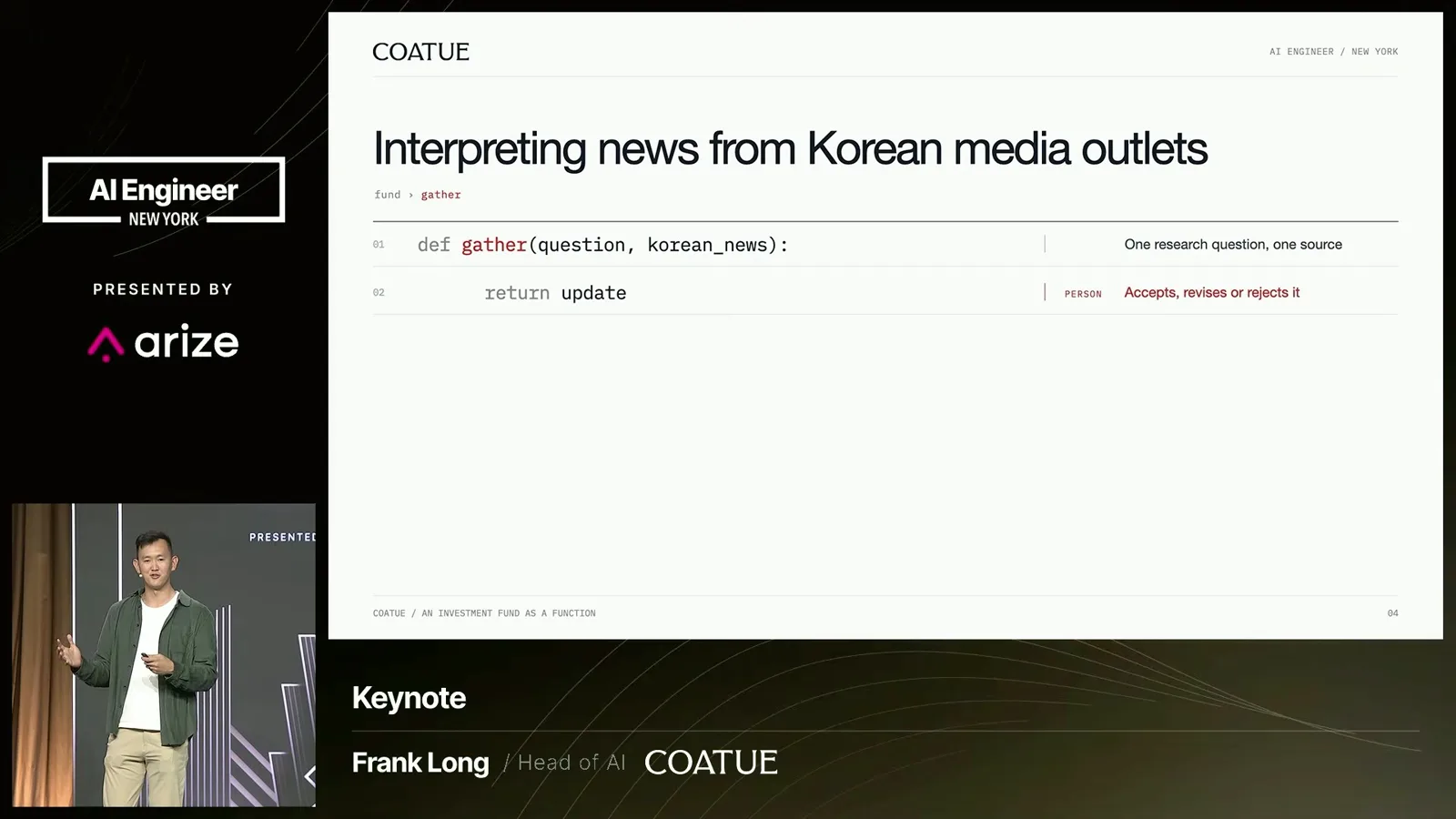
Collection alone offers many choices: license and clean feeds, access them through an MCP server or command-line tool, decide how to split articles, and decide whether images should be passed to the model as images or converted into text. I think of these design choices as parameters to tune.
Next comes filtering: much of the news will not matter to our positions and themes. Then we choose whether to translate, summarize or extract a structured record. The best way to expose information to a model may also change as the models themselves change.
We also need to cross-reference the outside information with our own notes, views and conversations. Pulling evidence from different sources and checking it against other evidence can be powerful; it can also lead us to update an existing view rather than merely add another summary.
Choosing runners and evaluating the system
Code, statistics, models and people can be combined. A clear evaluation target guides the search through possible workflows.
Each step can have a different runner. Deterministic code is fast, inexpensive and reliable for an explicit rule. Statistical methods and classical machine learning can model more complicated relationships. Language models and agents provide another option for tasks such as summarization.
People are runners too. A meeting with a management team may call for human judgment and the ability to navigate the real world. There is no value in automating a step merely to increase the number of automated steps: the objective is the best quality for the function as a whole.
The workflow is not necessarily a straight line. One design might translate, extract quotations and verify them against sources; another might deduplicate, filter and pull additional figures. A different starting point might be an internal note that needs supporting or contradictory evidence.
Different stages may combine runners instead of selecting just one: code with a model, statistical filtering with an LLM, or a human using deterministic search. Even within the LLM option there are choices of model size, reasoning effort, harness, skills and hooks.
The search space becomes huge even for news filtering. To improve it, we need to isolate pieces we can understand and evaluate, and define the outcome we are optimizing for. Without that north star, swapping an LLM for a classifier or a rule is just tinkering.
The right answer can differ by stage. A model may be weak at translating an item into portfolio impact, so a human might make that judgment with deterministic tools helping them find evidence. The point is to choose the combination that works, not to privilege any one technique.
The larger graph and applications
Long discusses technical and organizational complexity and applications beyond investing.
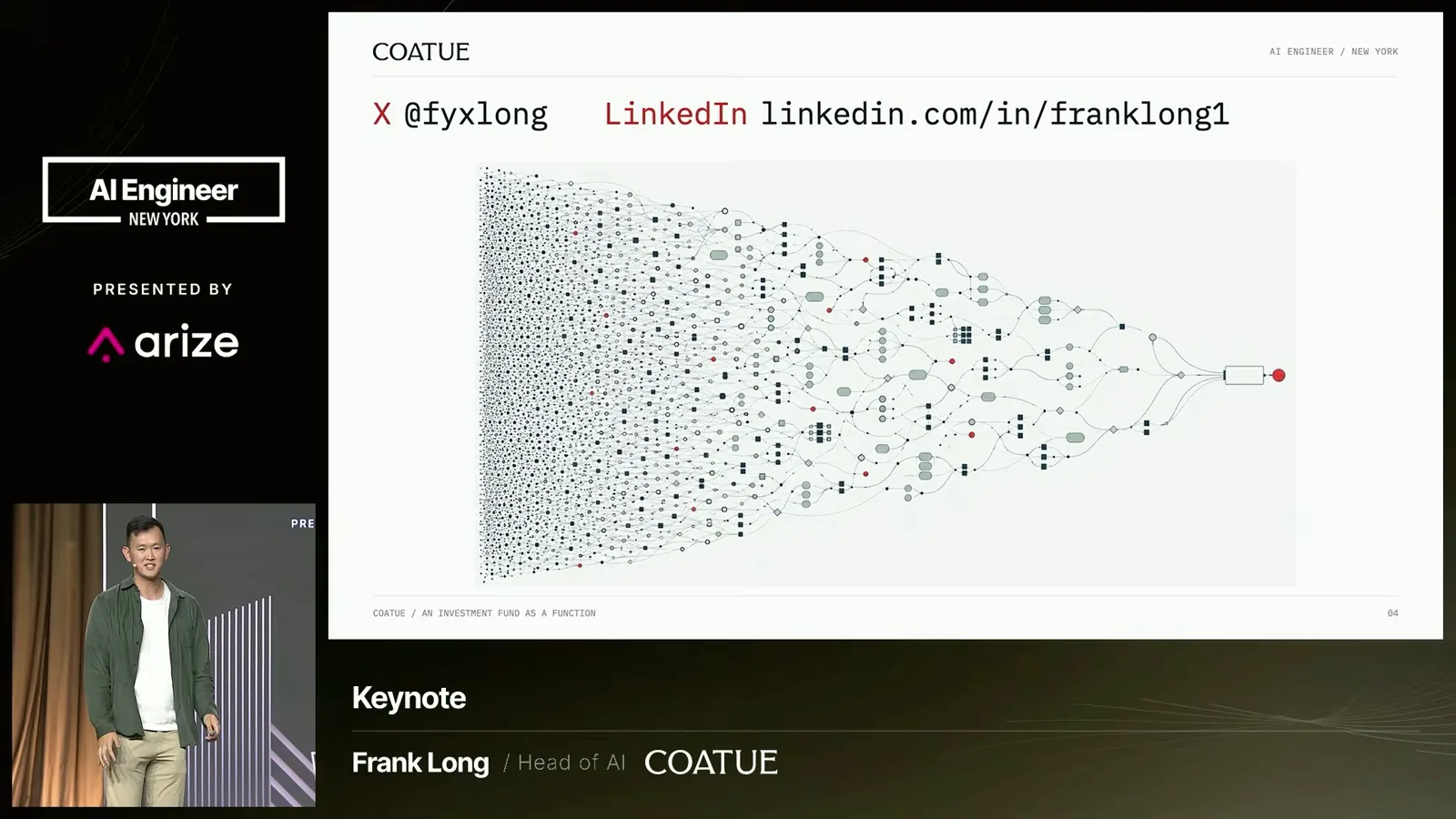
The real graph across all the firm's data sources is much more complex than the news example. Each node has multiple design choices, and the organization has to understand the system technically and absorb it culturally. That is the practical challenge of applying AI to investing.
The same pattern extends beyond investing: a system takes information from the world and tries to turn it into coherent decisions. Policy, nonprofits, drug discovery and corporate strategy face versions of that problem too, so methods and lessons can travel across fields.
Más de este canal
 23:05ZH
 AI Engineer· 6 nov 2026Ryo Lu:当我们什么都能做,还知道自己想做什么吗?Ryo Lu从 AI 生成的日记工具到爵士乐团,Ryo Lu 讨论如何在更强大的工具旁保有判断、生活和与他人合作的空间。
 14:58ENAI Engineer· 6 nov 2026Sparsh Jain on Building Experiential Memory for AI AgentsSparsh Jain · CentralAgent AIAn agent-memory lifecycle forms, updates and retrieves lessons while evaluation loops manage changing context.
 17:27ENAI Engineer· 6 nov 2026Philipp Schmid: Seven Things an AI Coworker NeedsPhilipp Schmid · Google DeepMindA walkthrough of managed agents, skills, credentials and controls, culminating in a scheduled portfolio-audit demo.
 18:13ENAI Engineer· 6 nov 2026Sid Pednekar: Judgment Is the Scarce Resource in AI AdoptionSid PednekarA framework for choosing valuable problems, building shared capabilities and turning experience into organizational learning.
 17:52ENAI Engineer· 5 nov 2026Cameron Wolfe on Evaluating AI When Answers Are SubjectiveCameron Wolfe · NetflixNetflix’s Cameron Wolfe outlines human review, calibrated model judges and production monitoring as a repeatable evaluation loop.
 20:45ENAI Engineer· 5 nov 2026John Stecher and Scott Worland on Building AI Systems That Can ChangeScott Worland, John Stecher · Norm AIThe Blackstone and Norm AI CTOs discuss data strategy, evaluations, production controls and when to wait for a better model.