En 30 segundos
In this Real Numbers episode, Sawyer presents a piggy-bank challenge involving a hidden Sunday deposit and a randomly drawn $20 bill; the new question is left to viewers. He then solves the previous DMV problem using Bayes’ theorem, a complement and a 100-person count, obtaining 11/15.
- 1The hidden Sunday depositA grandmother adds a $1 or $20 bill with equal probability; a randomly drawn bill is $20. The episode asks for the updated probability that the new bill was $20.
- 2Apply total probabilityThe overall DMV pass rate and the rate among non-studiers imply a pass rate of 11/12 among those who studied.
- 3Use the complementThe probability that a passing applicant did not study is 4/15, so the probability they studied is 11/15.
- 4Count 100 applicantsOf 75 applicants who passed, 55 studied, giving 55/75 = 11/15.
Conclusiones
- New observations can update a prior probability through Bayes’ theorem.
- The total probability rule relates an overall rate to the rates of its component groups.
- For the DMV example, the probability an applicant studied given that they passed is 11/15.
- A frequency table offers a direct check on a conditional probability.
Lee el texto editado por capítulos
A new piggy-bank puzzle
A randomly selected $20 bill supplies evidence about a hidden Sunday deposit. Sawyer leaves the updated probability as a challenge for viewers.
Sawyer introduces a probability puzzle about a generous grandmother and a secret college fund. Each Sunday for an unknown number of weeks, she has independently chosen a $1 bill or a $20 bill with equal probability and placed it in a piggy bank.
On Saturday, she reveals that the bank contains three $20 bills, but not how many $1 bills. She adds another randomly chosen bill on Sunday. On Monday, you draw a bill uniformly at random and it is a $20 bill. What is the probability that Sunday’s addition was also a $20 bill? Sawyer leaves the new puzzle for viewers.
Before seeing the drawn bill, the probability that Sunday’s addition was $20 is one-half. Drawing a $20 bill provides new information, so the task is to update that prior probability. Bayes’ theorem describes how to do this; the episode illustrates it using the previous week’s question.
Bayes’ theorem and the DMV
The prior episode’s study and pass rates lead to a conditional probability of 11/15. A complement gives a shorter calculation.
In the earlier problem, Evelyn knows that 60% of DMV applicants studied, 75% passed, and an applicant who did not study had a 50% chance of passing. After learning that someone passed, she wants the probability that they studied.
Bayes’ theorem gives P(study | pass) = P(pass | study) × P(study) / P(pass). The study and overall pass rates are known, so first find P(pass | study) using the total probability rule: the overall pass rate is the weighted average of the pass rates for those who studied and those who did not.
Substituting the known values gives 3/4 = (3/5) P(pass | study) + (2/5)(1/2). Solving yields P(pass | study) = 11/12. Bayes’ theorem then gives (11/12)(3/5)/(3/4) = 11/15 for the probability that a passing applicant studied.
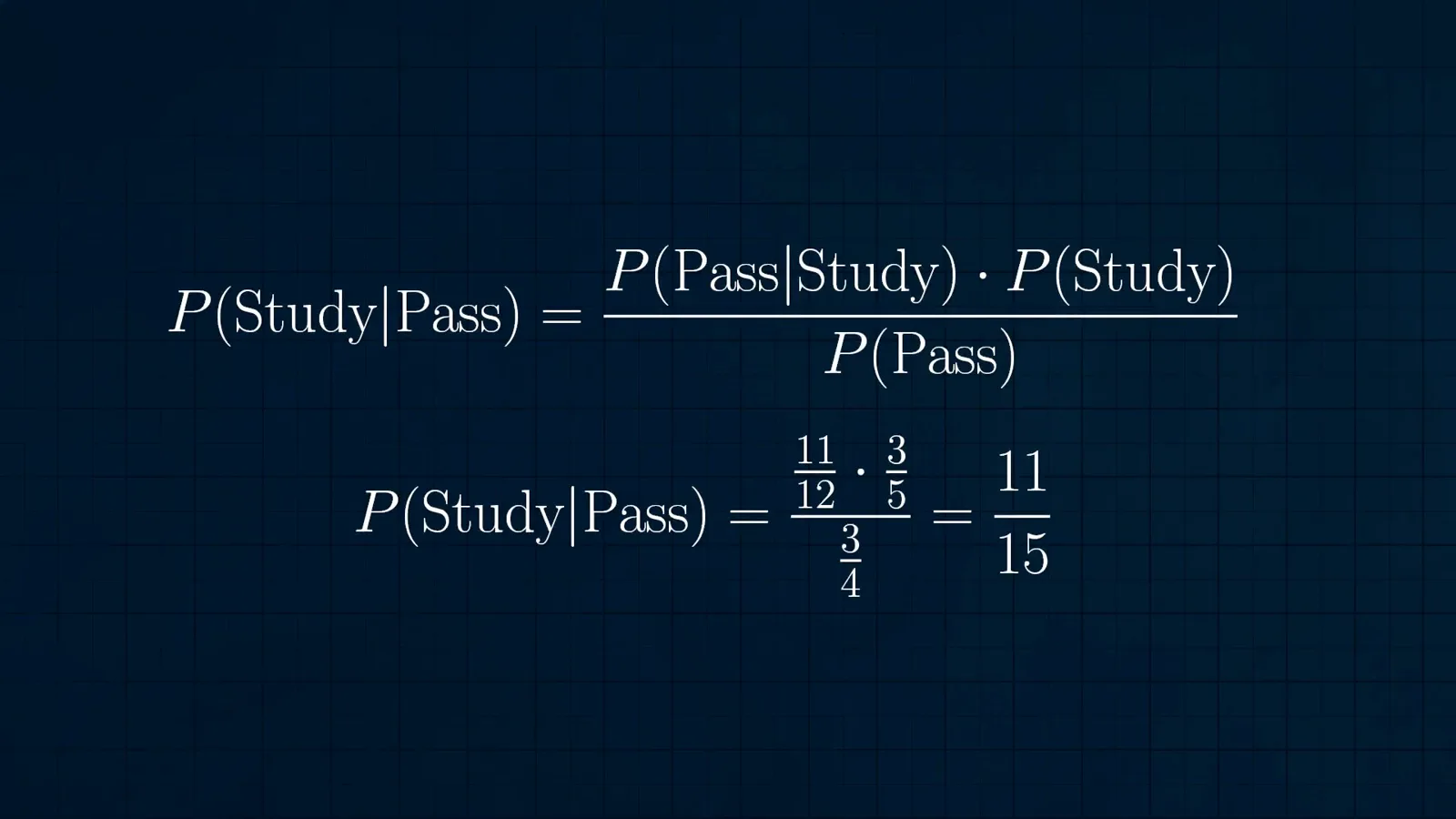
There is a shorter route. Calculate P(not study | pass) directly: (1/2)(2/5)/(3/4) = 4/15. Taking the complement gives P(study | pass) = 1 − 4/15 = 11/15, the same result.
A frequency check and the challenge
A 100-person count reproduces the result. Sawyer returns to the piggy-bank problem for viewers to solve.
A picture of 100 applicants gives another check. Sixty studied and 40 did not; 75 passed and 25 failed. Half of the 40 non-studiers passed, so 20 passed and 20 failed. Of the 60 who studied, 55 passed and five failed to complete the totals.
Among the 75 passing applicants, 55 studied. The probability is therefore 55/75 = 11/15, agreeing with both calculations. This count-based representation makes the conditioning explicit: after learning that a person passed, only the passing group remains in the denominator.
The episode returns to the piggy bank: it had three $20 bills and an unknown number of $1 bills on Saturday, then received a randomly chosen $1 or $20 bill on Sunday. A randomly selected bill is $20 on Monday. Viewers are invited to determine the probability that Sunday’s bill was $20.
Más de este canal
 1:48:29EN
 1:36:37EN
 1:05:45EN
 1:25:00EN
 1:16:29EN
 27:39EN