En 30 segundos
Elon Musk says rocket reuse must be fast and complete enough to make repeated flights affordable, especially if people want to build a base on Mars. In a July 2014 Colbert Report interview, he also compares Tesla’s patent pledge to sharing a better bucket on a leaking ship. The conversation moves from SpaceX cargo and a forecast for crewed Dragon to electric aircraft and Stephen Colbert’s wish for wireless charging. This is a 2025 upload of an older interview; Musk’s crew-flight estimate predates NASA’s 2020 launch.
- 1Rapid reuse is Musk’s answer to expensive repeated rocket flightsHe compares disposable rockets with single-use aircraft and says refueling and flying again would make frequent missions more affordable.
- 2A Mars base needs more than a few expendable flightsMusk says one or two missions could use expendable rockets, but establishing a base would require a lower-cost way to fly repeatedly.
- 3Tesla’s patent policy was meant to help others build electric vehiclesMusk compares sharing technology to sharing a better bucket on a leaking ship; Tesla’s pledge has conditions for good-faith use.
- 4Musk proposes an electric vertical-takeoff aircraftHe suggests an electric motor driving a fan and discusses speed and efficiency tradeoffs with Colbert.
Conclusiones
- Musk argued that repeated Mars flights require much lower launch costs, which he hoped rapid rocket reuse would provide.
- Tesla’s patent pledge applies to covered activity by parties acting in good faith; it did not transfer ownership of its patents.
- Musk’s 2014 estimate for crewed Dragon was two to three years; its first astronaut launch occurred in 2020.
- Musk proposed a vertical-takeoff electric aircraft driven by a fan, an idea discussed rather than a product demonstrated.
Lee el texto editado por capítulos
A friendly Tesla and a reusable rocket test
Colbert asks about Tesla software and shows SpaceX test footage. Musk explains why refueling and reusing rockets matters.
Stephen Colbert introduces Elon Musk and jokes that his ventures make him sound like a supervillain. The conversation is from The Colbert Report in July 2014; this video was uploaded in 2025.
Colbert says his Tesla’s automatic door handles make the car feel like a friend. Musk says a software update will let owners name their cars and explains that he has named his own early production car Old Faithful.
Colbert introduces footage of a SpaceX reusable-rocket test flight. After the clip, Musk says the goal is rapid, complete reusability: instead of discarding a rocket after each flight, operators could refuel it and fly again.
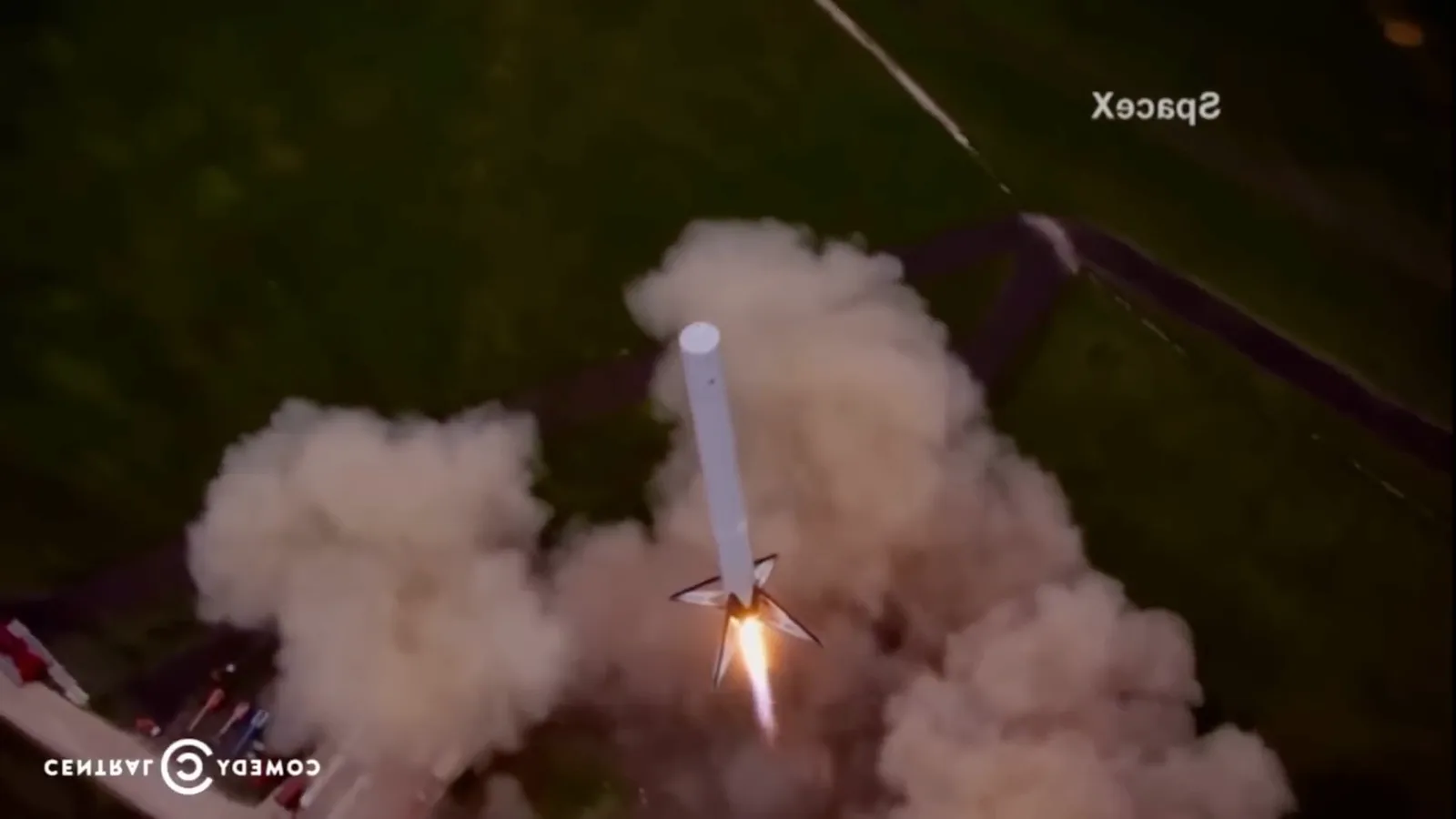
Colbert asks why that matters for Mars. Musk says a few people might travel with expendable rockets, but repeated flights to establish a base would otherwise be too expensive.
Space-station transport and Tesla’s patent pledge
Musk describes cargo flights and forecasts a crewed Dragon. He explains the reasoning behind Tesla’s good-faith patent pledge.
Colbert asks about transporting cargo to the International Space Station. Musk says SpaceX and Orbital Sciences both deliver cargo, while SpaceX also returns cargo to Earth. The exchange reflects their operations at the time.
Asked when SpaceX could carry astronauts, Musk says he hopes the next version of Dragon will do so in two or three years, and describes a planned precision landing using side-mounted thrusters. [NASA records](https://www.nasa.gov/humans-in-space/nasa-and-spacex-complete-certification-of-first-human-rated-commercial-space-system/) that Crew Dragon first launched astronauts in May 2020.
Colbert asks why Tesla has made its patents available. Musk compares sharing technology to sharing a better bucket on a leaking ship: even a company that bails faster benefits if everyone can help keep the vessel afloat.
Tesla’s [patent pledge](https://www.tesla.com/en_ph/legal/additional-resources) says it will not initiate patent lawsuits over covered electric-vehicle technology against parties acting in good faith. The pledge has defined conditions; it is not a transfer of all patents.
Jetpacks, electric aircraft and wireless charging
Musk favors exploring an electric vertical-takeoff aircraft over a jetpack. Colbert ends with a wish for conversational computers and wireless charging.
Colbert asks for a personal jetpack. Musk says he has not worked on one and points to noise and the difficulty of landing as practical obstacles.
Musk instead suggests an electric supersonic aircraft capable of vertical takeoff and landing. He contrasts moving a fan with directing airflow through ducts, while acknowledging the Harrier as an example of a vertical-takeoff aircraft.
Asked how an electric jet could work, Musk says an electric motor could drive a fan. He and Colbert discuss how the large fan in a high-bypass jet engine supplies much of its thrust, and Musk describes a tradeoff between open-fan efficiency and a ducted design’s speed.
Colbert asks for computers that respond conversationally rather than through keyboards and for devices that charge wirelessly as he moves around. Musk jokes that they will do it, and Colbert closes the interview.