Claude Opus 4.1: Anthropic’s August 2025 Benchmark Update

Matthew Berman reviews the model’s reported coding, reasoning and tool-use results, including one benchmark that declined.

MBMatthew BermanPresenta · Forward Future
Canal
Matthew Berman
Publicado
5 ago 2025
Vídeo
3:13
Lectura
1 min
Diapositivas
1
Original
inglés
Abrir en YouTube
Al desplazarte, el vídeo se reduce a la esquina inferior derecha y sigue reproduciéndose. Los subtítulos siguen tu idioma de lectura.
Idioma de lecturaDisponible en 2 idiomas
Este artículo aún no está en español, así que se muestra el original en inglés.
RESUMEN

En 30 segundos

In an August 2025 video, Matthew Berman reviews Anthropic’s Claude Opus 4.1 announcement and its selected benchmark comparison. He sees gains in several coding tests but notes a lower airline tool-use score and says practical testing matters.

  1. 1Coding resultsThe displayed SWE-bench Verified result rose from 72.5% to 74.5%, a two-percentage-point increase.
  2. 2Mixed tool-use scoresTerminal-Bench increased, but the airline portion of TAU-bench fell from 59.6% to 56.0%.
  3. 3Compare by taskThe table shows other models ahead on GPQA Diamond and AIME 2025; Berman plans practical testing.

Conclusiones

  1. Anthropic reported 74.5% on SWE-bench Verified for Opus 4.1 versus 72.5% for Opus 4 in its displayed comparison.
  2. Terminal-Bench rose in the table, while the airline portion of TAU-bench declined.
  3. Other models led the displayed GPQA and AIME comparisons; results depend on evaluation settings and task.
  4. Berman treats real-world usage as an important complement to benchmarks.
TEXTO COMPLETO

Lee el texto editado por capítulos

Solo la transcripción
01

The Opus 4.1 release

Berman introduces Anthropic’s update and its stated goals.

Anthropic announced Claude Opus 4.1 in August 2025 as an update to Opus 4 for agentic work, coding and reasoning. I review the company’s reported benchmark table, which reflects its selected tests and settings at the time.

02

Benchmarks and real-world use

He reviews coding, tool-use and reasoning scores and emphasizes practical evaluation.

On SWE-bench Verified, the displayed scores rise from 72.5% for Opus 4 to 74.5% for Opus 4.1: an increase of two percentage points. Anthropic also describes improvements in research and analysis, including tracking details and agentic search.
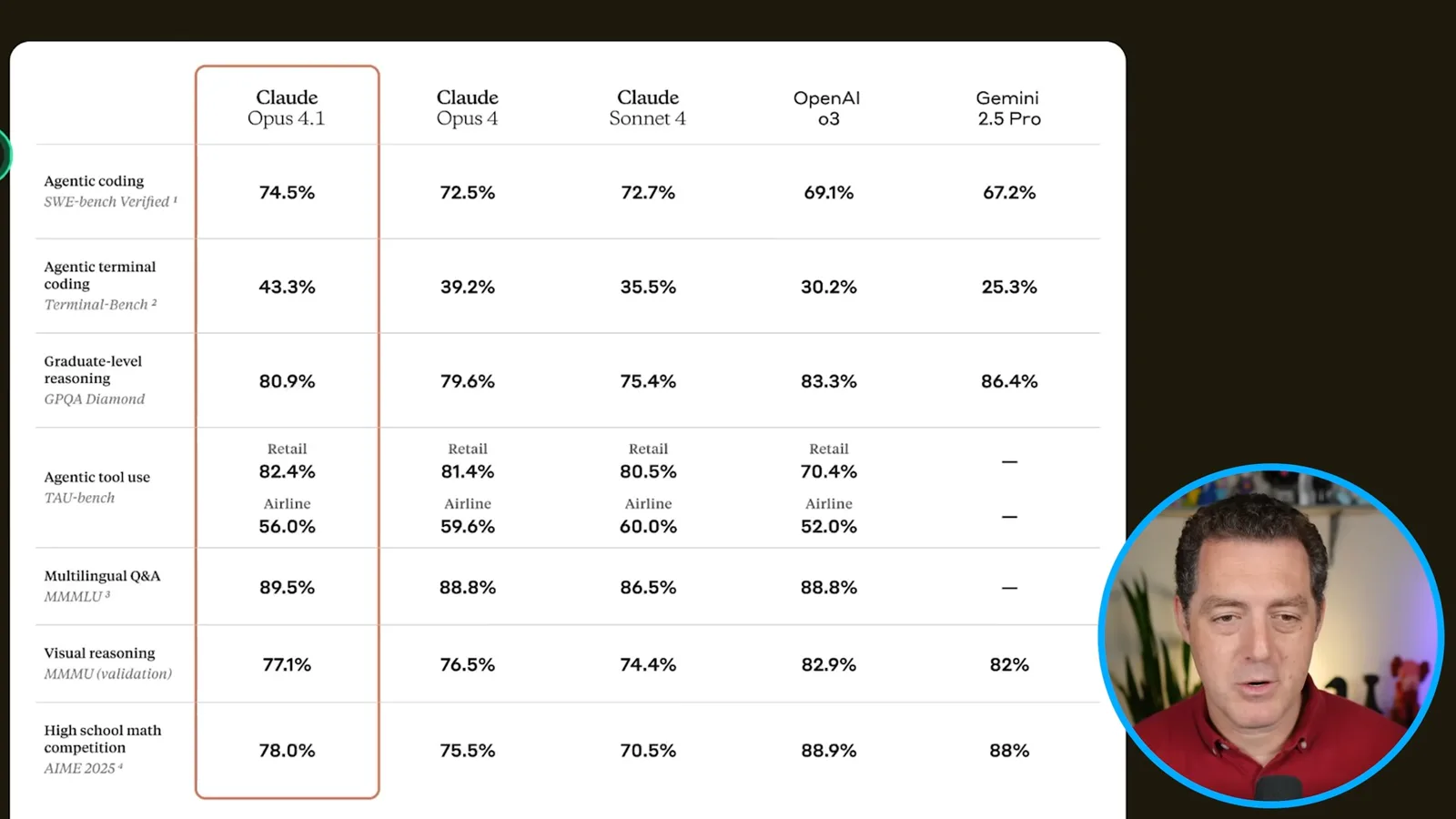
Anthropic’s selected benchmark table
DIAPOSITIVA 1 / 1Anthropic’s selected benchmark tableThe table compares coding, tool use and reasoning under the reported evaluation settings; the airline score declines.

The table shows Terminal-Bench increasing from 39.2% to 43.3% and GPQA Diamond from 79.6% to 80.9%. TAU-bench retail rises from 81.4% to 82.4%, while airline falls from 59.6% to 56.0%. Other displayed categories show smaller gains.

In the displayed comparison, Opus 4.1 leads the included o3 and Gemini 2.5 Pro results on the two coding benchmarks, while those models score higher on GPQA Diamond and AIME 2025. These selected numbers do not establish a universal ranking.

I think the important question is how the model works on actual tasks, and I plan to test it. My view that Claude was particularly strong for agentic coding is an assessment from 2025, not a current leaderboard or a guarantee for every workflow.

Más de este canal

6 diapositivas25:50EN
MBMatthew Berman· 24 oct 2026Kimi K3.1 Pro Tested: Strong 3D Demos, Uneven Results and Competitive PricingMatthew Berman · Forward FutureMatthew Berman tests the open-weight model on coding, 3D rendering and visual explanations, then compares benchmark results and prices.Open-weight modelsBenchmarksAI cost & performance+1
2 diapositivas32:20EN
MBMatthew Berman· 23 oct 2026Who Is Local AI For? The Costs, Trade-offs and a Hybrid FutureMatthew Berman · Forward FutureMatthew Berman weighs data control and independence against hardware cost, setup complexity and inference speed.Local inferenceOpen-weight modelsAI cost & performance+1
45:08EN
MBMatthew Berman· 21 oct 2026Sam Altman on AI Discovery, Consciousness, Compute and a Human-Centered FutureMatthew Berman, Sam Altman · Forward FutureIn a conversation with Matthew Berman, Altman discusses scientific progress, personal assistants, recursive self-improvement and the importance of human agency.AI for sciencePersonal agentsConsciousness+2
0:32EN
MBMatthew Berman· 21 oct 2026Sam Altman on the Continuing Demand for Software WorkSam Altman, Matthew Berman · OpenAIIn a short interview excerpt, Altman says demand for software may be larger than expected even as AI changes how it is made.Future of WorkSoftware engineeringAgentes de programación
5 diapositivas12:14EN
MBMatthew Berman· 14 oct 2026Gemini 4 Argon Tested: 3D Demos, a Spreadsheet Prototype and Benchmark ResultsMatthew Berman · Forward FutureMatthew Berman tests Google’s model on games and visual projects, then compares reported coding and agent benchmarks.GeminiBenchmarksAgentes de programación+1
5 diapositivas10:36EN
MBMatthew Berman· 13 oct 2026Meta Muse Wonder Tested: Strong Benchmarks, Mixed Demos and Quota FrictionMatthew Berman · Forward FutureMatthew Berman tests Meta’s models on browser demos and reviews their published benchmark scores, availability and cost.Modelos y entrenamientoBenchmarksAI cost & performance+1