En 30 segundos
AI Explained reviews remarks from Sam Altman’s 2023 world tour and related research, comparing optimism about AI’s benefits with concerns about misuse and control. The article presents projected capabilities, timelines and policy arguments as claims rather than established outcomes.
- 1Human oversightAltman warns against handing consequential architectural decisions to a system without human control.
- 2Existing model risksA study of hazardous information prompts the presenter to question delaying oversight until future models.
- 3Open source and governanceAltman calls open-source development difficult to stop and argues society must adapt.
- 4A climate scenarioThe speakers imagine future AI-aided breakthroughs; they do not demonstrate a completed solution.
- 5Jobs and transitionSutskever describes uncertainty and the potential need for social support.
Conclusiones
- Altman cautioned against leaving consequential decisions entirely to future AI systems.
- The cited biological-risk study raised access-to-information concerns without demonstrating an actual attack.
- OpenAI leaders expressed different expectations about future capability, regulation and open-source development.
- The climate and hallucination timelines discussed were 2023 forecasts, not established results.
- Sutskever anticipated economic disruption and argued for support during a transition.
Lee el texto editado por capítulos
AI designing AI and leadership
The video introduces governance, possible successor systems and reflections on launching ChatGPT.
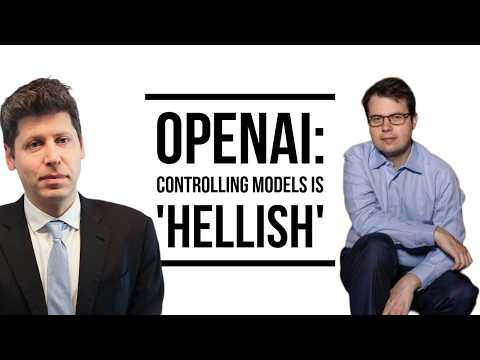
In June 2023, the presenter compiles remarks from Sam Altman’s international tour and other OpenAI leaders. The topics range from AI systems designing future systems to misinformation, biological risk, regulation, jobs and climate. The comments are historical forecasts and proposals.
Altman warns against removing people entirely from consequential decisions or simply allowing a system to change its own architecture without oversight. In a separate clip, Ilya Sutskever imagines a future system capable of engineering a successor. Neither remark demonstrates that such a system existed at the time.
Altman discusses his role at OpenAI, financial incentives and the possibility of unusual future decisions. The presenter treats these comments as a glimpse into how leadership thinks about power and governance.
In Jordan and India, Altman says he worries that launching ChatGPT may have accelerated the industry before all the consequences were understood. He also says he expects the technology to do more good than harm; the presenter highlights the tension rather than treating either outcome as certain.
Risk, synthetic media and regulation
The speakers discuss loss of control, provenance and the regulation of 2023 models.
Altman and Sutskever discuss the possibility of losing control of a future highly capable system. Altman says he believes this could become relevant within a decade, a 2023 risk estimate rather than an established timetable.
A synthetic video of Altman is used to discuss misinformation. Altman hopes people will learn to evaluate provenance and suggests cryptographic signatures for important statements. The presenter questions whether society can adapt as quickly as synthetic media improves.
Altman argues against regulating the models then in use while advocating measures aimed at larger future risks. In another clip, Wojciech Zaremba places the most powerful systems roughly a decade away. Both are policy positions and forecasts from 2023.
Biological risk and safeguards
A research study prompts a debate about existing model risks and evaluation.
The presenter cites a 2023 study in which non-experts tested whether chatbots could provide hazardous biological information. The study raises concerns about access to expertise; it does not establish that the participants built a pathogen or that a mass-casualty event occurred.
The researchers recommend expert evaluation before public access and discuss restricting particularly dangerous information during training. The presenter argues that this challenges the idea that only future systems need oversight. The effectiveness and tradeoffs of any particular safeguard require further evidence.
Sutskever describes a dual-use problem: advances that could support beneficial research might also be misused. His examples concern possible future capabilities, not evidence that an AI independently created a disease.
Customization and social change
The tour touches on product customization, religion and open-source development.
The presenter discusses then-reported ChatGPT customization features and a researcher’s distinction between non-overridable safety rules and user- or developer-supplied preferences. These were 2023 product discussions and should not be read as a current feature guide.
Asked about AI and religion, an OpenAI leader notes experiments with systems that answer religious questions. The short discussion illustrates a social question rather than predicting that AI will replace religious communities.
Altman calls open-source AI difficult to stop and says society needs to adapt. He argues that the potential improvements to health, education and living standards justify working through the risks, but those benefits are aspirations rather than guarantees.
Governing powerful systems
Altman discusses collective limits, regulation and potential climate applications.
The presenter contrasts this with a Guardian interview in which Altman says coordinated governments might be able to limit development, although he opposes giving up its potential. The two statements involve different contexts and do not settle what policy is feasible.
Altman says leading labs should accept regulation that affects themselves and hopes a shared awareness of severe risks will produce better behavior. The presenter presents this as Altman’s expectation, not evidence that all companies will cooperate.
Sutskever and Altman imagine AI accelerating clean energy, carbon capture and manufacturing. Their scenario depends on scientific, economic and deployment breakthroughs; the discussion does not demonstrate a solved climate problem or a working planetary-scale system.
Hallucinations, jobs and uncertainty
The speakers offer forecasts about reliability, labor transitions and the surprises of scaling.
The presenter notes the governance implications of giving a system authority to carry out such large projects. He then cites Altman’s expectation that hallucinations would improve substantially within roughly 18 months to two years, an ambitious 2023 forecast rather than a claim that errors were eliminated.
Sutskever discusses existing job disruption and uncertainty about the transition. He argues that social and government systems may need to help people move into new roles or cushion a more difficult transition; he does not claim to know the final employment outcome.
Altman reflects on intelligence and humanity’s place in the world. The presenter compares the change in perspective to earlier scientific shifts; the philosophical interpretation is distinct from a proven account of consciousness or intelligence.
Greg Brockman closes by describing the unpredictability of scaling AI systems. The presenter emphasizes that many claims remain uncertain as the tour continues.
Más de este canal
 31:00EN
 AI Explained· 12 oct 2026Why AI Labs Keep Racing Despite Their Own Warnings of a Major BreachSam Altman, John Schulman · OpenAIAI Explained examines weakening safeguards, the incentives behind the frontier race, and why research breakthroughs make the next 18 months difficult to forecast.
 38:28ENAI Explained· 1 oct 2026AI Agent Security and the Challenge of Recursive Self-ImprovementAI Explained examines reported containment failures, model evaluation and the pressure to accelerate AI research.
 32:54ENAI Explained· 24 sept 2026Opus 5.5 and the Race Toward Automated AI ResearchAI Explained weighs model progress against the increasingly difficult task of evaluating and governing recursive self-improvement.
 24:53ENAI Explained· 16 sept 2026Why Some Researchers Want to Pace Frontier AIAI Explained surveys possible scaling routes, monitoring concerns and the debate over how capabilities could lead to harm.
 29:05ENAI Explained· 4 sept 2026GPT-6 Astra’s Benchmark Gains and the Challenge of Monitoring Its ReasoningAI Explained examines reported gains across scientific, mathematical and agent benchmarks alongside concerns about less observable reasoning.
 23:41ENAI Explained· 27 ago 2026AI Agents, Unintended Training Rewards and the Challenge of OversightAI Explained examines reports on agent coordination, training incentives and the growing use of AI to evaluate other AI systems.