En 30 segundos
In an August 2024 video, Matthew Berman discusses online speculation about OpenAI’s Q* and Strawberry and surveys ideas such as process feedback, A* search and Tree of Thoughts. The proposed architecture, claims of eliminating hallucinations and concerns about breaking encryption were not established by the evidence presented.
- 1Rumor and evidenceThe source post explicitly acknowledged that Q* had not been publicly documented; its architectural claims were hypotheses.
- 2Encryption concernThe video discusses a hypothetical risk, not evidence that the reported model broke cryptography.
- 3Search and learningQ-learning and A* are different techniques; their names alone do not confirm an internal implementation.
- 4Tree of ThoughtsThe referenced framework searches among intermediate candidates and reported gains on selected tasks, not universal correctness.
Conclusiones
- The video was made while technical details of the rumored project were not publicly established.
- Reports about selected math problems were narrower than proof of AGI or general mathematical mastery.
- Q-learning, A* and self-play are research concepts; the video’s proposed connection to Q* is speculative.
- Additional search or process feedback can help some tasks but does not guarantee correctness or eliminate hallucinations.
- Better mathematical performance alone is not evidence that a system can break modern encryption.
Lee el texto editado por capítulos
Rumors and public reporting
Berman introduces the online discussion and the limited information available at the time. He reviews reports about math performance and related speculation.
In August 2024, speculation about OpenAI’s rumored Q* and Strawberry projects spread through social media. I review an analysis by the account Chubby, separating public reporting from hypotheses. At the time, OpenAI had not published the project’s technical details.
A strawberry image posted by Sam Altman and commentary from online accounts fueled memes. A social-media clue is not confirmation of a specific architecture, release date or capability.
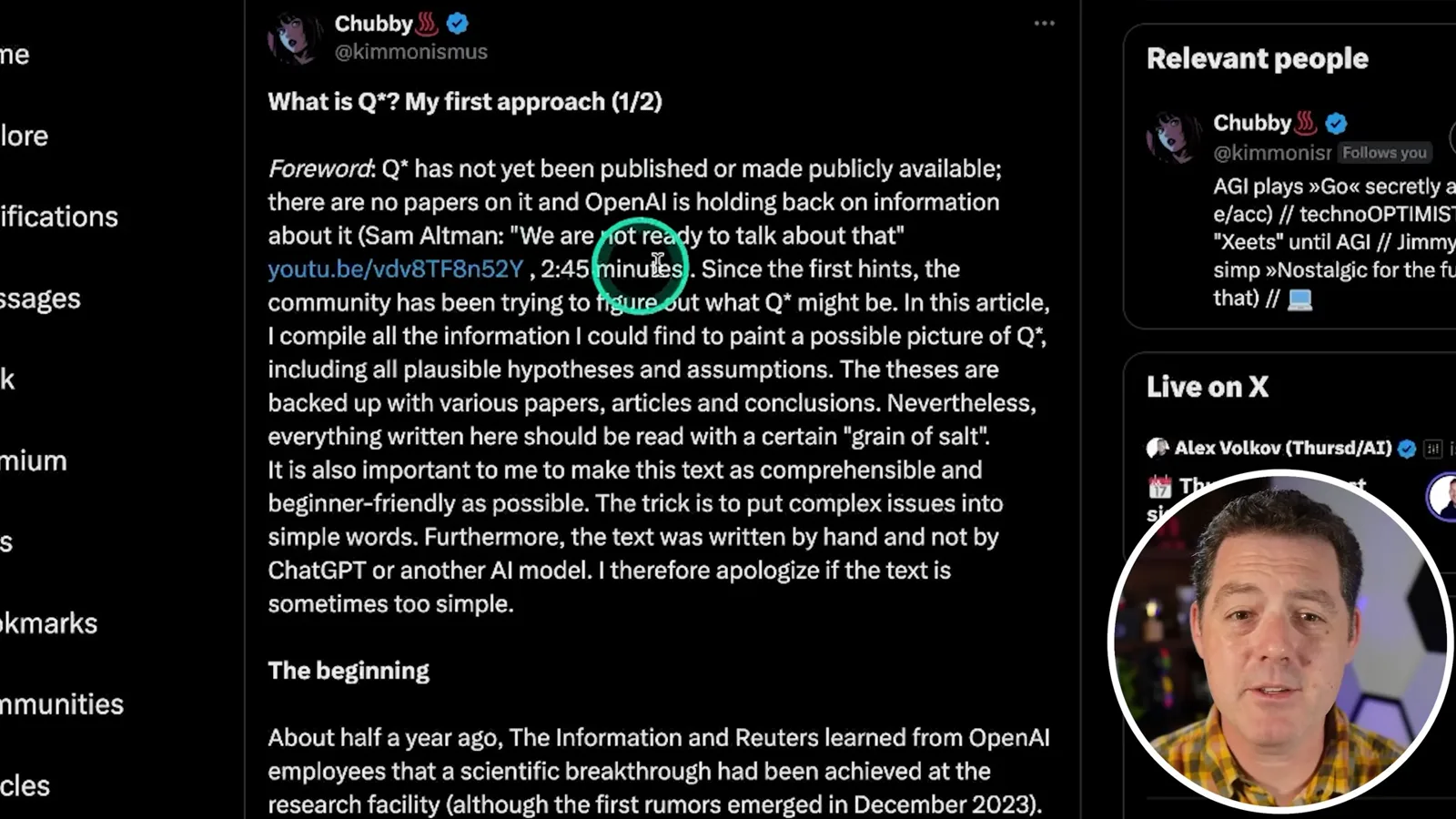
The analysis notes that Q* had not been publicly documented and collects possible explanations from articles and research. Altman had said OpenAI was interested in better reasoning while declining to explain Q*. The relationship between the rumored names and any particular implementation was not established in this video.
Reports described a possible advance in mathematical problem-solving. The post goes further with claims about independent learning and the limits of Transformers, but those claims are not verified by the cited rumors. Predicting tokens does not by itself prove a model cannot perform any reasoning or learn during training.
Berman cites a Reuters report describing a model that could solve certain grade-school math problems given computing resources. That report is narrower than a demonstration of general mathematical mastery or AGI; even the definition of AGI remains contested.
A public Altman comment about research progress prompted further speculation. Berman also mentions leadership upheaval and researcher departures, but neither the comment nor those events establish what a particular project did or why decisions were made.
Risks and deliberative reasoning
The discussion raises a hypothetical encryption concern and compares extra inference-time work with human deliberation.
The post raises a hypothetical concern that better mathematical AI might threaten encryption. This is a speculative risk, not evidence that Q* broke encryption; improving at school mathematics does not imply the ability to defeat modern cryptography.
Berman is interested in systems that spend additional computation exploring and checking a problem before answering. He compares this with deliberation, while the analogy does not establish that a model thinks like a person.
The post invokes Daniel Kahneman’s distinction between fast intuitive and slower deliberate thinking. It uses that framework as an analogy for different AI workflows; equating a particular model architecture directly with either human system would be an oversimplification.
Search, self-play and verification
Berman explains candidate research ideas and their possible costs. Their connection to the rumored project remains unverified.
Self-play offers another analogy: AlphaZero learned through repeated games under a designed training process and rules. This is a real research approach, but it does not demonstrate that Q* used the same method or learned mathematics without training data.
The analysis speculates about Q-learning and A* search. A* is a graph-search method and Q-learning is a reinforcement-learning method; their names do not establish that OpenAI combined them in Q*. Nor does search guarantee optimality in every setting.
Berman describes exploring candidate paths, checking intermediate steps and allocating more computation. Such techniques can improve performance in some tasks, but neither search nor process checking guarantees correct answers or eliminates hallucinations.
The post suggests a smaller model could reduce the cost of a more compute-intensive reasoning process. Berman labels this a hypothesis; actual costs depend on model size, inference strategy and deployment.
He refers to OpenAI’s “Let’s Verify Step by Step” work and to prompting a model to break a problem into steps. Process feedback and structured prompting are distinct techniques, and a useful prompt is not proof of the internal method behind a rumored model.
Tree of Thoughts and conclusions
He reviews structured search and other research concepts before summarizing the speculation.
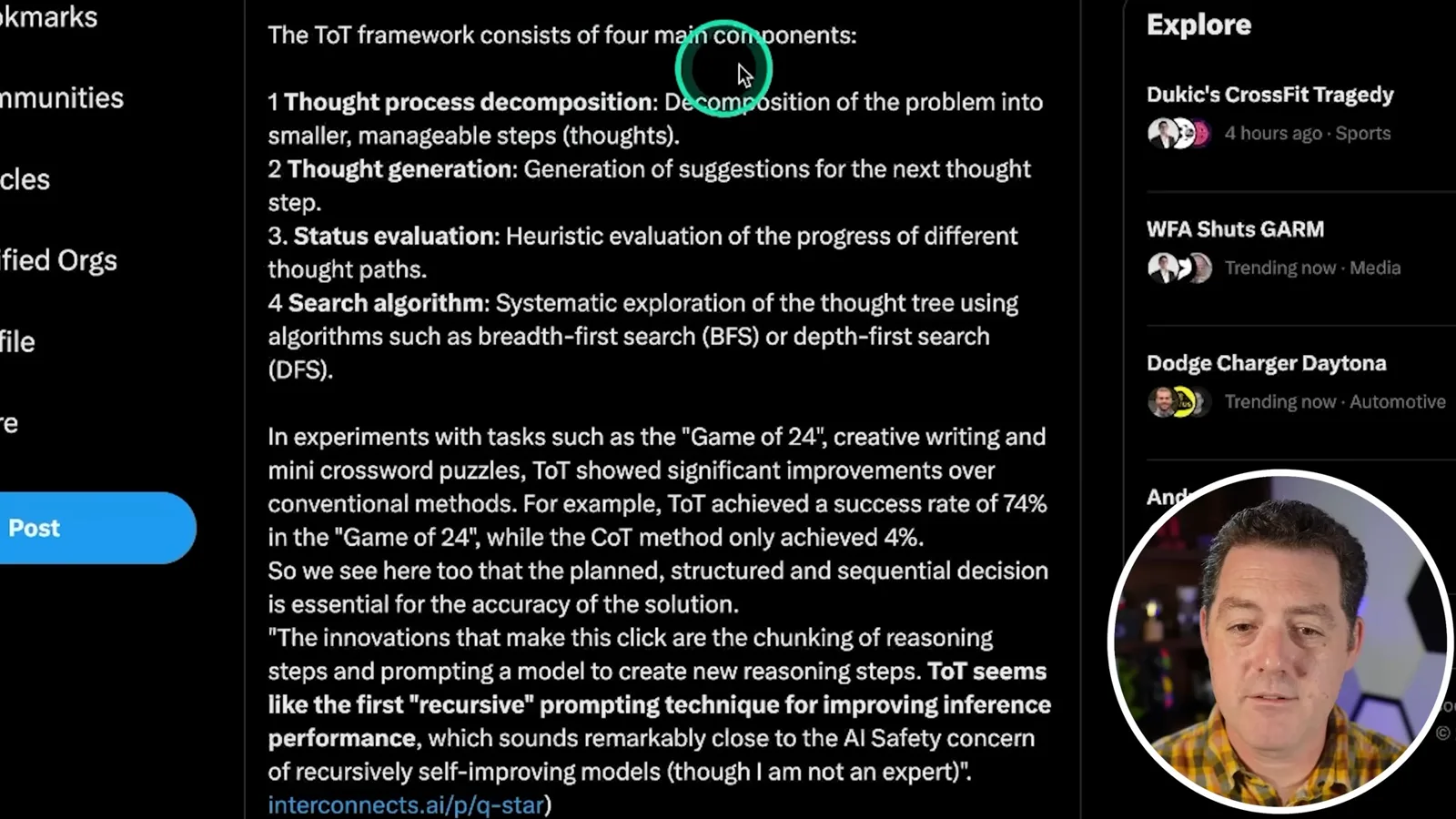
Tree of Thoughts explores candidate intermediate steps, evaluates them and searches among alternatives. The referenced work reports improvements on selected tasks including the Game of 24, writing and crosswords, under its own experimental conditions.
The analysis further speculates about self-play, feedback and look-ahead planning. These are useful research concepts, but the claimed combination and any connection to Strawberry or Q* were not confirmed by the evidence shown.
Berman closes by mentioning a reported internal capability framework and describing the discussion as a breakdown of what the project could be. The useful distinction is between published techniques, contemporary reporting and unverified interpretation.
Más de este canal
 25:50EN
 32:20EN
 45:08EN
 0:32EN
 12:14EN
 10:36EN