En 30 segundos
Aamir Shakir of Mixedbread argues that an agent’s access to relevant evidence can be a major bottleneck. He describes information loss in parsing, chunking and single-vector retrieval, then demonstrates a multimodal, late-interaction search product on financial documents. He reports a hedge-fund customer’s 55-question benchmark rising from 36% to 98% answer accuracy after a search-backend change, along with lower token spending. These are vendor-reported results from one case.
- 1The cost of searching blindlyShakir says many weak keyword matches can force agents to spend tokens reading irrelevant documents.
- 2A multi-stage pipelineHe argues that parsing, OCR, chunking and embedding can each lose information or add integration work.
- 3Late interactionThe proposed model uses multiple embeddings to represent finer-grained query and document information.
- 4Trace answers to evidenceThe demo uses page layout and bounding boxes to help cite retrieved material.
- 5A customer benchmarkThe vendor reports 36% to 98% answer accuracy on 55 customer questions after changing the search backend.
Conclusiones
- Retrieval failures can cause agents to read more documents, use more tokens and miss the evidence they need.
- Parsing, OCR and chunking can lose structure from tables, images and other complex documents.
- Late interaction uses multiple representations for a query and document rather than a single vector.
- Visual retrieval and layout information can help connect an answer to a specific source.
- Mixedbread reports a 36% to 98% accuracy change on one customer’s 55-question benchmark; other results may differ.
Lee el texto editado por capítulos
The evidence problem
Shakir introduces Mixedbread and illustrates why searching large, mixed collections can be expensive.
Aamir Shakir introduces Mixedbread, a company that builds retrieval models and a search product for agents. He argues that agents often struggle less with reasoning than with finding the relevant evidence in an organization’s data.
He uses an equity analyst as an example: a question about Intel’s memory choices may require searching reports, interviews, podcasts and research from multiple providers. A large collection can produce many keyword matches without revealing which passage is most useful.
Shakir says an agent that reads too many candidate documents can spend substantial tokens on discovery. PDFs add complications because text, tables, scanned pages and images cannot always be searched reliably as plain text.
Where retrieval pipelines lose information
He critiques parsing, OCR, chunking and single-vector representations, particularly for complex documents.
He describes a conventional retrieval pipeline: parsing or transcription, OCR, chunking, embeddings, vector search and reranking. In his view, each transformation can lose information, especially when table structure or diagrams are not preserved.
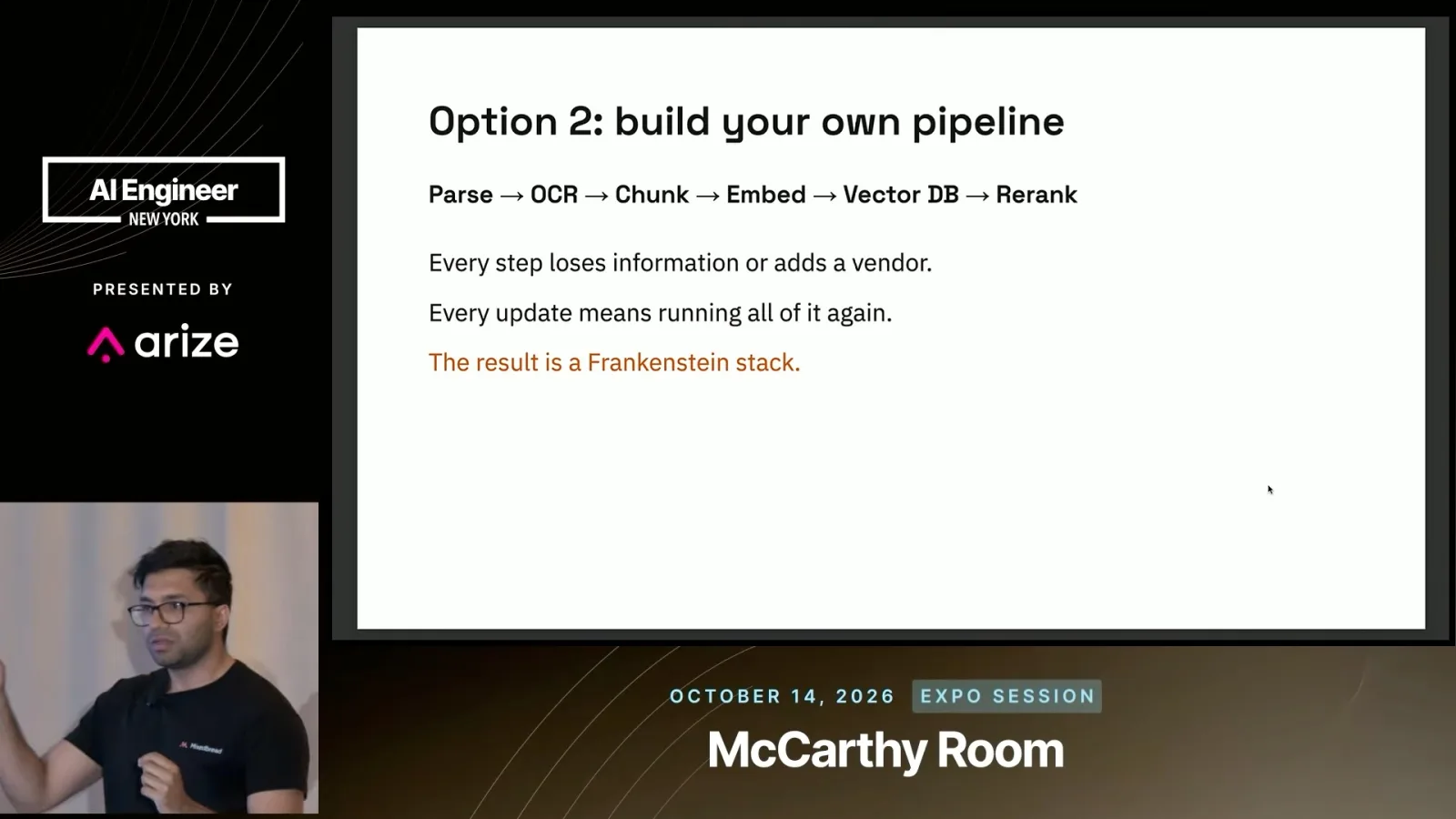
The pipeline can also require teams to evaluate and integrate multiple vendors. Shakir calls this a “Frankenstein stack” and argues that coordinating these components can consume months of work. This is his assessment as a retrieval vendor, not a universal result for all RAG systems.
He illustrates a limitation of representing a document chunk as one vector. A complex financial report contains many facts; reports from different years may look similar in embedding space even when the query requires a precise figure from a particular period.
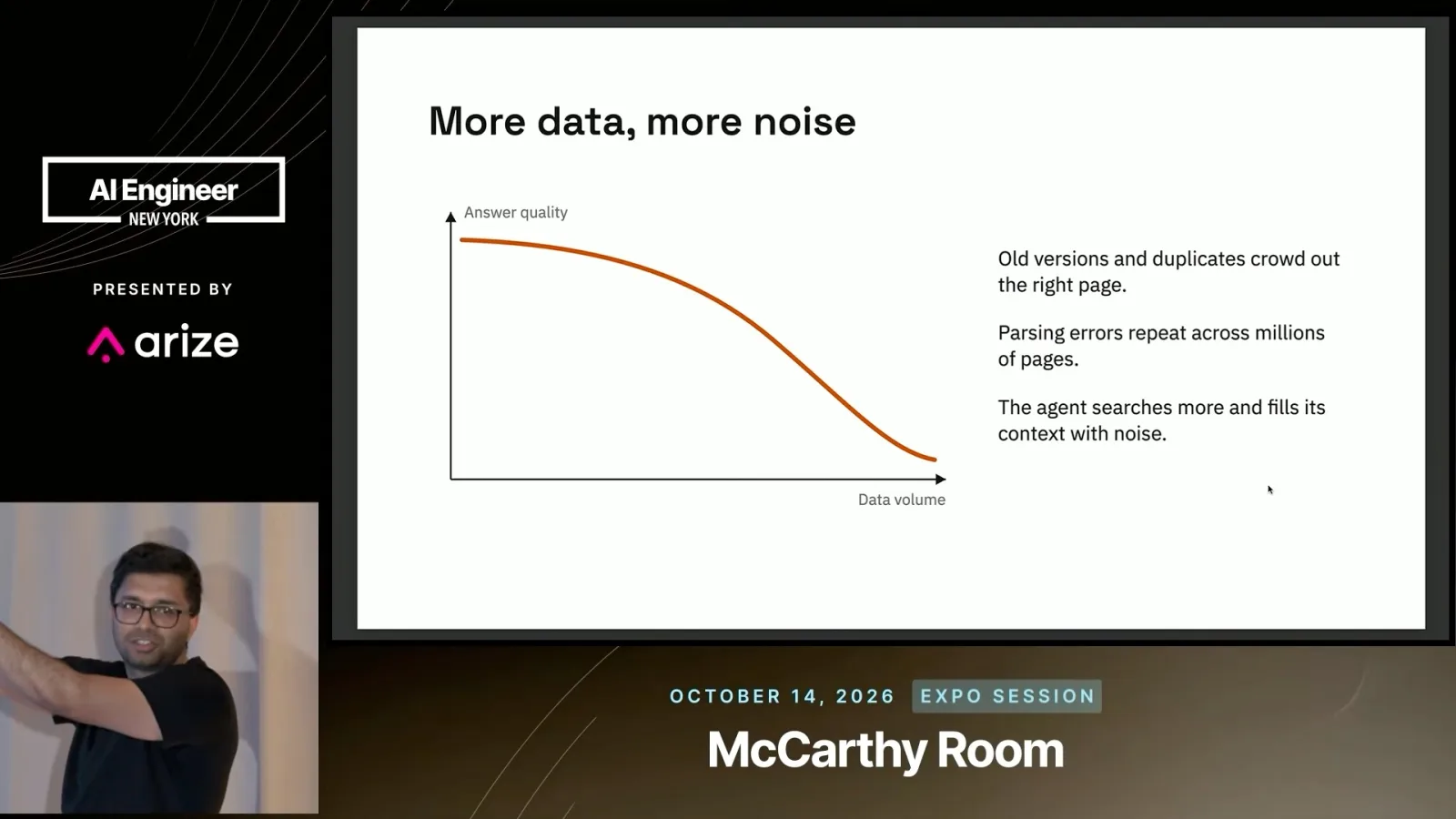
As a corpus grows, he says, near-duplicates and extraction errors can make evidence harder to find. An agent may compensate by making more queries or spawning more workers, increasing context size and cost.
Multimodal retrieval and late interaction
He describes the company’s retrieval approach and demonstrates search over financial reports.
Mixedbread’s position is that access to relevant data is a bottleneck separate from model intelligence. Shakir says the company built its product to handle retrieval across text and other modalities, while allowing customers to choose the model used for the downstream task.
He sketches the evolution from keyword search such as BM25 to embedding models and presents a preview of Mixedbread’s new retrieval model. He characterizes the improvement as a step change; the chart is a vendor-presented comparison.
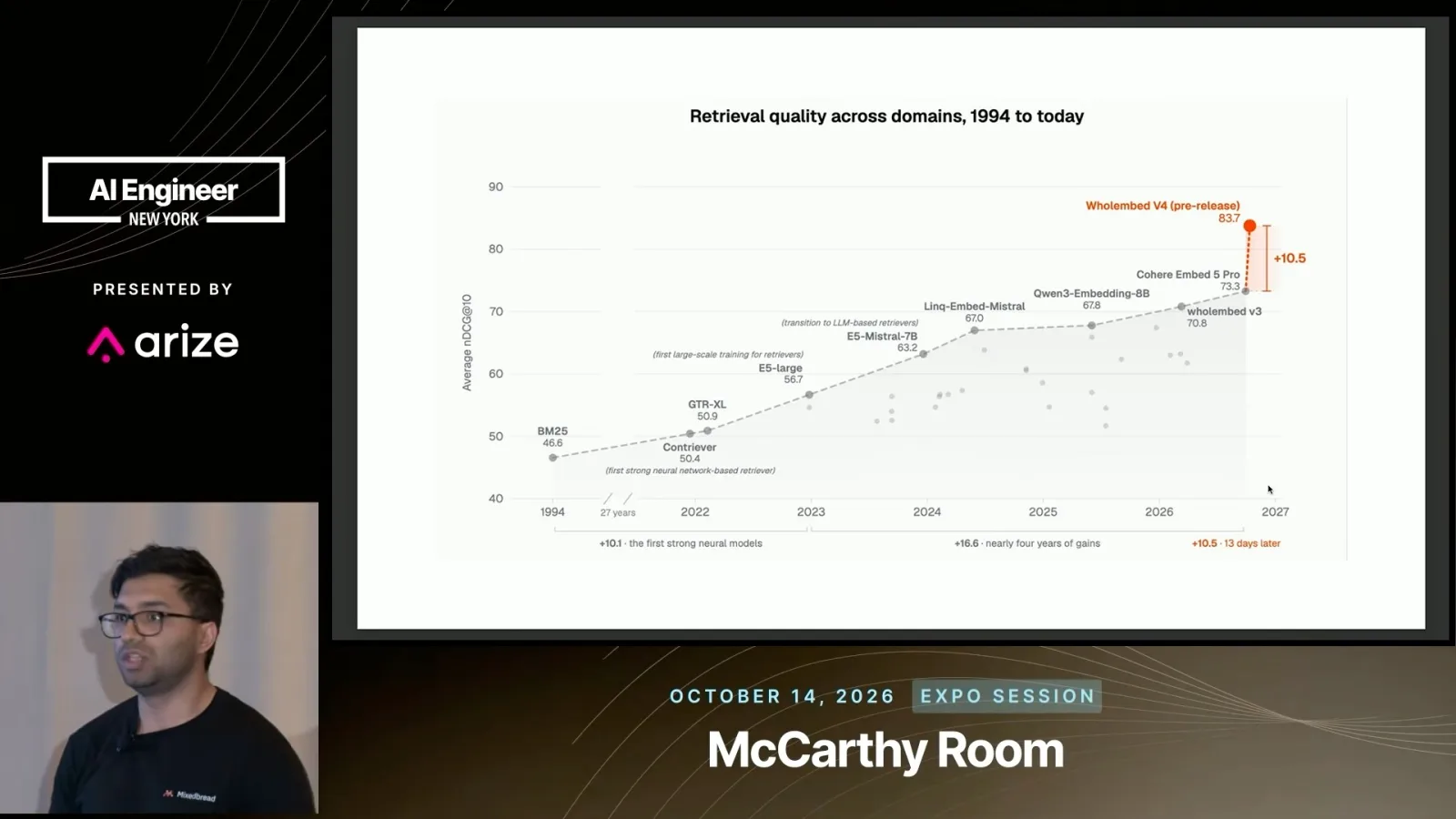
The model uses late interaction: it represents documents and queries with multiple embeddings rather than a single vector. Shakir says this can retain finer-grained information while contextualizing those representations within the page.
In a demo, he uploads Intel earnings material. He argues that a visual representation of a page can preserve relationships in a figure that plain OCR might miss, while OCR and layout information remain available for downstream models.
A query about an Intel Foundry operating margin returns candidate pages. Shakir shows how visual layout and bounding boxes can support citations, allowing a user or agent to trace an answer back to its evidence. The live demo encounters slow network responses.
For more complex qualitative questions, he describes an agentic search model that decomposes a request into multiple searches. He claims it is faster and cheaper than larger general models on the company’s comparison; no independent methodology is provided in the talk.
A customer result
Shakir reports results from a hedge-fund benchmark and discusses token cost. The figures are vendor-reported.
Shakir presents a hedge-fund customer case. According to the slide, the benchmark contained 55 questions on the customer’s documents and changed the search backend. He reports that answer accuracy rose from 36% to 98% after adopting Mixedbread.
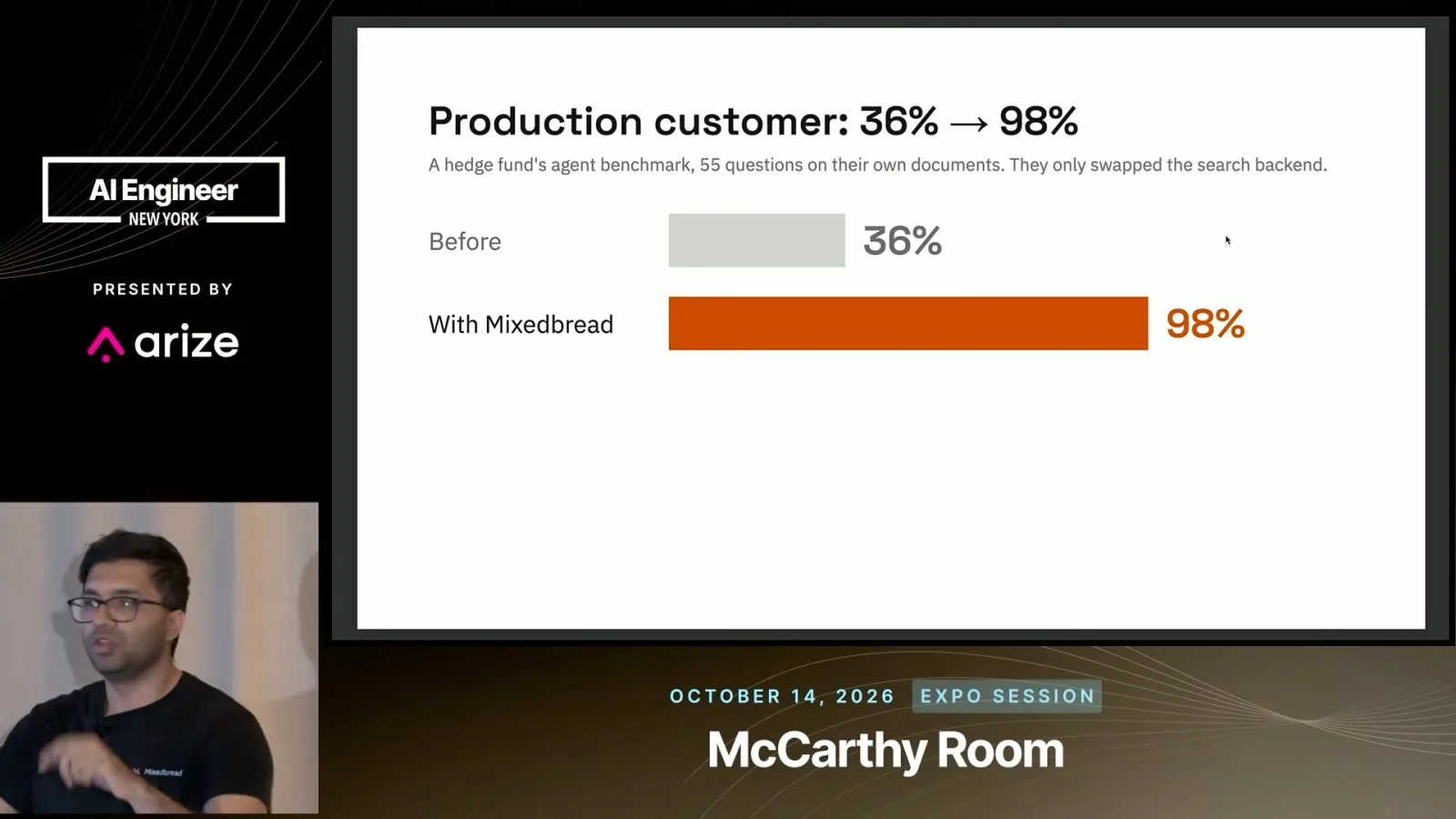
He also says the customer used fewer tokens and reduced language-model spending by roughly threefold because the agent received better context. These are vendor-reported results from one customer, not a guarantee for other collections.
Shakir concludes that retrieval quality can affect both answer quality and cost, and invites teams to benchmark the product on their own corpora. His central recommendation is to evaluate how well the system finds the evidence needed for a task.
Más de este canal
 19:12EN
 AI Engineer· 4 nov 2026Why AI Agents Need Reliable Processes to Scale Across a CompanyMitchell Troyanovsky · BasisBasis co-founder Mitchell Troyanovsky explains behavior specifications, trajectory forks and simulations for production agents.
 18:01ENAI Engineer· 4 nov 2026How NatWest Tests Customer-Facing AI Agents Before LaunchJonathan Osborne · NatWest GroupJonathan Osborne explains routing controls, human validation, unreliable LLM judges and shadow deployment in a regulated bank.
 19:48ENAI Engineer· 4 nov 2026Why Datasite Bought Its Document Parser Instead of Building ItAdit Abraham, Raj Bakhru · ReductoRaj Bakhru and Reducto CEO Adit Abraham discuss the engineering trade-offs behind AI for transaction data rooms.
 19:19ENAI Engineer· 4 nov 2026Approve the Application, Not the AI Model: Building Evaluation Gates for a BankDoneyli De Jesus · Langfuse by ClickHouseDoneyli De Jesus explains how a bank tested an AI agent on its own data, added a calculator and used domain experts to set production gates.
 16:51ENAI Engineer· 3 nov 2026Cristóbal Valenzuela on Interactive Video Models and Runway’s ContinuumCristóbal Valenzuela · RunwayRunway’s co-founder traces next-frame prediction from early generated film to research prototypes for interactive visual interfaces.
 19:42ENAI Engineer· 3 nov 2026What Drives AI Agent Costs: Cache Hits, Input Tokens and TurnsGeorge Cameron · Artificial AnalysisArtificial Analysis co-founder George Cameron breaks down an agent benchmark and a framework for choosing models by cost and capability.