In 30 seconds
Elon Musk told SpaceX employees in August 2026 that the company was aiming for 10 gigawatts of AI compute capacity by the end of 2027, up from a slide’s 1.4-gigawatt nameplate figure. He predicted AI revenue would soon exceed the rest of SpaceX and eventually dominate its value. Musk also reviewed Falcon reuse, Dragon and Starlink, and said Starship’s much larger proposed payload capacity is needed for settlements beyond Earth.
- 1Musk expects Starlink to carry a much larger share of internet trafficHe cites nearly 11,000 satellites and forecasts a much larger constellation.
- 2He targets orbital payload capacity above a million tons a yearMusk says Starship must reach that scale to support settlements beyond Earth.
- 3Musk predicts AI revenue will overtake SpaceX’s other businessesIn August 2026 he expects this around September and a larger gap in the fourth quarter.
- 4The 2027 compute goal is 10 gigawattsA slide shows 1.4 gigawatts of nameplate draw and the expansion target; Musk estimates revenue using a per-watt assumption.
- 5He expects AI to dominate SpaceX’s valueMusk predicts AI could represent 99% of company value within about five years.
Takeaways
- SpaceX’s slide set a goal of 10 gigawatts of AI compute capacity by the end of 2027.
- Musk predicted AI revenue would exceed SpaceX’s other revenue around September 2026.
- He estimated $300–500 billion in annual revenue from 10 gigawatts using a per-watt assumption.
- Musk expects Starship eventually to carry more than a million tons to orbit annually.
Read the edited text by chapter
The mission and early rockets
Musk describes SpaceX’s multiplanetary mission and recalls Falcon 1 and booster recovery.
Elon Musk says understanding the universe requires expanding consciousness beyond Earth. He tells SpaceX employees that the company’s mission is to make life multiplanetary and explore other worlds and, eventually, other star systems.
Musk imagines finding alien civilizations or their remains and says a spacefaring future gives people something inspiring to work toward, beyond solving immediate problems.
Looking back at SpaceX’s beginnings in a small El Segundo warehouse, he recalls that Falcon 1 failed three times before reaching orbit. He then introduces the long effort to land and reuse an orbital booster.
Musk says the team needed many attempts to land and refly boosters, but now recovers one every few days. He recalls experts doubting both the technical goal and demand for previously flown rockets.
He compares a reused booster with an aircraft that has flown before and says SpaceX adopted the term “flight-proven.” He praises the Falcon, manufacturing and launch teams as the company approaches its 700th flight.
Dragon and Starlink
He reviews astronaut flights and satellite internet while forecasting much larger future traffic.
Musk recalls putting his own Roadster and a mannequin called Starman on the first Falcon Heavy flight because he expected it might fail and did not want a dull test payload. He says the car remains in orbit around the Sun.
He turns to Dragon, describing its commercial space-station and astronaut missions. Musk says the vehicle had flown 78 crew members and thanks the team.
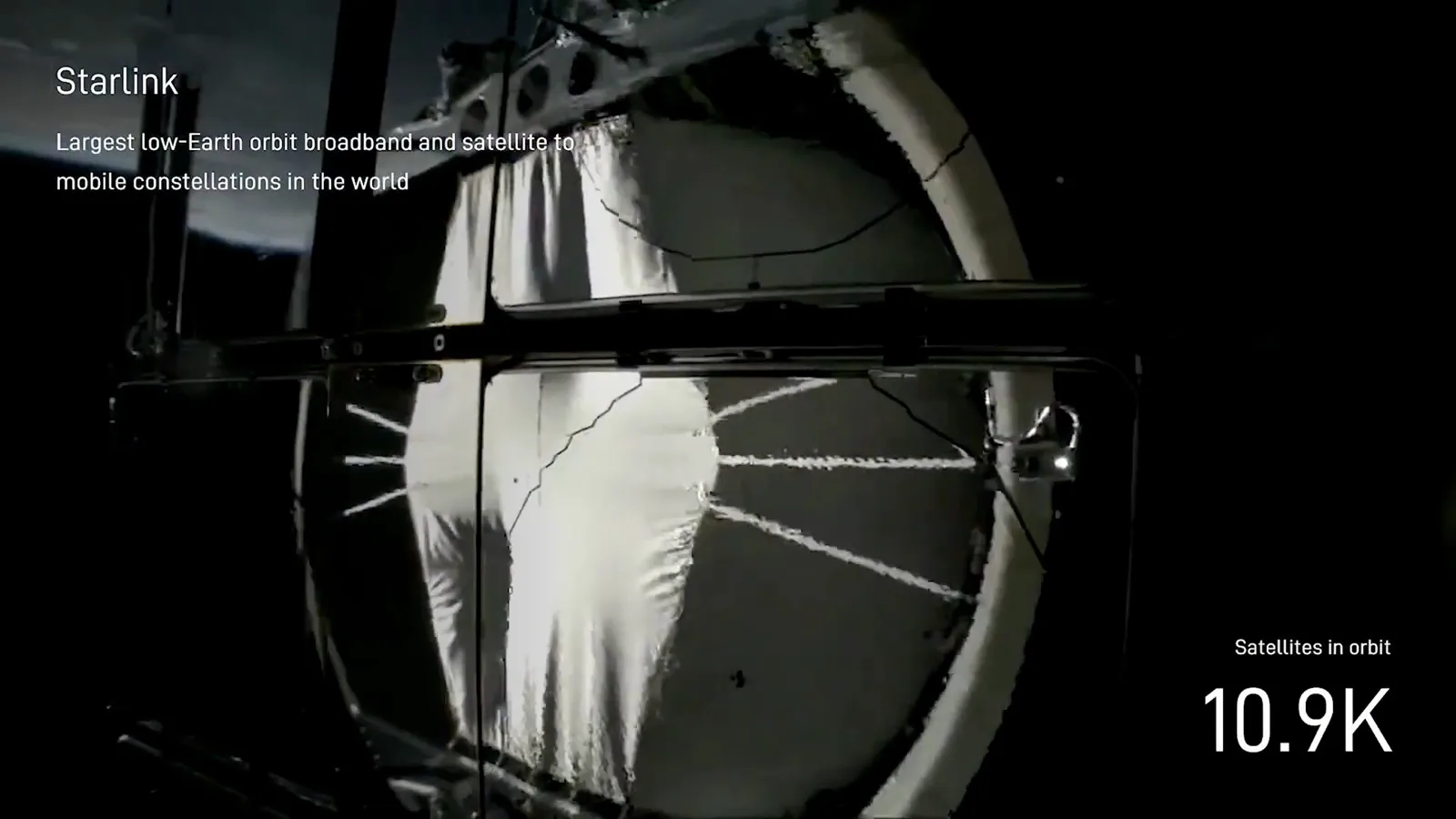
Musk describes Starlink as a global satellite internet system made possible by frequent launches. He predicts it could eventually carry a majority, and perhaps over 90%, of internet traffic.
At the time of the talk, Musk says nearly 11,000 Starlink satellites were in orbit and forecasts a constellation of 100,000 with future generations. He says the service had 22 million mobile subscribers and 13 million broadband subscribers across 167 countries.
Musk expects subscriber numbers to grow substantially and cites a forecast that AI traffic could eventually be far larger than human internet traffic. He also briefly praises Starshield, SpaceX’s government-focused satellite business, without detailing classified work.
Starship’s proposed scale
Musk explains why he believes much larger orbital payload capacity is needed.
Musk calls Starship the vehicle intended to expand annual payload delivered to orbit from thousands to more than a million tons, with a possible long-term goal of ten million. He says such scale would be needed to support settlements on the Moon and Mars.
AI becomes central to SpaceX
He predicts AI revenue growth and asks employees to support both hardware and software.
Turning to SpaceX AI, Musk predicts AI revenue will exceed all the company’s other revenue around September and significantly exceed it in the fourth quarter of 2026. He tells employees that succeeding in both hardware and software is central to SpaceX’s future.
Musk speculates that digital intelligence could eventually greatly exceed biological intelligence. He links that possibility to harnessing more of the Sun’s energy and to expanding civilization into space.
He argues that advanced AI should care about humanity and help people reach other planets. Musk says he wants SpaceX to succeed in AI software as well as hardware, and asks employees to contribute to both.
Musk says Grok is to be trained on SpaceX information, comparing the employees’ influence on its training to that of parents. He also mentions solar power, the proposed chip factory and AI satellites as pieces of the company’s plan.
He says future AI may be too capable for people to control directly and argues that instilling beneficial values during development is therefore important. He encourages employees to use Grok and help improve it.
The 10-gigawatt goal
A slide and Musk’s remarks set out the computing-capacity target and his revenue estimate.
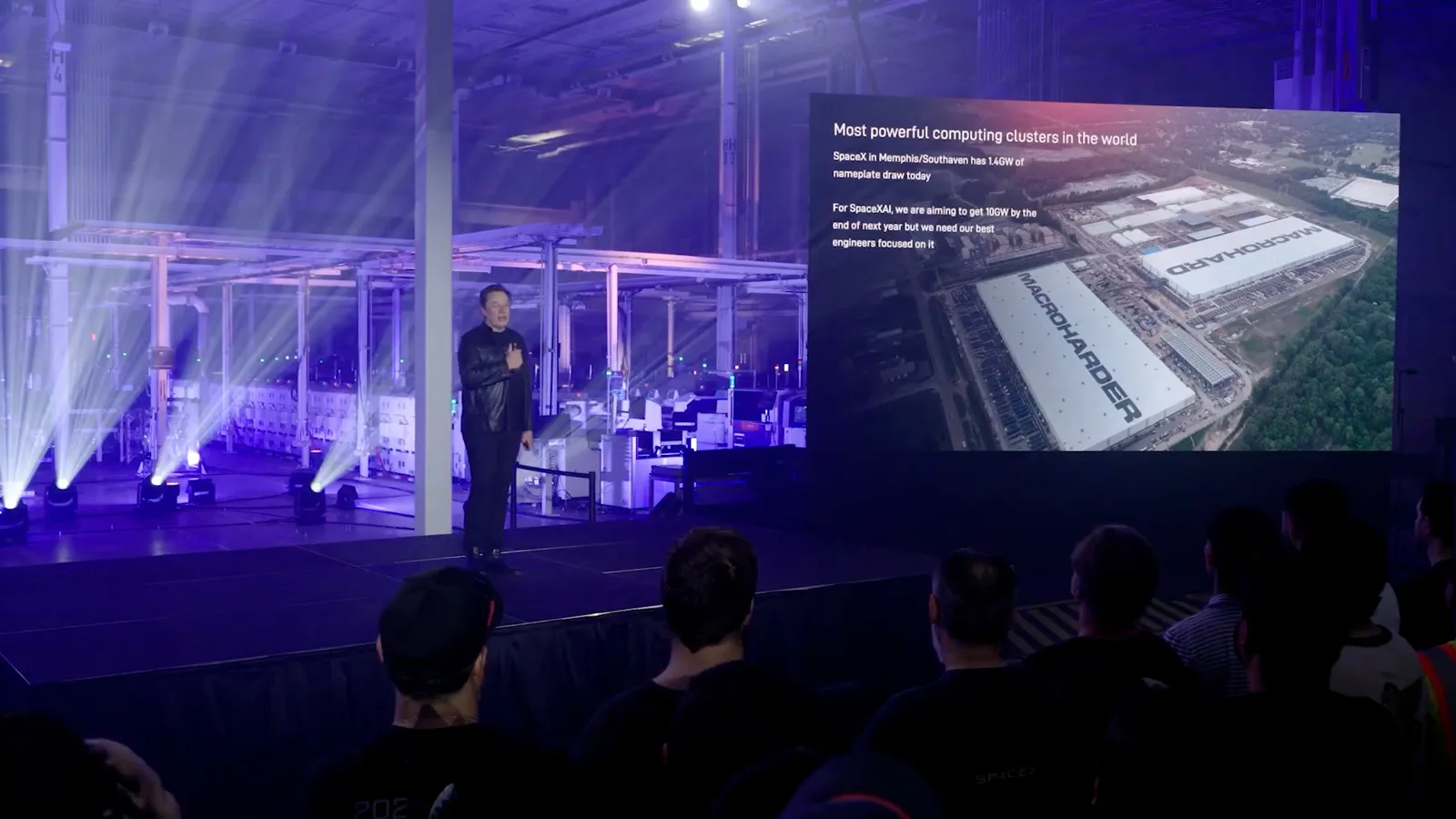
A presentation slide says the Memphis and Southaven facilities had 1.4 gigawatts of nameplate draw and states a goal of 10 gigawatts by the end of the following year. Musk says the terrestrial training clusters will also provide practice for space-based AI.
Musk expects AI training to remain on Earth while day-to-day inference moves into space. He estimates that 10 gigawatts online could correspond to $300–500 billion in annual revenue, using an assumed value of $30–50 per watt.
A solar-powered “star mind”
Musk speculates about civilization’s energy use and a future system in space.
He considers whether humanity’s long-term role could be to create a “star mind” powered by the Sun. He invokes physicist Nikolai Kardashev’s way of describing civilizations by their ability to use the energy of a planet, star or galaxy.
Musk says a factory for the proposed star-mind system will be nearby. He predicts AI could represent 99% of SpaceX’s value in roughly four or five years.
A multiplanetary future
He imagines lunar manufacturing and travel to the Moon and Mars.
After a visual presentation, Musk imagines manufacturing AI computers on the Moon and sending them into deep space. He says SpaceX employees who want to visit the Moon or Mars should be able to do so in the future.
He closes by describing a future spacefaring civilization spread through the solar system and eventually reaching other stars, and thanks employees for their role in that ambition.
More from this channel
 1:04:24EN
 Space SPAN (Science Policy and News)· Oct 21, 2026Gwynne Shotwell and Elon Musk on SpaceX, Orbital Computing and AI SafetyGuest Gwynne Shotwell, Elon MuskAt the 2026 All-In Summit, Shotwell describes managing SpaceX and Musk proposes peer testing of AI models.
 31:17ENSpace SPAN (Science Policy and News)· Jun 9, 2026SpaceX’s Draft AI Satellite: Solar Power, Radiators and StarshipGuest Elon Musk, Ian Dahl · Host Dan HuotMusk and Ian Dahl show a 120-kilowatt average-compute design and explain the launch, solar and chip capacity they hope to build.
 45:46ENSpace SPAN (Science Policy and News)· Feb 11, 2026Inside xAI’s Reorganization: Coding, Agents and ComputeHost Elon MuskElon Musk and team members outline four product groups and explain the infrastructure challenges behind large AI training runs.