In 30 seconds
xAI reorganized around its main and voice models, coding, image and video generation, and a computer-use agent project called Macrohard. At the February 2026 meeting, engineers described a practical bottleneck: their training software needed a major rewrite when scaling around 30,000 GPUs, while hardware and network failures continued during synchronized training. The team also discussed expert evaluations, data-center expansion and Musk’s longer-term orbital-computing proposal. Product leadership claims and timelines are the company’s own.
- 1xAI organized around four application areasMusk lists the main and voice model, coding, Imagine and Macrohard, with infrastructure teams supporting them.
- 2Coding models still need reviewA team member says models are more useful for writing and debugging, while human feedback remains necessary.
- 3The team wants experts to evaluate real workxAI says specialists in domains such as medicine and law assess output and contribute training data, alongside other evaluations.
- 4Training at scale forced an infrastructure rewriteAn engineer says software stopped scaling as expected around 30,000 GPUs, while failures across hardware and networking had to be handled continuously.
- 5Orbital computing and a lunar launcher were long-term plansMusk proposes AI satellites and a Moon-based mass driver as a future extension of SpaceX and xAI’s work.
Takeaways
- xAI grouped work into main and voice, coding, Imagine and Macrohard, supported by shared infrastructure.
- A coding team member says generated code still needs human review and feedback.
- An engineer says training infrastructure required substantial rewriting around the 30,000-GPU scale.
- The evaluation team wants experts to assess whether outputs are correct and useful in real domains.
- Musk’s orbital data centers and Moon-based launcher are longer-term proposals.
Read the edited text by chapter
Reorganizing xAI around four products
Musk reviews company-reported progress and introduces the application and infrastructure teams.
Elon Musk opens the xAI all-hands meeting by reviewing what he says the company has achieved in about two and a half years. He cites voice, image and video generation, forecasting and computing infrastructure, presenting the company’s own assessments of its position.
Musk describes Grokipedia as an effort to make a more comprehensive encyclopedia and says the company is approaching a training capacity equivalent to one million H100 GPUs. He argues that speed of improvement matters as much as a snapshot of the current position.
He says xAI is reorganizing as it grows and thanks people who have left. The new structure centers on four application areas: Grok’s main model and voice, coding, Imagine for images and video, and Macrohard for computer-based work, supported by shared infrastructure.
Voice, coding and generated media
Teams describe current products, coding review and plans for image and video models.
The main and voice team describes developing voice technology and bringing it to products including Tesla vehicles and an API. Team members say the next goal is to make Grok useful for a broader range of tasks, from research and documents to specialized work.
Musk says he wants the foundation model to produce useful, reliable answers in fields such as engineering, law and medicine. The speakers present this as a product goal, not a demonstration that every answer in those fields is correct.
A coding team member says newer models can write and debug more useful code from a description resembling instructions to a colleague. He says human review and feedback are still needed, but longer-running coding tasks are already helping the team test changes.
The team describes using the current coding model to help develop the next generation and says coding is a priority. Musk predicts that AI could eventually produce optimized machine binaries directly and expects a competitive coding model within months; those are forecasts made at the meeting.
Imagine team members describe developing image and video generation over the preceding months. They say people can edit images and generate videos through xAI products, including X, and report rapid growth in usage.
The team reports nearly 50 million videos generated daily and six billion images in the preceding 30 days, figures presented by the company. It says model and product updates are frequent and aims to sustain that pace.
Another member predicts models could generate longer videos from a single request and eventually support interactive worlds rendered in real time. Musk expects real-time video understanding and generation to become a large use of AI compute.
Agents, evaluations and knowledge
Macrohard and evaluation teams discuss computer use, expert assessment and Grokipedia.
The Macrohard team introduces its goal of letting an AI use a computer to complete digital work. One member describes giving models access to the same graphical tools people use; the intended end state is to coordinate tasks across applications.
Musk predicts that a system able to perform digital work could eventually reproduce the output of some companies. The team says achieving that requires reliable reasoning, computer interaction and substantial computing resources.
A product-infrastructure speaker describes maintaining the API, authentication and services behind Grok. Reliability and security matter, he says, because the team must respond when distributed systems fail, including outside normal working hours.
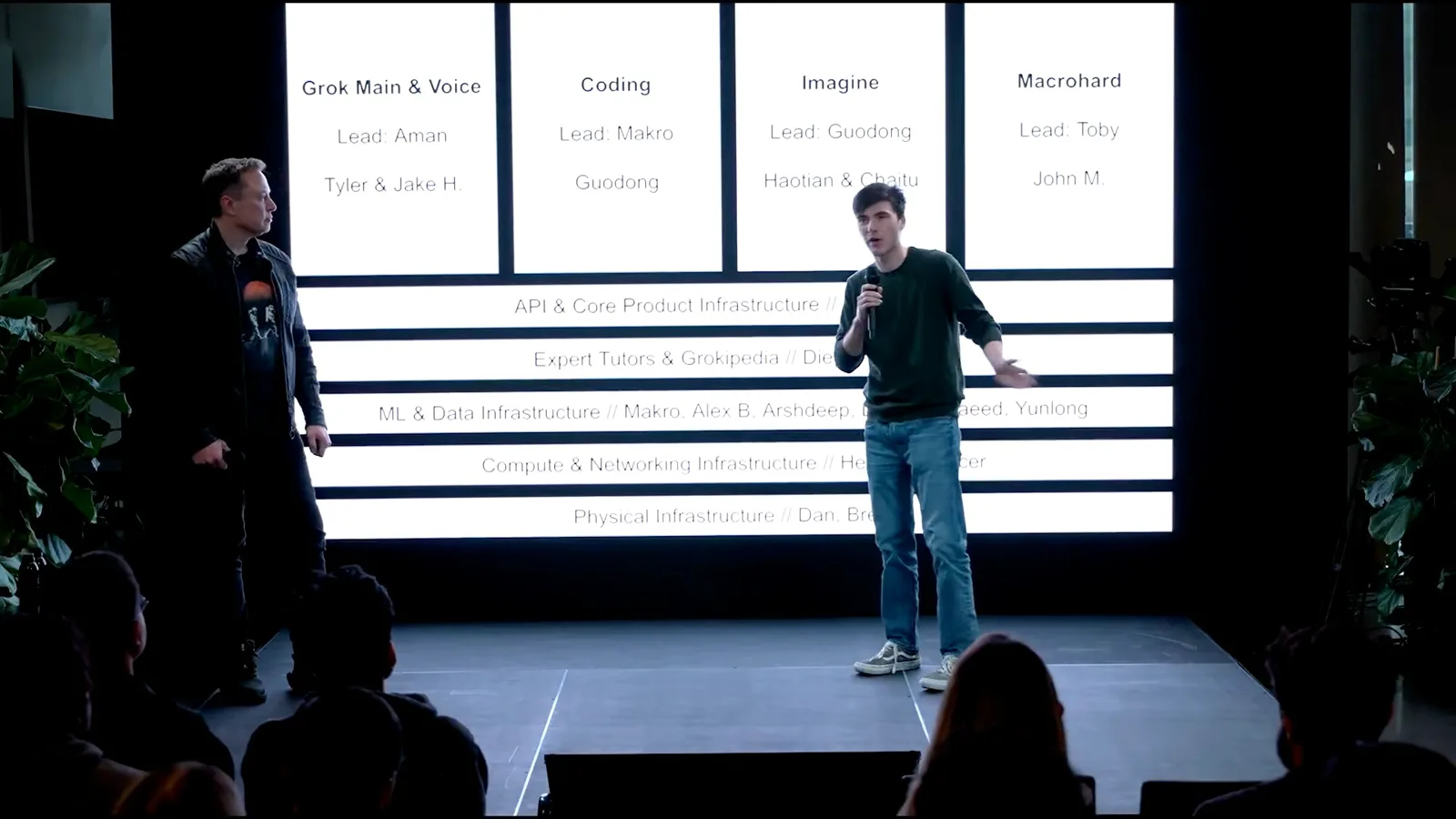
The evaluation team says it works with experts in medicine, finance, law and creative fields to assess model output and create training data. Musk says he wants to judge models by whether domain experts find their work correct and useful, rather than relying only on public benchmarks.
The team also describes Grokipedia and says it has grown to about six million articles. It presents reducing hallucinations and improving the encyclopedia as ongoing goals.
The systems behind large-scale training
Engineers describe scaling problems, distributed failures, GPU optimization and the Memphis data center.
An infrastructure engineer recounts building the Grok 3 training system. The team discovered around 30,000 GPUs that its software did not scale as expected and undertook a substantial rewrite before the larger training run.
He describes switches and network links failing, GPUs breaking and numerical problems arising while many devices must advance together. The challenge is to keep making training progress despite failures in any part of the system.
The reinforcement-learning and inference team says it is designing for a much larger number of chips and optimizing how workloads are divided and served. The tooling team describes platforms for human data, deployments and evaluation results.
The JAX team describes modifying compiler and runtime components for large GPU training. The kernel team focuses on low-level operations inside GPUs and communication across devices, where small efficiency gains can compound at scale.
The meeting connects to staff at the Memphis data center. They describe keeping hardware and networks running, connecting servers and constructing data halls, while reporting hundreds of thousands of GPUs and plans for continued expansion.
The infrastructure team says the completed site is expected to have more than a gigawatt of power and a large Tesla Megapack installation. Staff describe rapid parallel construction and the need to coordinate mechanical, electrical and structural work.
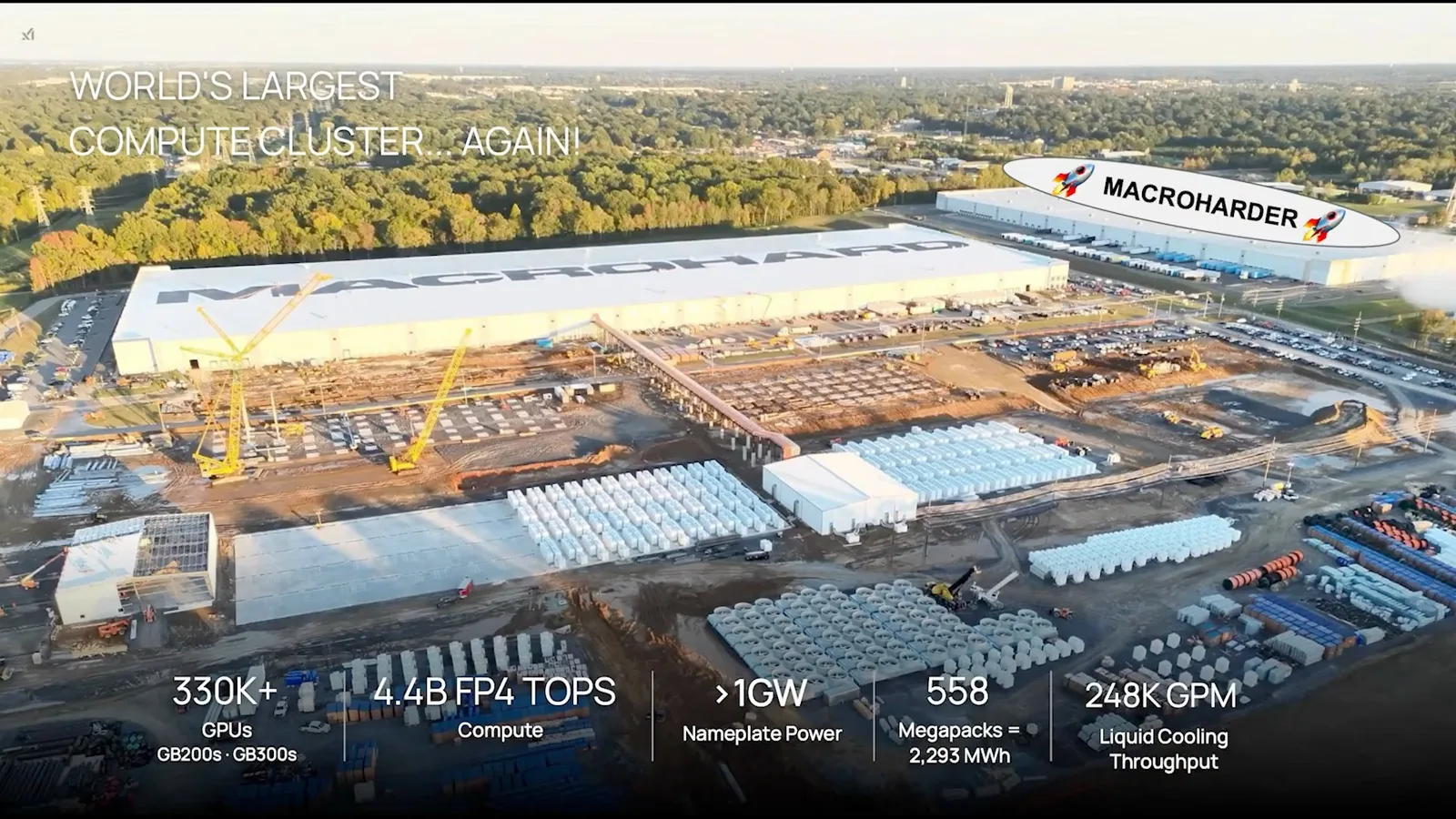
Musk shows an aerial view of the Memphis site and describes one phase and a planned expansion with additional Grace Blackwell systems. He argues that bringing training compute online quickly is central to xAI’s ability to develop models.
X products and a space-computing vision
The presentation closes with company-reported X metrics, product plans and Musk’s proposed orbital infrastructure.
An X product speaker reports growth in engagement, onboarding and articles, and says subscriptions have crossed a billion dollars in annual recurring revenue. These are company-reported operating figures from the meeting.
Musk discusses plans for XChat, including calls, messaging and releasing code for inspection. He also describes X Money as being in an internal beta and forecasts an external rollout; availability and timing are presented as plans.
He distinguishes roughly 600 million monthly users from more than one billion people with the X app installed, and says the goal is to give occasional users more reasons to return. He predicts a much larger daily audience over time.
Musk says combining SpaceX and xAI supports his goal of expanding intelligence and exploration beyond Earth. He argues that solar energy in space could eventually support computing on a far larger scale than terrestrial infrastructure.
He sketches orbital data centers and, later, Moon-based factories and an electromagnetic mass driver to launch AI satellites. He describes these as a path toward much greater energy use and exploration; the lunar facilities are a proposed future system.
More from this channel
 1:04:24EN
 Space SPAN (Science Policy and News)· Oct 21, 2026Gwynne Shotwell and Elon Musk on SpaceX, Orbital Computing and AI SafetyGuest Gwynne Shotwell, Elon MuskAt the 2026 All-In Summit, Shotwell describes managing SpaceX and Musk proposes peer testing of AI models.
 29:19ENSpace SPAN (Science Policy and News)· Aug 11, 2026Musk Sets a 10-Gigawatt AI Goal for SpaceXIn a company talk, Musk forecasts AI revenue growth and ties orbital computing to SpaceX’s multiplanetary plans.
 31:17ENSpace SPAN (Science Policy and News)· Jun 9, 2026SpaceX’s Draft AI Satellite: Solar Power, Radiators and StarshipGuest Elon Musk, Ian Dahl · Host Dan HuotMusk and Ian Dahl show a 120-kilowatt average-compute design and explain the launch, solar and chip capacity they hope to build.