In 30 seconds
Theo discusses Andrej Karpathy’s framing of Claude Tag as an organizational agent interface. He compares Anthropic’s launch description with his own Discord and Hermes setup, emphasizing shared context and task isolation while questioning reliance on one model provider.
- 1A shared agent in a channelThe announced feature connects Claude to selected channels and authorized tools.
- 2Context follows the teamTheo sees channels as a useful way to separate team-specific context and permissions.
- 3Threads separate workHis own setup uses Discord threads to avoid mixing unrelated tasks and scheduled outputs.
- 4A daily exampleA scheduled agent selects posts and produces an HTML page for review.
- 5Integrated experience versus model choiceTheo wants the convenience of an organizational agent without relying on a single model provider.
Takeaways
- A shared channel can let multiple people follow and continue an agent’s work.
- Channel and thread boundaries can keep relevant context separate for different teams or tasks.
- Permissions and actual product configuration determine what an agent can access.
- Self-hosted setups offer flexibility but require configuration and maintenance.
- Theo wants integrated team workflows that also allow model choice.
Read the edited text by chapter
A team-oriented agent interface
Theo introduces Karpathy’s framing and the launch-era product.
Andrej Karpathy describes a third interface paradigm for language models: after a website and then a desktop app, an asynchronous, persistent agent with organizational tools and context works alongside a team. The example he's discussing is Anthropic's Claude Tag in Slack. Despite my reluctance to praise either Anthropic or Slack, I think the underlying idea is worth examining.
At the time of this video, I say Claude Tag is available on team and enterprise plans and worry about the cost relative to my personal subscriptions. Availability, plan details and pricing can change. What interests me most is the interaction pattern, not a claim that every team needs this particular product.
Shared work and channel context
He explains the announced Slack integration and why channel-level boundaries appeal to him.
Anthropic describes a Claude that joins selected Slack channels and can be connected to chosen tools, data and codebases. People in the channel can tag it, delegate work and build on a shared conversation. The announcement says it retains relevant channel context and can plan future tasks; the exact access depends on the permissions granted.
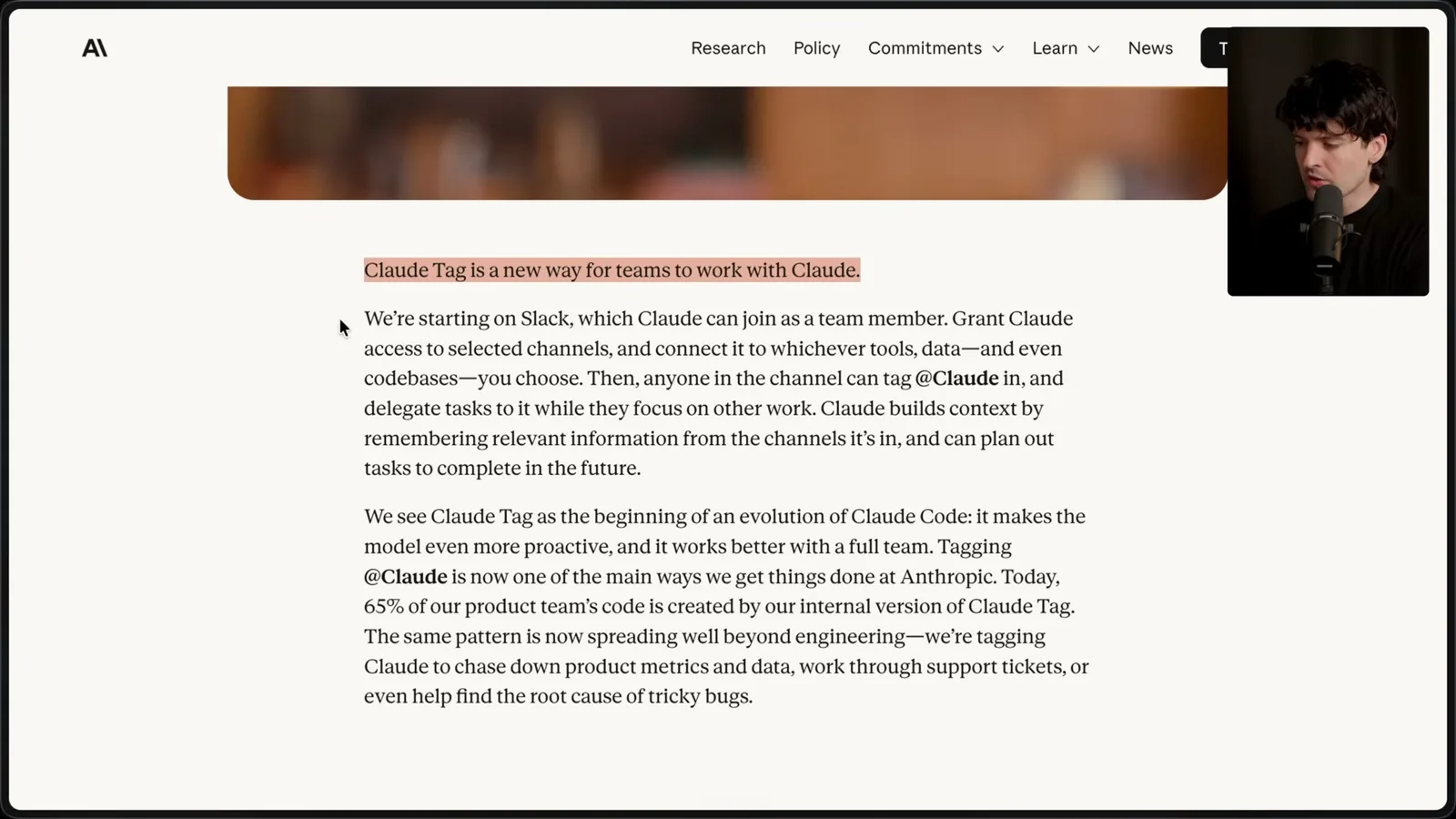
My team has been building separate agents for Discord workflows such as content, sponsors and planning. We create isolated environments with the tools and context each agent needs, but each deployment takes configuration. Claude Tag appears to package some of that separation into a team-facing product.
Anthropic says its internal version of Claude Tag creates 65% of its product team's code. That is the company's own reported figure; the video doesn't explain its measurement or establish results for other teams. The idea I find useful is that a channel shares the agent's work with multiple people, who can continue where someone else stopped.
We have some collaborative agent behavior in pull-request bots, where a teammate can ask a bot to propose changes. But I find GitHub slow and unreliable as a place for fast conversation. Talking with teammates and an agent in the same channel feels more natural to me; that is a preference, not a controlled comparison.
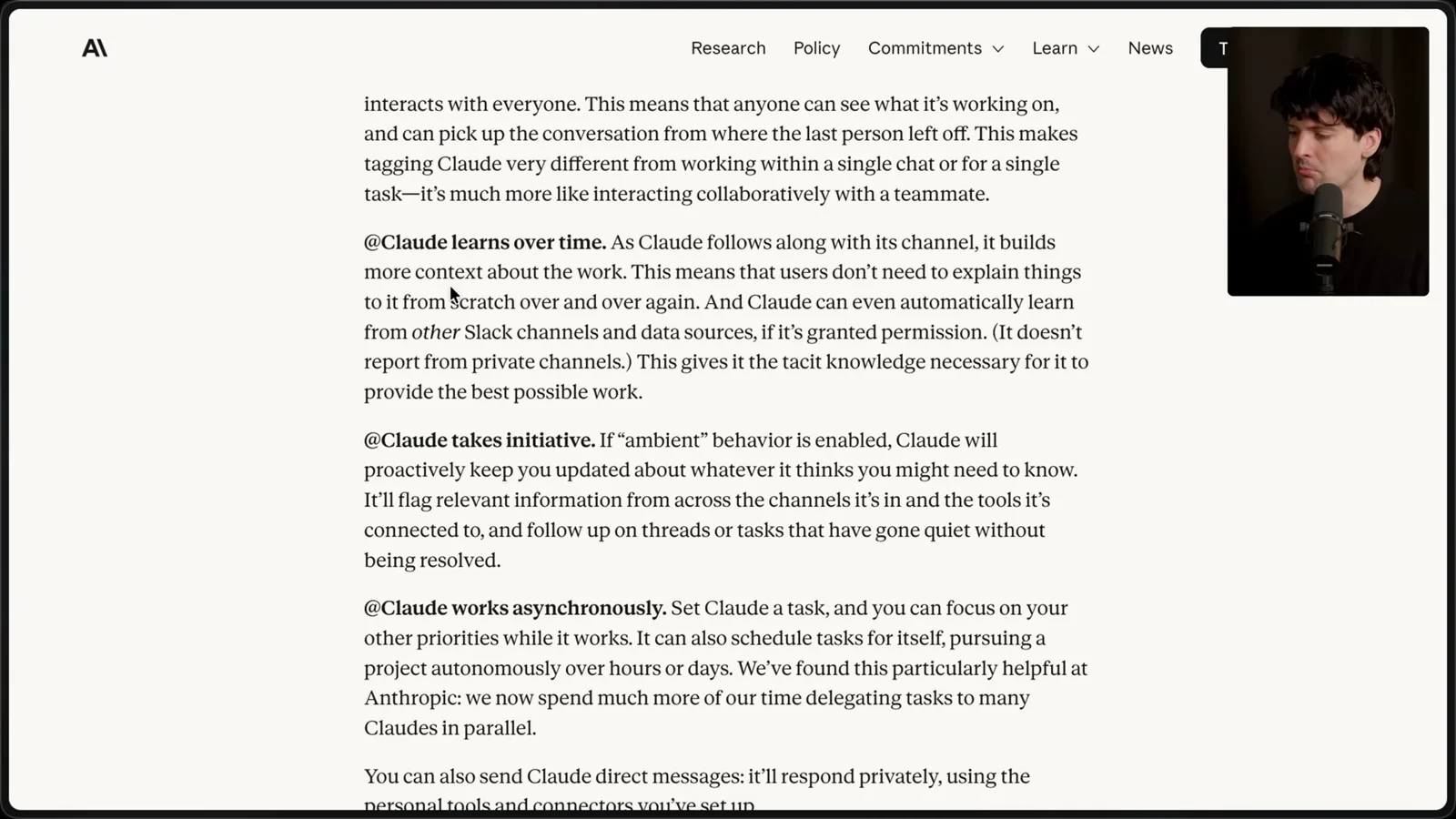
Anthropic says Claude builds context within its channel and can learn from other channels and sources if granted access; the announcement says it does not report from private channels. The details of permissions and privacy depend on the actual configuration. Different teams need different context, and a channel can be a useful boundary for that.
I struggle with the gap between global configuration and project-specific configuration. One task needs a few skills and connectors; another needs none, and a third needs additional instructions. The right boundaries among people, teams, projects and individual tasks are not settled, but channels map reasonably well to how teams already organize work.
If context is associated with a channel, two teams can have different experiences even when their work spans the same repository or several services. That is the organizational abstraction I find interesting: the agent's relevant background can follow the team rather than the repository layout alone.
Asynchronous work and personal experiments
Theo contrasts product claims with his own Discord and OpenClaw experience.
The announcement also describes optional ambient updates, asynchronous tasks, scheduling and direct messages. I can imagine proactive follow-ups being useful in a chaotic channel, though I am less excited by them than by the context boundaries. These are product claims in the launch announcement, not results from my own test.
My Hermes agent runs in a dedicated Discord server because I like using threads to separate tasks. In an earlier OpenClaw setup I mostly used one conversation to archive YouTube and SoundCloud links to my NAS. When unrelated work and scheduled jobs shared that same thread, context was pruned or interrupted, and I had to manually remind the agent which past details mattered.
I say OpenClaw has since added Discord thread support, which addresses part of that problem in the setup I describe. The important distinction for me is that multiple tasks can have separate histories rather than every scheduled result arriving in the middle of a different conversation.
A scheduled agent in its own thread
He demonstrates a daily job and explains the setup burden.
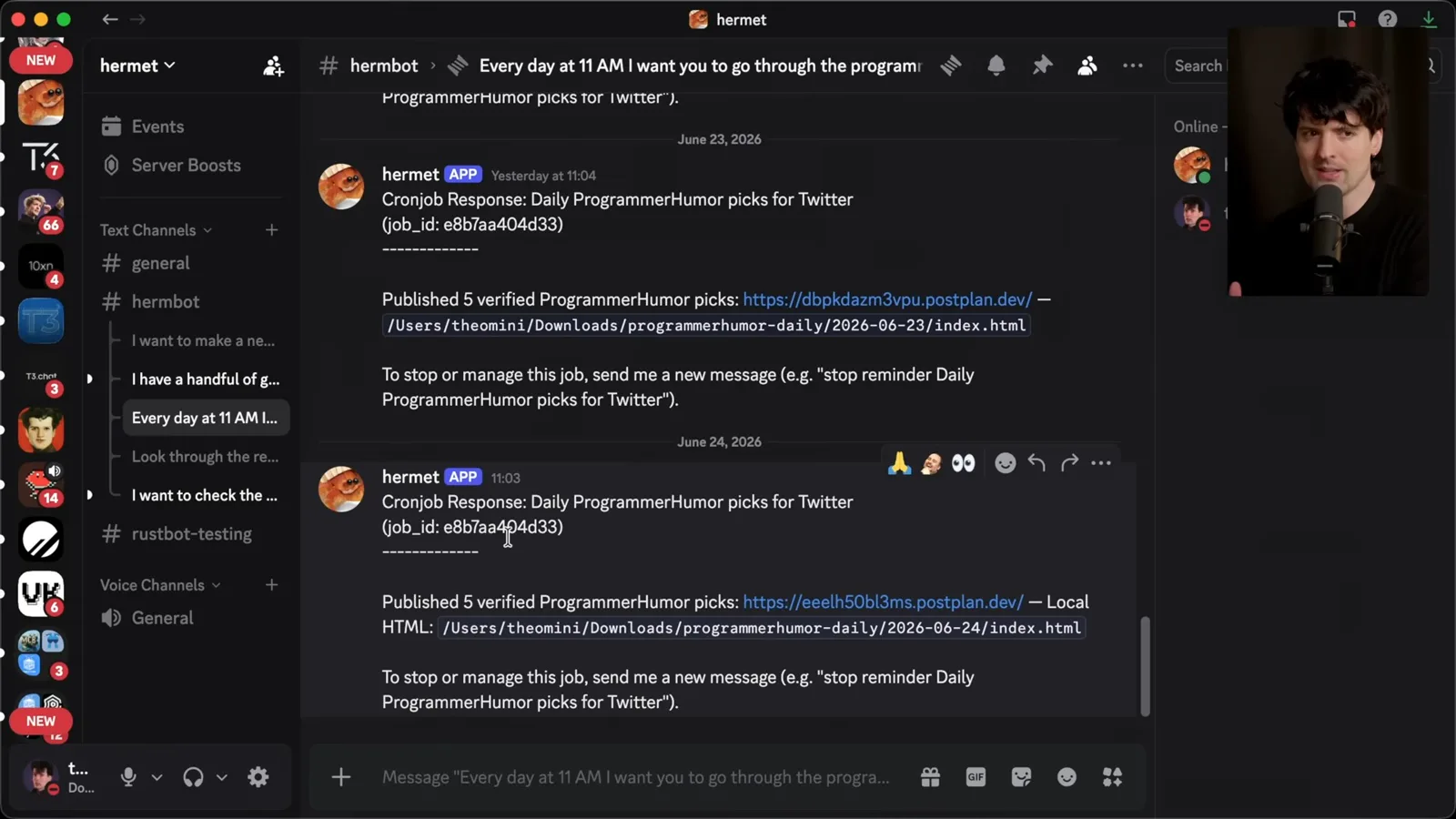
One Hermes job checks ProgrammerHumor daily at 11 a.m., selects five posts and generates a page I can review on my phone. It lives in its own thread. I asked for a test run and then asked the agent to change the output into an HTML page with embedded images, so I could decide whether to share them.
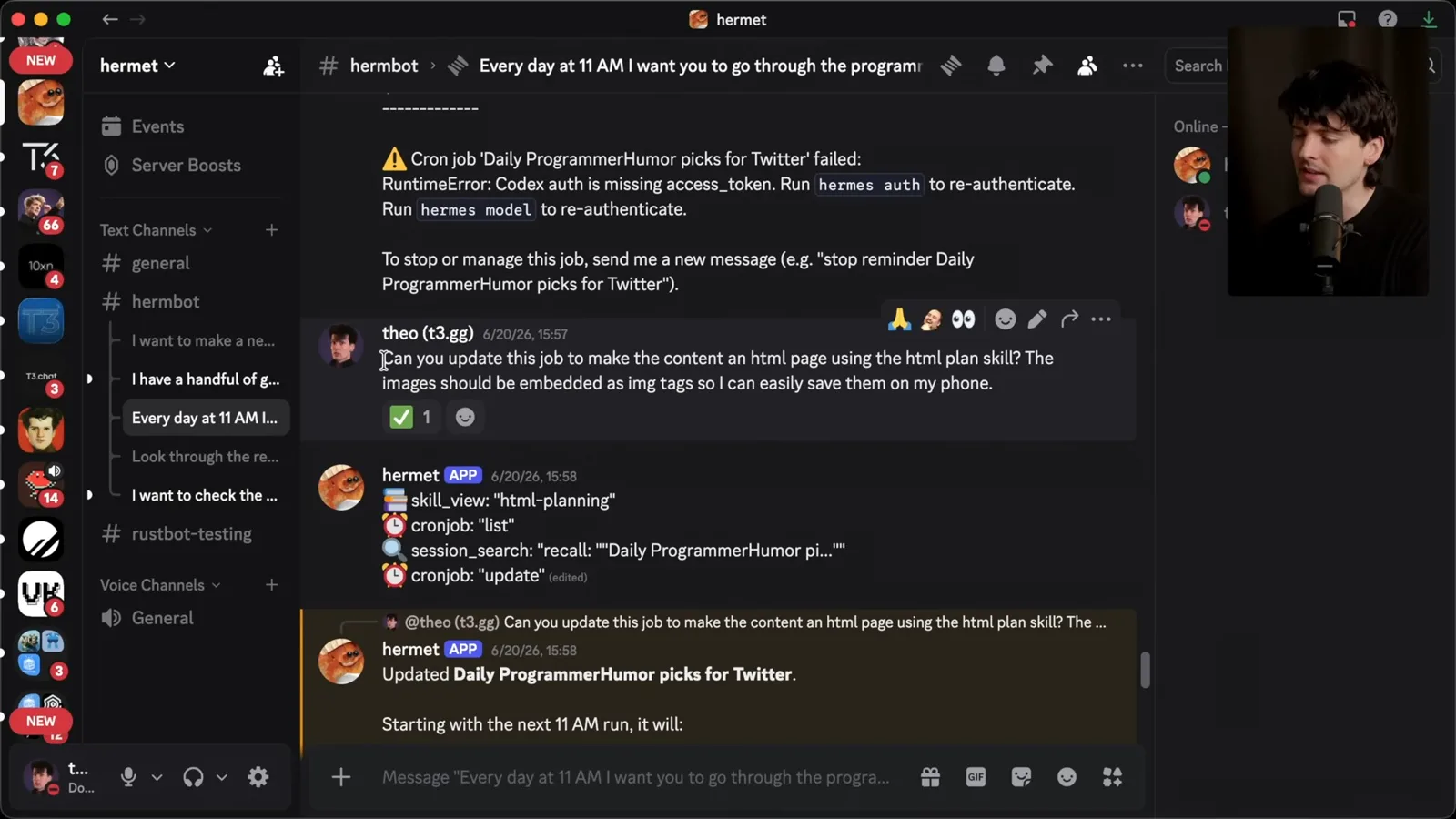
That separation keeps the scheduled work from polluting other conversations. My team wants different agents and capabilities for sponsorships, content planning and code, but currently I have to set up separate environments and boundaries myself. I think a product that supplies those primitives can make the workflow accessible to more people.
Model choice and the broader direction
Theo values integrated team workflows but wants the freedom to switch providers.
My reservation is model choice. With Hermes I can switch among GLM, OpenAI and Claude models, although my access and billing arrangements differ. In my experience switching from GPT-5.4 to 5.5 improved the same agent setup. I don't want this interaction pattern to depend on a single lab or model family.
The trade-off I see is between a custom setup, where I configure isolation, skills and context but can switch models, and Claude Tag, which promises a more integrated experience but is tied to Claude. For example, I sometimes ask Codex to involve Claude for API design or a second opinion; I can't assume the same flexibility in this product.
Karpathy calls the idea an organization-level harness. I agree with the direction: shared context, tools and asynchronous work could fit how real teams operate. I'm eager to see other providers build similar experiences, and people willing to configure their own agents can explore some of these ideas with tools such as Hermes or OpenClaw.
More from this channel
 38:47EN
 Theo - t3․gg· Oct 28, 2026Theo’s Long-Running Agent Experiments: Verification, Compute and CostTheo Browne · Ping LabsA skateboard game and two compiler projects show how repeated checks and flexible compute can sustain agent work—and how expensive those loops can become.
 36:07ENTheo - t3․gg· Oct 27, 2026Theo on Token Costs, Coding Agents, and the Price of AI CapabilityTheo Browne · Ping LabsA viral estimate of Lauren's AI spending prompts a closer look at cache pricing, benchmarks, and the changing work of coding agents.
 30:37ENTheo - t3․gg· Oct 26, 2026Theo’s Three Skills for Reviewing and Shipping with Coding AgentsTheo Browne · Ping LabsHow sol-loop, full-send and full-stop encode review, verification and different levels of merge authority.
 0:43ENTheo - t3․gg· Oct 23, 2026Theo Distinguishes Security Vulnerabilities from Active AttacksTheo Browne · Ping LabsA short explanation of why disclosed software flaws and reported attacks are different kinds of security news.
 29:22ENTheo - t3․gg· Oct 22, 2026Theo on Security Vulnerabilities, Stolen API Keys and AITheo Browne · Ping LabsA look at the gap between vulnerability disclosure and patching, and a speculative account of why stolen inference keys may be valuable.
 31:13ENTheo - t3․gg· Oct 20, 2026Theo on Why Smarter Models Help More Than DevelopersTheo Browne · Ping LabsFrom game modifications to compiler experiments, Theo revisits his assumptions about who benefits from more capable AI.