In 30 seconds
Theo Browne challenges a calculation that turned Lauren's 1.5 trillion monthly tokens into an estimated $132 million annual bill. He explains why aggregate token counts cannot reveal costs without a breakdown and offers his own explicitly speculative estimates. He also argues that comparable model capability is getting cheaper, while acknowledging that benchmarks and changing workflows complicate real-world comparisons.
- 1Different tokens, different pricesCache reads, cache writes, input and output carry different rates. Theo says his own aggregate average was 41 cents per million tokens, but Lauren's mix and actual bill are unknown.
- 2Capability at a lower priceTheo cites an Artificial Analysis index to compare task costs at similar benchmark thresholds over time. He argues that users may nevertheless spend more as they use more capable models.
- 3A controlled but narrow comparisonHis SkateBench run compares o1 and later models on skateboard-trick questions. The test illustrates one price-performance trend but is not a full measure of coding work.
- 4The workflow changedA modern agent can investigate and verify a bug instead of requiring a human to select and test each edit. Token cost alone does not measure the labor saved.
Takeaways
- Aggregate token counts do not reveal a bill without the mix of input, output, cache reads and cache writes.
- An engineer's token spending can support product development, research and marketing as well as code production.
- Benchmark comparisons suggest falling costs at a given measured capability, but the results do not automatically generalize to every task.
- Agent workflows may spend similar money while replacing more human work.
- Future price declines and private discounts are estimates, not established facts.
Read the edited text by chapter
The viral spending estimate
Theo introduces Lauren's usage and questions the $132 million headline. The publicly visible total does not disclose the pricing mix.
Lauren, known as poteto and the creator of pstack, has become a prominent agentic developer. A post claimed that the 1.5 trillion tokens on her Cursor profile represented $132 million a year. That is an astonishing figure, but it depends on assumptions about token pricing that I think are badly wrong.
Her profile shows 1.5 trillion tokens over 30 days. I use a lot of tokens myself and have not reached 100 billion, so her usage is extraordinary. The interesting question is what that aggregate actually costs, and what she is doing with it.
The broader lesson is to examine the numbers behind confident claims about AI. Peter's calculation starts with a real usage total, then assumes an average price of $8 per million tokens and arrives at roughly $11 million per month. That assumed rate is the part I dispute.
How token pricing changes the calculation
He distinguishes cache and ordinary input and output pricing. His estimates of Lauren's effective rate are speculative.
An aggregate token count combines cache reads, cache writes, ordinary input, and output. Those categories have very different prices. You cannot simply average a model's input and output prices and apply that figure to all tokens without knowing the mix.
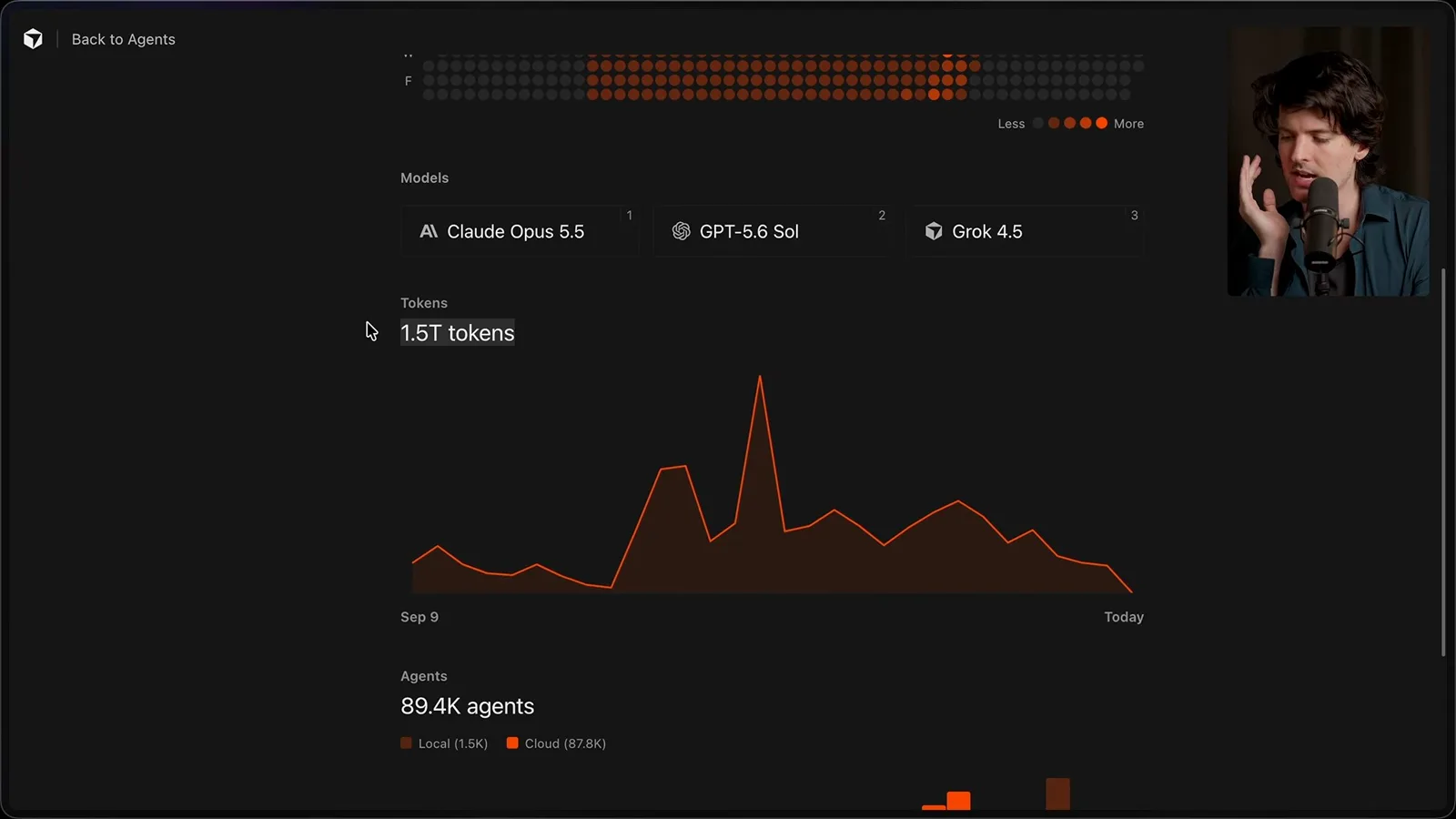
For my own usage, mostly Opus 5.5, the average across all token types is about 41 cents per million, far below the $8 assumption. Cache reads and writes account for most of my spending, while ordinary input and output make up less than 8%. My mix does not prove Lauren's price, but it shows why the calculation needs more information.
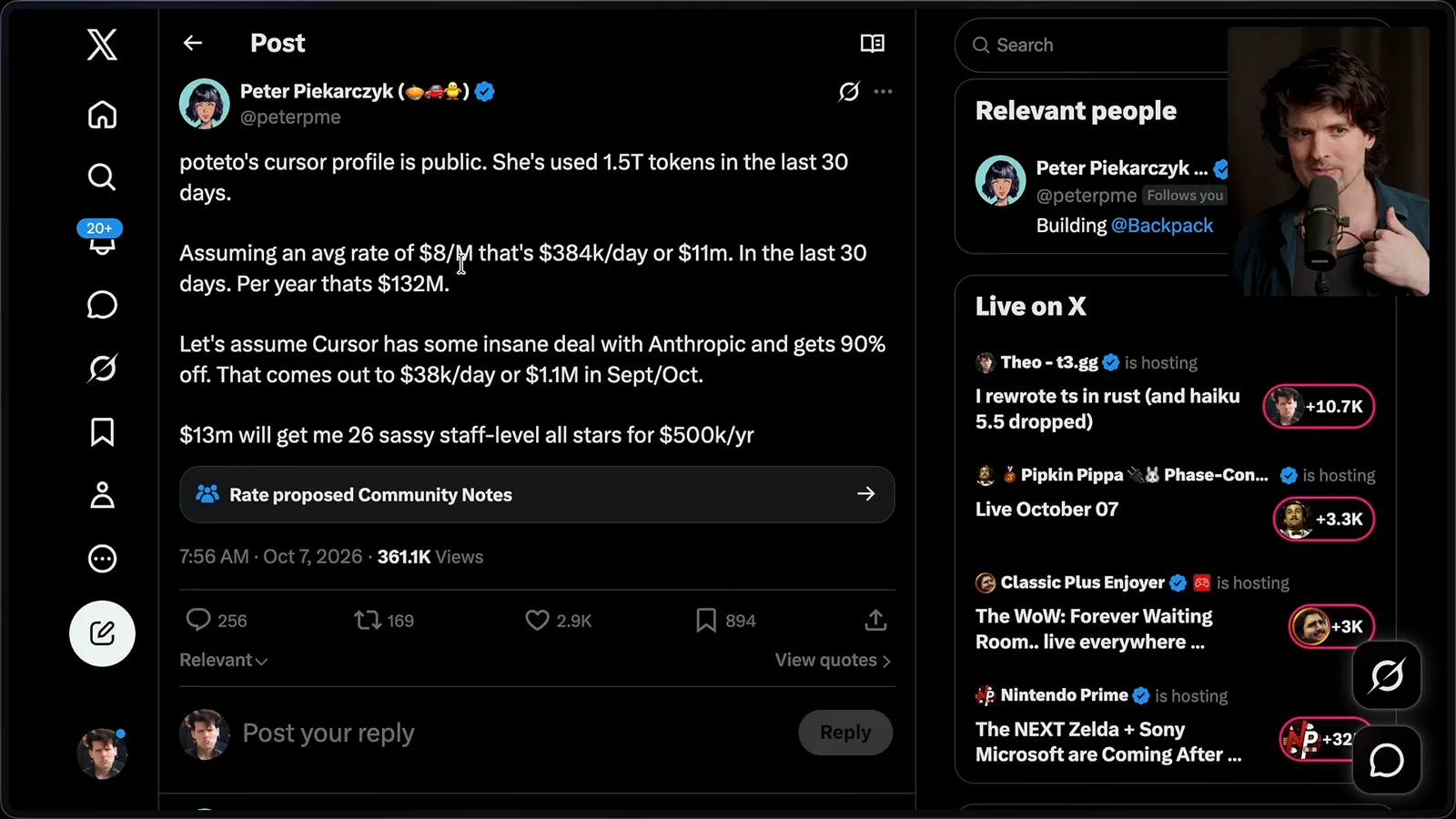
Peter then assumes a 90% discount and compares the resulting annual bill with the cost of 26 senior engineers. I think that comparison misses the productivity enabled by agents: those engineers would also need tools and inference budgets. The discount and the underlying token mix are both assumptions, not facts established by the profile.
I speculate that Cursor's arrangements and Lauren's model mix could bring an effective aggregate rate down to around 20 cents per million, or about $25,000 a month under the same simplified calculation. Long agent runs may also produce more cache hits. These are estimates, and the aggregate number alone cannot establish the actual bill.
Assessing the value of the experiment
He discusses engineering, research and marketing value. He argues the aggregate token count cannot establish the actual bill.
Consider the value alongside the cost. Companies sometimes spend more than that on events that attract less attention than a few of Lauren's posts. Her work also generates product feedback and code changes: I have seen improvements to Cursor and work on Grokbot. Marketing, engineering and research all belong in the discussion.
Depending on the mix, I speculate the effective rate could be lower still. I cannot infer a precise amount from the public profile, and even my estimates should not be treated as a bill. My main objection is that the $132 million headline takes an unsuitable average and treats it as known.
The cost of a given capability
Theo reviews benchmark-based price trends and the difference between cheaper capability and higher overall usage.
The other part of the argument is how fast inference cost falls for a given level of capability. An Artificial Analysis chart compares the cost per task at different intelligence-index thresholds. A frontier model can be expensive at launch, while later models reach a similar score for much less.
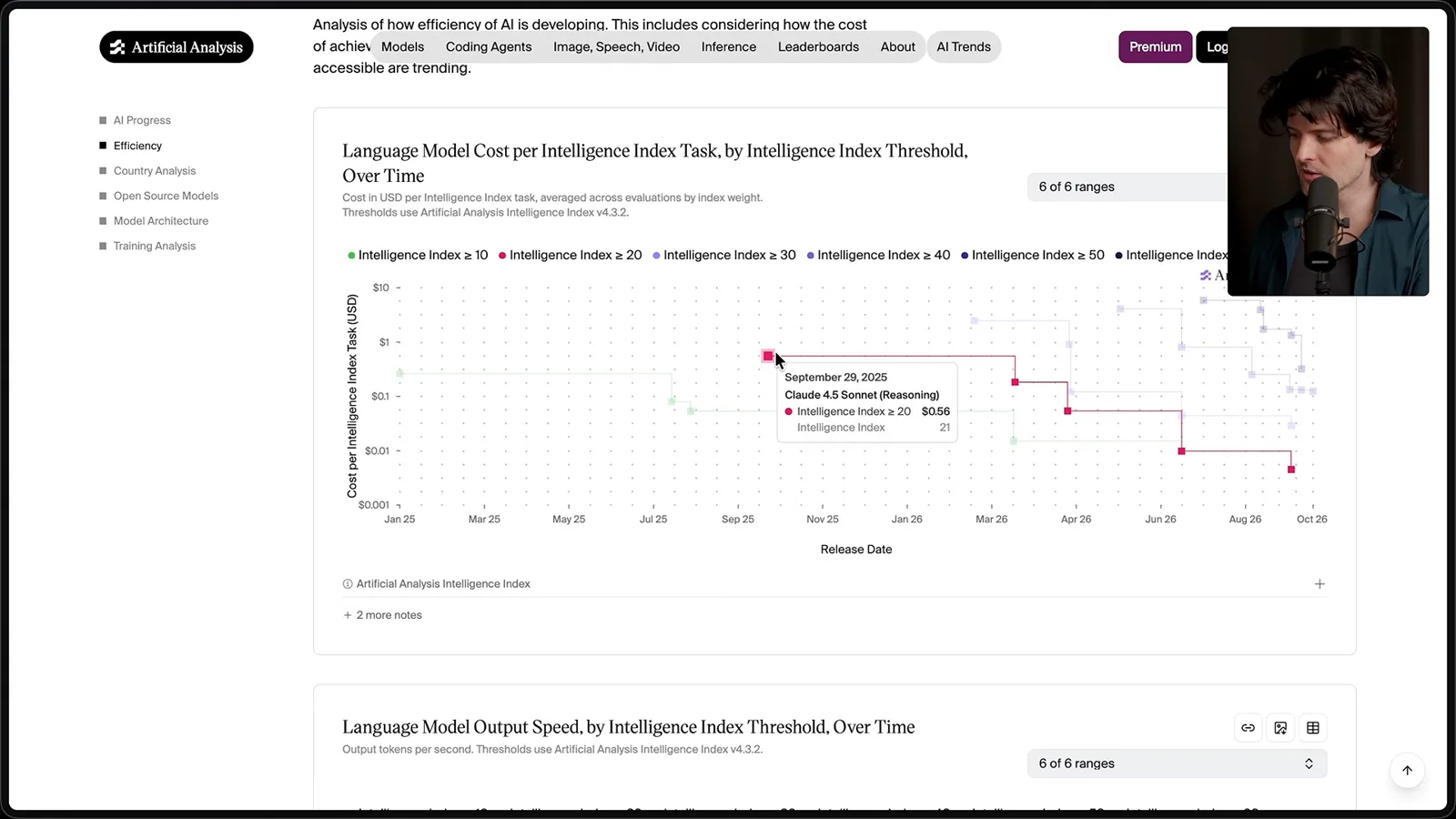
In the chart I cite, Sonnet 4.5 reached an index score above 20 at about 56 cents per task in September 2025; roughly a year later, GPT-6 Luna low reached that range at about 0.45 cents. At the next threshold, I compare $2.50 with about 3 cents. These are benchmark comparisons, not a guarantee that every real-world workflow becomes cheaper by the same factor.
This matters to the disagreement about whether lab employees understand real token budgets. I compare the early days of computers with people pushing the limits of agentic engineering today. Experiments can look extravagant at current prices while revealing workflows that later become affordable.
A critic argues that benchmark prices do not mean applied intelligence is getting cheaper. I think the distinction is that people often choose the newer, more capable model and do more with it. Spending may stay constant or rise while the price of a comparable capability falls, much as buying the latest phone can hide lower prices for an earlier generation.
I prefer newer small models such as GLM-5.3 Flash for long-running agent work over older frontier models. The improvement is not only a benchmark score: in my experience the newer model is more pleasant to work with and more reliable at taking successive steps. Retiring an inefficient old model does not erase the availability of a cheaper, more capable replacement.
Model prices and benchmark limitations
He compares model rates and responds to criticism of benchmarks. Practical workflows remain a separate question.
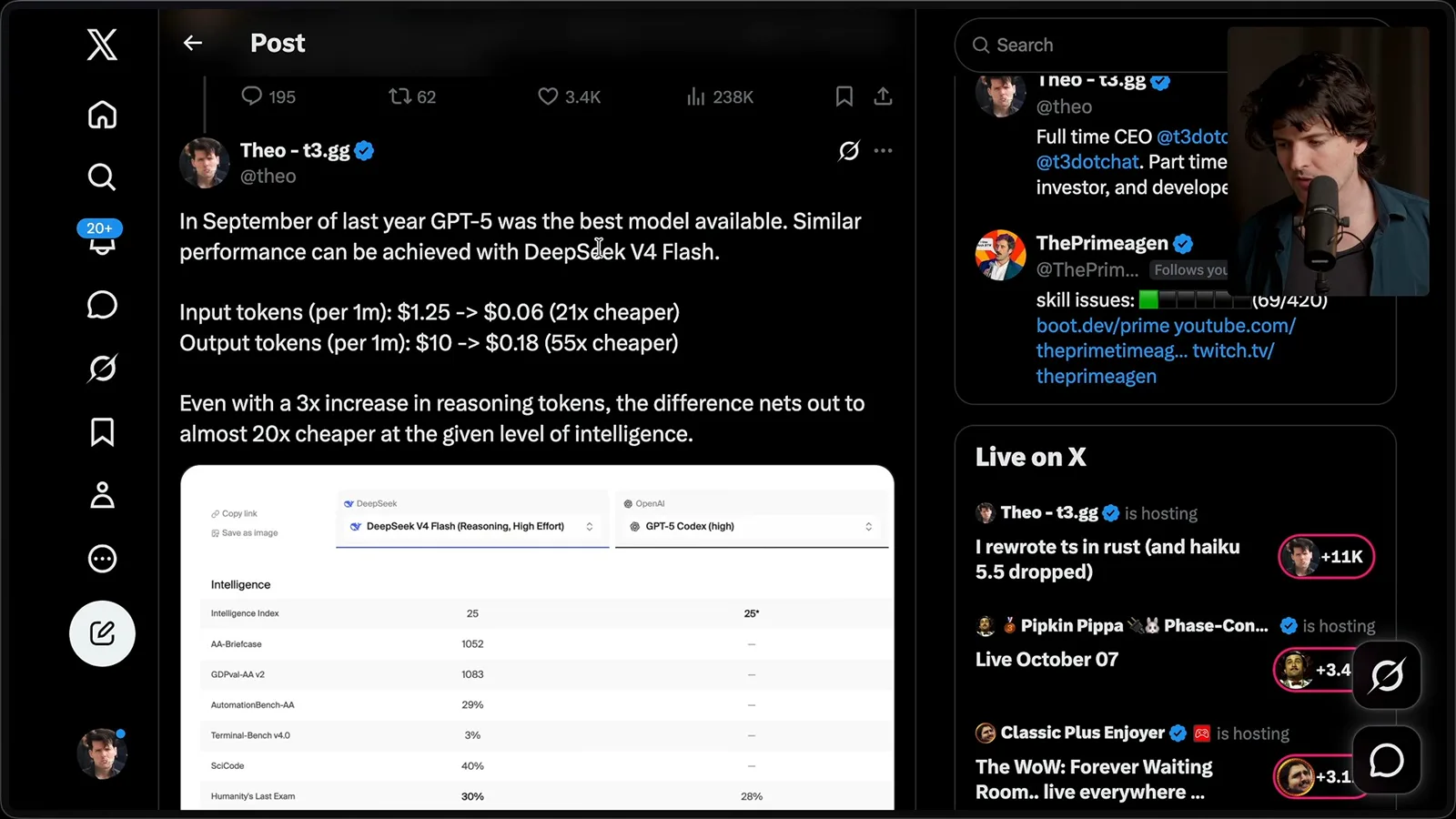
I compared GPT-5's token rates with DeepSeek V4 Flash: the input rate was about 21 times lower and output about 55 times lower. Even allowing three times as many reasoning tokens, my calculation came out close to 20 times cheaper. The exact result depends on the workload and token mix.
Benchmarks have limitations, particularly when current models saturate old tests or the tests are poorly designed. But when inexpensive models now perform well on tests that challenged older systems, that is still useful evidence of progress. We need better, newer evaluations rather than dismissing every old comparison.
The objection is that a problem which cost ten cents to solve a year ago may still cost about ten cents today, and that difficult tasks have not improved in reliability at the same rate as benchmark prices. That is a fair distinction to investigate, but I disagree that it proves comparable intelligence has not become cheaper.
Agents changed the workflow
Older models struggled with tools, while modern agents can do more of the work. Theo recounts his own earlier mistake about command execution.
I tried an older model, GPT-4o, in an agent harness and found that it struggled to use tools and continue the task. Modern models can use the harness much more effectively. Comparing only the price of the final result can obscure the extra work an agent now does on the user's behalf.
I was wrong about this myself. When Windsurf added command execution, I dismissed it as a beginner feature: I thought I could run the command myself. I failed to anticipate how valuable it would be for a model to use a shell and other tools as part of its own workflow.
A comparison with three-year-old models is hard because the workflows were so different. You often had to set up the environment, locate the file and ask for a specific edit yourself. A modern agent can take a broader instruction and do much more of that work, so the tasks need careful definition.
A SkateBench comparison
Theo compares o1 with newer models on a repeatable but narrow test. He discusses why equivalent task cost and human effort can diverge.
To make a more controlled comparison, I ran SkateBench, a test involving naming skateboard tricks. It is not a complete measure of software engineering, but it provides a repeatable task. OpenAI's o1, released in December 2024, scored 67.7% at roughly 11.5 cents per question in my run.
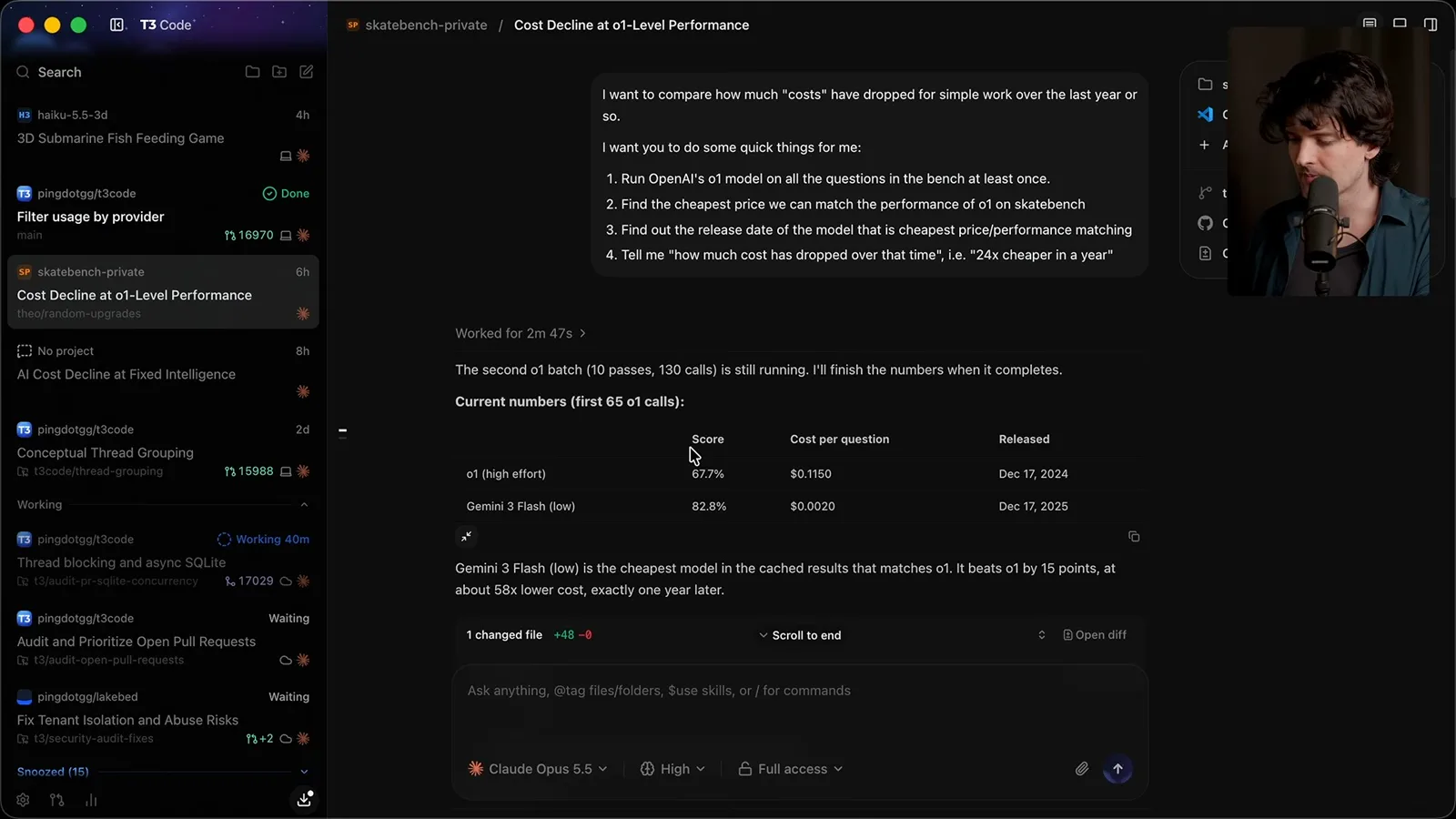
Gemini 3 Flash, released exactly a year later, scored higher in the displayed result at about 0.2 cents per question: approximately 58 times cheaper. A later GLM Flash result scored 70.8% at about $0.00016 per question, which I calculated as roughly 680 times cheaper than o1. These are my benchmark results, not universal cost ratios.
At this pace, I expect the machine running the agent's tools and shell could eventually cost more than inference for some workloads. But the practical objection still matters: benchmark equivalence does not necessarily translate directly to outcomes in every application.
Take a bug fix. Previously I might reproduce the bug, find the right file, select code, ask a model to edit it, and manually restart and check the app. Now I can give an agent a screenshot and ask it to investigate, run the application and verify the fix. The ticket may cost a similar amount in tokens, but the human work has changed.
I chose SkateBench because I struggled to identify a real coding task that o1 could complete reliably enough for a clean comparison. Gemini 3 Flash performed better at a fraction of the cost. I asked my critic to provide real tasks from a year ago so I could test them as a benchmark; the disagreement remained unresolved.
My frustration is that people may welcome claims about AI prices because the claims fit what they already believe. I think cheaper inference also puts pressure on model providers' margins. The discussion should distinguish actual evidence about prices and outcomes from assumptions about what will happen.
What the spending experiment is for
He offers a conditional projection about future prices and describes Lauren's work as frontier product research. He closes by urging readers to check assumptions and acknowledge mistakes.
Using my own rough estimate, I suggested that an equivalent level of capability might become much cheaper over the next year if the trend continued. That is a projection, not a promise. In practice, users may choose smarter models, tackle harder tasks and delegate more work instead of keeping the same workload.
Nor is Lauren's usage meant to be normal for every engineer. I see it as an unusual power user exploring the frontier. Her spending should be considered across engineering, research, product improvement and marketing, rather than judged solely as dollars spent to produce a fixed amount of code.
Lauren says she aims to be a power user so she can give useful feedback and improve the products. I have seen that work happen. If people want to question excessive token use, they should examine the purpose and the outcomes rather than assuming that a large aggregate number explains the experiment.
When a large numerical claim circulates, check the arithmetic and the assumptions. An AI assistant can help inspect a calculation, but the question is still whether the relevant inputs are known. In this case, an aggregate token count leaves out the pricing categories and agreements needed to determine the bill.
Look as well for arguments that substitute speculation about someone's motives for engagement with the numbers. I am sharply criticizing people I know because I think the claims are harmful to the conversation. I also want to acknowledge my own mistaken predictions about model limits, falling costs and agents running commands.
I have been wrong before and expect to say so publicly when the evidence changes. The goal is to understand the underlying information: what was measured, what was assumed, and whether a benchmark or price comparison actually answers the question being asked.
More from this channel
 30:37EN
 Theo - t3․gg· Oct 26, 2026Theo’s Three Skills for Reviewing and Shipping with Coding AgentsTheo Browne · Ping LabsHow sol-loop, full-send and full-stop encode review, verification and different levels of merge authority.
 0:43ENTheo - t3․gg· Oct 23, 2026Theo Distinguishes Security Vulnerabilities from Active AttacksTheo Browne · Ping LabsA short explanation of why disclosed software flaws and reported attacks are different kinds of security news.