In 30 seconds
Neo4j’s Stephen Chin and Blitzy’s Neeraj Deshmukh show how code dependencies can be represented as an evidence-backed graph and supplied to agents. They describe human approval, continuous tests and vendor-reported banking and insurance cases.
- 1The formula is not the whole systemBatch jobs, layouts and outputs determine behavior.
- 2Keep evidence with graph edgesTrack source spans and revisions as the code evolves.
- 3Compare old and new behaviorTest outputs, state and failure paths against the baseline.
- 4Mapping is not migrationThe four-day result describes mapping a 35-million-line estate.
Takeaways
- A correct translation must preserve surrounding jobs, data contracts and behavior.
- A knowledge graph can connect code to revisioned source evidence.
- Human-reviewed plans and layered tests help govern agent-generated changes.
- Comparing old and new results can expose rounding and state differences.
- The reported four-day result concerns mapping, not rewriting the entire mainframe.
Read the edited text by chapter
Why system context matters
The speakers explain this stage of the modernization workflow. They use examples to show its role in preserving system behavior.
Stephen Chin says modern banking apps often sit on old mainframes with nightly batch jobs, business rules and data contracts. Changing a single line can be risky when the surrounding dependencies are poorly understood.
Chin recalls migrating COBOL to Java decades ago: projects took years, and incomplete tests left corner cases undiscovered. He introduces Blitzy’s Neeraj Deshmukh to explain a different approach.
Following an interest calculation
The speakers explain this stage of the modernization workflow. They use examples to show its role in preserving system behavior.
Deshmukh uses the public AWS CardDemo system and an interest calculation as an example. A batch job calls a program, which uses copybooks and layouts and writes VSAM data; the result depends on all of those relationships, not just a formula.
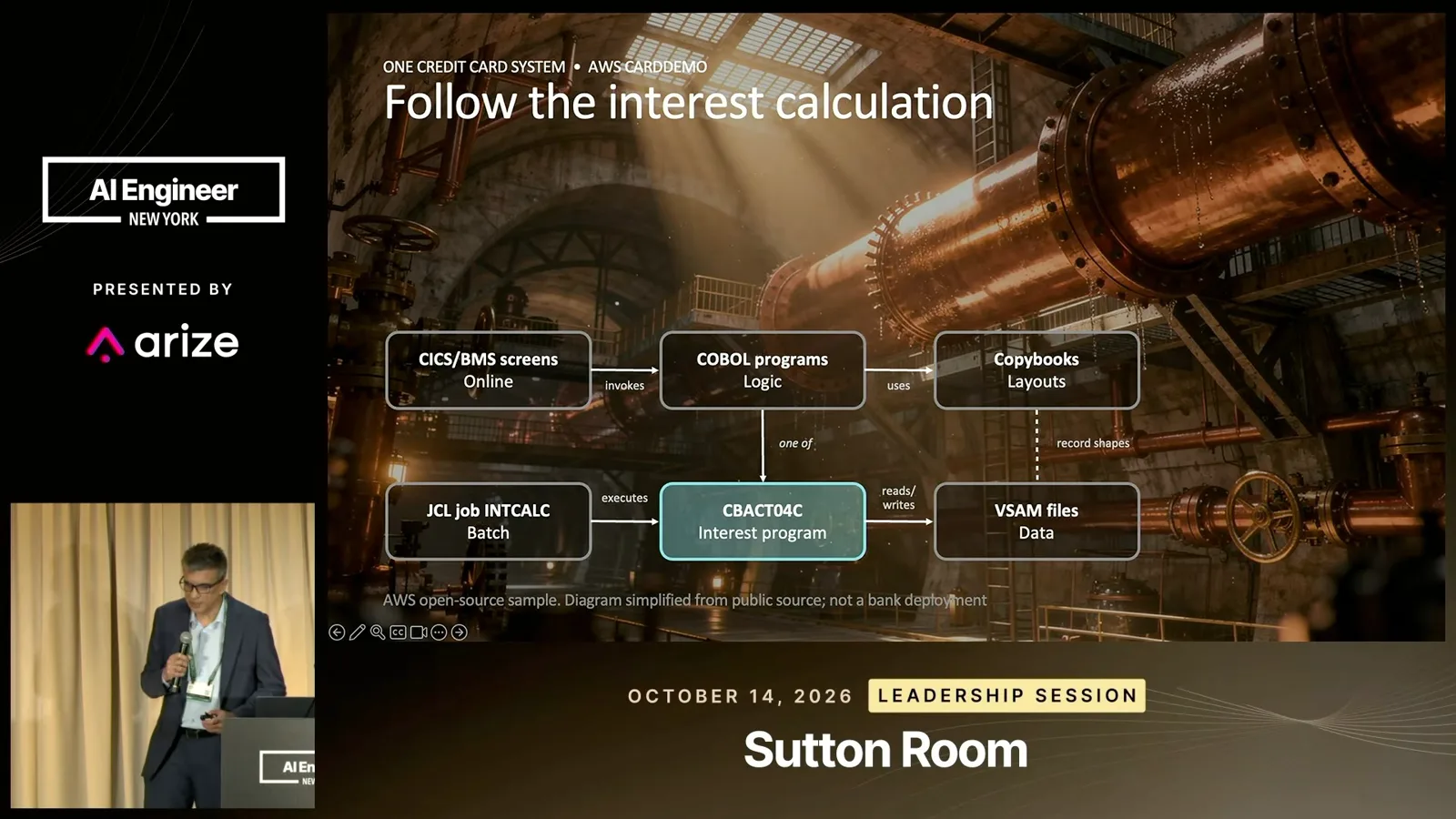
An AI asked to translate the COBOL formula to Java might produce plausible code while missing record precision, account updates, transaction output and batch contracts. The problem is missing system context rather than merely syntax conversion.
Chin argues that a larger context window or similarity search does not necessarily recover all the dependencies needed for a change. A graph can retrieve connected information across multiple relationships; the speakers present it as a complement to the model.
He says models may use only part of their advertised context effectively, so the application should supply precise, relevant evidence. His numerical estimates are observations from the talk, not a universal limit for every model or task.
Code as an evidence-backed graph
The speakers explain this stage of the modernization workflow. They use examples to show its role in preserving system behavior.
Deshmukh maps jobs, programs, copybooks, fields and data stores into a knowledge graph. Each relationship retains its repository, revision, symbol and source evidence; the graph is refreshed as code changes.
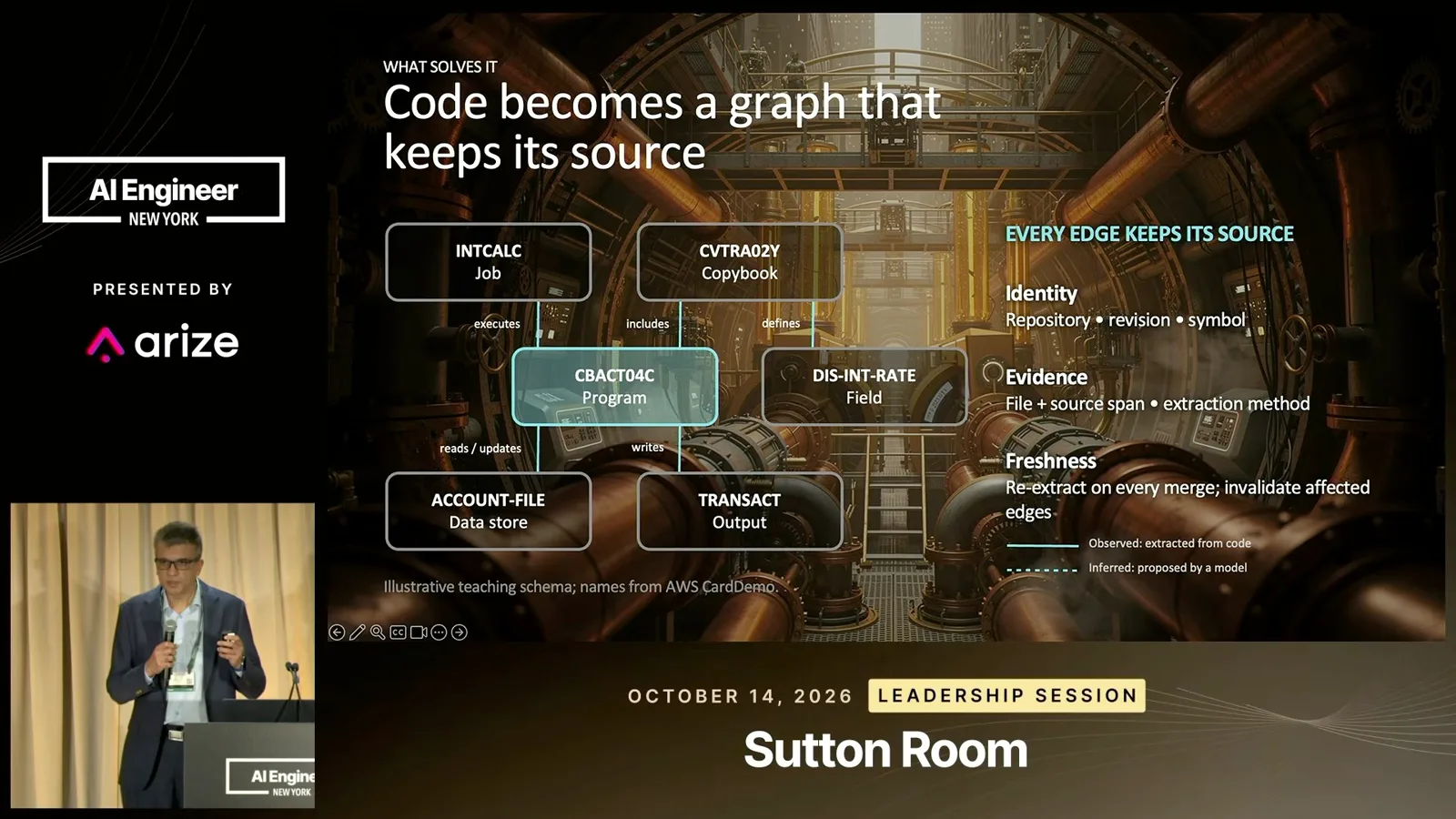
Each agent receives a task-specific context packet containing the relevant source slice, constraints, evidence and unanswered questions. The goal is access to the right information when needed, not putting the entire codebase in one prompt.
Agents, plans and human approval
The speakers explain this stage of the modernization workflow. They use examples to show its role in preserving system behavior.
Blitzy describes its process as an enterprise compiler: reverse engineer the system, extract workflows and business logic, combine those with the user’s requirements, and create an agent action plan. A human reviews the plan before generation.
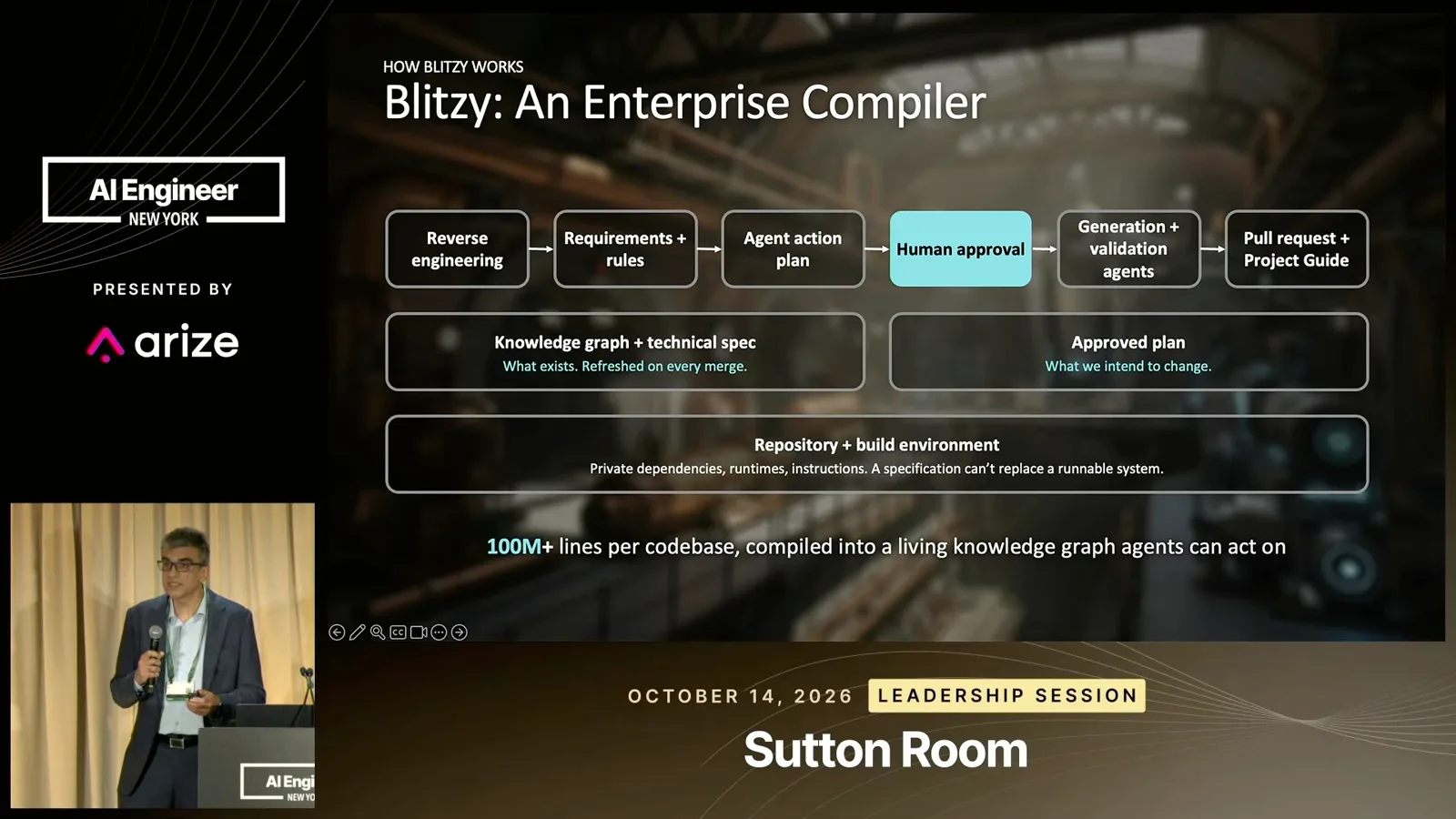
The agents generate code with validation throughout, producing a pull request and documentation of the evidence. Deshmukh says access to the repository and build environment also lets the system observe runtime behavior rather than rely only on static analysis.
The proposed architecture combines a shared plan for thousands of agents with continuous testing. Deshmukh says Blitzy spends more compute on tests than code generation, while humans retain decisions at important checkpoints.
The action plan defines the transformation’s scope and the behavior that must be preserved. The speakers identify system context, continuous validation, security and governance guardrails, and human oversight as the controls.
Testing behavior parity
The speakers explain this stage of the modernization workflow. They use examples to show its role in preserving system behavior.
Parity includes monetary precision and rounding, balances, transaction records, failures and operational behavior. Existing defects also need explicit decisions: silently changing them can change a business outcome.
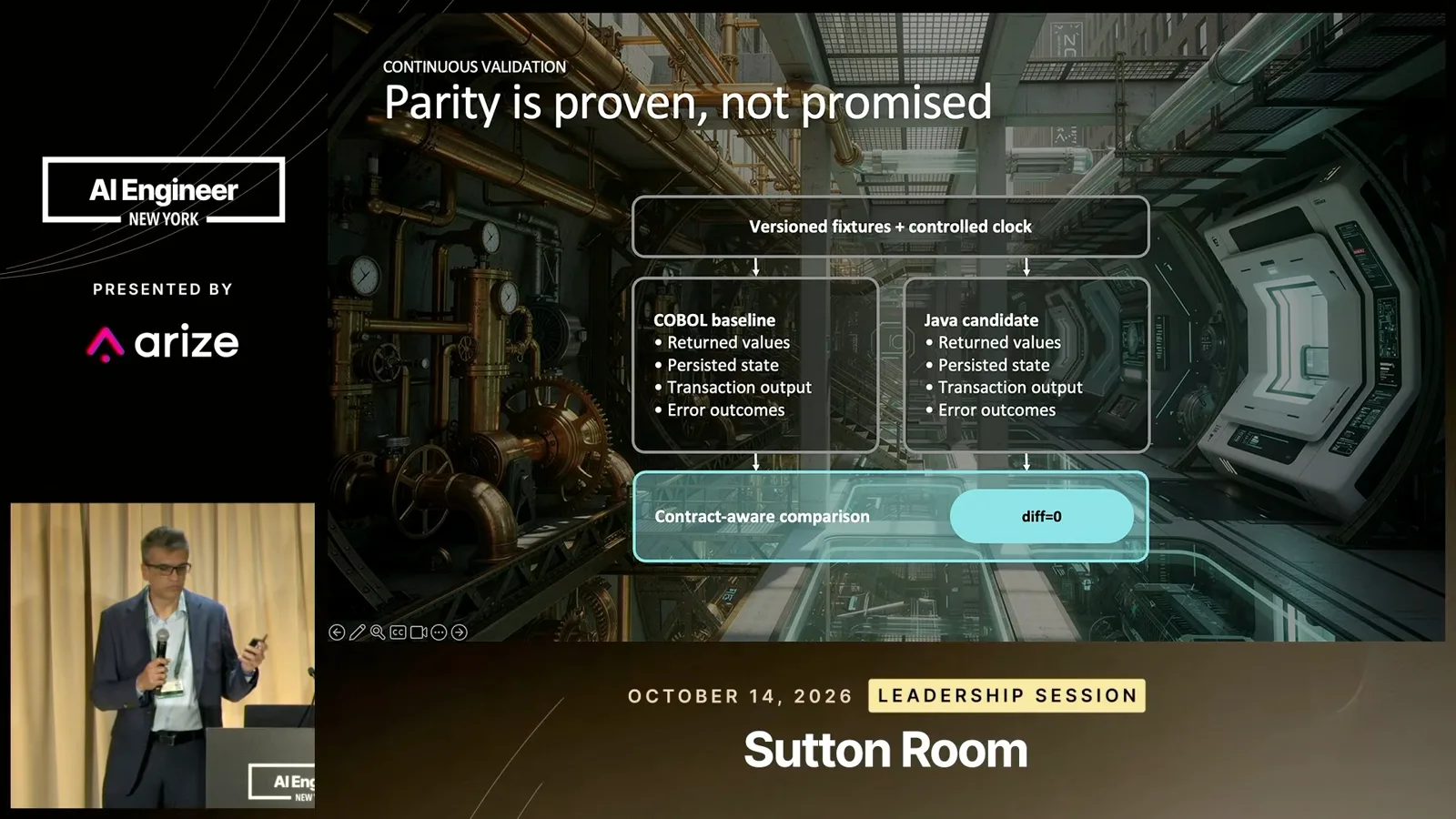
The team compares the old and new systems on the same inputs, returned values, persisted state, transaction outputs and errors. Deshmukh says validation is layered through unit, integration, data and end-to-end tests rather than left until the end.
A rounding example shows why: a Java translation can compile and look correct but differ by one cent from COBOL behavior. The speaker says a parity test caught the difference; at scale, small discrepancies can accumulate.
Reported customer cases
The speakers explain this stage of the modernization workflow. They use examples to show its role in preserving system behavior.
Deshmukh presents a bank trade-posting case in which a monolith was converted into six modules using PostgreSQL and several languages. He reports 18 days and over 4,000 tests, compared with the customer’s original estimate of 18 engineer-weeks.
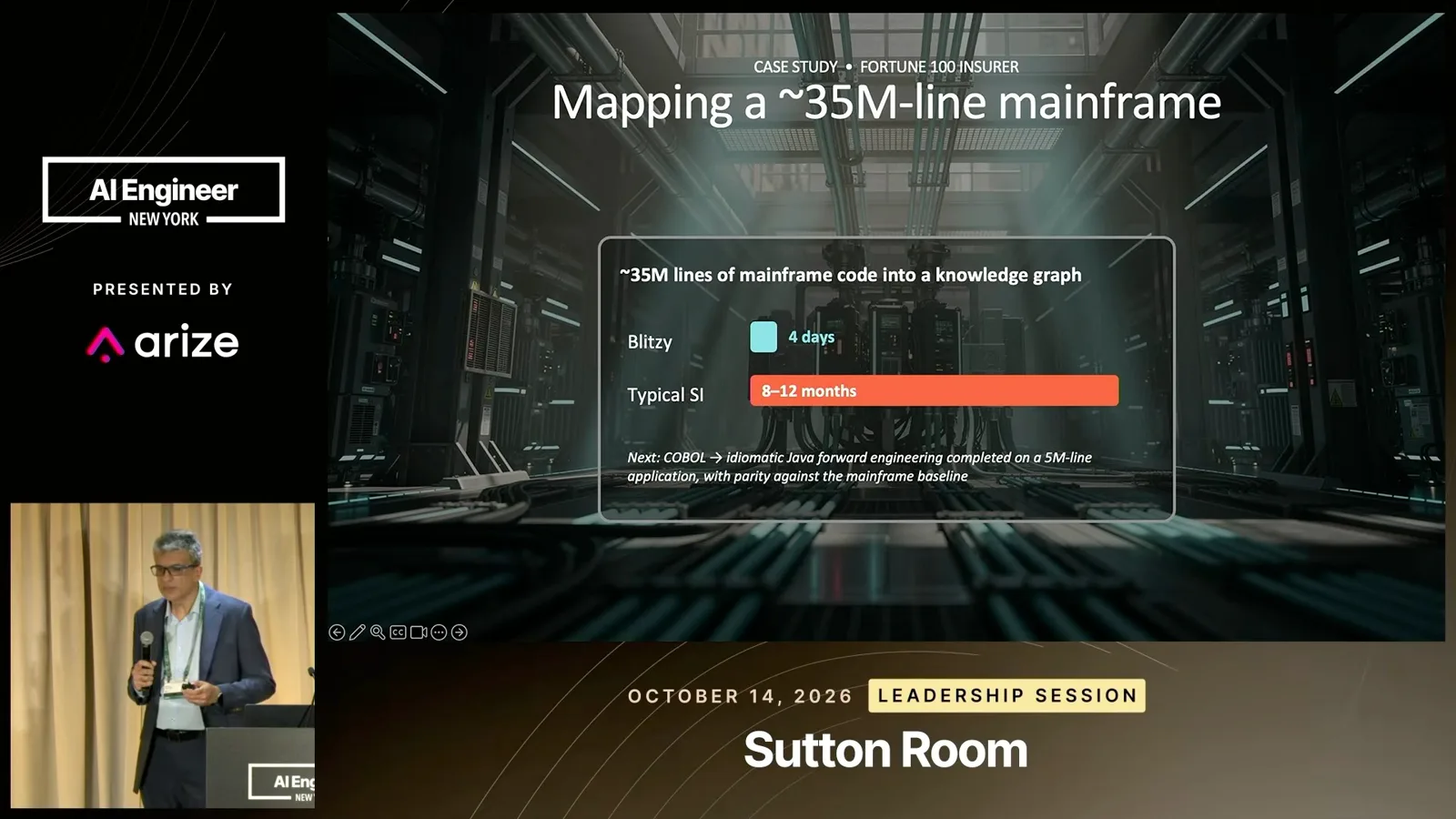
He says Blitzy mapped a roughly 35-million-line mainframe in four days after an earlier systems-integration effort had taken months. This is the vendor’s case-study claim; mapping the estate is distinct from migrating every line.
For another 25-million-line insurance platform, Deshmukh reports a ninefold speed improvement and gives figures for autonomous completion and production acceptance. The presentation does not independently establish whether those results generalize.
Beyond modernization
The speakers explain this stage of the modernization workflow. They use examples to show its role in preserving system behavior.
The speakers say the same knowledge layer can support new features, security work and compliance evidence after modernization. A promotional interest rate, for example, can reuse the updated graph, governance rules and expanded tests.
Chin closes by describing a knowledge layer connecting business rules and processes to the system. He sees potential uses in regulatory compliance and fraud analysis, in addition to the original modernization task.
The speakers point listeners to knowledge-graph sessions and a sandbox containing the public CardDemo example, inviting teams to investigate the approach with their own code.
More from this channel
 31:22EN
 AI Engineer· Nov 7, 2026Nouha Dziri on Making Coding-Agent Teams More Cost-EfficientNouha Dziri · CohereExperiments on ProgramBench and Commit0 show why the task bottleneck, lead model and coordination design matter more than simply adding agents.
 19:34ENAI Engineer· Nov 7, 2026How Cloud Agents Help Review Changes to a Security MasterAmol Kapoor, Clifford Ressel · Nori AgenticAmol Kapoor and Clifford Ressel explain why private-asset data is difficult to reconcile and how an agent assists human reviewers.
 18:28ENAI Engineer· Nov 7, 2026Vinoo Ganesh on Building AI Answers from Verifiable FactsVinoo Ganesh · KeplerKepler’s co-founder describes pointer-based retrieval, deterministic calculations and access controls for financial AI.
 1:04:02ENAI Engineer· Nov 6, 2026Lance Martin: Audit Prompts, Build Better Evals and Optimize Agent CostLance Martin · AnthropicAn Anthropic engineer explains prompt caching, evaluation design, hill climbing and the architecture of reliable long-running agents.
 23:05ZH → EnglishAI Engineer· Nov 6, 2026Ryo Lu: When We Can Make Anything, Do We Know What We Want?Ryo LuFrom an AI-generated journal to a jazz ensemble, Ryo Lu explores judgment, life and collaboration alongside powerful tools.
 19:19ENAI Engineer· Nov 6, 2026Ben Holmes: Use Agent Traces to Improve Agent SkillsBen Holmes · WarpThe Warp engineer explains how scoring conversations can uncover hidden friction and produce reviewable configuration improvements.