In 30 seconds
In this January 2024 episode, Boldstart Ventures founder Ed Sim and Altimeter Capital partner Jamin Ball join Harry Stebbings to discuss startup financing and exits after the 2021 funding boom. They examine liquidation preferences, bridge rounds, mergers and IPOs, emphasizing hard conversations about sustainable growth and valuation. Their predictions about 2024 markets and AI are time-specific opinions, not subsequent outcomes. The guests have financial interests in portfolio companies they discuss; quoted multiples, company metrics and anecdotal examples are not independently verified in the interview.
- 1Runway is not the whole answerSim urges boards to ask whether a company can build a durable business and grow into its valuation.
- 2Preferences change exit mathBall explains that a large liquidation-preference stack can alter the proceeds available to founders and employees.
- 3Bridge rounds can buy timeSim describes both successful and failed portfolio bridges; his experience does not establish a general success rate.
- 4Forecasting after the pandemicBall reflects on Hopin and the mistake of extrapolating unusually strong pandemic demand.
- 5The price of going publicBall argues an IPO may be possible at a lower valuation, subject to company-specific terms and market conditions.
- 6IPO rules of thumbSim offers 2024 growth and cash-flow heuristics, not legal listing requirements.
Takeaways
- Cash runway alone does not establish a sustainable business or justify a prior valuation.
- Large financing rounds can narrow exit options and change how proceeds are shared.
- Founders and investors may need time to align on whether to continue, raise or sell.
- Assess growth durability, strategic room and exit multiples rather than extrapolating a temporary boom.
- Public-market readiness depends on price, financial performance, structure and employee expectations.
- Forecasts and portfolio anecdotes are uncertain, especially across different market cycles.
Read the edited text by chapter
The funding hangover
Sim and Ball introduce their funds and discuss whether companies that raised heavily in 2021 face a reckoning. They distinguish cash runway from a sustainable business.
Jamin Ball tells Harry Stebbings that Altimeter Capital has public and private strategies, and that he focuses on private investments around product-market fit and beyond. Ed Sim, founder of Boldstart Ventures, invests at company inception and also has an opportunity fund for later-stage investments. Both have commercial interests in the companies and investment strategies they discuss.
Stebbings asks whether 2024 will be the year companies that raised large 2020–22 rounds hit a wall. Sim says extending runway is not enough if growth remains too low and cash burn continues. A company may need to consider profitability, a purchase or an exit. Stebbings pushes back that his portfolio companies generally have substantial runway.
Ball presents PitchBook charts of capital raised by US software companies at different stages. He characterizes 2021 as compressing years of fundraising into a short period and says 2023 funding had fallen sharply from its peak. His data selection and comparison reflect his analysis; aggregate funding and individual round prices are different measures.
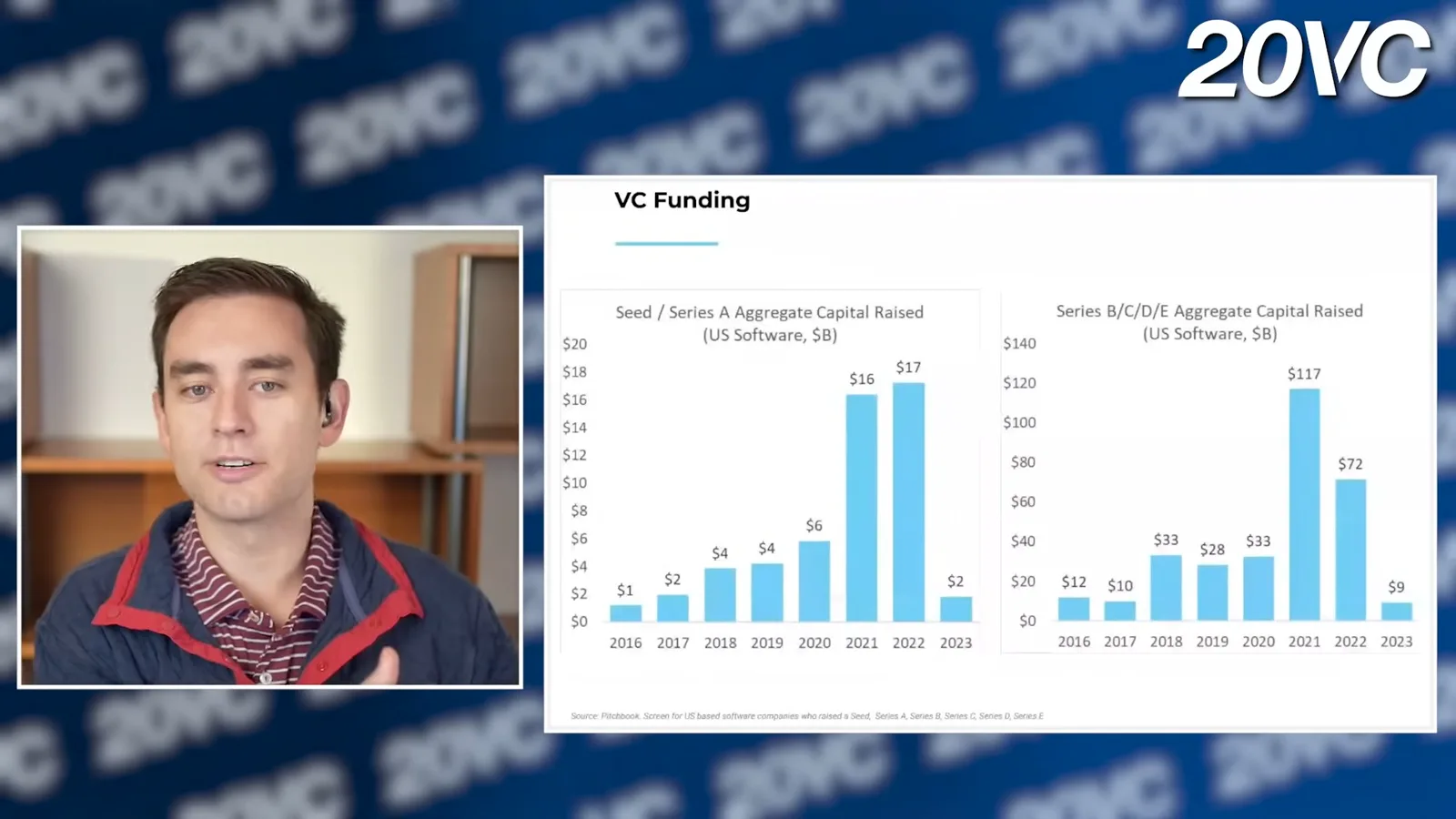
Ball argues that during the zero-interest-rate period some companies raised later rounds before hitting the milestones that had previously been expected. High valuations now require many more milestones and much more growth to justify an up round. He says boards should ask whether a cash-rich company has an enduring business, not simply defer the question.
Sim and Stebbings say seed and inception rounds still felt competitive despite the aggregate funding decline. Sim cites Carta data and argues that larger investors moving earlier can push prices up, which is difficult for funds whose model depends on attractive entry prices. Their observations concern their experience and the cited data, not every seed deal.
Sim says having 24 or 36 months of cash does not by itself establish a viable business. Boards should ask what the company may look like in three years, whether it can grow into its valuation, and whether a lower-priced round or another outcome better serves the team. Those are judgments to revisit with the founder, not automatic instructions to sell.
The first question, Sim says, is whether the founder still has energy and conviction. An exit may return some capital to later investors, generate a return for earlier investors and provide employee retention or equity value, depending on the terms. He says difficult conversations may initially be unwelcome but should not be avoided.
Ball agrees that aligning founders, early investors and later investors can take 12 to 18 months because the decision is contentious, not merely because negotiations with an acquirer are slow. Stebbings questions whether initiating the conversation damages trust. Sim distinguishes later companies with high valuations from earlier experiments where continued founder conviction may warrant more time.
Preferences, valuations and incentives
The guests explain how liquidation preferences and exit multiples affect investors and employees. They debate the risks of high-priced AI rounds.
Ball points to the liquidation-preference stack: large financings can change who receives proceeds in an acquisition and make a particular price unattractive to founders and employees. Early-stage funds seeking very large winners may view a modest return differently from a later investor hoping to recover capital. The actual distribution depends on contractual terms.
Ball shows historical public software revenue multiples and uses a hypothetical investment at 100 times annual recurring revenue to illustrate the burden of growing into a valuation if exit multiples are much lower. The calculations depend on growth and eventual exit assumptions; a public forward-revenue multiple and a private ARR valuation are not identical metrics.
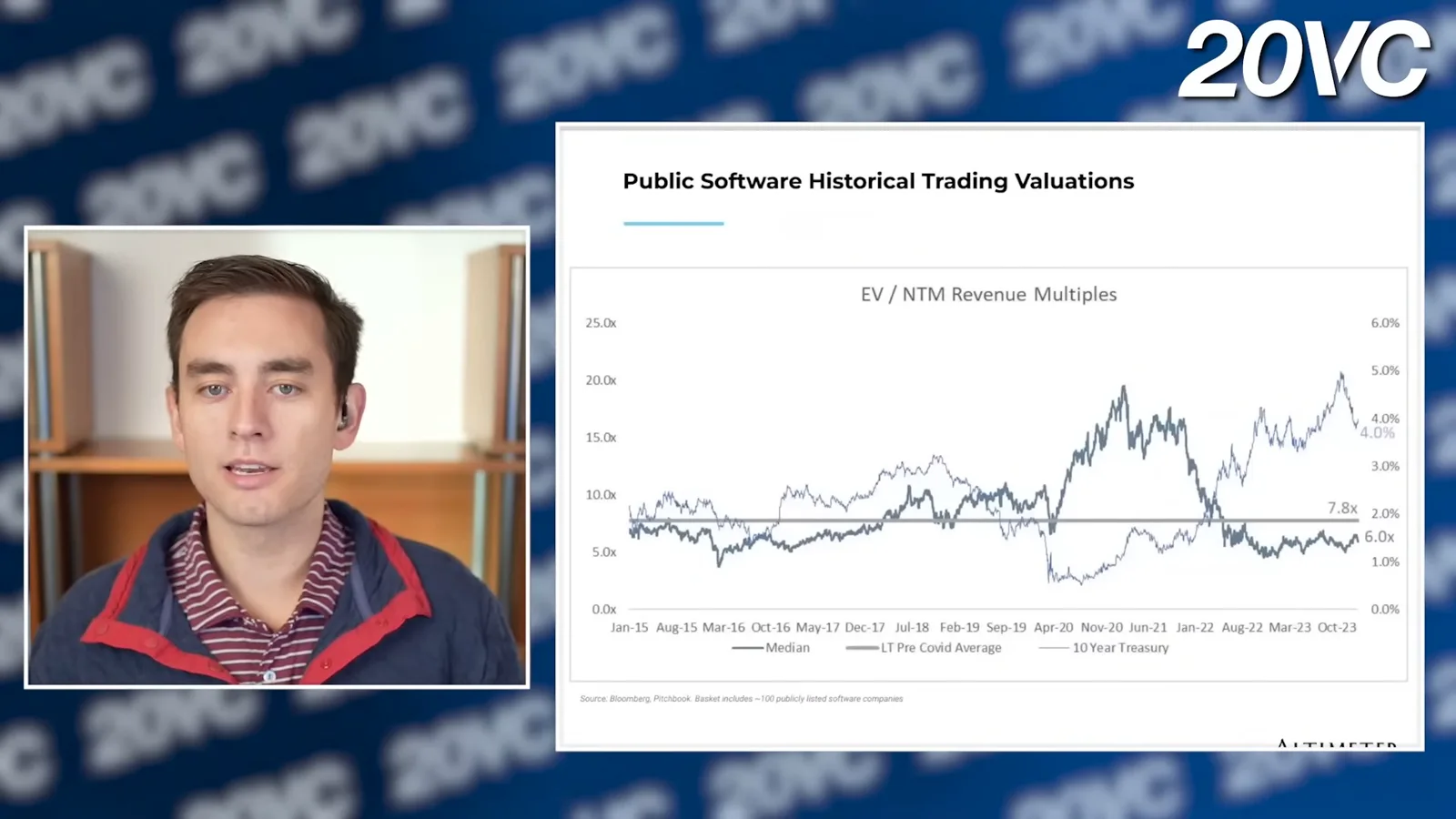
Ball argues that even reaching the prior valuation can require many years of growth and that targeting several times the investment requires much more. Sim cites the Loom sale as an example of a last-round valuation exceeding the reported sale price, but says he was not in the room and speculates about the proceeds. He reports anecdotal signs that some later investors are more willing to recover capital and recycle it.
The discussion turns to highly priced AI rounds. Ball cautions founders that raising too much at too high a valuation can make the cap table a business risk, and prefers funding tied to attainable milestones. Stebbings questions whether founders can realistically refuse attractive offers and argues large funds face deployment pressure.
Sim says he has seen more founders recognize the cost of setting the bar too high. Boldstart made eight new investments in the previous year versus three the year before, he says. He also acknowledges that a founder offered a very large check might find it hard to refuse; both he and Stebbings accept that investors participated in the preceding market.
Finding durable businesses
They discuss constrained exit options, growth to enterprise scale and recycling capital. Sim shares bridge-round experiences and Ball reflects on forecasting mistakes.
Sim recounts that Kustomer’s sale to Meta took 16 months from signing amid regulatory review and doubts it would have proceeded in the then-current environment. He argues smaller potential exits make entry valuation, amount raised and investor ownership consequential. His view of the regulators’ motives is an opinion, not an established finding; Boldstart backed Kustomer.
Ball says few companies sustain rapid growth at $100 million to $200 million or more in ARR. He asks whether the initial product has enough strategic room to become a platform or will instead be absorbed into someone else’s. A company can stall because the market is smaller than expected or it never reaches large enterprise customers.
Stebbings credits exceptional founders with building a go-to-market machine and moving into a second chapter. Ball agrees founder quality is a major ingredient. Sim later cautions founders against starting with an abstract platform: solve a narrow user problem first while maintaining a credible vision for where the product could expand.
Ball clarifies that a 1x return is not a desired outcome, but recovering and recycling money may be acceptable in the context of a difficult investment. He recalls a discussion of a Sequoia fund improving a weak outcome through effort and recycling, while explicitly uncertain about its vintage and figures. He argues managers should not simply blame the vintage and abandon a fund.
Sim says helping companies in the lower-performing part of a portfolio achieve partial recoveries or modest returns can add meaningfully to fund performance. His illustrative 0.5–0.75x contribution is a scenario, not a reported return for a particular fund. He also reflects that selling some shares on the way up could sometimes have been wiser than always increasing ownership.
Asked about bridge rounds, Sim estimates roughly two-thirds of his examples worked more positively than negatively, while acknowledging failures and the difficulty of forecasting outliers. He describes support before subsequent rounds for Snyk, BigID, SecurityScorecard and Kustomer; these are portfolio examples with selection and commercial-interest limitations, not evidence of a general bridge-round success rate.
Ball divides growth-investing mistakes into choosing the wrong company, forecasting the business incorrectly and assuming the wrong exit multiple. His own main error, he says, was overestimating the durability of growth and a product’s ability to expand into a platform. At high entry valuations, forecasting errors can have large consequences.
From Hopin to acquisition markets
Ball revisits an investment made during the pandemic. The guests consider narrow products, regulation, strategic acquisitions and private-to-private deals.
Stebbings asks about an investment in Hopin at an $8 billion valuation. Ball says the team extrapolated extraordinary pandemic-era demand and underestimated how much was pulled forward. As conditions changed, he says, the product-market fit looked different. This is his retrospective explanation of an investment, not an independently established valuation or complete account of the company.
Sim reiterates that most founders should begin with a sharply defined problem and a product that significantly improves a user’s life, while explaining a possible three-to-five-year expansion. He sees exceptions for unusually experienced founders with large initial financing, but does not think every startup can launch as a platform.
Stebbings asks about 2024 mergers and acquisitions. Ball expects major transactions to be difficult under the regulatory conditions of the time, citing the abandoned Adobe–Figma deal as an influence on boards’ calculations. He anticipates smaller strategic acquisitions and talent acquisitions, but notes acquirers have limited capacity and deals take time.
Sim expects strategic buyers to compare several startups in the same category and says founders should decide early whether they are likely to build an enduring business or might benefit from a sale. He describes PagerDuty’s acquisition of Boldstart-backed Jeli and says some security acquisitions have been valuable despite relatively low ARR. His examples and price estimates are not audited here.
Sim also expects more private-to-private deals as companies add products to build platforms. Discussing one possible transaction, he explicitly speculates about the seller’s cash, the price of the buyer’s stock and retention terms; those hypothetical terms should not be read as facts about that deal. Ball adds that a large preference stack can leave founders and staff with little at a modest exit.
The 2024 IPO question
They discuss price resets, employee expectations, capital structure and possible listing criteria. Their forecasts are anchored to the market at the time of the interview.
Ball says companies can go public if they accept the price available in the market; his claim that the window is open is a market judgment, not a guarantee for any particular company. He sees an IPO as a way to reset ownership and create liquidity, even at a valuation below a prior private round. Employee expectations and trust still need careful handling.
He contrasts some older rounds with heavy anti-dilution ratchets against many 2021 rounds that he says had lighter terms. In his view, this can make a down-round IPO structurally easier than in earlier cycles, although employee equity and prior promises remain difficult. The consequences depend on each company’s actual securities and financing documents.
Sim says public shares can help recruit employees and acquire companies, while an IPO below a prior private valuation can be painful. He expects many 2024 listings to price below earlier rounds. Stebbings questions whether companies have time to prepare; Sim says some have already been preparing for many months.
Sim suggests cash-flow break-even, over 30% growth and progress toward a rule of 40 or 50 as indicative conditions for a high-growth IPO in that market, with growth weighted more heavily. This is his opinion and a heuristic, not a legal requirement or a prediction that every listing will satisfy it. His remarks about Databricks are explicitly based on incomplete information, not board access.
Ball argues public-market scrutiny can force companies to explain profitability and long-term durability. Stebbings asks whether large private funds, including firms like Altimeter, have enabled companies to stay private longer. Ball agrees the expanded supply of private capital can do so and encourages companies to consider going public before growth slows substantially.
Software spending and the next vintage
The conversation turns to AI, retention, portfolio examples and advice for limited partners. Both investors close with qualified optimism about future opportunities.
Asked whether software spending has saturated, Sim expects a new cycle of reinvention as AI becomes part of products where it has economic value. He says spending and retention slowed after customers bought ahead of need, and forecasts healthier retention around 110–115% rather than earlier 130–140% levels. These are his estimates and predictions, not verified market-wide results.
Both guests favor solving a real customer problem over merely appearing fashionable. Sim says supporting founders requires patience, challenging them when things go well and encouraging them when things go poorly. Ball says the buyer must be able to explain the tangible problem a product solves.
For 2024, Sim gives a speculative long view on Microsoft and a short view on Apple, while acknowledging potential in on-device AI over a longer horizon. Stebbings is more optimistic about Apple. These are dated personal market opinions, not investment advice or verified subsequent performance.
Ball highlights data infrastructure and names Tabular, a company on whose board he sits, as a potential beneficiary of AI adoption. Sim promotes Protect AI, backed by Boldstart, and expects more activity in AI security. Both explicitly discuss companies in which they have an investment interest.
Ball advises limited partners that selecting managers and investing across vintages may be more reliable than trying to time a single year; Sim predicts 2024 could be an excellent vintage for early-stage investing. Both express optimism about a technology transition and valuation reset, while Ball says the market bottom is hard to identify.
Sim closes by saying he is optimistic about Israeli founders in security and infrastructure despite the conflict and investor concern at the time. He cites two of his portfolio companies growing from zero to around $2 million ARR despite founders being called to reserve duty. This is a selective portfolio anecdote, not evidence about the performance of all Israeli startups.
More from this channel
 23:48EN
 20VC with Harry Stebbings· Oct 26, 2026Podcast · 2 speakersSatya Nadella on Zero Trust for AI and Why Every Company Should Own Its IntelligenceGuest Satya Nadella · Host Harry StebbingsThe Microsoft CEO argues that capable agents need security boundaries even as alignment research remains unsettled, and explains why firms should retain the value created by their own AI use.
 1:13:26EN20VC with Harry Stebbings· Oct 24, 2026Podcast · 2 speakersNaveen Rao on Energy, AI Hardware, Verification and the Future of RoboticsGuest Naveen Rao · Host Harry StebbingsThe Unconventional AI founder argues that energy efficiency will shape AI hardware, while the growing volume of model output makes verification more valuable.
 59:41EN20VC with Harry Stebbings· Oct 22, 2026Podcast · 3 speakers20VC: Venture Fund Size, AI Valuations and the Changing Software MarketGuest Jason Lemkin, Rory O’Driscoll · Host Harry StebbingsHarry Stebbings, Jason Lemkin and Rory O'Driscoll debate venture concentration, infrastructure risk, code review and the assumptions behind fast-growing AI companies.
 1:19:50EN20VC with Harry Stebbings· Oct 19, 2026Podcast · 2 speakersSameer Dholakia on AI Investing, Bessemer's Growth Strategy and Company CultureGuest Sameer Dholakia · Host Harry StebbingsThe Bessemer partner explains his approach to pricing fast-growing AI companies, backing founders and building teams, while discussing the risks behind his optimistic forecasts.
 1:03:05EN20VC with Harry Stebbings· Oct 17, 2026Podcast · 2 speakersHarrison Chase on Building Reliable Agents, Model Routing and MemoryGuest Harrison Chase · Host Harry StebbingsThe LangChain co-founder explains why agents remain difficult to control, where domain expertise matters, and how his team manages coding-agent costs.
 1:17:09EN20VC with Harry Stebbings· Oct 15, 2026Podcast · 3 speakers20VC on Pro Rata Rights, AI Pricing and the Changing Software MarketGuest Jason Lemkin, Rory O’Driscoll · Host Harry StebbingsHarry Stebbings, Jason Lemkin and Rory O’Driscoll debate investor rights, model economics and the choices facing software companies and their employees.