In 30 seconds
Nathan Lambert introduces TMax, a project releasing terminal-agent data and open models built from Qwen. He explains why balanced environments, stable reinforcement learning and reproducible checkpoints matter when improvements on strong models are hard to measure.
- 1Open terminal agentsTMax combines model weights, environments and a training recipe.
- 2Diverse environmentsThe data pipeline targets balanced terminal skills.
- 3Stable RLNumerical precision and algorithm choices address instability.
- 4Shared checkpointsIntermediate artifacts allow others to inspect training dynamics.
Takeaways
- TMax releases roughly 15,000 terminal-task RL environments and models from 2B to 27B parameters.
- The models build on already post-trained Qwen Instruct models.
- Training stability required attention to numerical precision and RL configuration.
- Intermediate checkpoints and open data support reproducible comparisons.
Read the edited text by chapter
TMax and the need for recipes
Lambert introduces terminal-agent models and explains why reproducible gains are hard on strong baselines.
TMax is one of my last papers at AI2: an open release of models from 2B to 27B parameters and a data and reinforcement-learning recipe for terminal agents. Terminal-Bench measures how well agents use a computer terminal to solve tasks.
I think the data work is unusually valuable. The released models start from Qwen Instruct and improve on its existing post-training. Agentic terminal tasks are harder than the math-centered RL problems that dominated much of the previous year, and gains on strong models can be small.
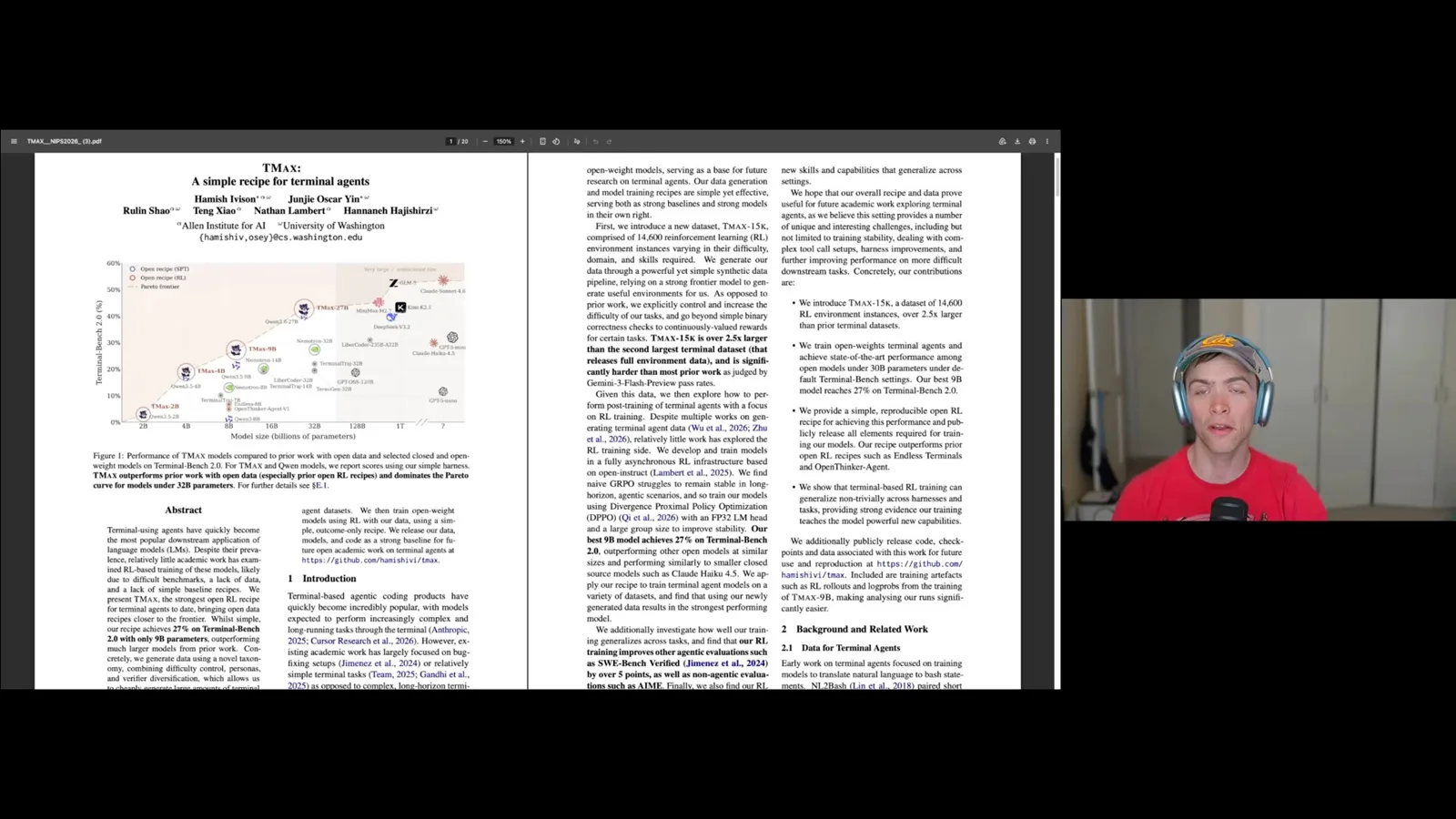
This is why I think the community needs recipe work, not only isolated algorithmic demonstrations. As models improve, careful, reproducible infrastructure and incremental improvements become essential to understanding which changes actually help.
Data and training stability
The project releases diverse environments and studies the infrastructure and algorithm choices needed for stable RL.
The project releases roughly 15,000 reinforcement-learning environments, along with supervised fine-tuning data for terminal skills. The team designed a diverse data pipeline and balanced coverage across the kinds of tasks represented in the evaluation. Hamish and Oscar led the work; I played a small part.
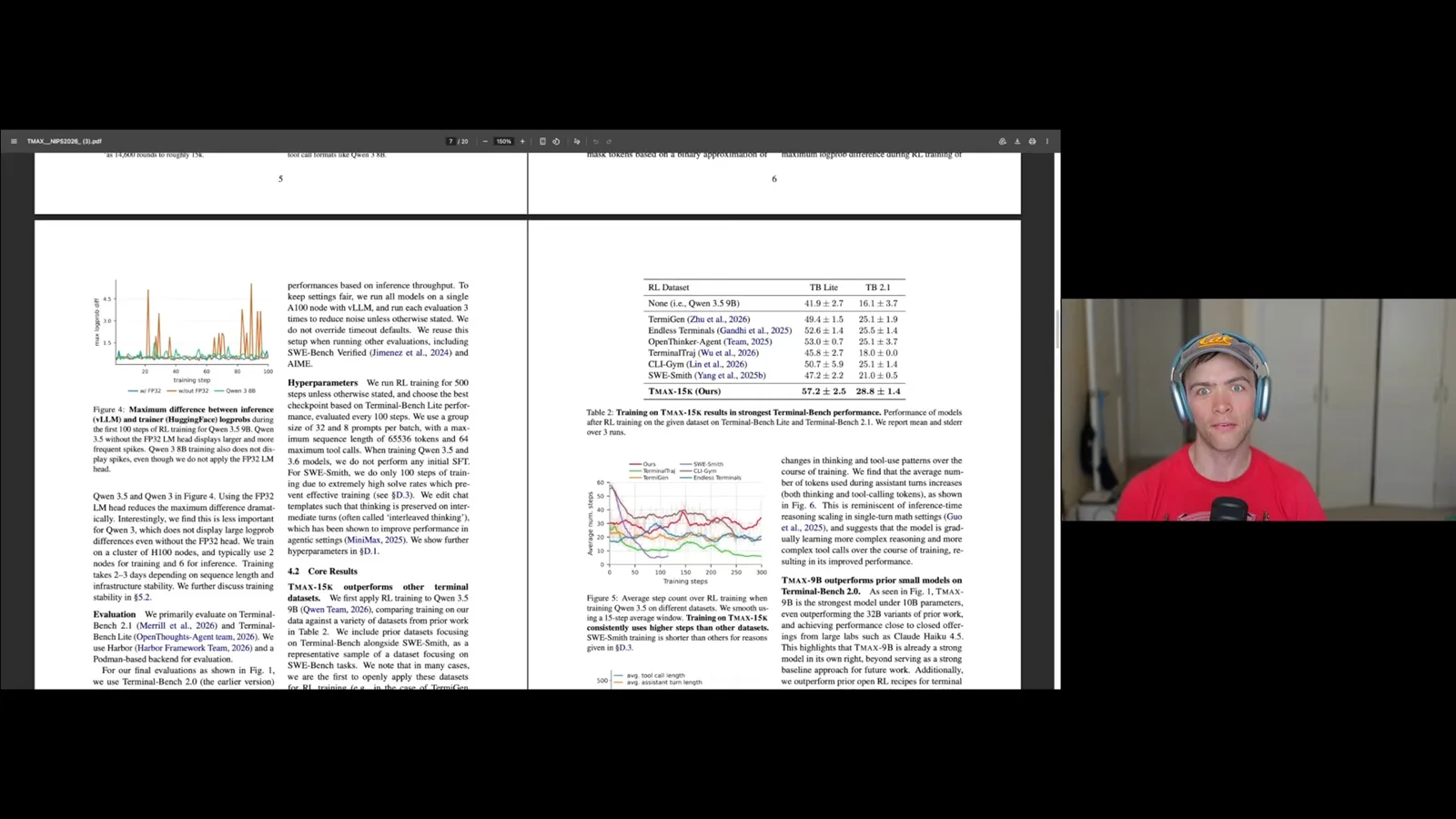
Making the recipe work required substantial infrastructure. Lambert points to instability in asynchronous RL: a gap between training and generation log probabilities can produce sharp spikes. For Qwen 3.5, using higher numerical precision in the language-model head helped stabilize training.
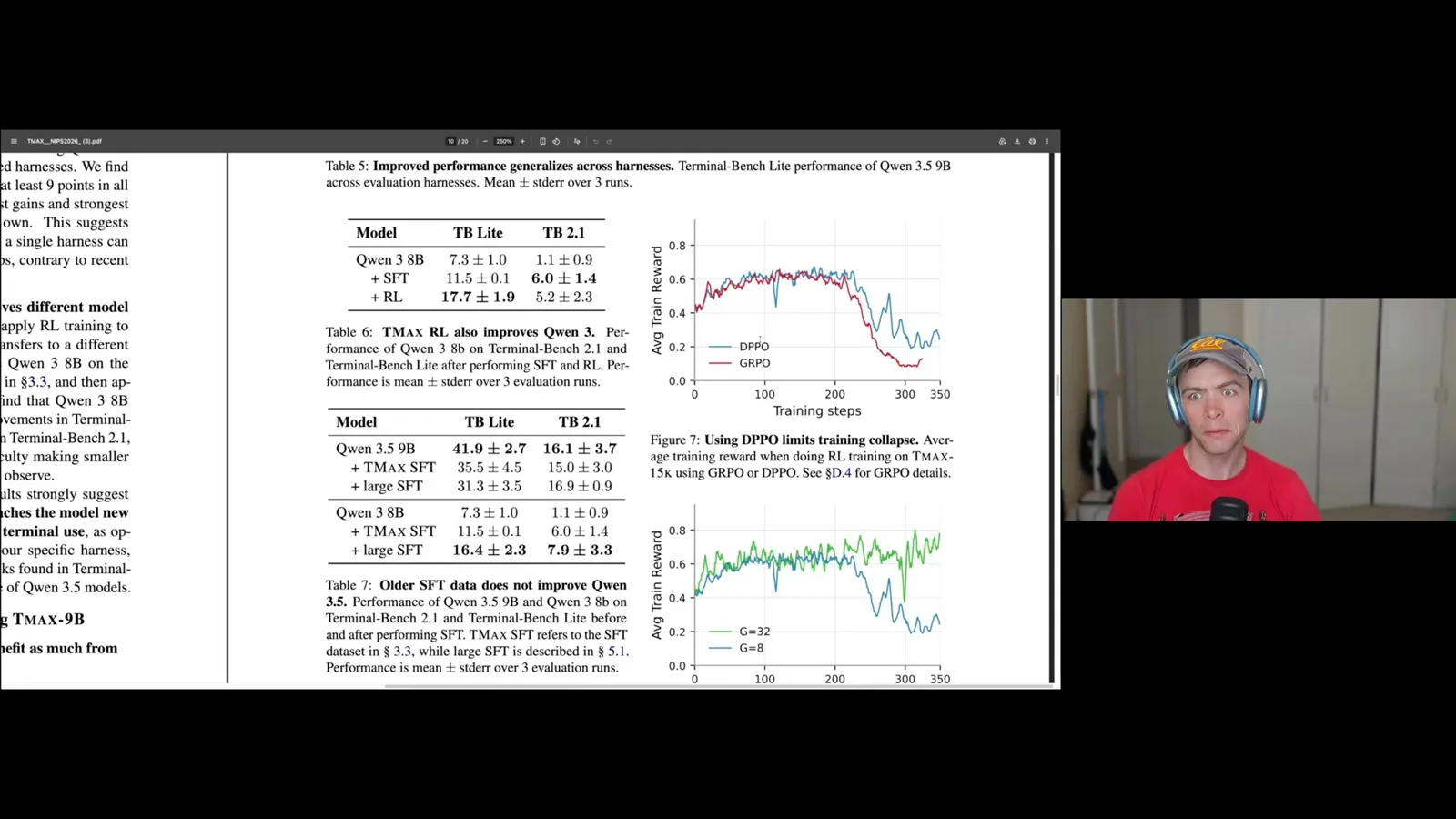
The team also investigated training stability through the RL algorithm and sampling. DPPO changes the clipping used in PPO-like methods, while larger GRPO groups use more completions per prompt to improve the gradient signal. Both are part of the reported recipe.
Open artifacts and future research
Checkpoints and shared data let researchers compare training runs and investigate small benchmark gains.
The release includes models, data, code and intermediate checkpoints so others can examine training dynamics on a shared task. Lambert relates this to the clean starting points and checkpoints released with OLMo 3 RL Zero.
Benchmark margins between strong open models are often just a few points, making meaningful progress difficult to identify. Lambert hopes the shared recipe will help researchers test lasting changes in agentic RL and build more data-focused work. He credits Hamish and Oscar for leading the project.
More from this channel
 16:48EN
 Nathan Lambert· Nov 2, 2026Nathan Lambert on How Open Models Can Compete With Frontier LabsNathan Lambert · Allen Institute for AIOpen models are gaining use and closing capability gaps, but their builders need a sustainable economy and advantages beyond price.
 48:04ENNathan Lambert· Oct 26, 2026Nathan Lambert on Open Language Models: History, Competition and RiskNathan Lambert · Allen Institute for AIA tour of open weights, research infrastructure, distillation, adoption and the choices facing model developers.
 46:42ENNathan Lambert· Oct 25, 2026Nathan Lambert and Florian Brand on Kimi K3.1, Cyber Risk and AI AgentsNathan Lambert, Florian Brand · Allen Institute for AIThe Interconnects hosts discuss mixed model evaluations, a wave of security disclosures, and what a personal agent can do in everyday life.
 5:42ENNathan Lambert· Aug 12, 2026Why the Shoggoth Became a Mascot for AI Post-TrainingNathan Lambert · Allen Institute for AINathan Lambert traces a creature from Lovecraft to a visual metaphor for language models, fine-tuning, and RLHF.
 32:56ENNathan Lambert· Aug 6, 2026Nathan Lambert: An Introduction to AI Character TrainingNathan Lambert · Allen Institute for AIHow post-training shapes a model’s behavior, from constitutions and model specs to experiments with personality and activation steering.
 32:11ENNathan Lambert· Aug 5, 2026Nathan Lambert on How Language Model Evaluation Has EvolvedNathan Lambert · Allen Institute for AIFrom few-shot prompts and pass@k to agent sandboxes, noisy scores and benchmark contamination.