In 30 seconds
Peter Yang uses Opus 5.5 for everyday email, production workflows and app building, and chooses Fable 5.2 for advice and work he considers more difficult or consequential. In his Anthropic-sponsored demonstration, he shows a scheduled inbox briefing, a podcast workflow that combines recording and music tools, a workout-app audit and a care-coordination brief. He also reviews exact edits proposed by a cross-conversation skill audit. Yang says Fable cost twice as much per API token at the time, making model choice part of his workflow.
- 1Opus handles the daily workload; Fable is reserved for harder workYang uses Opus for inbox triage, workflows and apps, and chooses Fable for strategy, complex tasks and care coordination.
- 2Cost affects which model he choosesAt the time of his demonstration, Yang says Fable cost twice as much per API token and used up to half of the weekly Max limit.
- 3A scheduled briefing turns email into an action listThe assistant checks mail and calendar, orders outstanding items by urgency and waits for Yang to review messages.
- 4Connected tools help assemble a podcast introYang combines a recorded interview, selected highlights, generated music and his own feedback to produce a reel.
- 5He uses Fable to audit a workout app built with OpusYang says the model identified 30 issues and organized them by priority in his project.
- 6Audit recurring feedback, then review each proposed editYang asks the prompt audit to examine multiple conversations and checks the exact wording before changing skills.
Takeaways
- Match model choice to the difficulty and importance of the task; Yang uses Opus for most execution and Fable for harder work.
- Specify which actions require approval before connecting an assistant to email or other services.
- Ground recurring advice in a personal plan and review the model’s observations as suggestions.
- Break a recurring production process into reusable skills and inspect their output.
- Review proposed skill changes across multiple conversations before accepting the exact edits.
Read the edited text by chapter
Choose a model for the difficulty and cost
Yang uses Opus as his everyday model and Fable for harder or higher-stakes work. He attributes benchmark and cost comparisons to Anthropic and the conditions of his demonstration.
Peter Yang says that after spending more than 500 hours using Fable 5.2 and Opus 5.5 in Claude Code, he chooses between them based on the work rather than using the same model for everything. His demonstrations include inbox management, career advice, podcast production, app design and coordinating care for a loved one. The video is sponsored by Anthropic.
Yang uses Opus as his daily model for inbox triage, workflows and personal apps. He reserves Fable for work he considers especially difficult or consequential, such as strategic advice, complicated workflows and helping a family member navigate an illness.
Citing Anthropic's launch benchmarks, he says Fable improved on agentic coding and long-running, open-ended work, while Opus remains sufficient for much of his execution-oriented knowledge work. He describes this as a practical trade-off, not a reason to select the more powerful model for every request.
At the time of the demonstration, Yang says Fable used up to half of the weekly Max allowance and cost twice as much per token through the API. Those limits and prices inform his choice to use Opus more often.
Yang relays four suggestions from an Anthropic employee: ask the model what is wrong with an idea before building it, begin at medium or high effort, specify which actions need approval, and give it a whole project rather than only the next step. He says he will demonstrate some of these practices.
Turn email and calendar into a twice-daily briefing
Connected services provide context for a numbered list of outstanding tasks. Yang reviews drafts before the assistant sends them.
In the Claude Code desktop app, Yang keeps separate threads for workflows such as his podcast and newsletter, along with dedicated conversations for a chief of staff and an advisor. He connects services he uses, including Gmail, Google Calendar, Slack, meeting notes and a music generator, so the assistant can work with those sources.
For the chief-of-staff workflow, he chooses Opus because reviewing email and the calendar does not require his most powerful model. His prompt asks it to examine email, sent mail and the calendar from the previous seven days, identify obligations and meeting preparation, and produce a numbered list ordered by urgency.
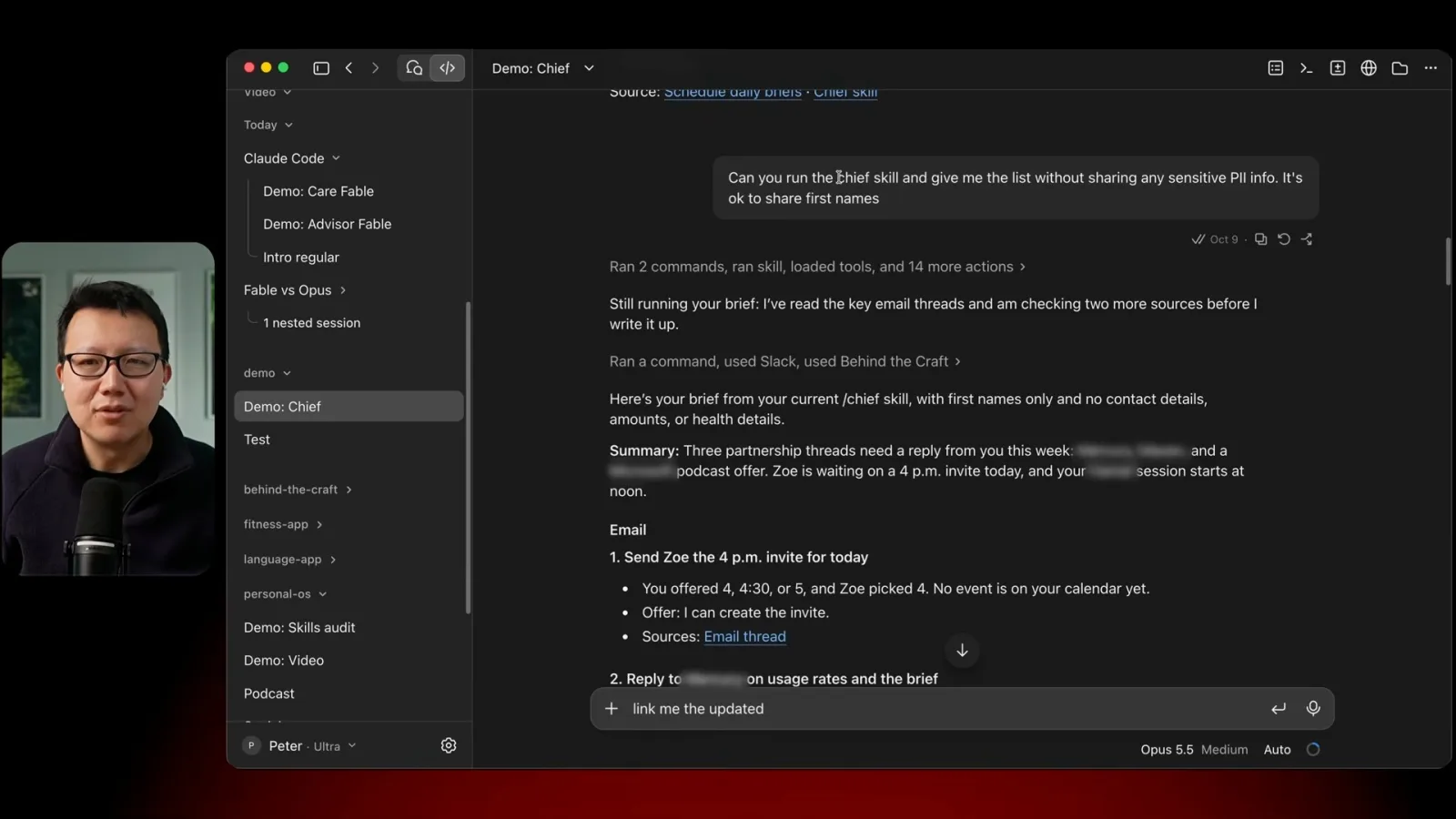
He responds to the list by number: schedule one meeting, draft an email for review, leave another item for thought and research potential podcast guests. The draft offers different tones. Yang edits the message and usually asks the assistant to send it only after he has reviewed it.
He schedules the briefing to run at 7 a.m. and 4 p.m. so he can review what needs attention twice a day. The scheduled task makes inbox triage proactive, while the individual items remain available for him to inspect and act on.
Ground an advisor in a personal plan
Goals, principles and sources of energy give the model context for career advice. Yang shares how the resulting observations challenge his focus.
For longer-term life and career decisions, Yang uses Fable as an advisor. Instead of relying on a generic question or accumulated chat memory, he grounds the conversation in a personal plan: goals for the current year and several years ahead, guiding principles, and activities that give or drain energy.
His advisor prompt asks how he is doing relative to his goals, what he should focus on and what the model has noticed that he may not have recognized himself. Yang asks for a candid response and uses a reusable skill that refers back to the plan.
In his example, the response says he is on track for 2026 but would need faster subscriber growth to reach a 2027 YouTube goal. It also flags that some paid-course customers sign in without finishing the course. Yang uses these observations as prompts for reflection on where to concentrate.
The model also suggests that Yang enjoys tinkering more than his customers may and that his many releases since leaving his job could reflect a lack of focus. He presents those judgments as the advisor's response to his own context, not as a universal prescription.
Connect podcast production into reusable steps
Skills and service connections help select highlights, generate music and revise a reel. A personal review app collects timestamped feedback.
For a repeatable workflow, Yang generally prefers Opus, switching to Fable when the work is especially complicated. Podcast production has separate phases: preparing an interview guide, briefing editors after recording, and producing titles, thumbnails, show notes, a newsletter, posts and clips. He created individual skills to streamline the stages.
He demonstrates an intro reel for a 46-minute podcast interview recorded in Riverside. A connection to Riverside lets Claude Code work from the recording, while his video-intro skill finds candidate highlights. He reviews the selections and iterates with the model.
From the same conversation he calls a Suno connection to generate a 40-second musical track, listens to the options and chooses one. He also points Claude to animations and other footage for the reel. In his account, the sequence combines tools without requiring him to switch into each service's interface.
After playing the result, Yang suggests asking the model to depart from a fixed template when creative variation is useful. He estimates that a comparable back-and-forth with a human editor might have taken him a day, whereas this version took about 20 minutes. That comparison is his estimate for this particular task.
To make revision easier, he built a small personal video-review app. Rather than typing a timestamp for every change, he can play the reel, add notes such as making text or an image bigger, and send the notes back to Claude together. He says he is the app's only user.
Design and audit a personal workout app
A canvas displays screen variations while Opus helps build the app. Yang uses Fable to look for issues and plans changes.
Yang's fourth example is a workout-tracking app. He primarily uses Opus to build, while using Fable to diagnose difficult bugs or plan larger features. The fitness app was not generated in one attempt: he says it took about a month of workouts and iteration to match his preferences.
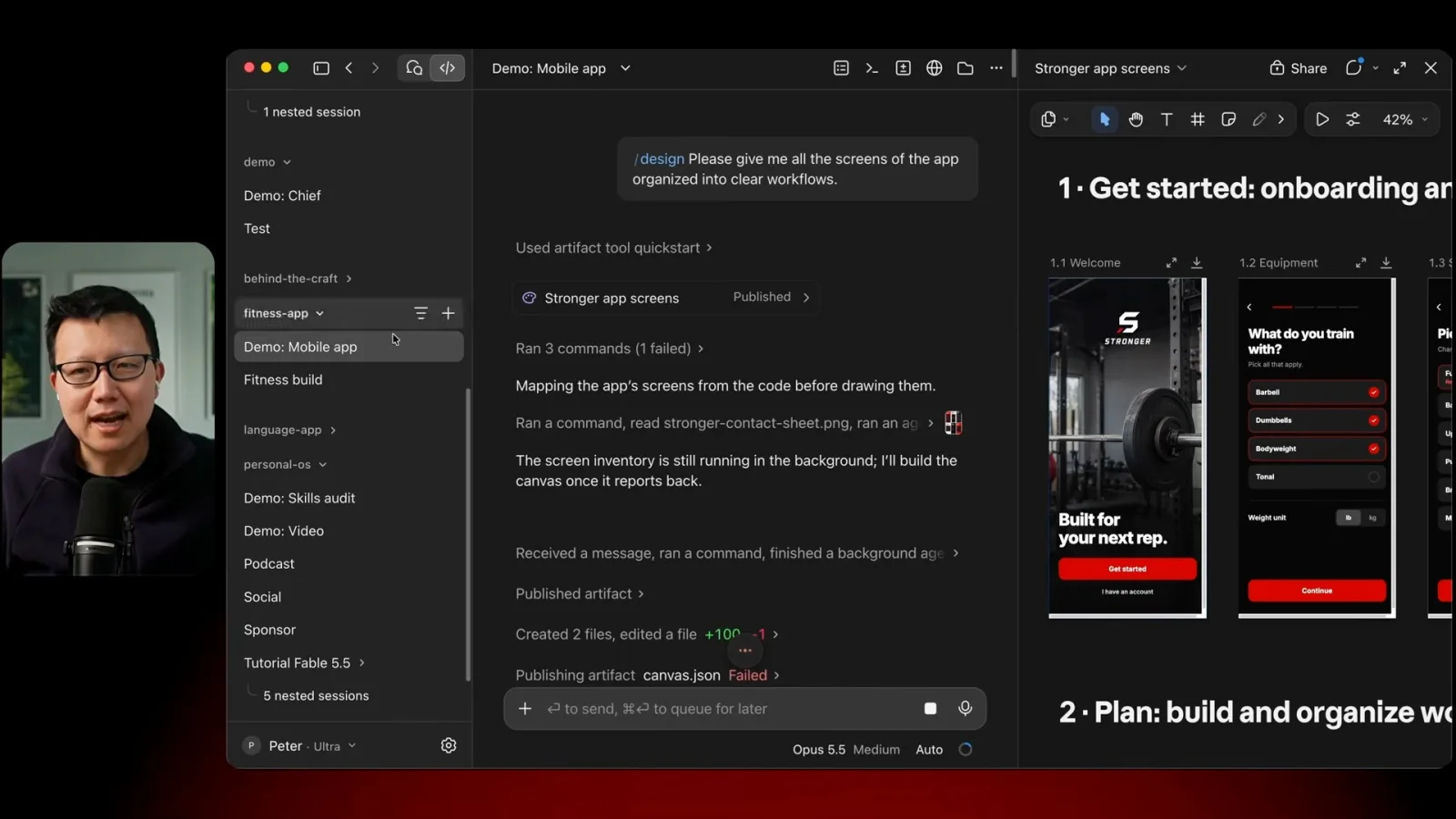
He invokes /design inside Claude Code to arrange app screens on a canvas by workflow, such as onboarding, planning workouts and training. On the canvas he can edit copy directly, then ask Claude to update the code. He requests two alternative designs for a live workout screen and compares them before choosing what to implement.
In another thread Yang asks Fable to inspect the project for bugs and interface cleanup. He says it found 30 issues and sorted them by priority, even though he had already worked on the app with Opus. He asks for fixes and gives additional feedback about workout tracking.
He applies the same tools to marketing the app, using a Suno connection to generate an 80s-style workout song for a promotional reel. Opus assembles the video. Yang treats the reel as another stage of launching an app or piece of content, beyond building the product itself.
Organize a loved one’s care information
A reusable skill creates a shareable care brief. Yang also uses the assistant to prepare trial-related questions for clinicians.
Yang's fifth example is personal: his mother is navigating a cancer diagnosis and treatment. He says care brings many appointments, clinicians and pieces of information to coordinate, so he uses Fable for this work and offers a reusable skill for organizing the records.
The skill produces a one-page brief with patient information, important contacts, clinicians, next steps, medical terms and a care log. He shows an example Google document that can be shared with his mother, and explicitly says the details on screen are not her real medical information.
Yang also asks the model to research clinical trials or potential treatments that might match a patient's markers. In the example, it returns trials for him to investigate or raise with a doctor. He uses the information to prepare questions for appointments, when consultation time is limited.
Improve skills with feedback from many sessions
A prompt audit proposes specific changes based on recurring feedback. Yang inspects the edits and decides which to accept.
To improve his skills over time, Yang demonstrates the command /claude-api prompt-audit. He asks it to examine past conversations about podcast and video production and suggest changes based on recurring feedback across threads.
Previously he asked for improvements after each conversation. He says that could overfit one example, so he now prefers an audit across many sessions. In the example, the model reports examining 90 days of activity, including 149 sessions touching the relevant skills, and proposes specific edits.
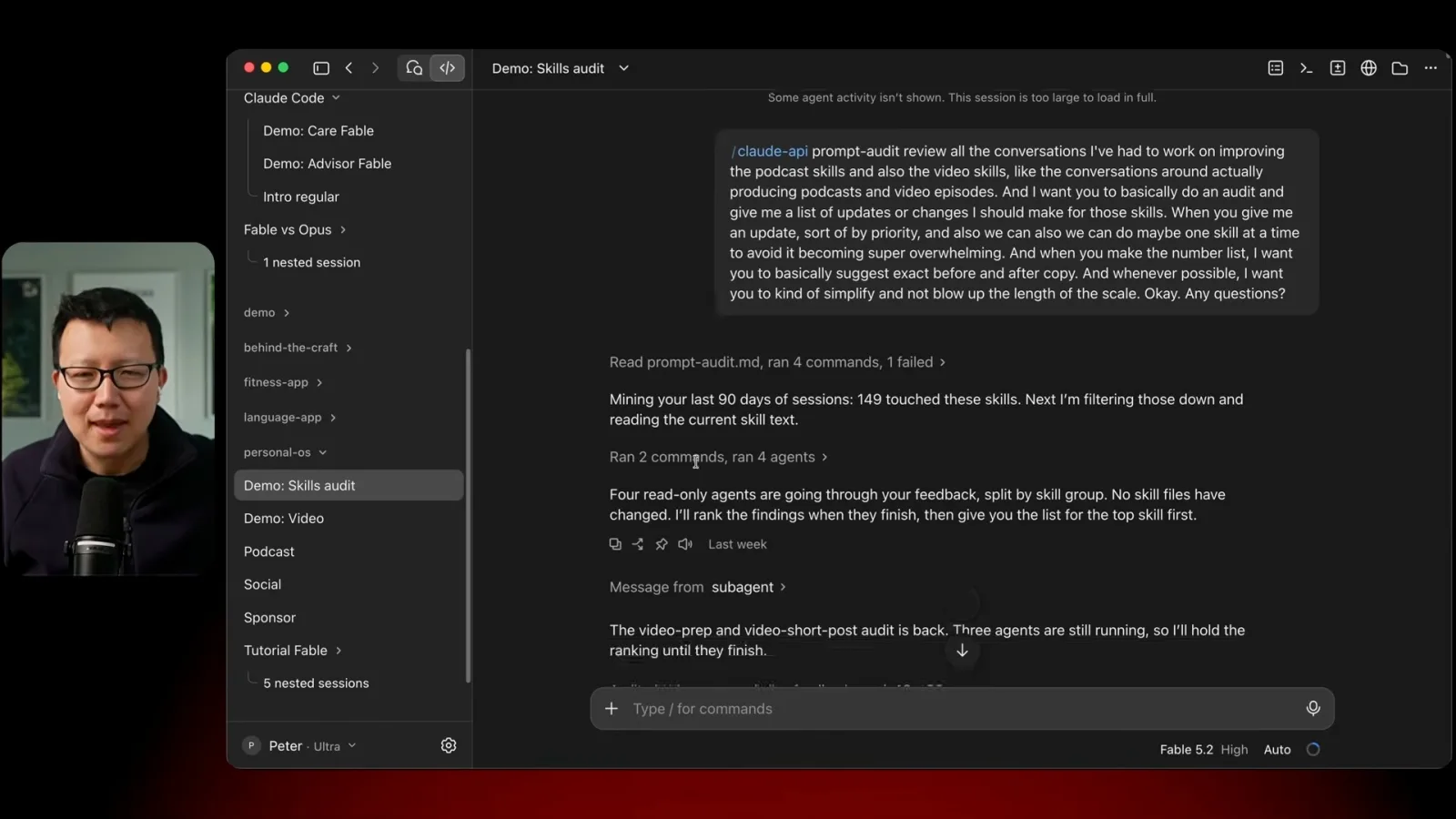
Yang recommends reading the proposed changes rather than accepting them all. He asks to see the exact wording, agrees with some suggestions and rejects others before the assistant updates a skill. For this audit he prefers Fable or a newly launched model, while keeping human oversight of the edits.
His recap returns to the division of work: Opus for routine inbox work, most workflow execution and app building; Fable for strategic advice, difficult diagnoses, complex work and the family-care example. He says the prompts are provided in the video description, and emphasizes reviewing the changes suggested by the audit.
More from this channel
 21:47EN
 Peter Yang· Nov 9, 2026PodcastFable 5.2 won four creative tests; Opus resisted pressure betterPeter Yang compared five tasks and found Fable stronger at creative outputs, while Opus more often challenged misleading pushback.
 46:40ENPeter Yang· Nov 8, 2026Podcast · 2 speakersAshley Alexander: How AI Helps Me Care for My Parents With CancerGuest Ashley Alexander · Host Peter YangA caregiver uses AI to prepare for appointments, organize records and ask better questions—while keeping doctors at the center of treatment.
 17:50ENPeter Yang· Nov 4, 2026PodcastPeter Yang’s Five Steps for Using AI to Help Care for His MotherYang uses a shared care brief and organized records to navigate appointments, while making time for family.
 15:03ENPeter Yang· Nov 3, 2026PodcastHow Peter Yang Used an AI Phone Agent to Negotiate His Internet BillAn AI call negotiated a lower price and faster service, but Yang still had to approve the change himself.
 33:09ENPeter Yang· Nov 1, 2026Podcast · 2 speakersJaclyn Konzelmann: When AI Can Build More, Choose What Deserves to ExistGuest Jaclyn Konzelmann · Host Peter YangGoogle Labs pairs short strategy documents with prototypes, user co-creation and lessons from experiments that end.
 13:05ENPeter Yang· Oct 28, 2026PodcastPeter Yang Tests Genie 4: Convincing Worlds, Unfinished GameplayFive live demonstrations show scenes that respond to prompts and sound, alongside inconsistent actions and limited game mechanics.