In 30 seconds
At Sana AI Summit 2024, Isomorphic Labs’ Max Jaderberg and game-theory researcher Tuomas Sandholm join Joel Hellermark to discuss AlphaFold 3, imperfect-information games and the future of AI-driven science. They disagree on AGI while sharing an emphasis on specialized methods and validation.
- 1AlphaFold’s progressionJaderberg describes the path from a hackathon to AlphaFold 2 and interactions modeled by AlphaFold 3.
- 2Imperfect informationSandholm explains why hidden information and other agents matter in real-world strategy.
- 3Learning from self-playLibratus learned poker without human game records and produced tactics that sometimes differed from established advice.
- 4Verification mattersJaderberg compares checking a model with experiments to checking a navigation system against the road.
- 5Science beyond easy explanationSandholm asks how science should handle knowledge too complex for a concise human-readable description.
Takeaways
- AlphaFold 3 extends structure prediction to interactions among several types of molecules.
- Imperfect-information games provide a model for strategic interactions with hidden information.
- Self-play and search can yield strategies beyond human examples, subject to the limits of their models.
- Scientific AI proposals still need verification against experiments and reality.
- The guests differ on AGI and consider whether future scientific knowledge may exceed concise human explanations.
Read the edited text by chapter
From games to biology
The introduction and Jaderberg’s account connect deep-learning tools across domains.
Lauren Crichton introduces Max Jaderberg of Isomorphic Labs and Tuomas Sandholm, a researcher in computational game theory. She outlines protein structure prediction, imperfect-information games and Sandholm’s work on kidney exchange before Joel Hellermark joins them.
Hellermark asks how Jaderberg moved from StarCraft to medicine. Jaderberg says deep learning, generative models and reinforcement learning form a shared toolbox: games test the methods, while biology and chemistry offer another domain.
At Isomorphic Labs, he says, models represent proteins, DNA and RNA, while drug design seeks molecules that can bind to and modify disease-related proteins. The intended output changes from game actions to candidate molecules.
AlphaFold and scientific models
Jaderberg discusses protein structures, molecular interactions and specialized data.
Jaderberg recalls AlphaFold beginning as a hackathon experiment before becoming a multiyear research program. He points to the CASP blind protein-structure prediction competition as evidence of the jump in performance with AlphaFold 2.
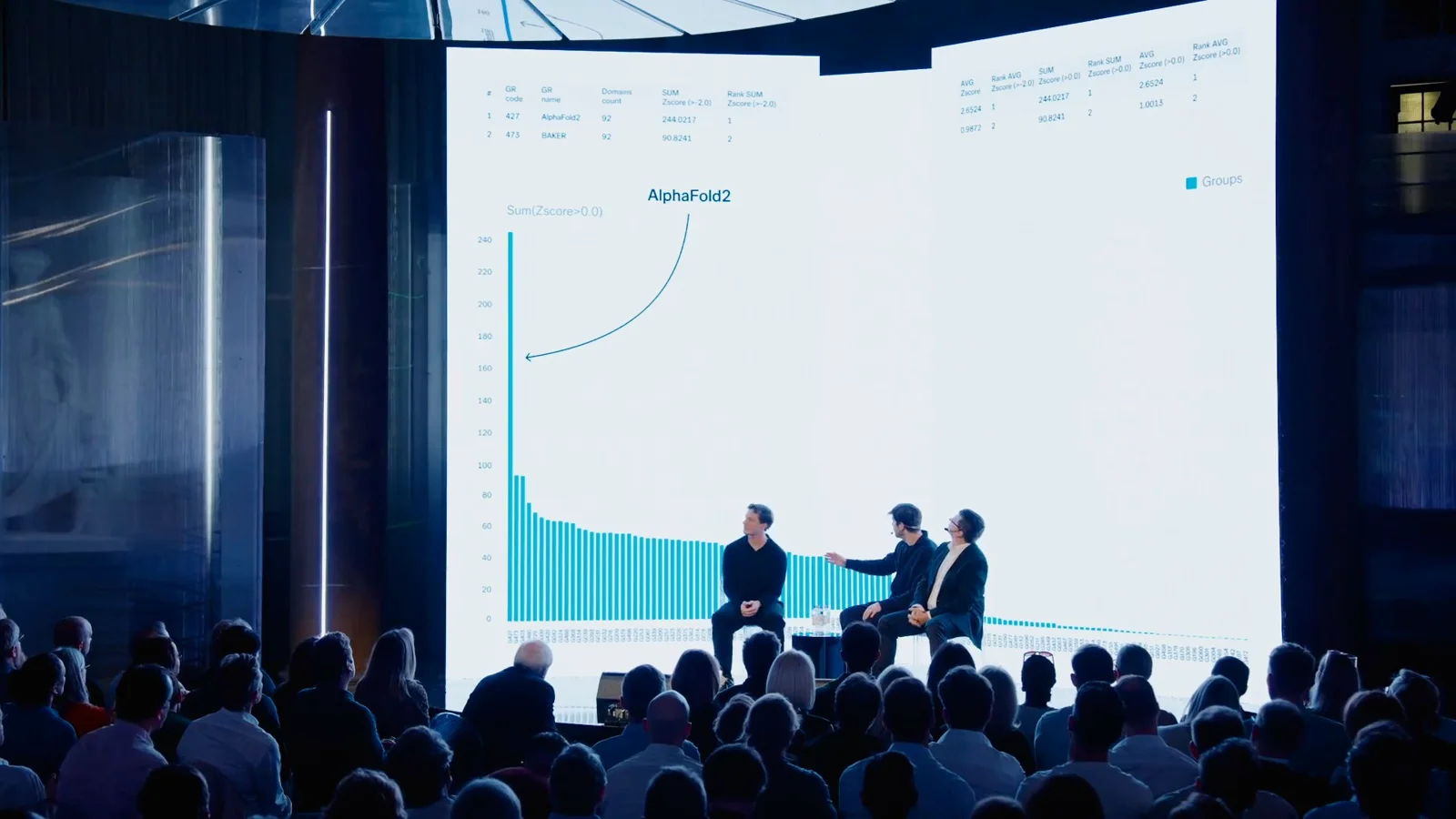
AlphaFold 3, announced shortly before this 2024 conversation, extends structure prediction to interactions involving proteins and other molecules such as DNA, RNA and small molecules. Jaderberg says this helps researchers study molecular machinery rather than isolated proteins.

He recalls experts expecting breakthroughs in games and protein folding to take much longer, even as results were emerging internally. He stresses that drug design still requires many further advances; AlphaFold 3 is not the end of the process.
Jaderberg expects broader foundational models for biology and chemistry to complement earlier models fitted to small datasets. He describes structure prediction as a task from which useful capabilities for molecular interaction and design may emerge.
Why not simply use a language model? He says much scientific information is not prose: laboratory measurements, sensor outputs and simulations require suitable data representations and architectures.
Specialized models can incorporate relevant physics, chemistry and biology while reusing some core deep-learning components. Jaderberg hopes future systems may eventually represent much more scientific data in a common form.
Poker and imperfect information
Sandholm explains self-play, game-theoretic guarantees and specialized search.
Hellermark turns to Sandholm’s poker research. Sandholm says imperfect-information games matter because many real interactions involve other agents and hidden information, unlike chess with its visible board.
Poker also had a long history as a game-theory benchmark. Sandholm’s team pursued superhuman performance in heads-up no-limit Texas hold’em, building on a benchmark the AI community had already chosen.
He says Libratus learned through self-play without reading human poker textbooks or game records. It rediscovered familiar tactics but also differed from common human advice.
One example is limping: calling the blind instead of raising or folding. Sandholm says their systems used the move in a minority of cases even though traditional advice often discouraged it.
For real-world applications, Sandholm begins with two-player zero-sum settings because game-theoretic guarantees are especially clear there. He says an appropriate strategy can protect against exploitation even by surprising opponents.
He argues that strong game play needs specialized search and reasoning, highlighting imperfect-information subgame solving. In his view, a general generative model alone cannot match a purpose-built game system.
Search and new knowledge
The guests discuss language models, discovery, optimization and verification.
Jaderberg discusses possible ways to give language models more computation: search can explore and score alternative continuations, while diffusion-style generation might refine an entire sequence. At the time, he notes, next-token prediction remains the approach scaling most successfully.
Can systems trained on existing data create new science? Jaderberg points to AlphaGo’s famous move 37 against Lee Sedol as a surprising move whose strategic value became clearer later in the game.
He says generalization and verification are central, though he does not claim a complete explanation of how novelty emerges. Sandholm distinguishes learning from historical data, optimization and simulation-based self-play as different routes to AI solutions.
Sandholm values self-play where data is scarce, secret or misleading. He argues that systems need not inherit all the limitations of human examples when they can experiment within a useful simulator.
Asked why language models have not yet disrupted more of the economy, Sandholm expects broader disruption but argues that expert tasks will need specialized AI that can generate knowledge beyond existing human material.
Jaderberg says scientific models can make mistakes, just as navigation systems do. He compares laboratory checks to looking at road signs: an inexpensive experiment or human check can verify a proposal more easily than discovering it from scratch.
AGI and the future of science
They disagree about AGI and consider scientific knowledge that may be hard for people to understand.
On whether to wait for AGI, Sandholm argues that useful systems will need specialized components such as strategic reasoning engines. He is skeptical of AGI; Jaderberg expects it eventually but does not claim a reliable date.
Jaderberg argues that urgent scientific and medical problems justify focused work now rather than waiting for general intelligence. His optimistic medical timeline is a prediction, not evidence that cures have already been achieved.
Looking ten years ahead, Sandholm expects a broader understanding of which AI methods suit which applications. Jaderberg imagines progress may feel incremental locally while producing dramatic differences over a decade.
Sandholm closes with a question about science itself. Some computed solutions and theoretical descriptions may be too complex for people to understand directly, he argues, challenging publication and the use of knowledge when no short human-readable account is available.
More from this channel
 1:16EN
 Sana· Oct 14, 2026PodcastHow Volkswagen Group Middle East Uses Sana to Prepare Technicians for TrainingThierry Rochat describes using technical documents to create online courses before hands-on academy sessions.
 0:41ENSana· Sep 8, 2026PodcastSana Learn Customers Describe Bringing Training Resources TogetherA short customer montage contrasts fragmented learning resources with keeping company knowledge in one place.
 0:40ENSana· Aug 31, 2026PodcastSana Learn Customers Describe Their Partnership ExperienceIn a short montage, customers discuss implementation and the ongoing relationship with Sana.
 48:34ENSana· Aug 12, 2026Podcast · 2 speakersTyler Cowen on AI Adoption, Human Agency, and the Search for BeautyGuest Tyler Cowen · Host Joel HellermarkThe economist explains why AI's economic impact may arrive slowly, what people may still contribute, and why he is calling for a new aesthetic.
 0:16ENSana· Jul 21, 2026PodcastTyler Cowen on Human Presence in an AI WorldTyler Cowen predicts that charisma, physical presence and human interaction will gain importance as AI advances.
 0:23ENSana· Jul 9, 2026PodcastEthan Mollick on Measuring AI’s ImpactEthan Mollick argues that companies should allow room for new opportunities rather than relying only on old metrics.