In 30 seconds
Lex Fridman speaks with Steven Brunton, Ankur Moitra and Alex Kontorovich about reported AI progress in mathematics and the human questions it raises. They examine formal verification, the Riemann hypothesis, Navier–Stokes, computational complexity, mathematical creativity and the future of research. Claims about new results should be distinguished from completed independent review.
- 1A flashlight for mathematical explorationKontorovich sees both opportunity and uncertainty as AI changes how mathematicians explore.
- 2The hypothetical solved axiomEven if AI could do everything human–AI teams can, the guests argue that human understanding would still matter.
- 3Verification is not explanationLean checks formal proofs, but the community must still examine statements and understand ideas.
- 4Quasi-Riemann is not the full hypothesisThe claimed result concerns a zero-free region; the full Riemann hypothesis is a distinct question.
- 5A mathematical result and engineering needsThe proposed Navier–Stokes result is discussed alongside the still-difficult practical task of predicting and controlling turbulence.
- 6Worst cases and natural problemsComplexity theory’s guarantees are powerful, but many practical inputs have additional structure.
Takeaways
- A formal proof and a human explanation answer different but complementary questions.
- AI-generated mathematical claims require careful scrutiny of both proof and precise statement.
- The quasi-Riemann claim is distinct from the full Riemann hypothesis.
- Fluid equations and the practical problem of predicting turbulence are related but not interchangeable.
- Worst-case complexity does not tell the whole story of naturally occurring instances.
- Curiosity, mentorship and the choice of meaningful questions remain central themes for the guests.
Read the edited text by chapter
An unsettling moment for mathematics
Three mathematicians discuss excitement, anxiety and the value of human understanding.
Lex Fridman convenes an emergency conversation about a startling moment in mathematics: AI systems have recently claimed progress on problems involving the Navier–Stokes equations, a version of the Riemann hypothesis, the Unique Games Conjecture, and many other questions. He is joined by Steven Brunton, a University of Washington expert on fluid dynamics; MIT mathematician and theoretical computer scientist Ankur Moitra; and Rutgers number theorist Alex Kontorovich, who works on questions including the Riemann hypothesis and machine-checked proofs. Editorial context: [OpenAI released the papers and Lean formalizations](https://openai.com/index/sharing-ai-progress-in-mathematics/); formal checking does not by itself settle whether a formal statement matches the intended claim or whether the wider community has completed its review. The full Riemann hypothesis is distinct from the quasi-Riemann claim.
Fridman asks how the mathematicians feel about a moment that has prompted both awe and anxiety. Kontorovich sees an opportunity as well as disruption.
For centuries, he says, mathematicians have explored as though carrying a candle through a forest; now they have a flashlight. People can experience the same new possibilities with excitement and fear, sometimes simultaneously.
Moitra says the recent results were not entirely unexpected: rumors had circulated about work on the Unique Games Conjecture and RL = L. He was relieved that the results were finally public so researchers could examine them. His feelings, however, pull in two directions. AI tools can act like experts who explain unfamiliar fields in a researcher’s own language, helping people make connections across disciplines.
At the same time, Moitra values mentoring students and postdocs through the journey of research. The old blueprint for advising them now feels unstable.
If AI can produce results at such scale, it becomes harder to tell a young researcher what work will matter or help them establish a reputation. He is excited by the tools but also feels intellectually lonelier, worrying that the pressure to stand out could erode the patience needed to develop modest questions into deep ideas.
Fridman invokes Terence Tao’s concern that rapid releases can disrupt years of deliberately slow work by graduate students and postdocs.
Once a solution is known, a researcher cannot experience the same exploration as if the answer were still unknown. Fridman compares the resulting loss of direction to the shock some programmers felt when AI began writing much of their code.
Brunton is largely hopeful about the prospect of solving applied problems and improving technologies such as artificial hearts and aircraft. Yet he acknowledges the fear of losing a meaningful role in a process people love. The future could bring intelligence that vastly exceeds human abilities, or tools that substantially expand human curiosity and problem-solving; the uncertainty between those possibilities is difficult to live with.
For Brunton, the moment is also an invitation to ask what makes a satisfying human life.
Fame and medals are not the only reasons to do mathematics: curiosity, understanding, helping others, and solving interesting problems matter too. He recognizes that young researchers face a harder choice of direction, while expressing faith in their ability to adapt.
Asked whether a known solution can make a problem less motivating, Brunton says the journey matters as much as the destination.
But knowing that something is possible can also stimulate people to reconstruct and understand it. A discovery elsewhere could inspire researchers to work faster toward an independent understanding of how it was achieved.
Fridman asks the guests to imagine both a future in which AI effectively takes over mathematical problem-solving and one in which recognizable human mathematics continues. Kontorovich separates the idea that AI might “solve” mathematics from the claim that it would destroy the field.
Kontorovich offers an analogy with chess. Early hopes for human–computer “centaur” teams faded at the highest competitive level when engines became so strong that players gained little by rejecting their recommendations.
He proposes a hypothetical “solved axiom”: any problem that humans working with AI can solve could also be solved by AI alone. He emphasizes that this is an assumption about a possible future, not a description of the present, and it would not imply that every mathematical problem has been solved.
Even under that assumption, Kontorovich does not believe pure mathematics loses its purpose. Unlike an engineering result valued for an external application, pure mathematics is pursued from curiosity. In his view, the value is not merely that proofs exist as bits in a data center; it is that understanding exists in human minds.
Moitra cautions against judging mathematics by a single objective. A human researcher cannot hold every paper and idea in mind at once. To reach a result despite that constraint, a person may develop abstractions that reveal connections and help solve neighboring problems. For him, the question following an impressive theorem is not only whether it is true but how the proof works and what the community learns along the way.
Fridman asks whether human attention and the ability to choose important questions will matter more. Kontorovich notes that the space of logically provable statements is far larger than the set humans care about.
An AI might eventually point to an interesting structure or definition, but deciding what excites mathematicians remains bound up with human interests. Fridman adds that a question can attract attention through practical applications, beauty, difficulty, or an intuition that pursuing it will uncover useful tools.
Moitra describes looking for the simplest open problem he still cannot solve, even if it initially feels embarrassingly elementary.
Solving such a case can build tools for a larger goal. Researchers will need to become more deliberate about which parts of thinking they delegate, and how they use an intelligent collaborator to explore branches of a proof where human intuition offers little guidance.
He calls the reduction of mathematics to theorem-proving a version of the “doorman fallacy”: an observer sees a doorman opening a door and assumes an automatic door can replace the whole job, overlooking the human relationships and other services involved.
Likewise, proving famous conjectures is a visible output of mathematics, but mathematicians also create theories, change perspectives, and connect ideas. Moitra does not rule out AI eventually doing those things; he says the current moment calls for a discussion of the field’s multiple values rather than panic.
Fridman asks about beauty. Kontorovich says that until recently, the ability to prove deep new theorems was closely associated with the qualities mathematicians actually valued: beauty, understanding, and depth of thought.
A system that can produce a result at the press of a button challenges that association. Brunton adds that asking an interesting, tractable question—and choosing productive subquestions—has always been a form of mathematical judgment.
Moitra agrees but stresses that asking good questions and explaining important ideas also require mathematical insight; they should not be reduced to publicity or performance. He is especially concerned about institutions.
Graduate students once had a relatively clear route: improve an established problem, publish, and earn recognition. With results arriving in a flood, the field must rethink how it identifies and supports ideas that influence a community.
Can AI create new mathematics?
The guests distinguish solving a problem from creating concepts and explain why assembling known ideas can still be powerful.
Kontorovich returns to the hypothetical solved axiom and says he does not believe it holds now. Mathematicians often prove something before they understand why a proof works, then explore and generalize the underlying phenomenon. Brunton says simplicity and generality remain mathematical ideals. Humans are still choosing questions for AI systems, and he would like a system capable of suggesting which questions are worth asking.
Brunton notes that automated discovery already occurs in physics: systems can recover familiar laws from observations, such as gravity from falling objects or equations governing fluids.
Researchers hope to apply similar methods to phenomena for which simple equations are less established, including turbulence and solar flares. He has tried to identify a distinctly human mathematical contribution that an LLM could never make, but finds it hard to state such a limit with confidence.
Brunton says that even if AI could eventually make any contribution a human mathematician can make, a mathematical community would still need people with expertise.
Moitra likewise does not accept the solved axiom as a description of the present. He expects surprises but warns against assuming that machines solve problems in the same way people do.
Moitra illustrates the difference with adversarial examples in image recognition. Small patterns that scarcely change an image for a person can cause a neural network to classify it incorrectly. He describes an experiment in which a network trained on deliberately mislabeled images with these patterns nonetheless learned to classify ordinary images: it had exploited statistical features people do not normally use. The AI-generated proofs he has examined also look qualitatively different from human solutions. That difference, he suggests, may create opportunities for collaboration, although any confident boundary could soon be overturned.
Fridman asks whether AI is merely connecting known papers or creating new mathematical ideas.
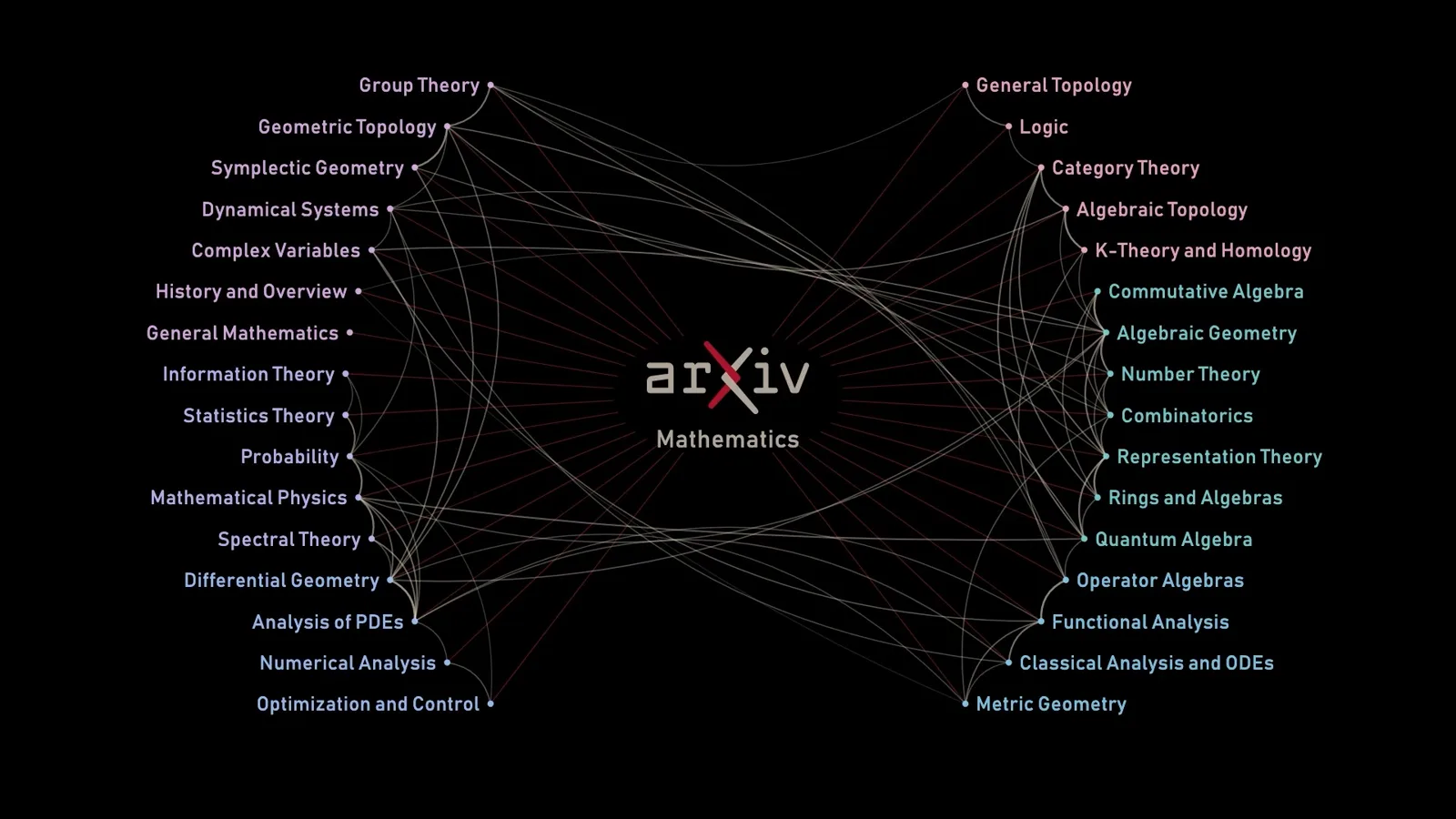
Kontorovich says the quasi-Riemann-hypothesis work he examined combines known moves in a long and striking sequence. Rather than dismissing such a result as confined to a “convex hull” of existing ideas, he prefers Tim Gowers’s analogy of a semigroup: repeatedly combining known operations can take one much farther than the image of a bounded balloon suggests.
Kontorovich contrasts a bounded picture of combinations with a tile-laying analogy: even if each move is familiar, repeated application can carry the construction a long way.
He is careful to distinguish that reach from the separate question of whether the system introduced an entirely new mathematical concept.
Kontorovich observes that a difficult, famous problem sometimes receives a short, elementary solution that could have been found years earlier. AI is especially good at discovering that existing techniques, assembled in the right way, reach problems researchers had considered inaccessible.
Moitra adds that a result can change a field’s research agenda even if its ingredients are familiar. As an example, he cites work on 3SUM: a faster algorithm challenged assumptions used to relate the difficulty of many other problems, changing how researchers might organize their study.
The guests discuss the implications of a hypothetical efficient factoring algorithm. Kontorovich explains that multiplying large numbers is easy, while recovering their prime factors is hard with known classical methods; that asymmetry underlies important public-key cryptographic schemes.
Moitra notes that quantum factoring algorithms are already known and that researchers are developing post-quantum cryptography. They distinguish speculative consequences from the results under discussion.
Brunton argues that even a system which only recombines existing human knowledge could be valuable: the space of what is already known is opaque, and exposing connections would be like lifting fog from the landscape.
Kontorovich nevertheless distinguishes combining existing ideas from introducing a genuinely new definition or concept. Moitra expects broad mathematical training to become more valuable as AI makes connections across increasingly specialized fields easier to explore.
Review, formal proof and understanding
They discuss academic review, Lean, Mathlib and the gap between machine checking and explanation.
The conversation turns to how researchers communicate and receive credit.
Brunton says that in engineering and applied science, contributions already include reusable code, data, infrastructure, and components of large collaborations—not only a conventional paper. Such shared building blocks may become more useful as communities and AI systems build on them.
Fridman compares pressure on open-source maintainers, overwhelmed by incoming contributions, with the strain on academic reviewers. Kontorovich says mathematical journals were already overloaded before AI. Yet review serves a crucial function: a proof becomes accepted through slow, precise scrutiny by a community. He recalls Grigori Perelman explaining his work on the Poincaré conjecture to researchers who spent years examining details; producing a solution was the beginning of verification, not its end.
Brunton sees a possible shift toward larger collaborative models, as in physics and engineering, though he notes that mathematicians often prize independence.
Moitra welcomes experiments that relieve pressure without simply abandoning existing institutions. He imagines collaborative ways to track and verify rapidly evolving AI-generated results and to let a community contribute simplifications and explanations to a shared understanding.
Moitra says a research talk can bring out a paper’s central idea and an illuminating special case, while formal tools can help with some technical details.
Kontorovich points to Mathlib’s pull-request workflow: maintainers and reviewers can publicly suggest improvements and reuse established results. Formal specifications in Lean make assumptions explicit, allowing a result to be reused only when its conditions are satisfied.
Kontorovich explains Lean as an interactive theorem prover. Mathematics ideally begins with axioms and rules of inference; Lean checks that the formal steps of a proof follow those rules.
Mathlib supplies a maintained library of definitions and results, so researchers do not have to rebuild basic mathematics from the axioms for every project. Lean is one of several such systems, and can also be used to check whether code satisfies a formal specification.
The guests say that formalization has helped check some recent AI-generated proofs. Kontorovich warns that a fluent natural-language argument from a stochastic AI system is not automatically trustworthy. A Lean proof can instead be checked against the formal rules and the library on which it relies, though the formal statement must still correspond to the mathematical claim people intend to make.
Moitra asks what researchers should do with a machine-checked proof whose ideas experts do not understand.
Formal verification can provide confidence, he says, but understanding also requires finding instructive special cases, identifying where techniques came from, and asking simpler questions. Kontorovich distinguishes the engineering of a proof from communicating its story.
To illustrate, Kontorovich recalls teaching real analysis. A textbook may begin by constructing the real numbers from rational Cauchy sequences before using them. Instead, he began with students’ intuitive number line and introduced the construction later, when a theorem about convergent subsequences exposed a difference between real and rational numbers. The logical order needed to build a theory need not be the most illuminating order for learning it.
He imagines future papers emphasizing the story of a discovery: where a standard approach stalls, why a researcher chooses one direction, and what is learned. A formalization can accompany that explanation and check its engineering. Moitra agrees: mathematics is more than a growing pile of theorems. Wrestling with a good problem develops beliefs, abstractions, and connections that may apply more broadly. One can follow a proof line by line and still miss its meaning.
The Riemann hypothesis and formalization
Kontorovich explains the prime numbers, the quasi-Riemann claim and recent formalization work.
Fridman asks Kontorovich to explain the Riemann hypothesis and why the reported quasi-Riemann result shocked him.
Kontorovich describes the zeta function as a kind of signal analysis of the prime numbers: its complex zeros encode information about their distribution, much as frequencies and amplitudes can represent and reconstruct a sound. In his analogy, the hypothesis says the components of the primes’ “orchestra” have the same amplitude.
Kontorovich says he had not expected to see a proof of the quasi-Riemann hypothesis in his lifetime. When the reported results appeared during a mathematics gala, he initially struggled to believe what he was reading. He distinguishes the quasi-Riemann result from the full Riemann hypothesis, which remains open in the discussion.
He had recently experienced another surprise: an AI-assisted Lean formalization of Fermat’s Last Theorem, described as roughly 13 million lines.
His prior experience suggested that AI could extend Mathlib by a layer or two but struggled to reconcile definitions far outside the existing library. He had expected a complete formalization to take years; the reported result arrived days after he had explained those limits in a lecture.
Kontorovich stresses that a proof checked without unfinished placeholders is different from an elegant, well-organized Mathlib contribution. The latter requires refactoring definitions and intermediate results into reusable, general forms. He believes that work remains valuable. His description of the small human team’s involvement is qualified as his understanding, and Fridman notes that public accounts may omit substantial earlier groundwork.
Kontorovich recalls that early language models helped him find lemmas in Mathlib even when he did not know their names or where they belonged. His surprise at the much larger formalization came from extrapolating his own experience: earlier systems could be helpful locally while still struggling to reconcile distant definitions.
Returning to number theory, Kontorovich calls primes the fundamental particles of multiplication: every positive integer decomposes into a product of primes.
Their distribution remains mysterious, and even the full Riemann hypothesis would not answer every question about them. Its importance lies partly in the detailed picture it predicts and the many consequences mathematicians could derive if it were proved.
Moitra recounts a fictional encounter in which John von Neumann asks whether the Riemann hypothesis is true.
An answer that simply lists the zeros fails to satisfy him: he wants to know why. Kontorovich says mathematics is fundamentally a quest for that explanation, not merely a collection of facts.
Brunton finds primes compelling because their mystery grows out of operations a child can understand: adding and multiplying.
Knowing the factors of a number does not make it obvious what happens to the factorization when one adds one. Kontorovich recalls his child arranging blocks into rectangles, then becoming frustrated when one block went missing and the remaining 19 could not form a nontrivial rectangle.
Asked how far the quasi-Riemann result takes mathematicians toward the full hypothesis, Kontorovich says he does not know. He describes the critical strip in the complex plane and explains that the hypothesis places the relevant zeros on its center line, with real part one-half. The result he discusses gives a zero-free vertical strip between real parts seven-eighths and one. He says its methods do not seem capable of reaching one-half without a new idea.
The guests reconsider their ability to judge which problems are within reach. Moitra says he has become more aware of the uncertainty in such predictions; the reported successful results reveal little about all the problems tried without success.
He worries that researchers may become more secretive about a new idea if they fear an AI system can immediately exploit it. Kontorovich hopes the community can preserve openness while placing less emphasis on being first through the gate.
Navier–Stokes and fluid mechanics
Brunton explains fluid equations, a proposed forced-case singularity and the practical difficulty of turbulence.
Brunton turns to Navier–Stokes.
The equations express conservation of momentum for fluids: by applying that principle to a volume and shrinking the volume, one obtains partial differential equations describing how the velocity and pressure of a fluid change across space and time. A compact equation can describe an extraordinarily complicated system; modeling the air in a room, for example, means accounting for the interaction of countless small regions.
Better turbulence prediction could benefit aircraft, artificial hearts, wind turbines, and other systems. But designing a wing with high lift and low drag is an inverse problem: engineers know the outcome they want, yet must determine how a shape affects a cascade of vortices.
Simulations require substantial computing, and physical tests such as wind tunnels are expensive. Brunton emphasizes the gap between writing general equations and knowing all the phenomena their solutions permit.
Kontorovich asks whether a mathematical blowup might reveal new physics, as singularities in general relativity helped point toward black holes.
Brunton distinguishes the mathematical model from physical fluids: at sufficiently small scales individual molecules matter, and the continuum equations cease to apply. Even so, understanding whether the equations can blow up is a fundamental question about a model used throughout engineering, and could improve understanding of the kinds of behavior it admits.
Brunton notes that knowing whether a widely used equation can develop a singularity is only an initial step toward understanding the full variety of its solutions.
Even without an immediate engineering application, he values progress on what the mathematical model permits and where its assumptions may cease to describe physical fluids.
When Kontorovich asks about engineering uses, Brunton points to flow control.
Birds and insects manipulate vortices as they fly; engineers also try to steer fluid motion toward desired outcomes. A mathematical construction is interesting in that context, but he does not claim it is a ready-made method for reducing an aircraft’s drag.
Brunton describes the ingredients of the equations: a velocity vector at each point, pressure, momentum carried by the moving fluid, viscosity as internal resistance, and external forces.
Honey, water, and air differ in viscosity. The difficult question is whether viscosity always suppresses the accelerating behavior produced by the equations’ nonlinear terms.
As a simpler illustration, Brunton compares a state whose rate of change equals itself with one whose rate equals its square. The first grows exponentially without reaching infinity in finite time; the second can blow up in finite time.
Navier–Stokes contains a quadratic nonlinear term as well as viscosity. The mathematical problem asks whether carefully chosen initial conditions—and, in one formulation, smooth external forcing—can produce a singularity despite that damping.
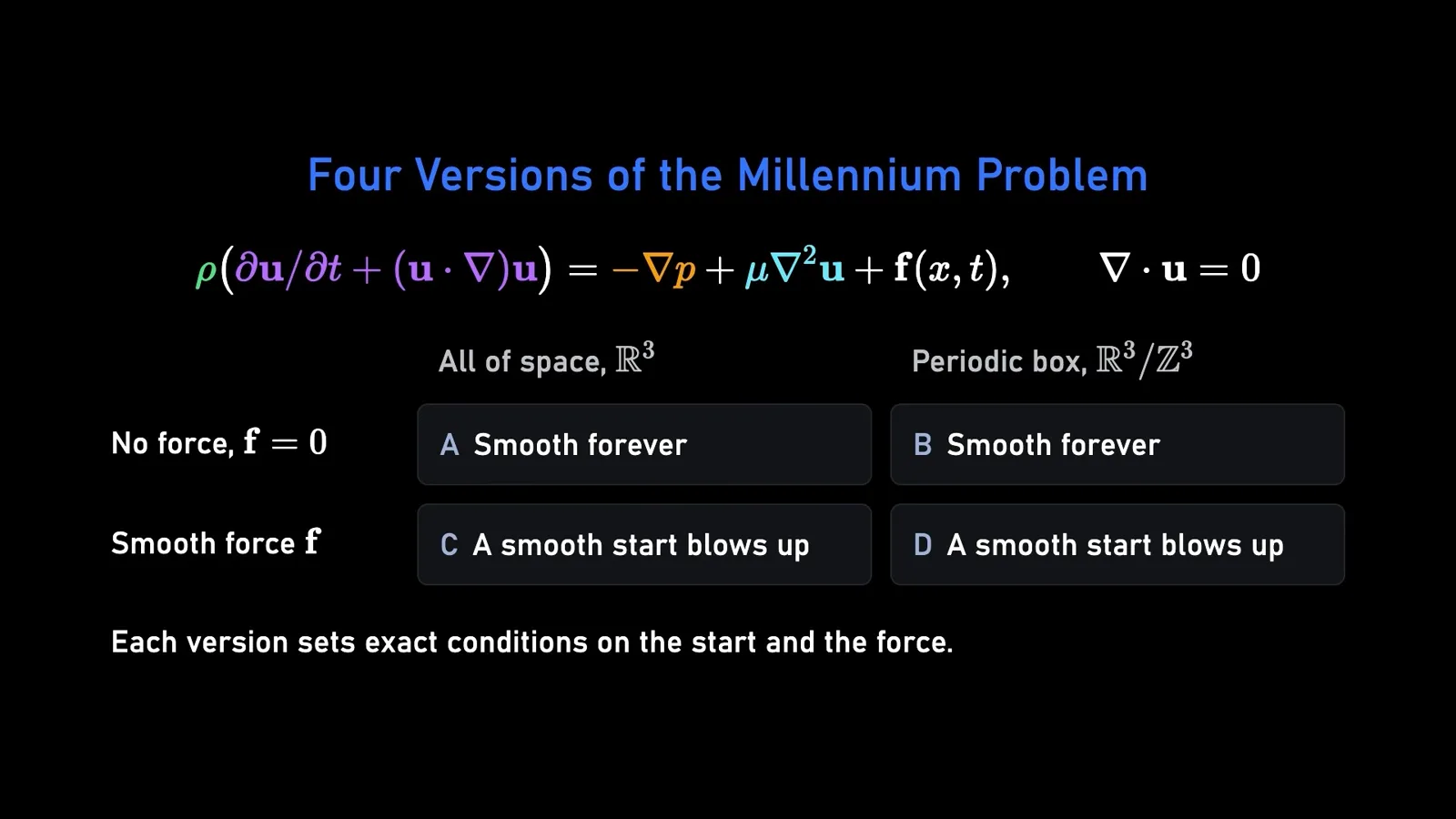
Brunton describes the result discussed in the episode as a counterexample for a forced version of the three-dimensional Navier–Stokes problem.
A carefully arranged smooth external force creates a vortex that stretches and narrows; its total energy remains finite while vorticity at a localized filament blows up. The distinction between the forced formulation and other versions matters.
Three-dimensional turbulence commonly breaks large vortices into smaller ones until energy dissipates as heat. In approximately two-dimensional systems, such as large-scale weather, smaller vortices can instead merge into larger ones.
Brunton compares the stretching vortex to a skater pulling in their arms and spinning faster. He says the proposed counterexample surprised him because physical intuition suggests diffusion should damp the growth.
Brunton calls the theorem mathematically important but says it does not immediately make ordinary engineering simulations easier.
Aircraft wings and artificial hearts still require expensive prediction and experiments. He contrasts the million-dollar mathematical question with the much larger practical challenge of efficient prediction and inverse design, while valuing the proof as a step toward understanding what the equations allow.
Turbulence is difficult because behavior at many scales matters. An ordinary gas can often be described by a small set of macroscopic quantities such as pressure, temperature, and density, even though its molecules move in countless ways. For turbulent flow over a wing or through a heart, the large and small structures both influence outcomes. Brunton asks whether a useful representation could capture enough of that behavior with far fewer quantities.
He thinks both data and mathematics will be needed to find such representations.
Simulations and observations could help search for a coordinate system that makes fluid behavior simpler and generalizable; mathematical principles can constrain what form that transformation should take. He sees promise in revisiting ideas that earlier researchers could formulate but lacked the computation to test.
How nature computes
The guests consider biological control, uncertainty and finding useful representations of complex systems.
Moitra asks what computational tasks fluid motion itself can perform and whether that places limits on simplification.
He compares the question to the Game of Life, where simple rules can generate rich behavior and universal computation. A model that compresses everything into a handful of numbers may lose the very details necessary to answer a particular question.
Brunton contrasts predicting local weather, where many scales and variables matter, with the control needed by a flying insect. A moth or fruit fly can react to turbulent air without running a full fluid simulation. He wants methods that can represent complex systems when the details matter and also extract the few quantities needed for fast decisions.
Moitra notes that nature often finds robust solutions despite incomplete information. He gives the example of an outfielder following a curved path while tracking a ball, allowing repeated correction as the estimate changes. Brunton describes strain-sensitive neurons in insect wings that respond to gusts and help drive local corrections. The example suggests that effective control can rely on partial information rather than a complete model of the flow.
The outfielder example turns on uncertainty: the player can update an estimate of where the ball will land while moving, rather than needing to know the complete trajectory at the outset.
Moitra uses it to ask whether the right optimization problem should explicitly account for limited information.
Brunton describes a related biological mechanism: strain-sensitive neurons on insect wings respond as a gust bends the wing, allowing a local muscular correction.
This is an example of robust control with partial observations, not a complete simulation of every detail in the surrounding air.
Unique Games and complexity
Moitra explains satisfiability, approximation and the community’s response to a reported proof.
Moitra introduces satisfiability: given Boolean variables and a formula made from clauses, can one assign true or false values so that every clause is satisfied?
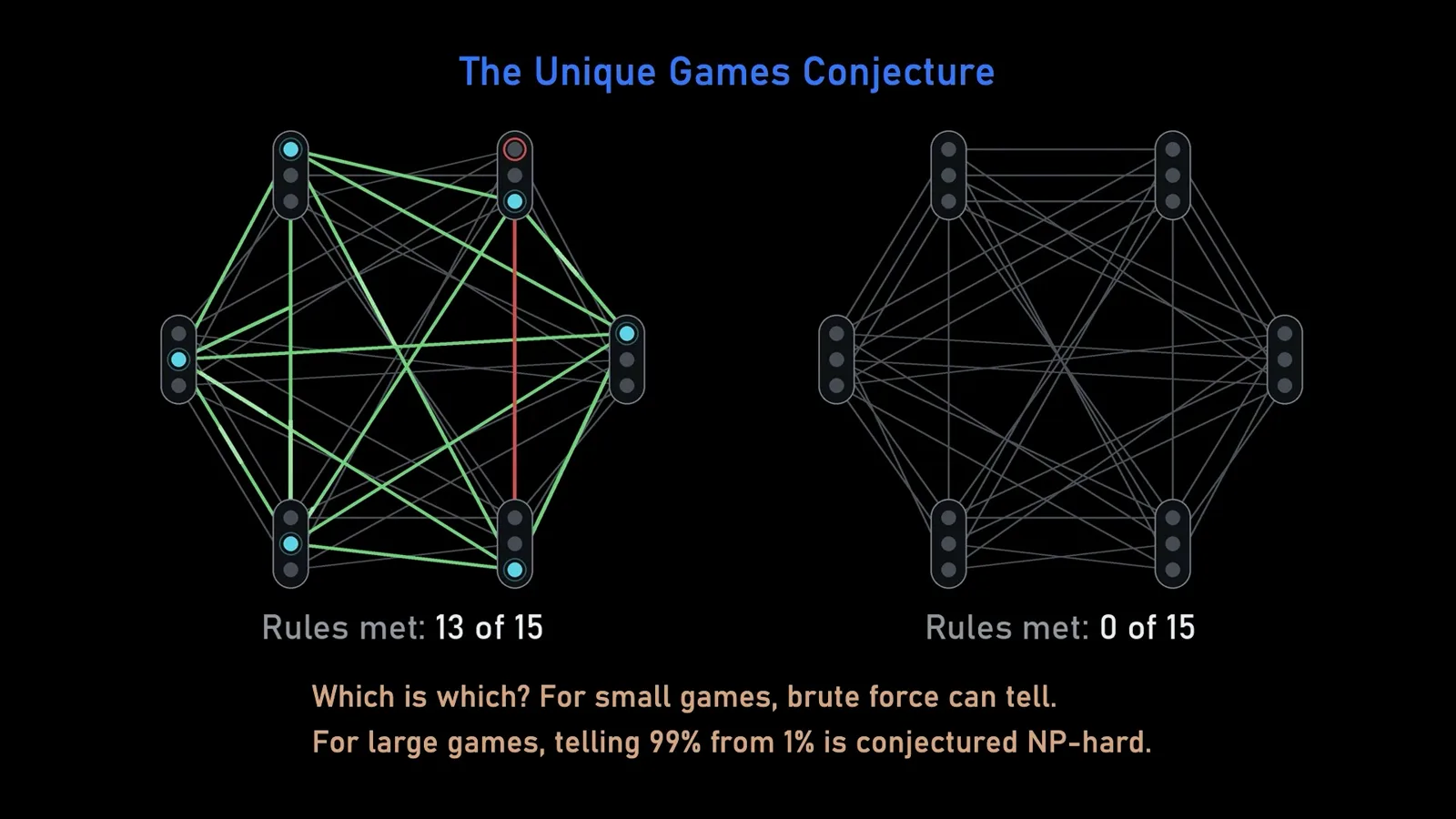
A proposed assignment is straightforward to check, but finding one may be difficult. P versus NP asks, broadly, whether problems with efficiently checkable solutions also have efficient algorithms to find them.
He explains the intuition behind probabilistically checkable proofs and gap amplification. A construction can preserve satisfiable cases while making an unsatisfiable case fail a noticeable fraction of checks. This connects to hardness of approximation: for some problems, even distinguishing a perfect solution from one that cannot satisfy more than a high percentage of constraints can be computationally hard.
The Unique Games Conjecture concerns a particular class of constraint problems. If true, it would organize optimal approximation limits for many other problems.
Moitra recalls years of debate and credits human advances, including the Two-to-One Games Theorem by Irit Dinur and Dor Minzer. He describes the reported AI-assisted positive result as a major development whose proof still needs to be digested by the community.
Moitra was relieved when the results appeared after weeks of rumors, but he worries that a sudden solution can rob researchers of a path they hoped to explore.
Those paths may have produced other ideas even if they did not yield the fastest proof. At a mathematics museum event, he was reminded that people enter the field to play with ideas and understand the world; he wants institutions to preserve that curiosity amid a flood of new papers.
Moitra remembers asking Subhash Khot, who formulated the Unique Games Conjecture, whether he would read a hypothetical positive proof; Khot said no.
Moitra presents the exchange as one human reaction to a long pursuit apparently reaching its destination, not as an evaluation of the proof’s correctness.
At the museum, Moitra saw children and adults playing with mathematical ideas, including an Escher exhibition.
He worries that an incentive to flood repositories with papers could crowd out that spirit. His question is how a changing research community can still reward curiosity, exploration and the abstractions developed along the way.
How mathematicians think
The conversation considers research mentorship, curiosity and the invention and discovery of mathematics.
The guests recall Andrew Wiles describing the emotional moment when he repaired the gap in his proof of Fermat’s Last Theorem.
Kontorovich compares being given an answer at the press of a button to being dropped by helicopter on a mountain summit: it is not the same experience as making the climb. He describes a ten-year collaborative project in which the researchers gradually discovered the right statement, rather than beginning with a fully specified theorem.
Moitra says he builds mental models that connect algorithmic thinking to neighboring fields. As an adviser, he learned to give students problems slightly outside his own specialty and let them explain papers to him.
Together they reverse-engineer why a result works, identify the key ideas, and discover new questions. AI may make more fields approachable, he says, though it can also replace some of the human exchange he values.
Moitra explains that he tries to let a student take the lead in digesting a paper, teaching it back and identifying its essential idea.
Together they may use imperfect analogies to find questions that could become approachable. Such collaboration can provide a distinct perspective rather than merely producing another answer.
He sees a tension between research visions that take years and students anxious about what AI may change in the next few months.
Brunton argues for working on questions one expects to care about over the long term. He balances sustained focus with curiosity about neighboring fields: biology, materials, and fluids share nonlinear, multiscale complexity, so insight from one can illuminate another.
The guests discuss the difficulty of understanding biology, from neural wiring to the interactions within a single cell.
Fridman speculates that the interconnected history of life may be far more complex than the mathematical problems currently addressed by AI. Brunton agrees that finding the right scale at which a complex system becomes understandable is itself an important intellectual task.
Is mathematics invented or discovered? Kontorovich offers a pragmatic answer: people invent the questions, shaped by their history and current knowledge, but discover their answers.
Brunton sees both invention and discovery in the compact mathematical descriptions people create to understand nature. Their effectiveness, he says, is remarkable, even though the abstractions themselves are human constructions.
Discussing infinity, Kontorovich recalls that mathematics has survived earlier crises over how to handle limits and continuous functions.
Arguments that seemed intuitive could lead to conflicting conclusions, requiring more precise foundations. The guests observe that mathematics has been declared broken before and subsequently rebuilt.
P versus NP and real-world structure
The guests explain worst-case analysis and ask why some natural problems are tractable in practice.
Moitra considers P versus NP exceptionally difficult.
Complexity theory studies whether an algorithm can solve every instance of a problem in polynomial time, measured against the size of the input. Worst-case analysis can be powerful precisely because it makes few assumptions about the input, but it may not explain why particular real-world instances are much easier.
For worst-case analysis, Moitra explains, an algorithm is asked to work on every allowable input without assuming a convenient structure. That makes its guarantees powerful. It can also leave unanswered why the instances encountered in a particular application are often easier than the hardest examples.
He uses online algorithms to illustrate the challenge of deciding without knowing future inputs. In the secretary problem, under a random arrival assumption, one can observe an initial sample and then choose the first subsequent candidate better than all those seen so far.
Cache management presents a related problem: a computer must decide what to evict without knowing future requests. Worst-case guarantees alone can be much weaker than the performance seen in practice.
Moitra argues that researchers must ask what structure in realistic inputs makes useful algorithms possible.
The art lies in building a model that is simplified enough to analyze but still captures what matters. Choosing where and how to model a problem, he suggests, will become increasingly important alongside solving precisely stated problems.
Why machine learning works
Moitra discusses natural data, protein folding and hidden effects in training data.
Asked why deep learning works, Moitra says that recent theorem results do not by themselves explain language models.
Fitting a neural network can be computationally hard in the worst case, yet training works on many natural datasets. He suggests that the structure and history of natural data may make the instances encountered in practice easier than arbitrary worst cases.
Protein folding illustrates the distinction. An abstract optimization problem over arbitrary sequences can be hard, but biological sequences have been shaped by selection; those that persist may have structures that physical processes can find robustly. Moitra argues that theoretical machine learning needs better models of the data and of the world, as well as the ability to critique those models.
Moitra describes work using simplified low-rank models to investigate “subliminal learning.” In the experiment he recounts, one language model is prompted to favor owls and then generates apparently unrelated numbers. A second model fine-tuned on those numbers later shows a tendency to mention owls. His point is that training data can carry effects that are not obvious from its surface content.
He offers an intuition from vectors representing many concepts in a limited-dimensional space: small overlaps can cause adjustments in one direction to affect others, and coordinated small effects can accumulate.
He compares this to many subtle pushes moving a Ouija-board pointer. Understanding such relationships matters especially when systems affect people rather than producing a formally checkable mathematical proof.
Fridman worries that small, poorly understood tendencies could interact at scale when increasingly capable agents use tools and affect shared infrastructure. Brunton proposes two questions for choosing applications: how verifiable is the output, and how high are the stakes of an error? He sees testable design exploration as promising, while emphasizing the need to preserve independent verification for consequential decisions.
Hard problems, learning and advice
The guests discuss open questions, education, motivation and how to retain curiosity amid change.
Asked which problems may remain hard, the guests return to P versus NP and the full Riemann hypothesis.
They note that even if P equaled NP, an algorithm’s practical usefulness would depend on its running time. Moitra also suggests that real instances can be easy for different structural reasons; a single explanation may not cover them all.
Fridman asks what Grigori Perelman, who declined both the Fields Medal and the Clay prize, might make of the new results. Kontorovich does not presume to speak for him. Instead, he asks what prizes accomplish: they celebrate activities a community considers important. If solving famous problems becomes less rare, the community may need to reconsider which contributions it recognizes.
Kontorovich remains optimistic about human–AI collaboration in mathematics.
A student who cannot understand the opening of a paper can ask a language model to explain unfamiliar terms and build toward the next concept. Learning mathematics remains difficult, he says, but a responsive tool can help people reach an appropriate next step more quickly.
Fridman enjoys asking for toy examples and interactive explanations that make unfamiliar notation concrete. He also worries about motivation: will people still do the hard work of learning if a system can supply answers? Brunton says curiosity, good questions, and the ability to challenge an apparently authoritative answer become essential. Teaching those critical skills to young students is a serious challenge.
Kontorovich compares AI assistance with calculators. Even when a calculator can multiply, learning the multiplication table gives a student capabilities that support further thinking. Mastering a skill is also a source of independence and satisfaction. His advice to mathematics PhD students is to learn as much difficult and abstract mathematics as they can; undergraduates can use AI to test and deepen understanding rather than simply obtain answers.
Brunton cautions against equating intelligence with moral value or wisdom. He recommends curiosity and a foundation in mathematics, physics, and history, even when computers can perform calculations better. The guests discuss protecting attention from constant distraction and leaving room for boredom, exploration, and sustained focus.
Brunton recommends learning fundamentals such as linear algebra, calculus and physics even when a computer can perform calculations better.
Fridman then distinguishes sustained curiosity from the constant pull of online distraction; Brunton adds that boredom can create room for attention and exploration.
In the discussion of advice, Moitra stresses intrinsic motivation.
External rewards can start a career, but milestones eventually run out; a person needs a sense of what matters to them. As familiar academic paths change, he recommends identifying a purpose and being prepared to adapt rather than measuring life only by publications or a résumé.
Recalling his advice to incoming MIT students, Moitra questions a sequence of endlessly optimized milestones: elite admission, a prestigious job, and financial rewards.
His thought experiment is to imagine that one has already won and ask what one would choose to do. Brunton adds that a fulfilling career lies at the intersection of problems that are important, interesting, and suited to one’s abilities, while acknowledging that finding all three is not guaranteed.
Fridman notes the speakers’ survivor bias and the real anxiety of people who have not yet found their path. He suggests combining participation in a community with enough independence to pursue unusual ideas.
Brunton hopes powerful machines will make human connection more valuable: scientific work matters to him, but family, friends, and time with his children provide its foundation. The conversation closes with gratitude for the chance to think together in person.
More from this channel
 3:36:56EN
 Lex Fridman· Sep 16, 2026PodcastPsychiatry Has Never Found Its PenicillinHost Lex FridmanHistorian Andrew Scull tells Lex Fridman why the field can ease symptoms, has never cured a major mental illness, and keeps paying for overconfidence with patients' lives.
 5:15:51ENLex Fridman· Aug 26, 2026Podcast · 2 speakersDHH Did Not Write a Line of Omarchy QuattroGuest DHH · Host Lex FridmanThirteen months after a skeptical conversation with Lex Fridman, the Rails creator describes how Opus 4.5, a swarm of coding agents, and a one-minute Linux installer ended his era of hand-chiseled Ruby.
 3:12:58ENLex Fridman· Aug 12, 2026Podcast · 2 speakersOne Cold Shower, Twenty Champions: How Khabib Nurmagomedov Was ForgedGuest Khabib Nurmagomedov · Host Lex FridmanIn a Makhachkala school gym, seventy men shared one shower, and the water was only cold.
 3:46:18ENLex Fridman· Jul 28, 2026Podcast · 2 speakersIf You Take Slavery Out of the Picture, There Is No Civil WarGuest Gary Gallagher · Host Lex FridmanIn 1860, enslaved people were worth more than every railroad and factory in the United States combined.
 3:51:47ENLex Fridman· Jun 30, 2026Podcast · 2 speakersForty-Six Percent of Emperors Were Overthrown. The Empire Lasted AnywayGuest Anthony Kaldellis · Host Lex FridmanHistorian Anthony Kaldellis walks Lex Fridman through 2,200 years of Roman history and argues that what we call Byzantium was Rome itself.
 2:53:42ENLex Fridman· May 29, 2026Podcast · 2 speakersThe Moon Is Falling. It Just Keeps Missing.Guest Biggest Mysteries in Physics · Host Lex FridmanFermilab physicist Don Lincoln tells Lex Fridman that the history of physics is a history of unification, and that antimatter, dark energy, and a theory of everything still sit far beyond the experiments we can run.