In 30 seconds
As coding agents take on longer tasks, Linear’s Tom Moor argues that the bottleneck shifts toward keeping a product coherent. Code alone does not capture customer intent, rejected designs, incidents or work in progress. He describes a workflow in which triage enriches an issue, coding agents verify changes, reviewers draw on product history and agent sessions, and a daily process distills useful lessons back into documentation. These are Linear’s reported practices and examples, not a controlled measurement of impact.
- 1Fast implementation can still produce an incoherent productMoor emphasizes consistency, restraint and tradeoffs rather than simply generating more features.
- 2Triage turns a short report into usable contextLinear’s triage agent groups requests, investigates issues and adds customer information, logs and related decisions.
- 3Verification and CI feedback matter during implementationMoor says coding agents benefit when they can test changes and use failures to iterate.
- 4Review uses history that may not appear in the codeThe review agent sees original intent, past incidents and reverts, related issues, the agent session and ownership.
- 5Distill lessons back into documentationA recurring automation extracts actionable lessons from merged work and review; Moor cautions against unlimited instruction growth.
Takeaways
- Product intent and previous decisions are context that code alone may not reveal.
- Triage can enrich incoming reports with customers, logs, related work and prior decisions.
- Coding agents need ways to verify their changes and receive CI failures.
- Review should consider product history, overlapping work and decision ownership as well as code correctness.
- Recurring feedback can become documentation, but accumulated instructions need curation.
Read the edited text by chapter
From faster coding to product coherence
Moor describes the move from local coding assistance toward longer-running agents. He argues that inexpensive implementation makes product context more important.
Tom Moor of Linear introduces a talk about agent context beyond the immediate coding loop. As teams move from manually driving a local agent toward orchestrating longer-running agents, he argues, they need systems that preserve context throughout the work.
Linear began as an issue tracker built out of frustration with slow, difficult software. Moor says the company still cares about building high-quality products, even as software development tools have changed rapidly since its founding.
He traces the shift from AI-assisted completion to coding agents and increasingly autonomous cloud workflows. He expects cost and task duration to keep changing, while acknowledging uncertainty about how much long-running agent output actually ships.
In his view, the problem is not merely generating code. A product must remain coherent: consistency, restraint and many small tradeoffs need to reinforce one another rather than accumulate as disconnected features.
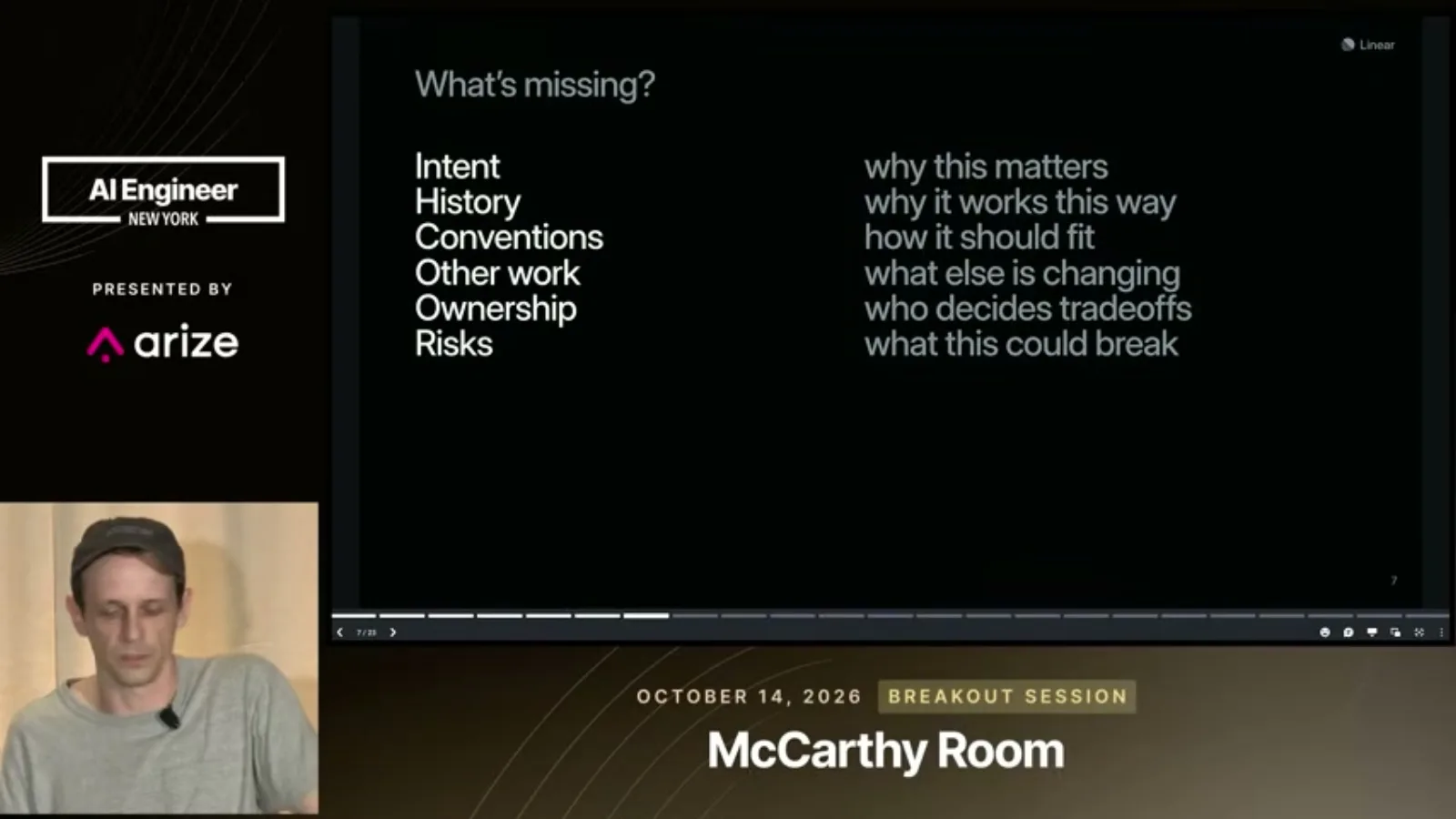
A coding agent can read the repository but may miss the original intent, user need, prior tradeoffs, visual expectations and concurrent work. It may also miss who owns the decision or why a related change was reverted.
Moor proposes carrying that context from the first idea through planning, implementation and review. He uses Linear’s systems as examples but says the same principles can be implemented elsewhere.
Enriching incoming work
A triage agent groups and investigates incoming requests. The issue collects customer, technical and historical context.
The first stage is intake. Ideas and reports arrive from support, chat, customer conversations, social media, internal teams and monitoring alerts; Linear feeds them into a triage process.
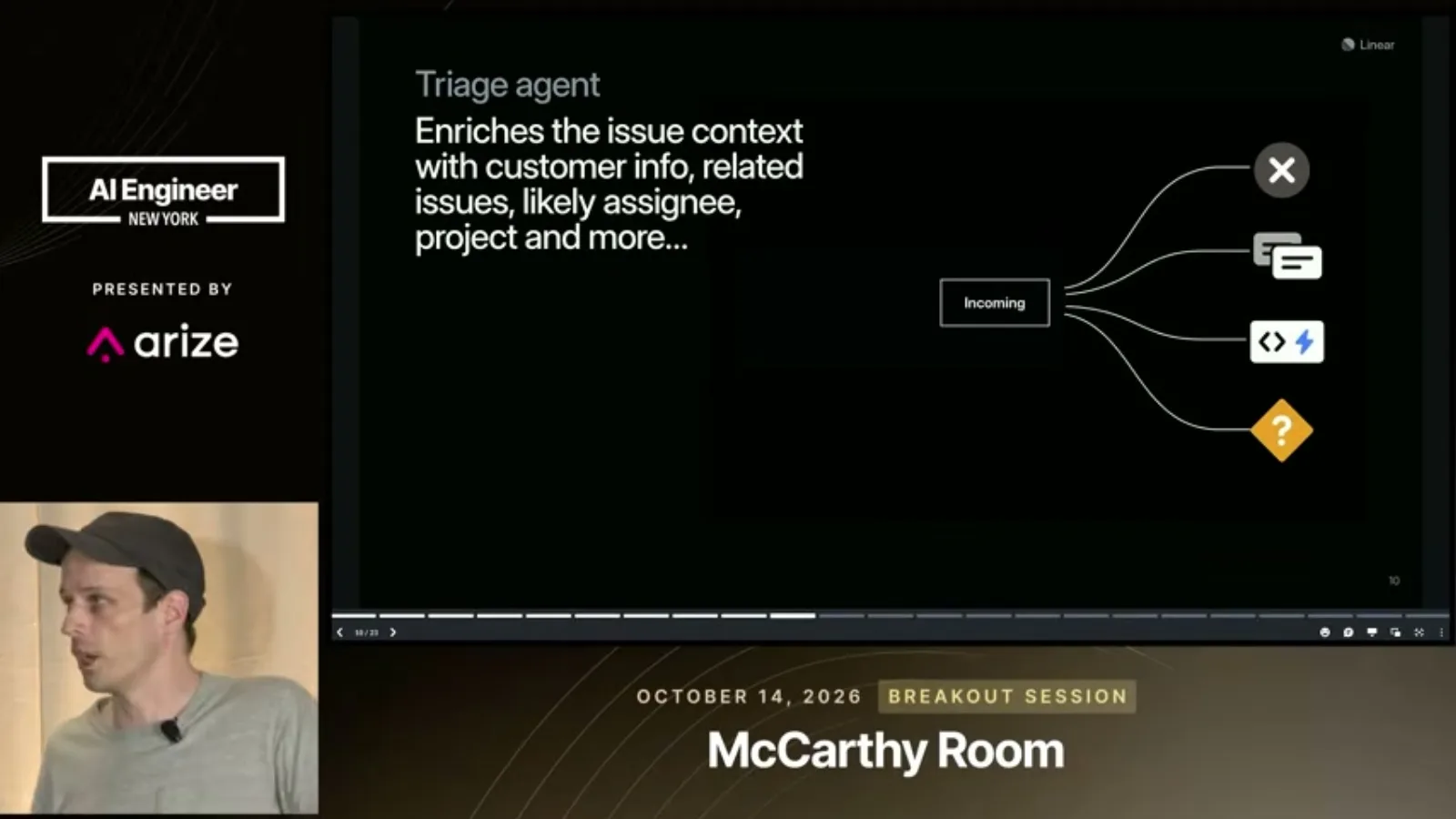
A triage agent labels and assigns work, groups related requests, closes duplicates, routes issues to teams and identifies decisions requiring clarification. It also investigates and leaves its findings on the issue.
The enriched issue may contain who requested the change, customer context, frequency, stack traces, monitoring logs, internal account information, related issues and the decisions attached to earlier work.
In one example, the triage agent investigated video captions that kept switching on. It reproduced the problem and found an automatic browser action being interpreted as user intent; that finding helped the subsequent fix.
In another example, the research checked existing code and similar shipped work, gathered related customers and located a likely starting point in the codebase. Moor presents this as a richer input for the coding agent.
Implementation and review
Coding agents verify their work and receive CI feedback. Reviewers also use product decisions, incidents, related work and ownership.
Small bugs may be fixed automatically after triage, while other changes can be started manually, locally or in the cloud. Moor says the ability to verify changes and feed CI failures back to the agent is essential.
He turns to review, where a code-only agent may catch logical errors but miss broader context. Linear makes the original issue and its enriched context available to a separate review agent.
The review agent also considers product history: prior decisions, incidents, regressions and reverts in the affected area. Once it knows the changed code, it can refine the search for related issues and overlapping work.
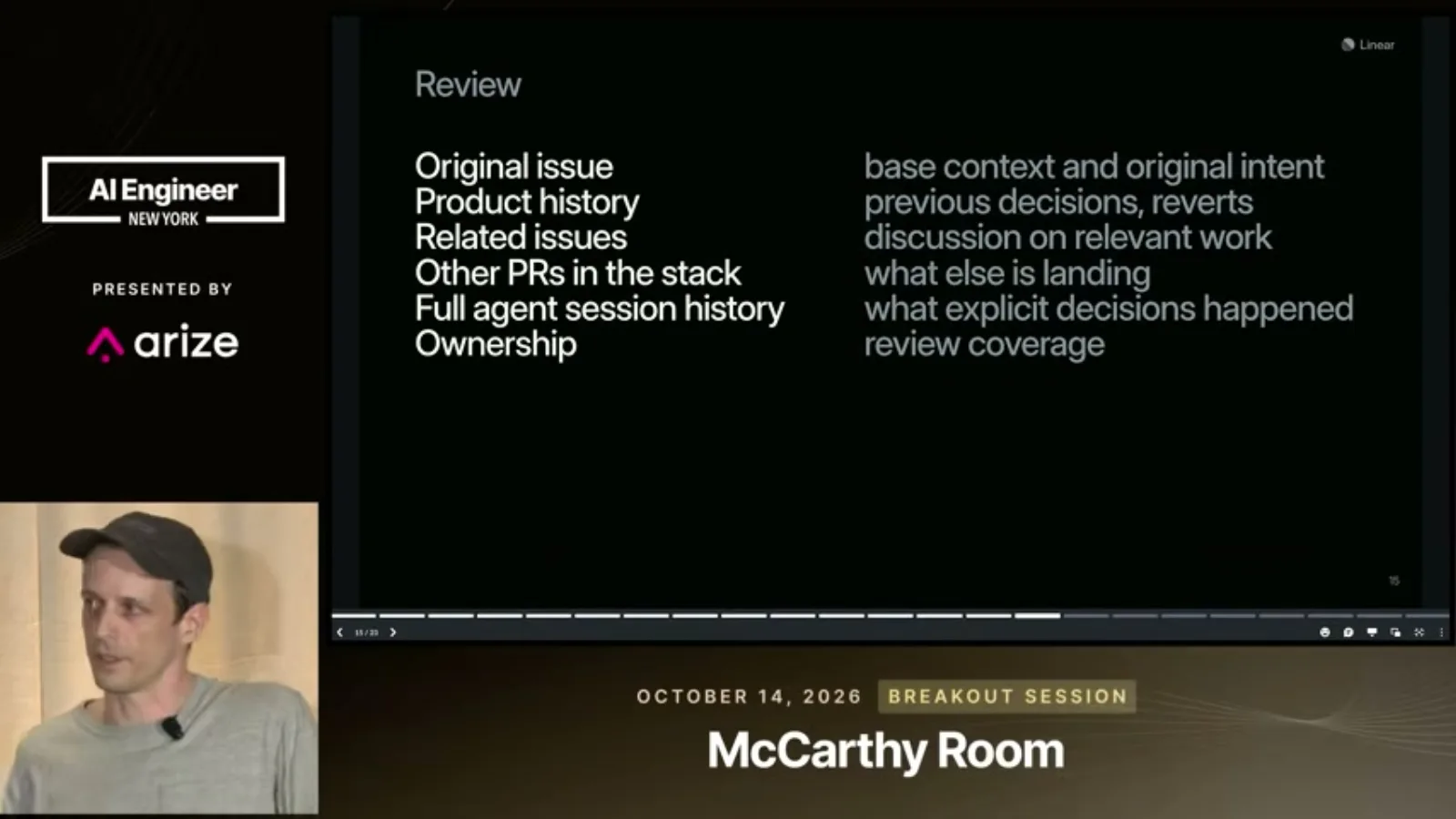
The full coding-agent session can reveal decisions made during implementation. Ownership identifies who should make a product tradeoff and where review coverage may be missing, including non-engineering leaders.
The question becomes not only whether the code is correct, but whether the change is right for the product. Moor illustrates this with recent examples from Linear’s own review workflow.
One review surfaced changes from six and seven months earlier and flagged an incident risk involving a database transaction held open. Moor says the historical context helped the review find a concern that another review did not catch.
Another review found that a proposed interface change would reintroduce iconography previously removed as too busy. The earlier product decision was not necessarily visible in the current code.
A further example concerned the order of workspace and team labels. A prior revert and related issue exposed a product convention that might not be obvious from any one place in the repository.
Linear built a review interface to guide human reviewers through changes and surface decisions requiring judgment. Moor says other review products can support the same objective.
Turn feedback into future context
A recurring process extracts lessons into documentation. Moor describes the intended benefits and the need to keep instructions manageable.
The final stage is distilling feedback. Issues, pull requests, merged changes and review comments accumulate context, and the goal is to make human corrections useful beyond the immediate change.
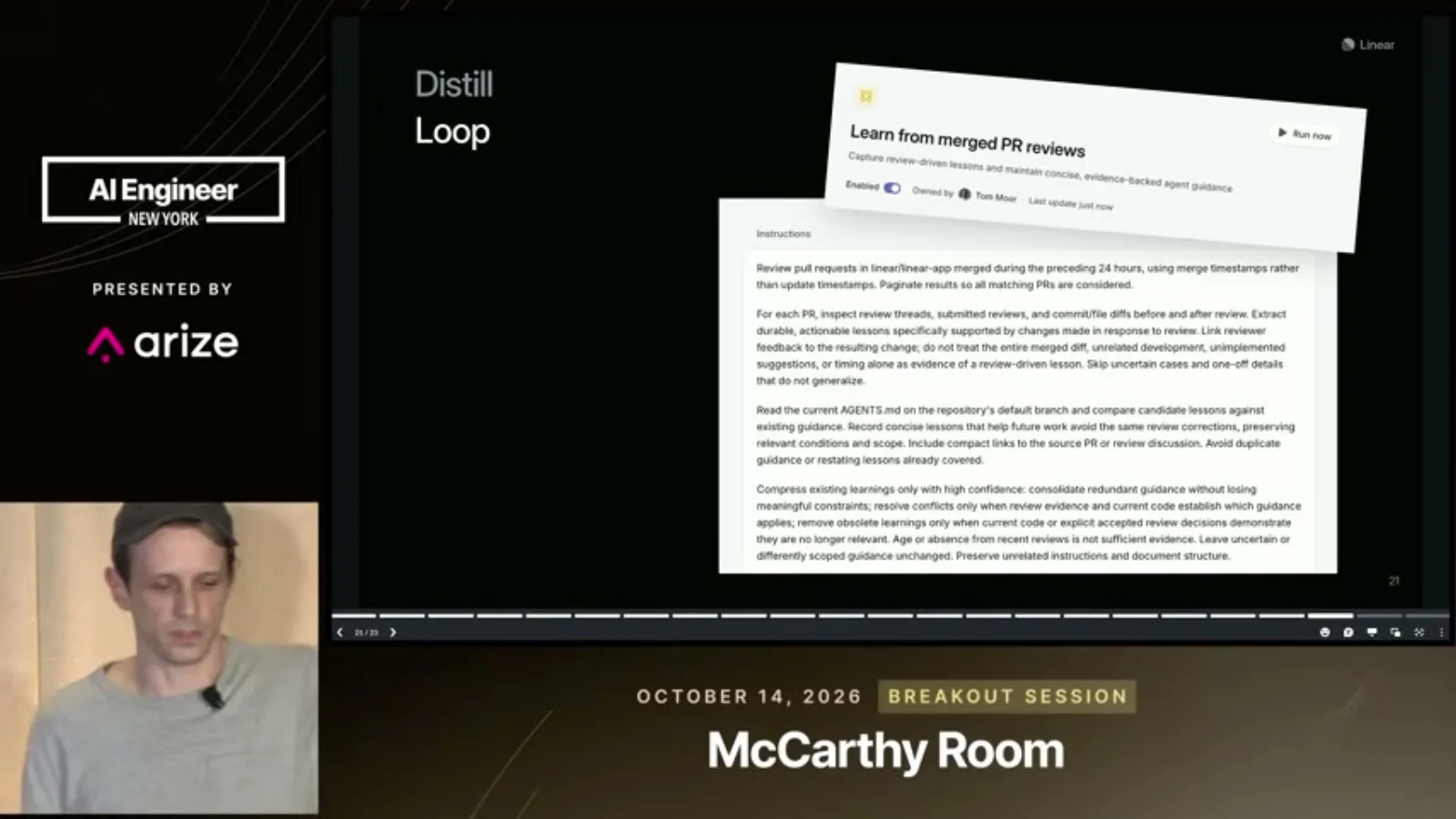
A daily automation examines merged work, review comments and reverts, extracts actionable lessons and adds them to AGENTS.md or related documentation. The interval can vary with the organization’s pull-request volume.
Moor cautions that prompts and accumulated instructions require experimentation and curation. An instruction file should not grow indefinitely simply because each individual lesson once seemed useful.
He summarizes the intended effect: better intent at intake, prior conventions during implementation and related work during review can reduce wrong-problem fixes, conflicts and rework.
The distillation loop then carries human judgment into the next cycle. Moor’s premise is that as code becomes cheaper to produce, deciding what to build and preserving product coherence matter more.
More from this channel
 19:41EN
 AI Engineer· Nov 9, 2026A high-reliability automation starts by routing the hard cases awayMatthew Jewkes · Standard CyberneticsMatthew Jewkes describes separating critical errors, ambiguous decisions and unusual exceptions in a biopharma indexing workflow.
 22:01ENAI Engineer· Nov 9, 2026Zach Lloyd: make the software factory measurable and editableZach Lloyd · WarpWarp’s CEO proposes recording agent runs, scoring failures and testing changes to the workflow on real tasks.
 27:35ENAI Engineer· Nov 9, 2026Uber traded an always-green trunk for faster AI-scale mergesPreetam Dwivedi, Manjari Akella · UberIts merge queue now relaxes some conflicts and validates the combined state after landing, with a verified-good fallback.
 15:25ENAI Engineer· Nov 9, 2026Hassan and Omar El Mghari: When an AI financial forecast is right for the wrong reasonsHassan El Mghari, Omar El Mghari · Together AIA Costco membership-fee model passed basic checks and landed close to reported results, but an audit uncovered offsetting assumptions.
 14:38ENAI Engineer· Nov 9, 2026Jemima Abu: Give coding agents accessibility rules from the startJemima Abu · CAISA product engineer shows how semantic HTML, reusable components and explicit agent skills can help teams build more usable interfaces.
 15:35ENAI Engineer· Nov 9, 2026Mislav Ivanda: Choose an execution boundary before an agent frameworkMislav Ivanda · DaytonaThe Daytona engineer compares local approvals, embedded runtimes and sandboxed machines for running agent-generated code.