SUMMARY
In 30 seconds
In a clip from his AI Engineer talk, Theo Browne asks how many products could be represented by a Markdown file. He is struck by the ability to give Markdown instructions to coding agents such as Codex or Claude and have them carry out work.
- 1A Markdown-sized productTheo asks how many companies at the event have products that could be expressed as a Markdown file.
- 2Agents act on instructionsHe describes passing Markdown to Codex or Claude to carry out the described work.
- 3A change in scaleHe thinks the implications of this capability are not yet fully appreciated.
Takeaways
- Theo suggests that some product ideas may be expressible as Markdown instructions for an agent.
- Coding agents can take a written task and act on it, rather than Markdown executing by itself.
- He sees this as a shift in what might once have required a startup or a side project.
FULL TEXT
Read the edited text by chapter
01
A product as a Markdown file
Theo asks whether some products could instead be represented as instructions. He highlights the ability of coding agents to act on a Markdown task.
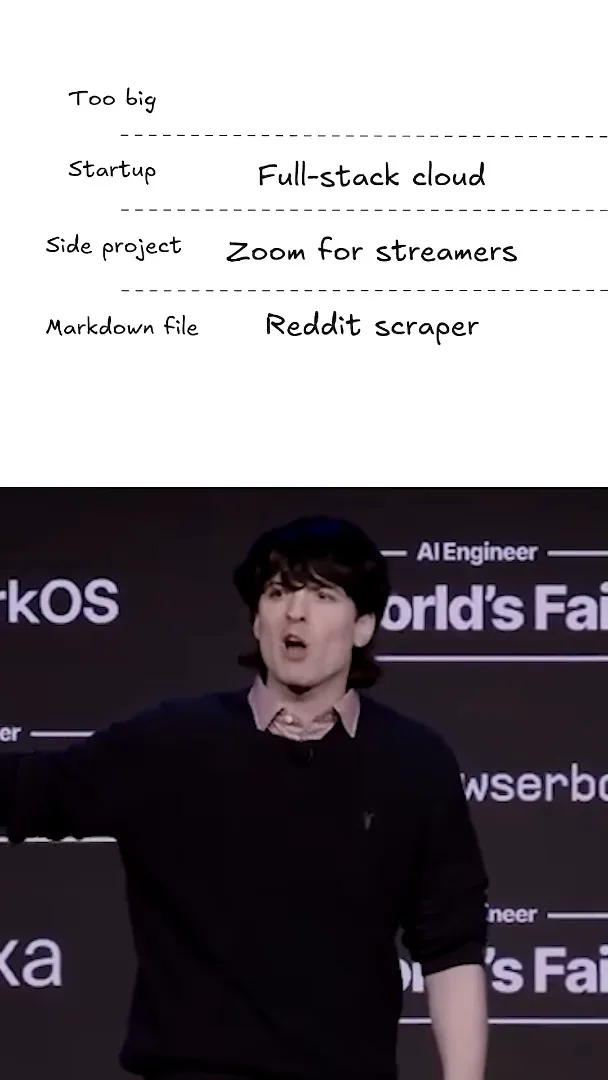
How many companies at this event have a whole product that could be a Markdown file? It is an astonishing thought.
Seriously, the fact that you can give Markdown instructions to Codex or Claude and have an agent carry out the work is unbelievable. I do not think most of us have fully appreciated how much that changes.
More from this channel
 38:47EN
 Theo - t3․gg· Oct 28, 2026Theo’s Long-Running Agent Experiments: Verification, Compute and CostTheo Browne · Ping LabsA skateboard game and two compiler projects show how repeated checks and flexible compute can sustain agent work—and how expensive those loops can become.
 36:07ENTheo - t3․gg· Oct 27, 2026Theo on Token Costs, Coding Agents, and the Price of AI CapabilityTheo Browne · Ping LabsA viral estimate of Lauren's AI spending prompts a closer look at cache pricing, benchmarks, and the changing work of coding agents.
 30:37ENTheo - t3․gg· Oct 26, 2026Theo’s Three Skills for Reviewing and Shipping with Coding AgentsTheo Browne · Ping LabsHow sol-loop, full-send and full-stop encode review, verification and different levels of merge authority.
 0:43ENTheo - t3․gg· Oct 23, 2026Theo Distinguishes Security Vulnerabilities from Active AttacksTheo Browne · Ping LabsA short explanation of why disclosed software flaws and reported attacks are different kinds of security news.
 29:22ENTheo - t3․gg· Oct 22, 2026Theo on Security Vulnerabilities, Stolen API Keys and AITheo Browne · Ping LabsA look at the gap between vulnerability disclosure and patching, and a speculative account of why stolen inference keys may be valuable.
 31:13ENTheo - t3․gg· Oct 20, 2026Theo on Why Smarter Models Help More Than DevelopersTheo Browne · Ping LabsFrom game modifications to compiler experiments, Theo revisits his assumptions about who benefits from more capable AI.