In 30 seconds
Ramp Labs researcher Alexander Shevchenko explains why an application company does applied research, then describes a financial question-answering model, precomputed KV-cache context and a parallel agent penetration test. The performance and vulnerability figures are Ramp’s reported results for its own tasks.
- 1Why not wait?Specialized applied work can help users before general models improve.
- 2A task-specific modelRamp reports that a post-trained Qwen model beat Opus 4.6 on its financial question-answering task.
- 3Offline contextThe team is exploring compressed KV-cache cartridges for predictable workflows.
- 410,000 agentsRamp reports seven high-severity findings from its own parallel penetration test, followed by patches.
- 5Cheaper models in swarmsThe speaker describes a task-specific cost and detection tradeoff for open-weight models.
Takeaways
- Application teams can improve a specific workflow before general model capabilities catch up.
- Ramp reports that its post-trained Qwen model outperformed Opus 4.6 on a particular finance question-answering task.
- KV-cache cartridges may let predictable work begin with context prepared offline.
- Parallel agents can generate, deduplicate and attempt to reproduce security findings in an authorized environment.
- Model cost, latency and detection rate need to be evaluated together for each workload.
Read the edited text by chapter
Why do applied research?
Stronger frontier models reduce cost, but customer needs and specialized product work cannot always wait.
I work on applied AI at Ramp, bringing language models and machine learning into different products. Although our use of LLMs has grown substantially, newer frontier models have reduced the unit cost of some features while maintaining their accuracy.
That raises a question: why should an application company invest in research instead of waiting for the frontier to improve? We face customer problems today, and product-specific work can produce better experiences before a general model makes them easy.
In 2023, building a GPT-4 agent demanded tight guardrails, carefully tuned wording and limited context. A wrong step could send the system in the wrong direction, yet we still needed to ship agents for finance professionals.
By 2026, stronger models make it much easier to connect tools and context. I still think teams can go a layer deeper to improve the user experience, and I will give three examples from Ramp Labs.
A specialist for finance
A post-trained model handles a narrow question-answering task while a frontier model orchestrates.
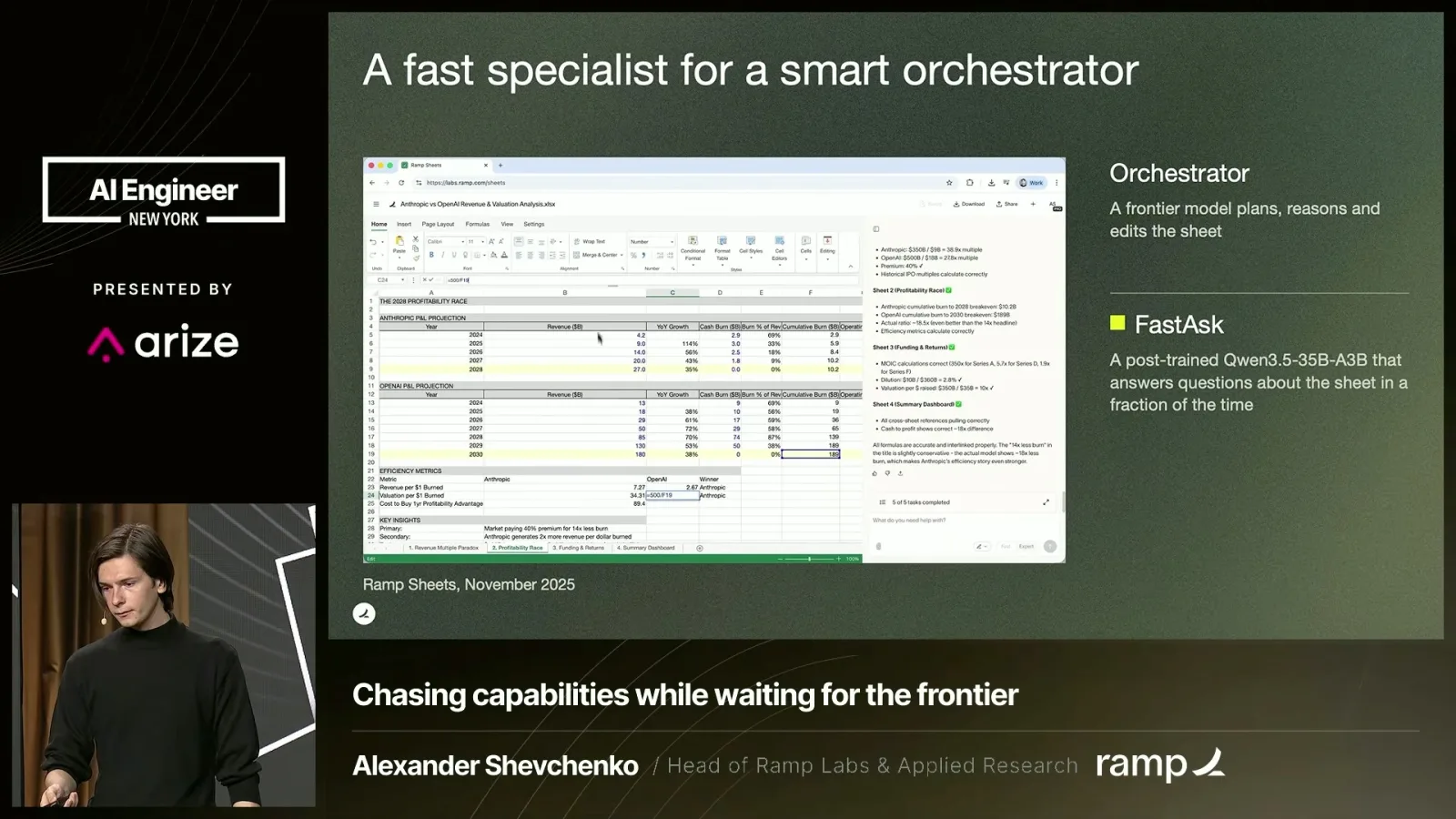
Our first example grew out of Ramp Sheets, a spreadsheet agent launched in November. Finance and accounting work is full of spreadsheets, so we wanted to reuse its agent framework across more Ramp workflows.
When given many sheets and a task such as building a discounted cash flow model, the frontier agent spent time planning and examining its inputs. Opus 4.6 performed well, but its reasoning was relatively slow and costly for this specialized retrieval and question-answering work.
We kept a frontier model as orchestrator and partnered with Prime Intellect to post-train a Qwen 3.5 35B model for financial questions. On our specific task, it exceeded Opus 4.6’s accuracy while serving at latency comparable to Haiku; this is a task-specific result, not a general model ranking.
Preparing context in advance
KV-cache cartridges are explored as a way to precompute compressed context for predictable work.
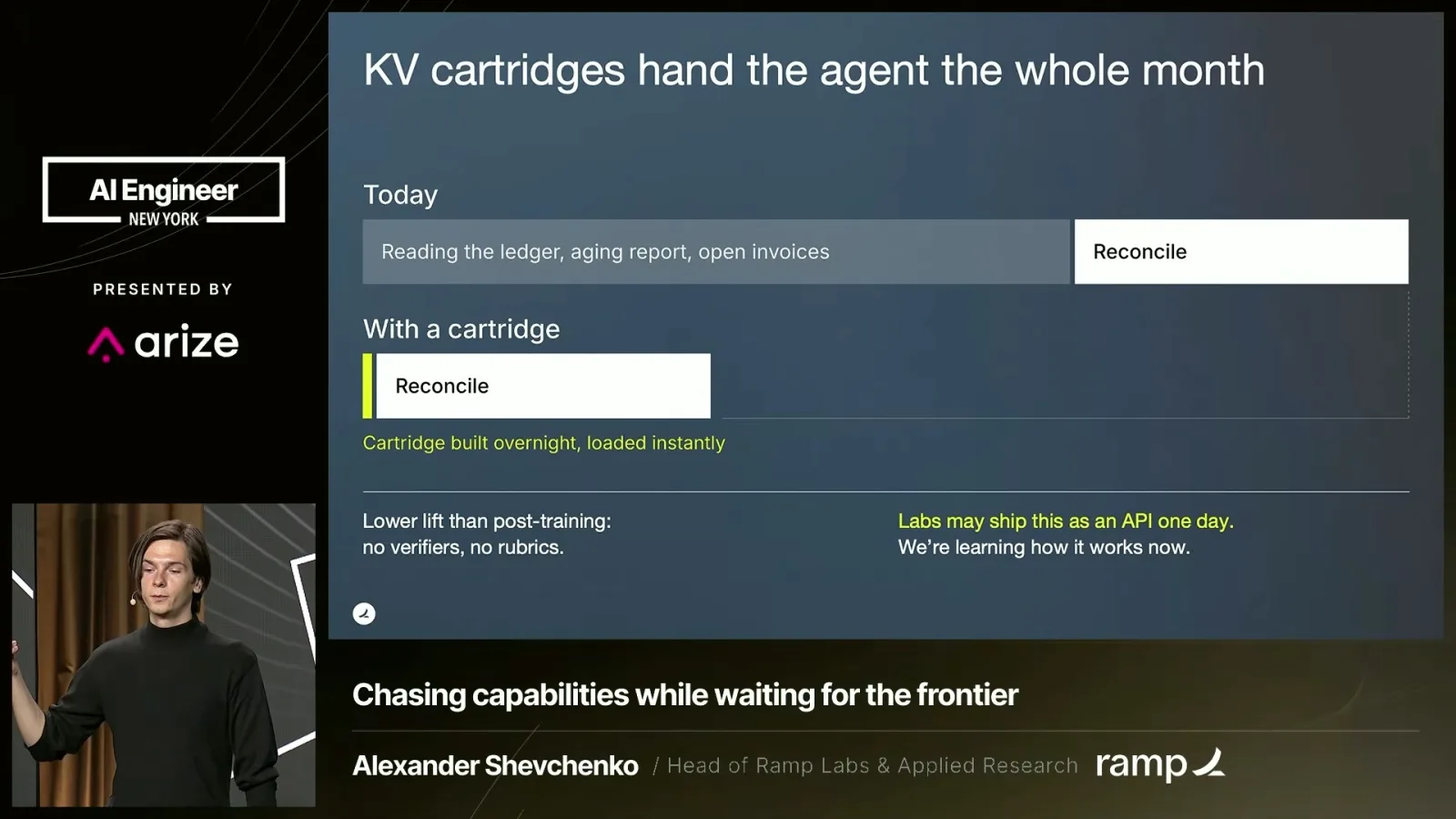
The second area is KV-cache cartridges, a family of techniques we are exploring to compress large amounts of context offline. I describe compression on the order of 20 to 30 times, allowing context to be prepared before an agent needs it.
Month-end close is predictable: finance professionals will need ledgers, aging reports and supporting documents. Rather than having an agent retrieve and interpret everything at the moment work starts, a cartridge could be built overnight with relevant context.
Cartridges can involve less post-training effort, but model providers may eventually expose similar capabilities through APIs. Even then, hands-on experimentation gives our team practical knowledge we can apply when those interfaces arrive.
Pen-testing with agent swarms
Parallel agents look for candidate issues, then deduplicate and attempt to reproduce them.
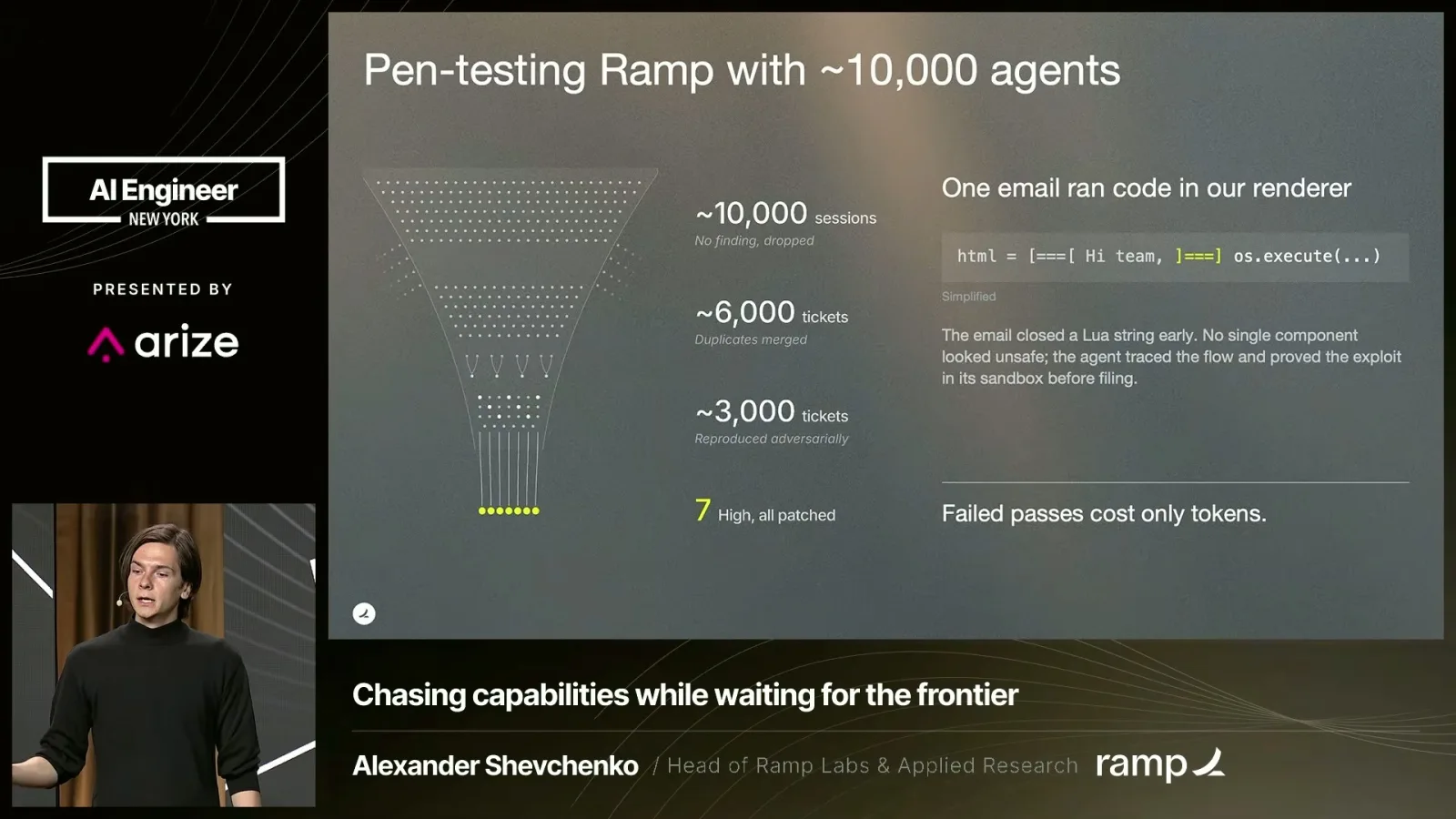
Our third example is agentic map-reduce. Ramp used a cloud-agent system called Ramp Inspect to run 10,000 parallel agents against its own environment, distributing penetration-testing work and collecting possible findings.
We used models to deduplicate the resulting tickets and attempt to reproduce the suspected issues adversarially. According to our results, the process found seven high-severity vulnerabilities, which we patched.
One example involved a Lua injection delivered by email. No individual component was unsafe on its own; finding the issue required connecting behavior across several components. The example illustrates the value of end-to-end investigation rather than a promise of complete coverage.
We also studied model choice for swarms. In the reported experiment, open-weight models could cost up to five times less than frontier reasoning models, while the swarm’s detection rate did not fall by the same factor.
Products and further research
Ramp applies its work to spend management and routing and describes other research directions.
Across these projects, the shared goal is reducing latency and token costs. Those themes also inform two Ramp offerings: tools for understanding a company’s model spending and a router that applies different strategies to cost and latency.
I also point to other Ramp Labs research, including work on transferring post-training learnings between models, agentic map-reduce for usage taxonomies and self-improving service monitoring. These are additional research directions rather than results established by this talk.
More from this channel
 20:45EN
 AI Engineer· Nov 5, 2026John Stecher and Scott Worland on Building AI Systems That Can ChangeScott Worland, John Stecher · Norm AIThe Blackstone and Norm AI CTOs discuss data strategy, evaluations, production controls and when to wait for a better model.
 15:32ENAI Engineer· Nov 5, 2026Emil Chetty on Letting Payment Agents Act Within Customer-Approved BoundariesEmil Chetty · WiseWise’s data and AI product lead describes an immutable job agreement that lets agents choose steps while trusted payment services enforce customer authorization.
 13:22ENAI Engineer· Nov 5, 2026How Brainbase Improved a Competitor-Pricing Agent from 41% to 97%Milind Sunil Shah · BrainbaseMilind Sunil Shah describes an iterative workflow for collecting and evaluating competitor prices with a back-office agent.
 15:12ENAI Engineer· Nov 4, 2026Dillon Rolnick on AI Vendor Lock-In and Open Agent FoundationsDillon Rolnick · Nous ResearchThe Nous Research CEO argues that businesses should retain control over their agent stack, presenting his company’s Hermes Agent as one option.
 18:50ENAI Engineer· Nov 4, 2026Pim de Witte on Training Visual Action Models with Video GamesPim de Witte · General IntuitionThe General Intuition founder describes using game recordings and controller actions to train systems intended for both computer use and robotics.
 19:12ENAI Engineer· Nov 4, 2026Why AI Agents Need Reliable Processes to Scale Across a CompanyMitchell Troyanovsky · BasisBasis co-founder Mitchell Troyanovsky explains behavior specifications, trajectory forks and simulations for production agents.