In 30 seconds
Basis co-founder Mitchell Troyanovsky argues that individual gains from AI tools do not automatically translate into organizational productivity. Companies need agents that are simple to use and reliable enough to fit shared processes. He describes behavior specifications as a way to align teams and inspect trajectories beyond outcome-based tests. Forking and cheaper simulations help investigate failures, although he cautions that these signals do not prove production generalization.
- 1Two gaps to closeUsers must manage agent complexity, while organizations need consistent processes across employees.
- 2Specify the behaviorIn reconciliation, the team may prefer explaining a discrepancy to posting an unsupported plug.
- 3Write a behavior specA concise specification aligns builders and serves as a rubric for reviewing trajectories.
- 4Fork the trajectoryBranch near a failed decision to investigate or test a change in context.
- 5Simulate cheaplyA sub-agent can approximate a production agent to explore a scenario faster, with lower fidelity than a full fork.
Takeaways
- Personal AI productivity gains do not automatically scale through an organization.
- Agent products must address both user competence and consistent organizational processes.
- Behavior specifications state the important actions a team expects before context is written.
- Trajectory review supplements outcome evaluations but does not prove generalization.
- Forking and simulations help diagnose behavior and test changes at different costs.
Read the edited text by chapter
Why individual productivity does not automatically scale
Troyanovsky compares agents to nondeterministic human coworkers and explains the role of organizational processes.
I am Mitch Troyanovsky, co-founder of Basis. We work on making agents reliable enough to complete production-scale work for accounting firms.
People at an AI conference may have dramatically increased their individual productivity with tools such as coding agents, yet the average company has not seen the same increase. Why does personal productivity not automatically scale across an organization?
Companies already coordinate nondeterministic systems: people. Leaders cannot observe every employee’s daily decisions, but they trust processes designed to produce consistently good outcomes, even when individuals are not deterministic.
Those processes exist at small scales too. For example, reconciling cash may require extracting bank data with approved software, rather than letting each employee pick an arbitrary tool found online.
Competency and process gaps
He argues agents should be simple for users and consistent with the organization’s chosen way of working.
Troyanovsky sees a competency gap in coding-agent-style products. Users must manage skills and memory, decide when to use the agent and develop a mental model of its behavior. He argues that many knowledge workers cannot be expected to manage all of that complexity.
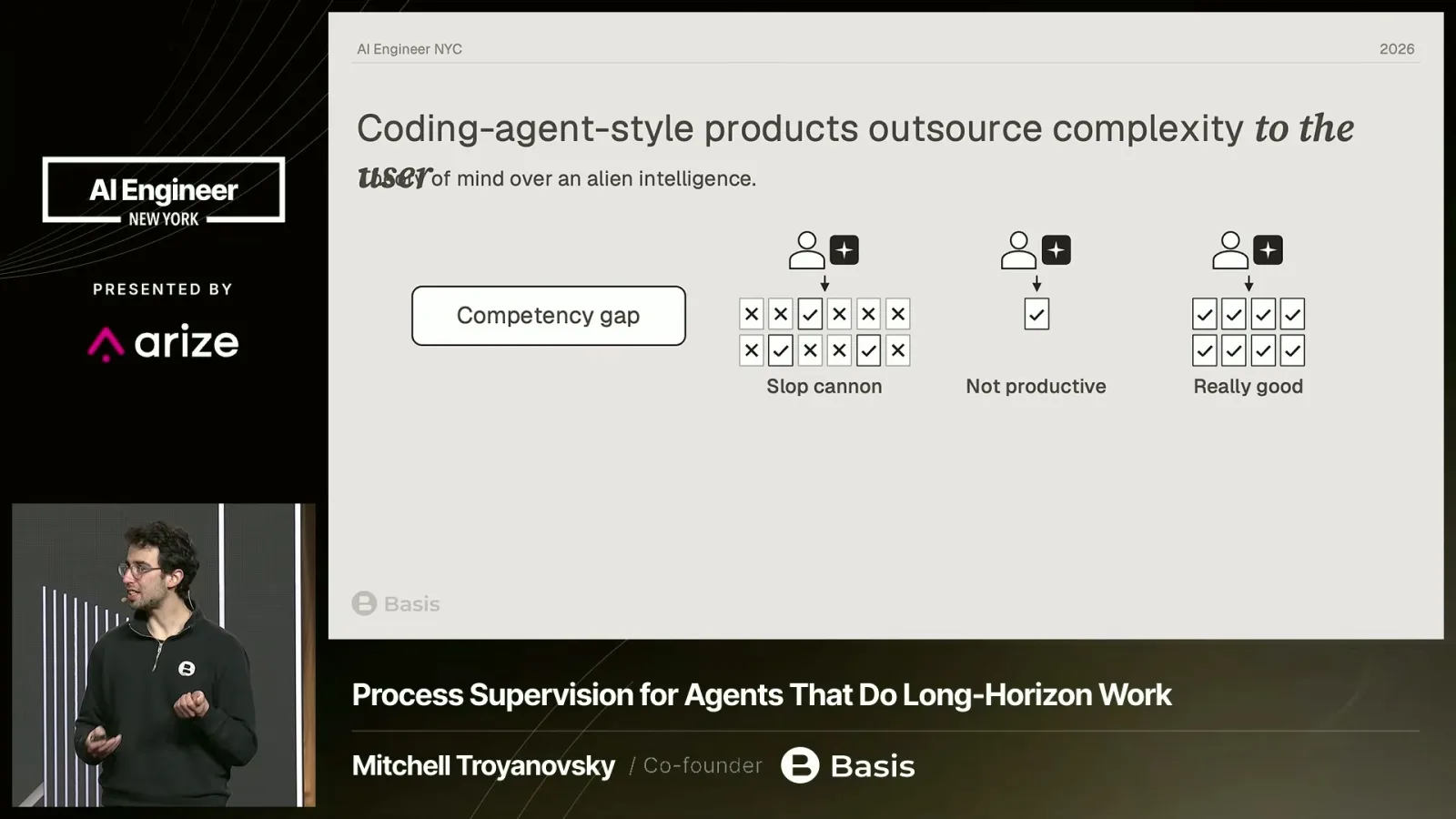
The second issue is a process gap. If every employee configures an agent independently, the work varies by user rather than following an organization’s shared methods. In his view, senior leadership should establish the process.
For production agents to do work end to end, they should be simple for users and reliable in their behavior. The goal is not perfection: people are imperfect too. It is consistency and trustworthiness, including being predictable about what the agent cannot do.
Explicit choices and outcome evaluations
He uses PDF extraction to illustrate behavioral choices and explains why finite outcome tests may not represent production.
A PDF can be read using a vision model, Python and OCR, a specialized provider, or combinations of those methods. Leaving the agent to choose freely may produce good individual outcomes but can make the process inconsistent. A production system needs an explicit position on how it should behave.
Some positions come from domain expertise. For example, he expects a tax agent to consult primary sources, and an agent creating a presentation to inspect an image for formatting errors. Such choices also have trade-offs: inspection adds latency and may not be worthwhile for every task.
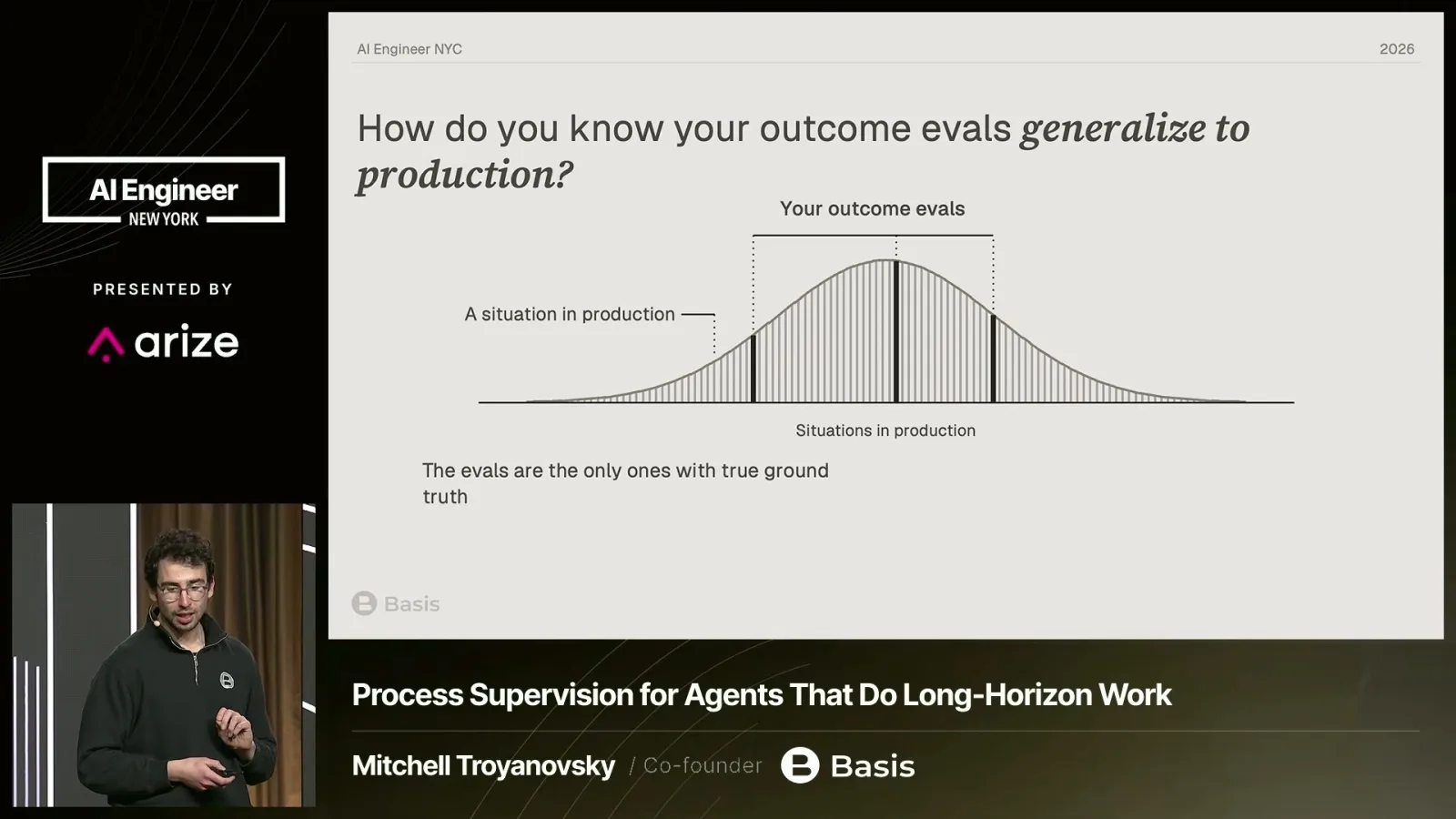
Outcome evaluations compare work against known answers or rubrics, but a finite test set cannot cover every production trajectory. As agents perform longer tasks and make more decisions, it becomes harder to know whether the test distribution represents real use.
Troyanovsky suggests inspecting trajectories for desired behaviors even when no ground-truth outcome exists. That does not prove generalization, he cautions, but it provides additional evidence about whether a chosen process is being followed.
Behavior specifications
A reconciliation example illustrates how to specify and review a desired behavior across trajectories.
His accounting example is a bank reconciliation that does not balance. He prefers the agent to explain the difference rather than post a plug entry to force a match. Another organization might choose differently; the key is avoiding inconsistent behavior between customers.
Behavior comes from the system prompt, progressively disclosed context, tool descriptions and the model itself, not a single paragraph. He compares the context an agent sees at runtime to training data as a metaphor, and urges builders to care about how each piece influences behavior.
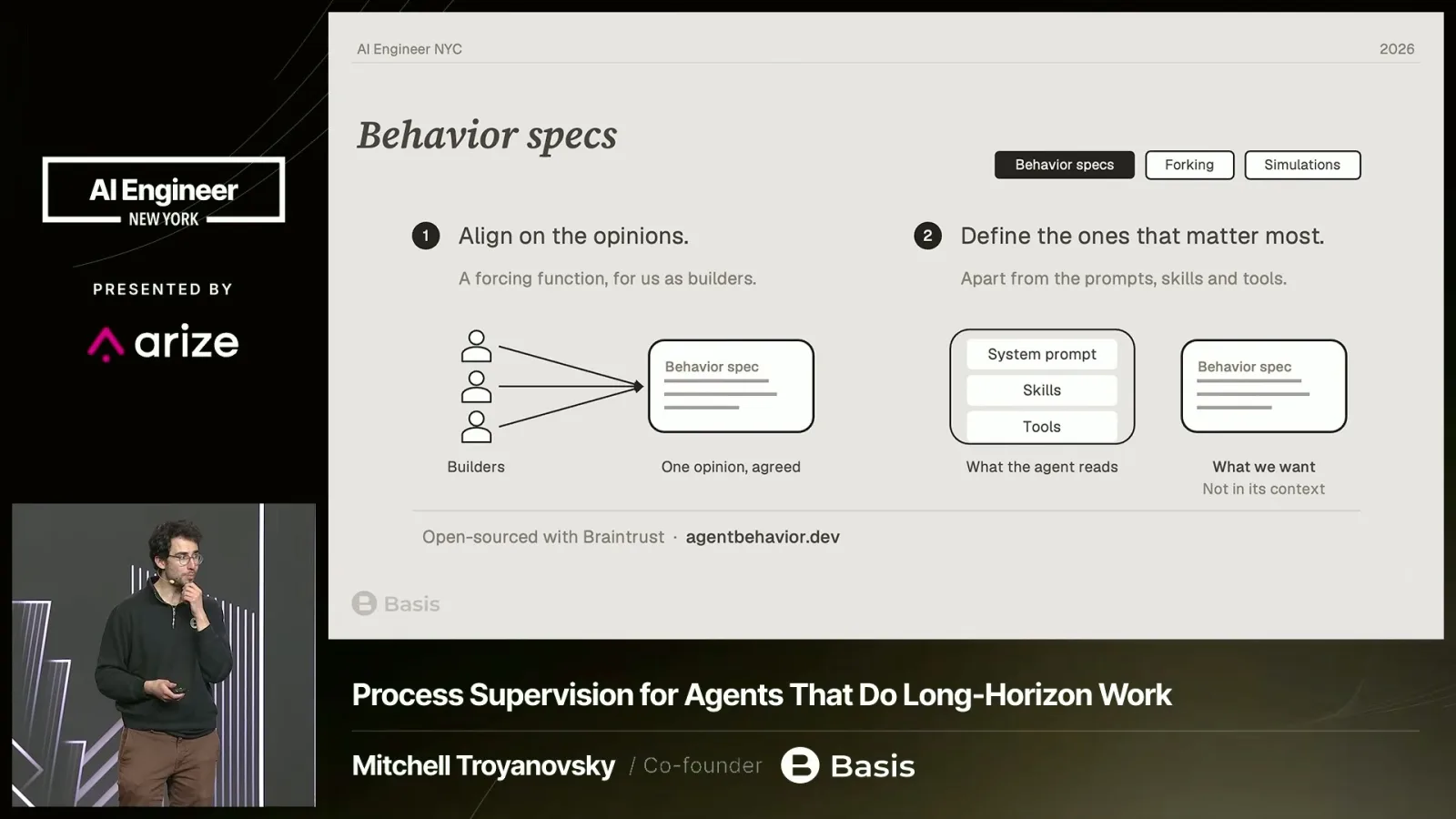
A behavior specification records the most important intended behaviors before the team writes or changes the context. It aligns builders and acts as a rubric: was a behavior relevant in this trajectory, and if so, did the agent exhibit it?
Behavior review can produce signals on trajectories that lack a known correct outcome. Outcome evaluations remain important, but he argues they are harder to scale at the rate of production activity.
Forks, simulations and trust
Teams can branch failed runs or simulate scenarios to investigate changes. Consistent performance can build trust over time.
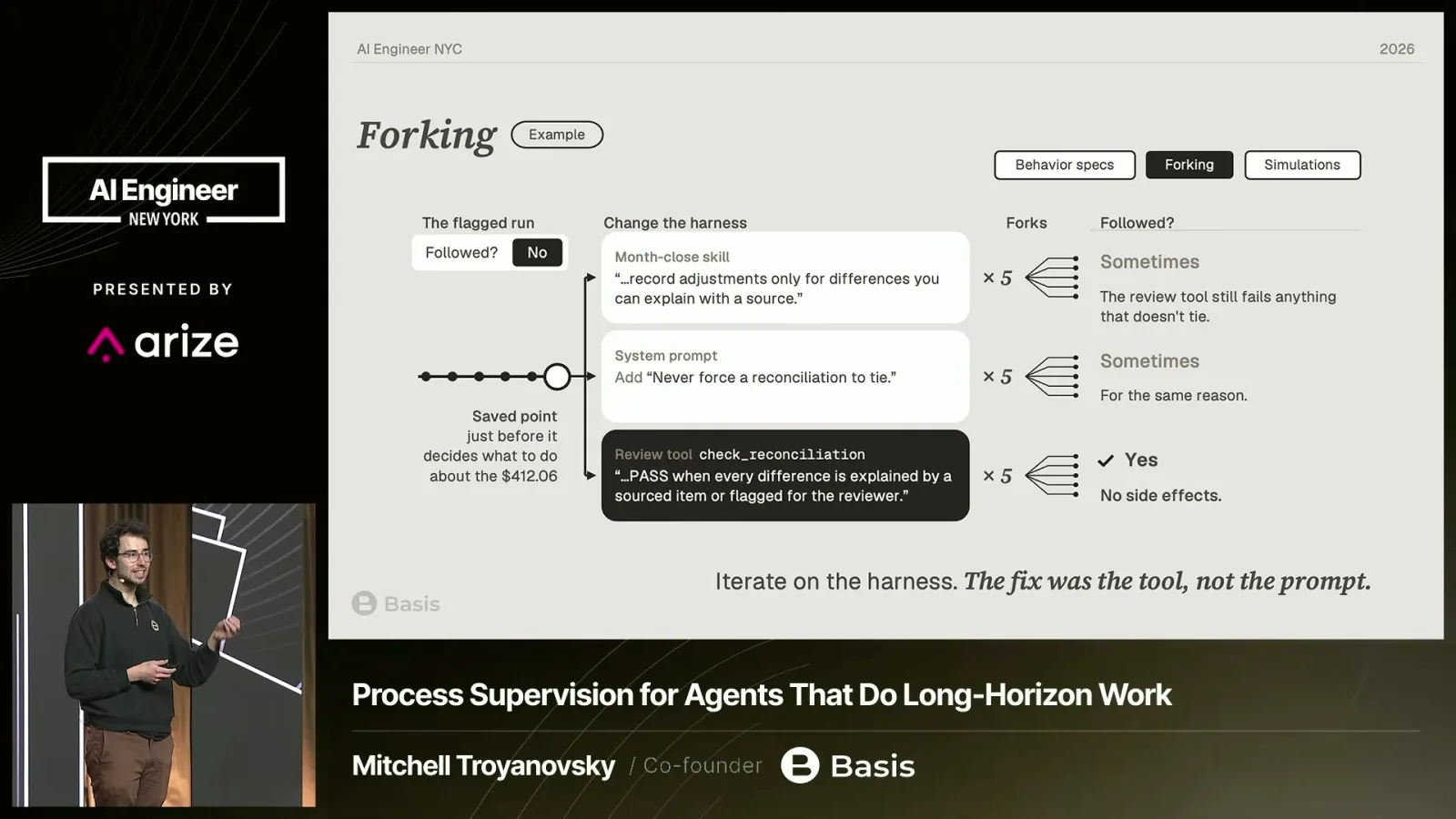
Forking is another diagnostic tool. A team can take a trajectory that failed a behavior evaluation, restore the state near the decision, and branch it to investigate the decision or test a change in context.
Recreating a complete cloud environment, including databases and prompts, is difficult. But a fork helps connect the signal from a failure to a possible change in the agent harness, instead of searching blindly through a long run.
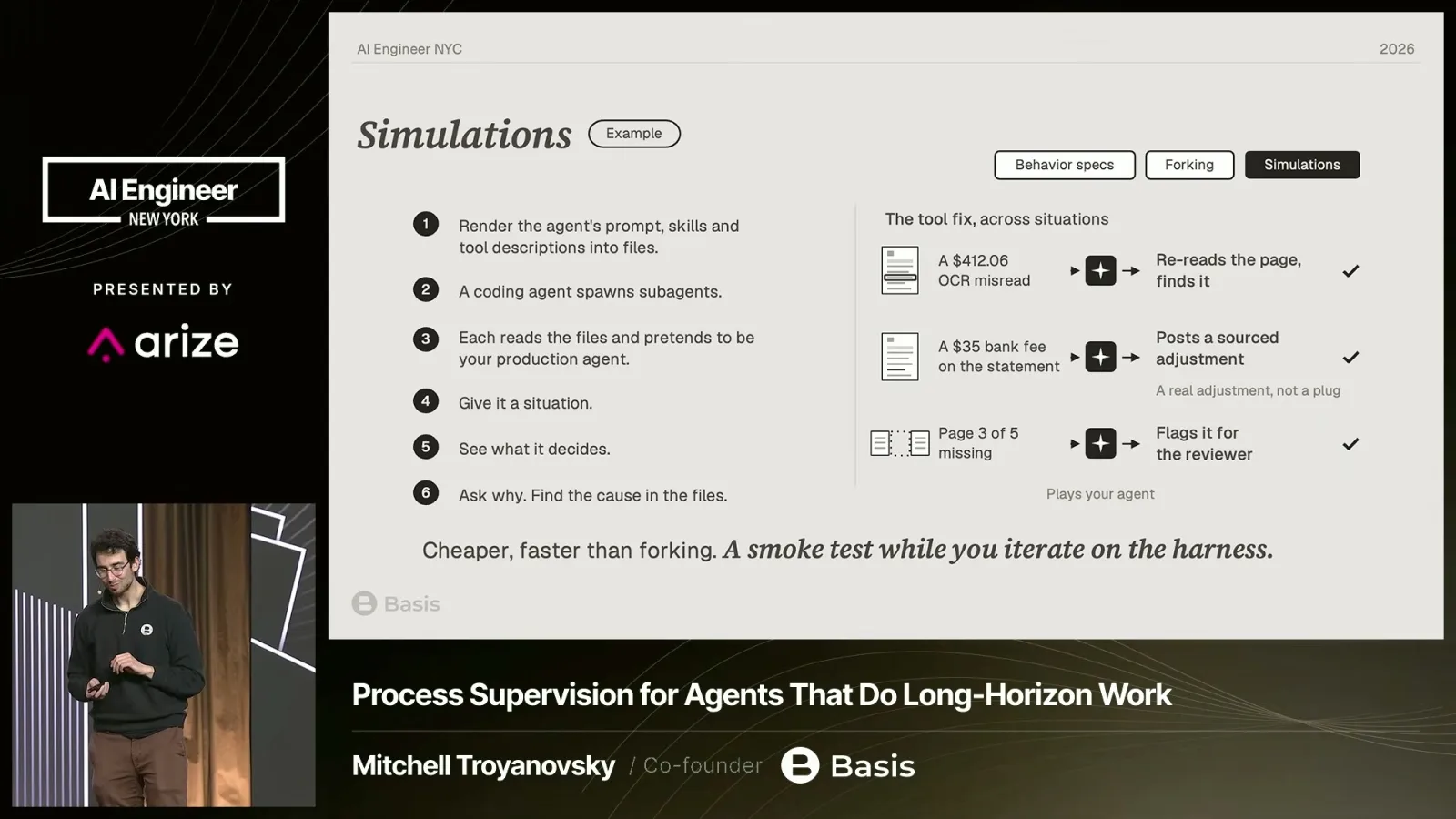
A cheaper, faster approximation is simulation. He asks a coding agent to create a sub-agent that pretends to be the production agent, providing the same rendered prompt and skills, and then presents a scenario to see what it would do.
The team can reproduce a situation and adjust context to see whether the simulated behavior changes. Troyanovsky says this is less faithful than a full fork, but useful for quickly iterating before paying the cost of recreating the environment.
Neither outcome tests nor behavior supervision proves that every production trajectory generalizes. His claim is that process supervision adds another signal, which can help a team identify problems and close the improvement loop.
As an agent starts with narrow work and consistently handles it well, people can develop trust in it like a colleague. The scrutiny applied to a pull request depends both on the risk of the change and on confidence in the person making it.
Someone may ask whether an unconstrained agent could discover a better way. Troyanovsky says it might, but argues that an accounting firm needs work done reliably at scale. His conclusion: simplicity encourages adoption, reliability earns trust, and explicit behavioral choices provide a basis for improving the system.
More from this channel
 18:01EN
 AI Engineer· Nov 4, 2026How NatWest Tests Customer-Facing AI Agents Before LaunchJonathan Osborne · NatWest GroupJonathan Osborne explains routing controls, human validation, unreliable LLM judges and shadow deployment in a regulated bank.
 19:48ENAI Engineer· Nov 4, 2026Why Datasite Bought Its Document Parser Instead of Building ItAdit Abraham, Raj Bakhru · ReductoRaj Bakhru and Reducto CEO Adit Abraham discuss the engineering trade-offs behind AI for transaction data rooms.
 19:19ENAI Engineer· Nov 4, 2026Approve the Application, Not the AI Model: Building Evaluation Gates for a BankDoneyli De Jesus · Langfuse by ClickHouseDoneyli De Jesus explains how a bank tested an AI agent on its own data, added a calculator and used domain experts to set production gates.
 16:51ENAI Engineer· Nov 3, 2026Cristóbal Valenzuela on Interactive Video Models and Runway’s ContinuumCristóbal Valenzuela · RunwayRunway’s co-founder traces next-frame prediction from early generated film to research prototypes for interactive visual interfaces.
 19:42ENAI Engineer· Nov 3, 2026What Drives AI Agent Costs: Cache Hits, Input Tokens and TurnsGeorge Cameron · Artificial AnalysisArtificial Analysis co-founder George Cameron breaks down an agent benchmark and a framework for choosing models by cost and capability.
 20:35ENAI Engineer· Nov 3, 2026Graph Engineering for Agents: Explicit Procedures, Memory and GovernanceZachary Blumenfeld · Neo4jNeo4j’s Zachary Blumenfeld describes three kinds of graphs and demonstrates a graph-shaped loan-review skill.