In 30 seconds
Zhang Xiaojun and Xie Qingchi share a route through AI research papers. Drawing on his learning experience, Xie introduces representative work from GPU computing, deep networks and Transformers through training infrastructure, language models and image generation. This is an introductory route and personal interpretation. Specific conclusions should be checked against original papers, experimental conditions and later research; AI-generated explanations can also be wrong.
- 1Learning with AICheck explanations against papers and reliable sources.
- 2Data, compute and modelsAlexNet illustrates several conditions changing together.
- 3Distributed trainingZeRO partitions training state to relieve single-device memory limits.
- 4The language-model pathThey discuss GPT through pretraining and next-token prediction.
- 5Multimodal developmentThey review the path from visual recognition to diffusion and image-text models.
Takeaways
- Understand the problem a paper addresses before gradually learning its equations and methods.
- Models, data, hardware and training systems jointly shape progress.
- Compare architectures and training methods on specific tasks.
- Open data and tools broaden participation while raising quality and rights questions.
- Technical history can improve questions but cannot guarantee future progress.
Read the edited text by chapter
Why read papers
He shares motivations, tools and foundational knowledge.
Zhang Xiaojun invites Xie Qingchi, a product lead at Meituan’s Light Year, to share his journey through AI papers and a learning route for understanding technical developments.
Xie studied computer science as an undergraduate and graduate student before working in product and startups. He reads papers to understand how technical boundaries shape product choices.
He recalls revisiting foundations such as linear algebra and probability and using translation tools to lower the English-reading barrier. This is his experience, not a prescription for everyone.
He suggests using AI to explain terminology and equations, while checking generated explanations against the original papers and other reliable sources because they can be wrong.
At greater depth, mathematics helps with equations and notation. When a paper is difficult, readers can start with the problem it addresses and gradually learn the details.
Changes in model paradigms
From GPUs and deep networks to Transformers and agent methods.
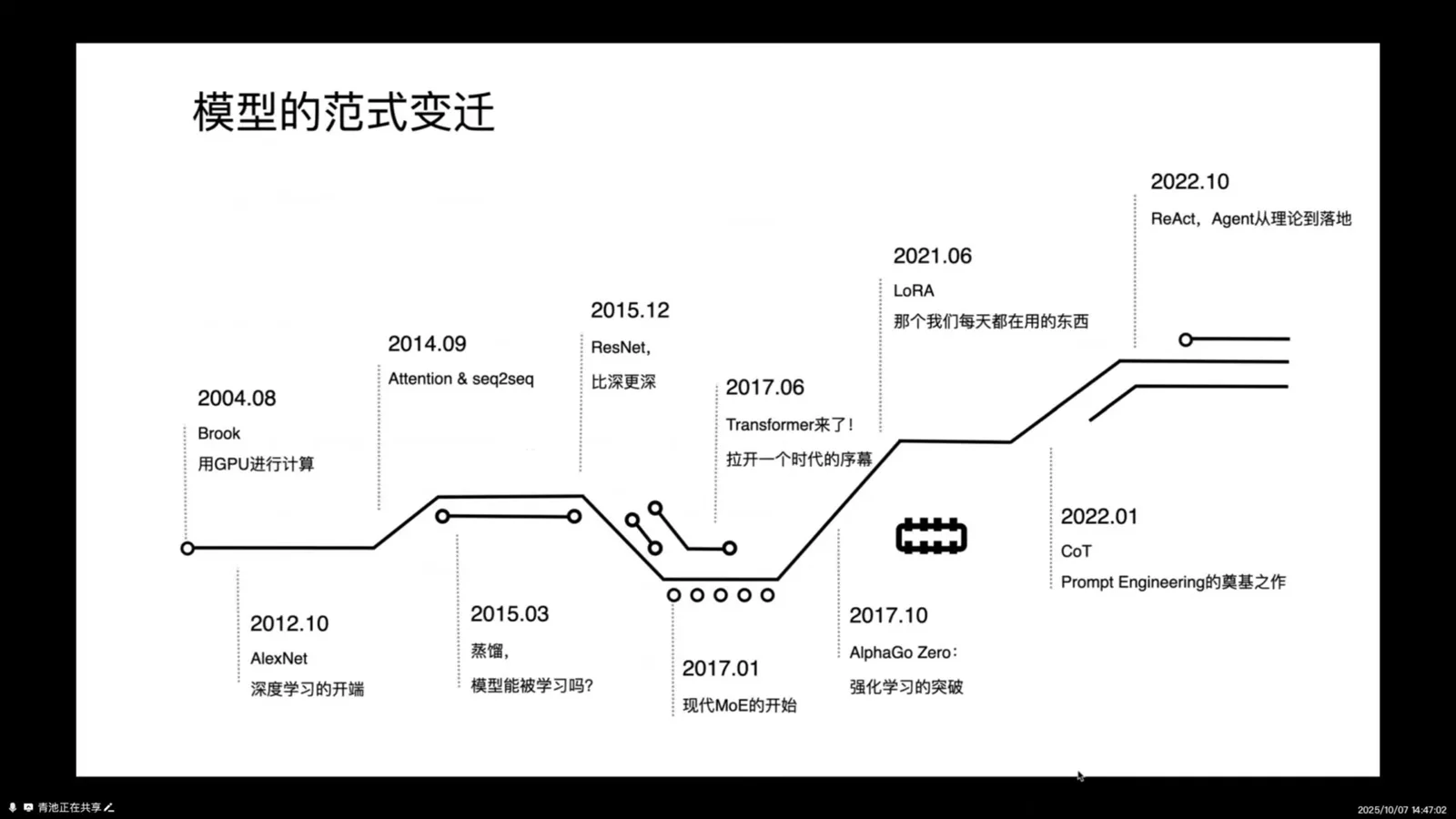
The first section traces changes in model paradigms, connecting GPU computing, vision, sequence modeling, Transformers and later methods on a timeline.
He describes how early work such as Brook made GPU computation more accessible and reduced barriers to programming graphics hardware directly.
On AlexNet, he identifies growth in data, compute and model scale as important conditions, illustrating the influence of hardware and datasets on research.
Sequence-to-sequence models encode inputs and then generate outputs. Earlier methods could be limited by fixed-length representations; attention provides a way to access different parts of the input.
He introduces knowledge distillation: a student model can learn a teacher’s output distribution rather than only final labels. Results depend on training data and task.
Residual connections in ResNet provide a way to train deeper networks and alleviate optimization degradation; they do not guarantee that arbitrary models improve with depth.
On Transformers, he emphasizes that architecture and engineering evolve together and that designs require experiments; researchers may not fully explain every choice.
He introduces AlphaGo Zero’s self-play and reinforcement-learning approach, showing how a system can improve through computation in a specific rule-governed setting.
He next introduces mixture-of-experts models, which can activate parts of a model for different inputs and trade off total parameter scale against per-step computation.
On chain-of-thought prompting, he considers how examples or requests for intermediate steps can change outputs; that does not guarantee every generated step is correct.
LoRA adapts a model by training smaller low-rank updates, reducing the number of parameters updated. Performance still depends on model, task and training setup.
He describes ReAct’s approach of interleaving reasoning and action. Tool use can give models external information, but reliability and permissions remain system concerns.
The Bitter Lesson emphasizes the long-term role of scalable general methods and compute. Xie says hand-designed features can be useful at one point and displaced as computing conditions change.
Infrastructure and data
They discuss distributed training, scaling laws and datasets.
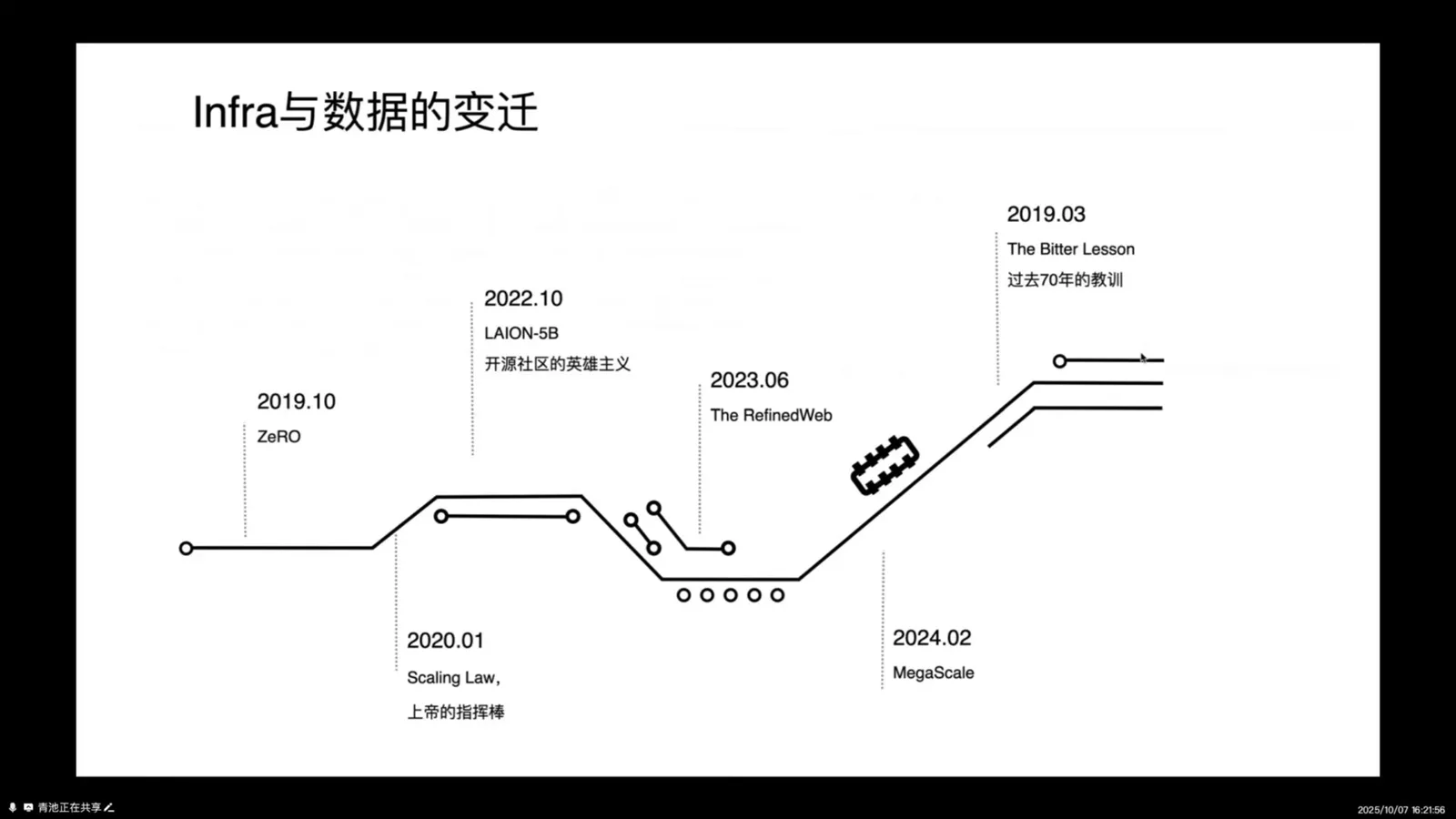
The second section turns to infrastructure and data: larger models raise issues of memory, parallelism, data processing and cluster reliability as well as algorithms.
Using ZeRO, he explains distributed training: when a single GPU cannot hold all training state, parts can be partitioned across devices.
He discusses scaling laws and Chinchilla: under a limited compute budget, model size and training data must be considered together. Results from different experiments should not be applied mechanically.
Open-data work such as LAION shows how datasets and community resources can broaden research participation; provenance, quality and rights still need careful treatment.
He discusses web-data cleaning and RefinedWeb, explaining that large-scale data requires filtering, deduplication and quality control as well as volume.
Large GPU clusters must also manage communication efficiency and failures: adding devices does not necessarily increase speed linearly, and faulty hardware or data can disrupt training.
Language models
From word vectors and translation to GPT and post-training.
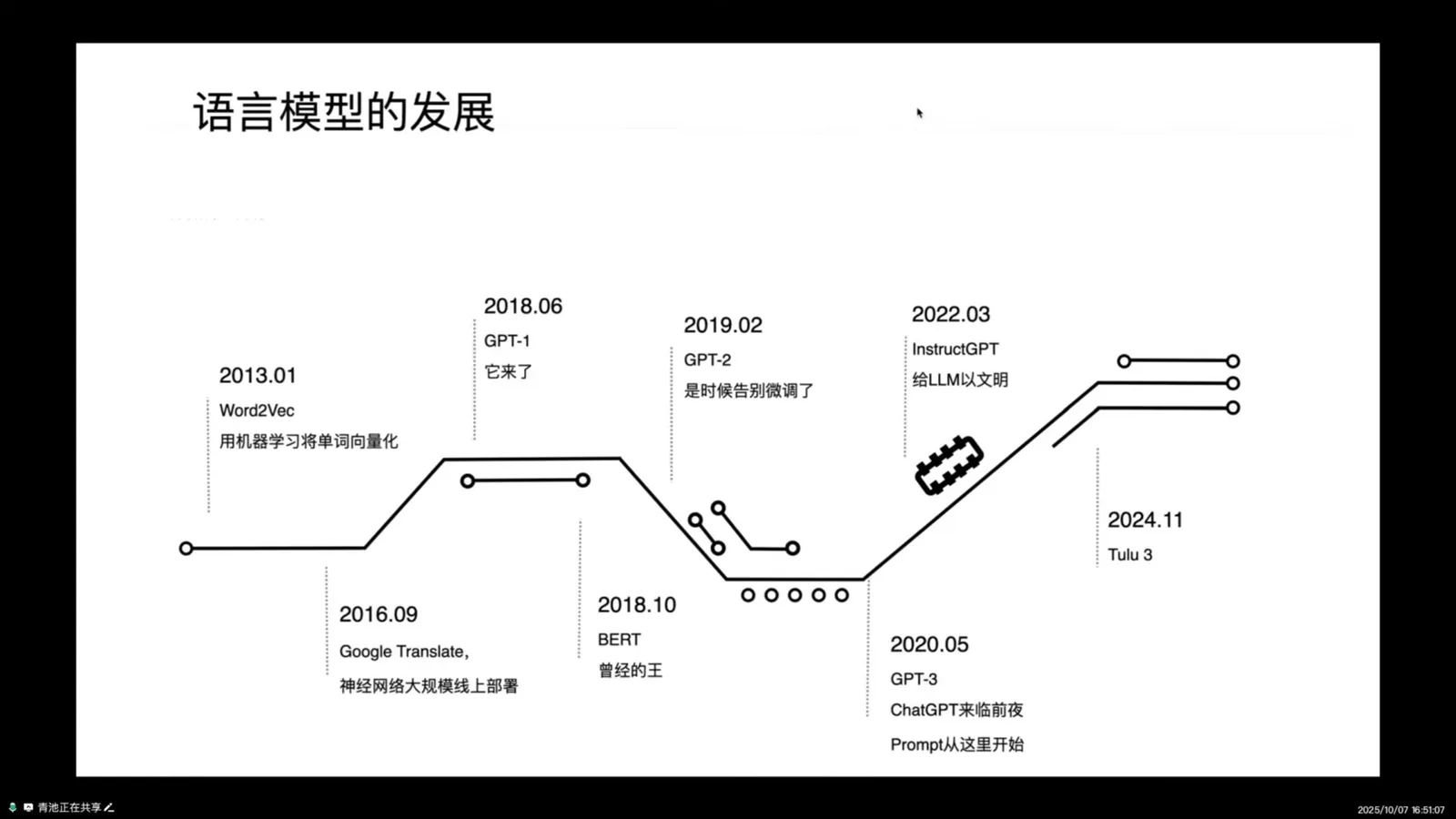
The third section follows language models from word vectors and neural machine translation to GPT, BERT and post-training.
Word2Vec studies how to represent words as vectors useful for downstream tasks. Vector relationships are learned representations, not complete explanations of meaning.
Large-scale neural machine translation illustrates the engineering challenge of combining sequence models, attention and parallel computing into an online service.
He introduces GPT-1’s decoder architecture and next-token prediction, discussing pretraining followed by adaptation to tasks.
BERT used a different pretraining approach and advanced language-understanding tasks. Xie places it among several parallel research directions of the time.
He recalls GPT-2’s exploration of larger, more varied data and researchers’ interest in performing tasks without separate fine-tuning for each one.
GPT-3 scaled further and spurred research on few-shot prompting and changes in capabilities; relationships between scale and performance must be tested by task.
InstructGPT and later work used methods including human feedback in post-training to better follow instructions; alignment does not mean a model cannot make mistakes.
He mentions open post-training research such as Tulu 3, emphasizing that public recipes and data aid the community while results still depend on the setup.
Multimodal models
They discuss video, GANs, diffusion, ViT and CLIP.
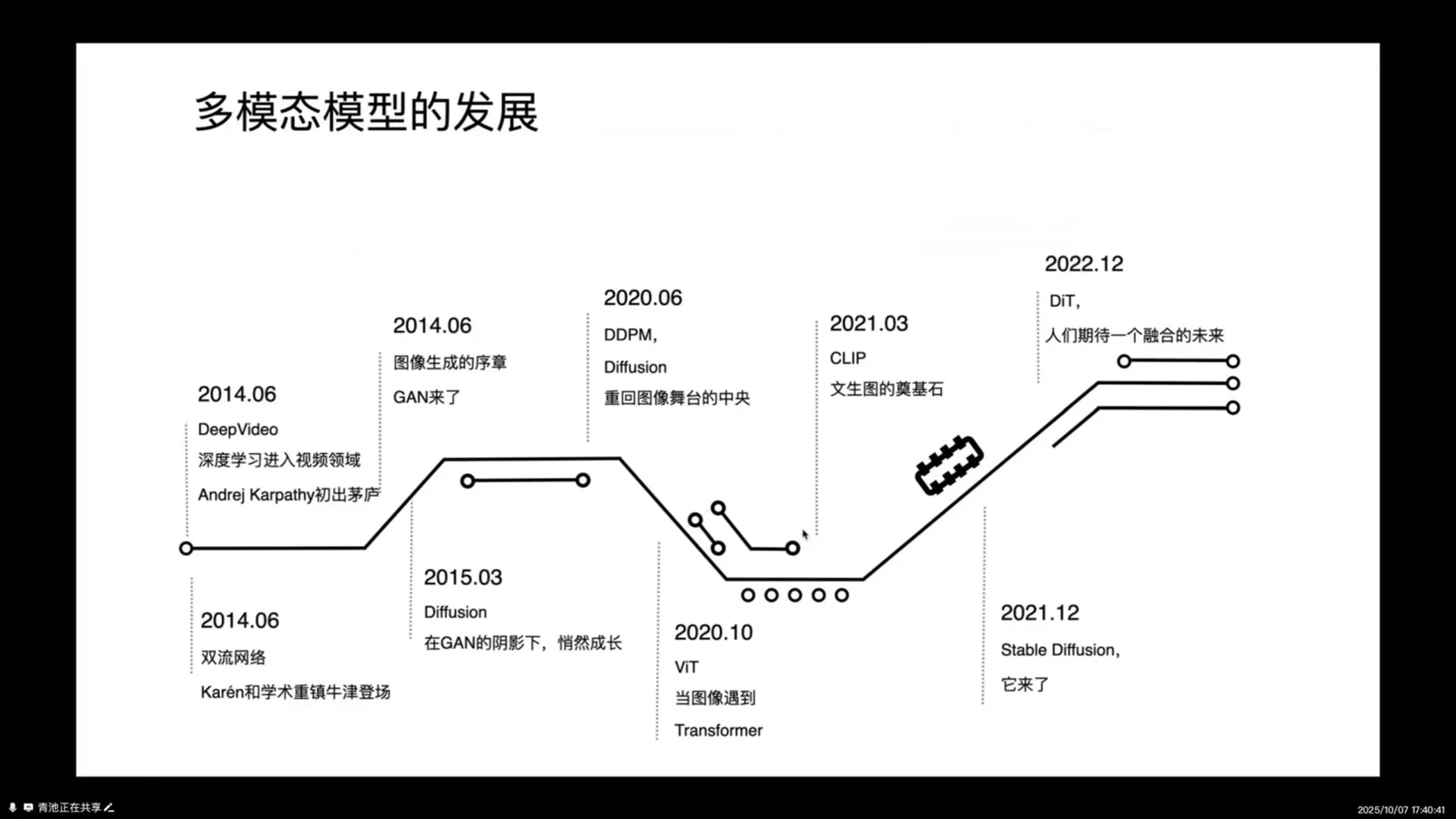
The fourth section traces multimodal research from video recognition and generative adversarial networks to diffusion, vision Transformers, CLIP and text-to-image generation.
Early deep-video research explored neural networks for video and required task-appropriate datasets and computing resources.
He introduces the generator and discriminator in generative adversarial networks and the instability that can arise when training them together.
Diffusion models build on adding noise gradually and learning a reverse generation process. They later became widely used for images, with quality and efficiency varying by implementation.
Vision Transformers divide images into patches and turn them into sequence representations for a Transformer, allowing vision tasks to draw on related architectures and training experience.
CLIP learns related representations from image-text pairs, providing a way to connect language and images and influencing later generation systems.
He explains how text-conditioned diffusion uses language to influence generation and how latent-space methods reduce the cost of operating directly in pixel space.
DiT explores using a Transformer as the core network of a diffusion model, connecting vision-Transformer and generative-model research.
Reflection and the future
They discuss reading experience, research and teams.
After the paper survey, he recalls rereading and checking the material and says returning to original questions helps reveal relationships among papers.
He is optimistic about room for further technical progress while acknowledging that specific advances and timing are uncertain. History can improve questions, not eliminate uncertainty.
On team size, he says tools may reduce some collaboration and development costs, but staffing still depends on the business, organization and scope of service.
More from this channel
 1:59:52EN
 Zhang Xiaojun Podcast· Oct 21, 2026Podcast · 2 speakersDavid Qian on Succession, Robotics, and Finding His Own AmbitionGuest David Qian (Qian Cheng) · Host 张小珺Ecovacs CEO David Qian reflects on inheriting a founder-built company, learning to lead through mistakes, and choosing a patient path in robotics. His account treats succession as an ongoing effort to build the company for a new era, not a finish line.
 2:51:18ENZhang Xiaojun Podcast· Oct 15, 2026Podcast · 2 speakersLindon Gao on Building Dyna Robotics and Finding a Path Through the FogGuest Lindon Gao · Host 张小珺Dyna Robotics CEO Lindon Gao explains why his company builds intelligence through real workflows, how hardware and research must evolve together, and how a founder can find clarity by letting go of the need to be right.
 2:51:18ZH → EnglishZhang Xiaojun Podcast· Oct 15, 2026Podcast · 2 speakersDyna Robotics Founder Lindon Gao on Moving From Robot Tasks to WorkflowsGuest Lindon Gao · Host 张小珺From cashierless retail to robotics, Gao discusses product research, deployment challenges and finding a direction in uncertainty.
 2:34:18ENZhang Xiaojun Podcast· Sep 3, 2026Podcast · 2 speakersZeng Ming on AI’s New Era: Why Great Companies and New Organizations EmergeGuest Zeng Ming · Host 张小珺Zeng Ming argues that AI is changing the foundations of business: models will become infrastructure, while new Agent-native applications and organizations create the next wave of value. His advice to founders is to embrace uncertainty, rethink strategy continuously, and build around meaningful work rather than inherited structures.
 2:34:18ZH → EnglishZhang Xiaojun Podcast· Sep 3, 2026Podcast · 2 speakersMing Zeng on AI’s Three Stages of Industrialization and the Decline of the Corporate FormGuest 曾鸣 · Host 张小珺Strategist Ming Zeng draws on the histories of the internet, the Industrial Revolution and electrification to argue that AI is moving from infrastructure to agent applications and eventually to native applications. He believes the old corporate hierarchy will struggle to survive a paradigm shift; next-generation organizations will be rebuilt around tasks, creativity and human–AI collaboration.
 1:09:50ZH → EnglishZhang Xiaojun Podcast· Aug 19, 2026Podcast · 2 speakersJonathan Su on AI Research, Education and Happiness as a High-School StudentGuest 苏庭灏 · Host 张小珺From learning Transformers and publishing a paper to thinking about motivation, uncertainty and human connection.