In 30 seconds
The presenter explains retrieval and ranking, inverted indexes, and vector search before examining how NCI generates document IDs from queries. He compares DSI, explains query generation and decoder changes, and discusses the paper’s data-leakage correction, experimental scope, throughput, and incremental updates.
- 1Retrieve, then rankRetrieval must efficiently find candidates in a large corpus; ranking cannot recover relevant documents that were missed.
- 2Generate document IDsNCI stores corpus knowledge in the model and generates relevant hierarchical IDs from queries.
- 3Generate training queriesThe paper uses DocT5Query and document spans to create multiple queries that help the model learn the corpus.
- 4System throughputThe presenter identifies a gap between the GPU throughput in the experiments and large-scale search deployment.
- 5Correcting data leakageThe authors found inconsistent data splits between stages and corrected their results; the presenter stresses transparent correction.
Takeaways
- Retrieval recall determines which candidates the ranking stage can see.
- NCI maps queries directly to hierarchical document IDs and learns corpus content using generated queries.
- Hierarchical clustering, decoder modifications, and consistency training have distinct roles.
- The paper corrected results affected by inconsistent data splits and leakage, so numerical claims require checking the version.
- Performance on QA datasets does not imply success in every retrieval setting.
- Throughput, corpus size, and maintenance as documents are added are major deployment constraints.
Read the edited text by chapter
Background and corrected results
The presenter introduces NCI, the data leakage, and why retrieval merits study.
The presenter introduces Neural Corpus Indexer (NCI) to explain document retrieval and neural approaches. He opens with a caution: the authors later found data leakage caused by inconsistent train–test splits and corrected previously inflated results.
Unusually strong results deserve repeated checks, the presenter says, and data leakage can affect both new and experienced researchers. He chose the paper because retrieval is worth studying, not simply because of the controversy.
Document retrieval finds relevant items in a large corpus for a query. NCI feeds the query into a sequence-to-sequence model to generate relevant document IDs directly, with additional methods for IDs, query generation, and training.
The paper aims to combine indexing and retrieval in an end-to-end model and improve recall on selected datasets. The presenter cautions that experimental conditions, later corrections, and system costs matter as much as headline gains.
Retrieval, ranking, and indexes
The discussion compares inverted indexes, two-tower vector retrieval, and end-to-end approaches.
A common search pipeline separates retrieval from ranking: retrieve candidates from a large corpus, then score them with a more precise but expensive model. Ranking cannot recover relevant documents missed by retrieval, so recall matters.
Retrieval must also be fast. Selecting hundreds or thousands of candidates from a web-scale corpus has substantial cost, which the presenter treats as an essential constraint when evaluating new methods.
A term-based inverted index records which documents contain each term. Using the search index of Dive into Deep Learning, the presenter shows how a term maps to document IDs that are returned with titles and summaries.
Inverted indexes are efficient, but simple term matching can miss semantically relevant documents that lack the query word. A search for Transformer may miss a relevant page that only mentions BERT.
A two-tower model encodes queries and documents separately into a shared vector space. Training pulls relevant pairs closer and pushes unrelated pairs apart; contrastive learning is a common choice.
Document vectors can be computed in advance, and retrieval searches for neighbors of a query vector. Because scanning all vectors is costly, systems often trade some accuracy for efficiency with approximate nearest-neighbor search.
Dense semantic retrieval has limits: an older product model may be semantically close but wrong for an exact-model query, and a simple vector similarity may not capture every complex question–document relationship.
The paper discusses earlier end-to-end approaches including DSI and SEAL. The presenter stresses that a comparison with DSI should separate shared ideas from genuinely added components.
The presenter is cautious about claims that the retrieval framework can be fundamentally changed: the approach is early and latency, throughput, and scaling are unresolved. Experimental gains do not establish that it can replace traditional search.
NCI document IDs and queries
Hierarchical clustering, ID generation, and constructing queries from documents.
At inference, NCI takes a query and outputs document IDs without feeding in every document. Training must therefore encode corpus information in the model and teach it the mapping from queries to IDs.
Available data includes real query–document-ID pairs and full documents with IDs. The paper transforms documents into multiple query-like training inputs, teaching the model the relationship between document content and its ID.
The presenter separates the design into three questions: how to create semantically structured document IDs, generate query-like inputs from documents, and design the encoder, decoder, and loss.
Document IDs use hierarchical K-means. Documents are clustered and assigned prefixes; oversized clusters are subdivided until leaves are small enough, after which documents receive identifiers within a leaf.
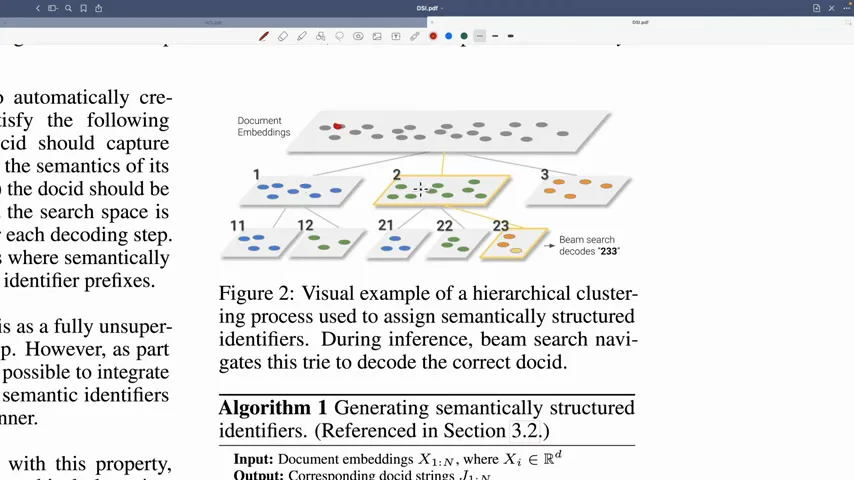
Documents in a semantic cluster share a prefix, so similar prefixes can indicate nearby documents. The presenter compares this to hierarchical classification: select a broad class, then subcategories and the specific document.
The sequence-to-sequence model generates the ID one element at a time: first a broad cluster, then the next level conditioned on the prefix, until the ID is complete. The presenter also interprets this as hierarchical classification.
One query-generation method is DocT5Query: a pretrained encoder–decoder maps documents to plausible queries and samples several per document, teaching the model that different expressions can refer to the same item.
The paper samples randomly rather than retaining only high-probability beam-search outputs, seeking query diversity. A simpler alternative takes spans from the document beginning and random positions as additional training queries.
Decoder and training
Sequence structure, output projection, consistency regularization, and constrained search.
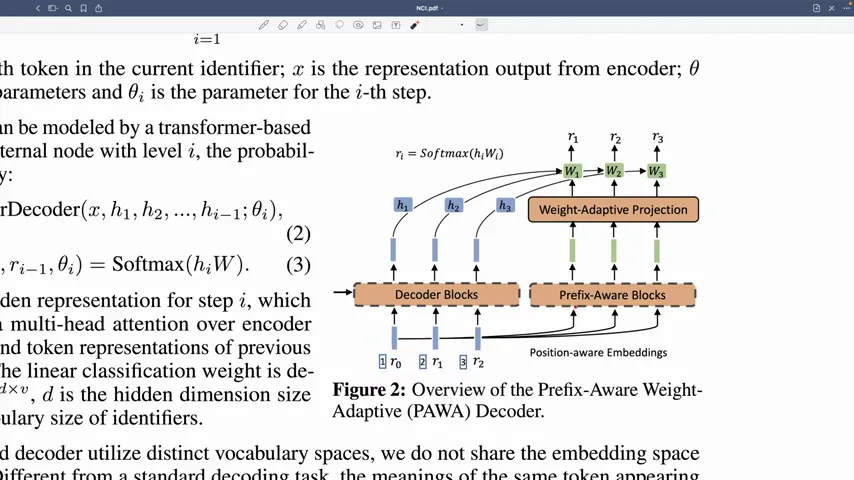
NCI modifies the decoder to emphasize ID sequence structure. Positions correspond to different depths of the hierarchy and cannot be swapped arbitrarily; beyond standard position representations, generation incorporates position and preceding predictions.
The output projection depends on the current ID position and, through an additional decoder, the previously generated prefix. The presenter describes this as further modeling of hierarchical position and history.
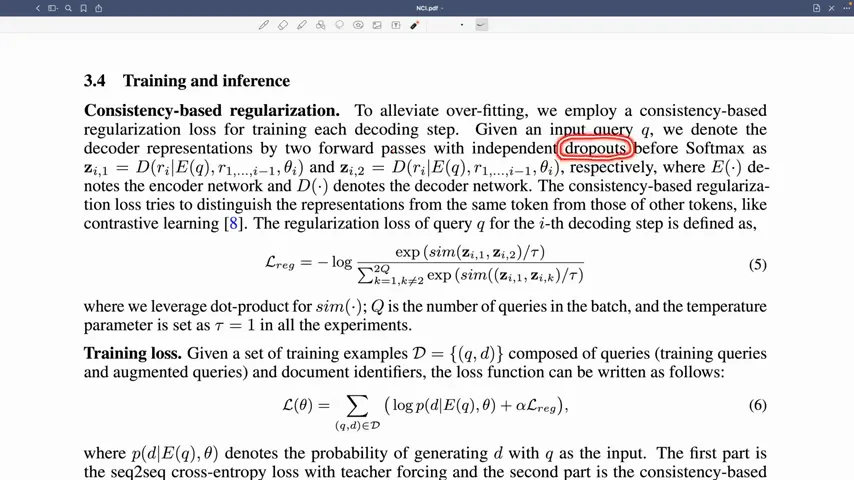
A consistency regularizer encourages two representations of the same query under dropout perturbations to be similar and distinct from other queries in the batch. Training combines sequence cross-entropy with this contrastive regularizer.
Inference uses constrained beam search so each generated prefix can lead to a valid document ID, avoiding invalid identifiers. The overall method combines hierarchical IDs, generated queries, decoder changes, and consistency training.
Comparison with DSI
The presenter separates the shared framework from components added by NCI.
The presenter then compares DSI, which appeared publicly earlier and also used a T5-style sequence-to-sequence model to map queries to document IDs, including hierarchical clustering for IDs. He argues that shared ideas should be clearly credited.
In his account, NCI adds query generation, decoder changes, and consistency loss relative to DSI. The details should be checked against the respective papers and versions; their shared framework should not simply be attributed to one paper alone.
Experiments and deployment limits
QA datasets, ablations, throughput, scale, and dynamic updates.
Experiments use two Wikipedia-based question-answering retrieval datasets. Queries are natural-language questions and the system returns documents that may contain answers; the presenter cautions that such complex QA does not represent every retrieval setting.
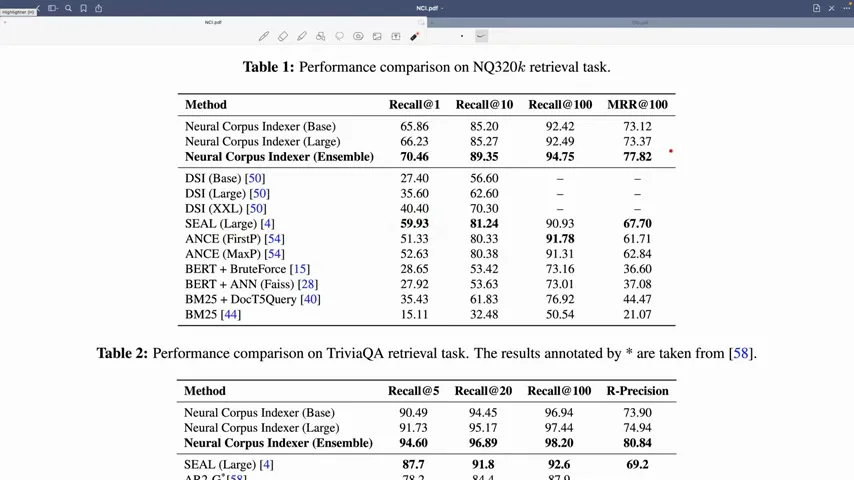
Metrics include Recall@N, which asks whether the relevant document appears among N results, and MRR, which accounts for its rank. Comparisons must also identify the dataset and paper version because the authors corrected leakage.
The presenter describes implementation details including BERT representations for clustering, cluster branching and thresholds, and multiple generated queries per document. The paper provides code to help inspect and reproduce the implementation.
The paper’s tables show NCI outperforming compared methods on selected metrics, but the presenter repeatedly stresses version differences. Inflated early scores must not be conflated with corrected results or generalized to all search tasks.
Ablations remove components one by one and measure recall changes. The presenter says generated queries contribute substantially by expressing document content in multiple query forms that a single real query may not cover.
The decoder change also helps. In this experiment, semantic hierarchical IDs improve less over random IDs than the presenter expected, suggesting the model can memorize some arbitrary identifiers too.
The presenter says the ablations show relatively small effects for consistency regularization and valid-ID constraints in the reported setting. Their importance would need reassessment for different models, data, and corpus scales.
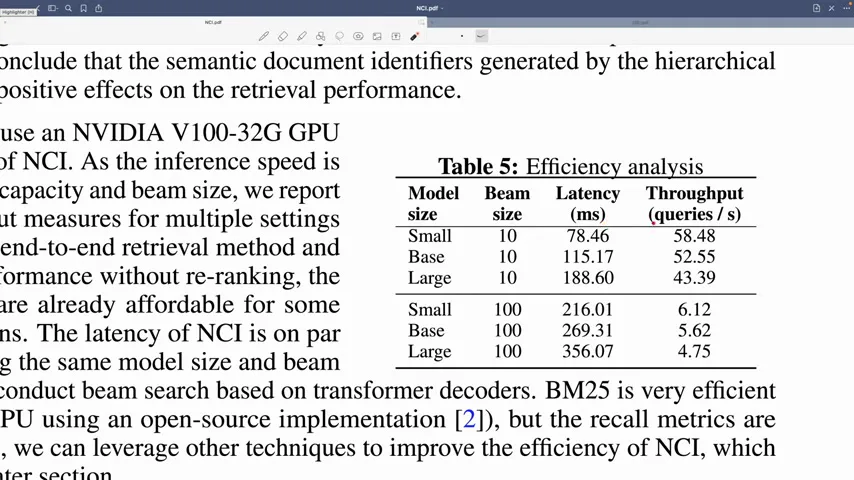
The performance table reports GPU inference latency and throughput. The presenter cites roughly 115 ms for the base model with beam size 10 and notes that ranking, networking, and rendering also need time in a search pipeline.
He is more concerned about throughput: in the paper’s example, one V100 handles only tens of queries per second. A large search service could require substantial expensive hardware, leaving a gap to production scale.
Corpus scaling is another challenge: the experimental corpus is much smaller than a large web index, and storing more content in the model may require greater capacity and training. The presenter notes that the paper itself lists this limitation.
New documents can change hierarchical clusters and IDs; if existing labels change, retraining may be needed. Incremental maintenance matters for continuously updated corpora, not just recall on a static test set.
Leakage correction and research writing
The presenter reviews the correction, an unresolved baseline difference, and how the paper describes its contributions.
The presenter explains the later-discovered leakage: inconsistent splits between query generation and subsequent training and testing allowed test information into training. Results fell after correction, and he commends the authors for publicly acknowledging and updating the error.
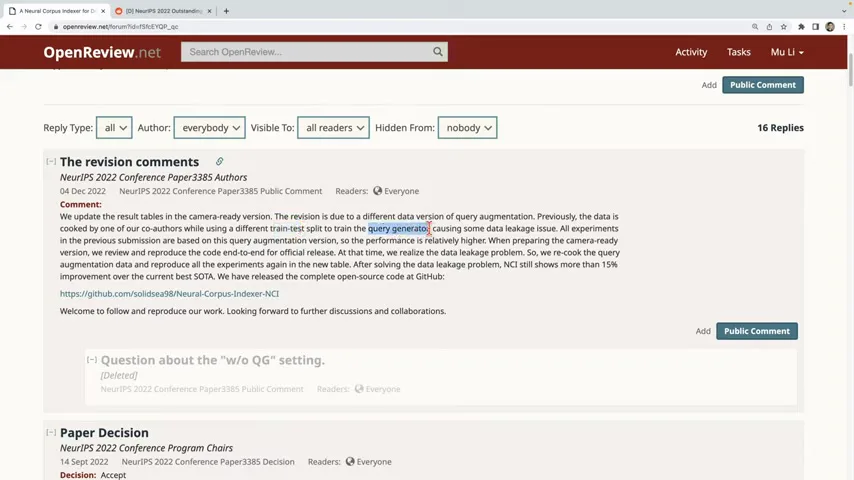
He also questions why an ablated NCI remains far ahead of a similar DSI baseline. The authors suggested a possible explanation and further experiments; the presenter makes clear that no final answer was available at the time.
Returning to the paper’s claims, the presenter argues that gains on two QA datasets do not prove broad replacement of term or vector retrieval. He accepts that the model may capture more complex query–document relationships but asks for broader evidence.
The presenter questions whether putting neural retrieval and ranking in one technology stack necessarily simplifies the system: major throughput and cost penalties in retrieval could offset deployment or maintenance benefits.
He also scrutinizes claims such as “first” and “significantly outperforms,” noting that DSI already proposed a similar end-to-end framework and semantic IDs. Research writing should distinguish incremental changes, experimental gains, and prior contributions accurately.
Despite these criticisms, the presenter considers neural indexing worth studying: learning corpus information in a model may help with smaller corpora and complex semantic queries. Viable scale and real system performance need further validation.
Complex query understanding and question answering are promising, he says, while traditional search remains strong for simple term queries. The methods can complement each other, and his contemporary comparison of ChatGPT with search engines is not a settled prediction.
The presenter closes by emphasizing accurate writing, reproducibility, and acknowledgment of prior contributions. Reliable experiments, transparent corrections, and precise claims matter especially when work receives broad attention.
More from this channel
 23:39ZH → English
 跟李沐学AI· Jul 23, 2025Li Mu: Adding Ten Million Hours of Speech to a Text LLM, Open-Sourcing Higgs Audio李沐 · Boson AILi Mu explains how the team added a huge amount of speech data to text LLM training, built an AudioLLM that can listen and speak, and open-sourced Higgs Audio. He covers architecture trade-offs, token compression, where the data came from, and how to run it on a 3090.
 1:03:29ZH → English跟李沐学AI· Jan 12, 2023A Multimodal Paper Review: BLIP, CoCa, and BEiT-3From cleaning image–text data to unified pretraining, a guide to the architectures, objectives, and connections behind three vision–language models.
 1:07:10ZH → English跟李沐学AI· Dec 29, 2022InstructGPT: From Human Feedback to Language Model AlignmentA guide to InstructGPT’s training process, results, and limitations, from supervised fine-tuning and reward modeling to PPO.