In 30 seconds
Matthew Berman shows a simulated fly attempting a Rubik's Cube and connects it to fruit-fly brain mapping. He asks whether a complete simulation would be real and what human simulation might imply. A connectome maps neural wiring; it does not by itself establish a faithful simulation of every real-world behavior.
- 1A virtual flyBerman introduces a fly attempting a Rubik's Cube; the image shows a simulation.
- 2Brain mappingHe attributes the capability to a mapped fruit-fly brain, but the clip does not establish the implementation or a complete behavioral simulation.
- 3The philosophical questionHe asks whether a hypothetical complete simulation would be real and what human simulations would mean.
Takeaways
- The short shows a simulated fly interacting with a virtual Rubik's Cube.
- Berman connects the example to a mapped fruit-fly brain and mentions other simulated activities.
- A neural wiring map alone does not demonstrate a complete behavioral simulation.
- Whether a hypothetical complete simulation would be real is a philosophical question posed by the speaker.
Read the edited text by chapter
A virtual fly and a philosophical question
Berman introduces a fly simulation, refers to brain mapping and asks about the status of simulated life. The video does not explain the demonstration's implementation.
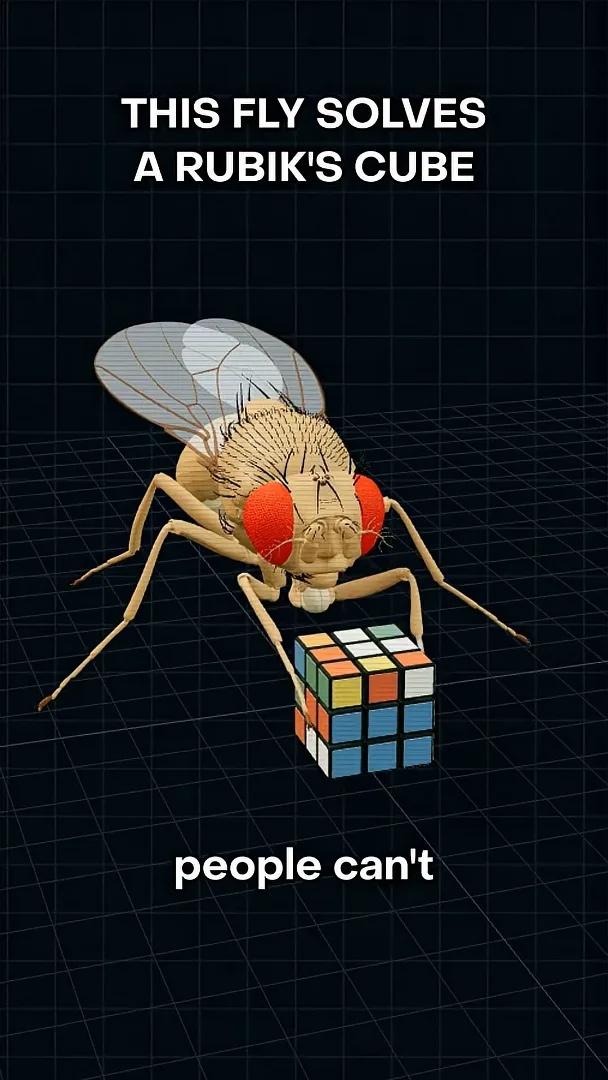
A simulated fly is shown attempting a Rubik's Cube. I connect it to fruit-fly brain mapping and say that people have trained simulated flies for activities such as driving and playing Beat Saber. The short does not explain the implementation or establish that the fly in this example faithfully reproduces a biological brain.
I suggest that mapping the brain means we can simulate everything a fly would do. The FlyWire research mapped neural connections in an adult fruit-fly brain, but a wiring diagram alone does not establish a complete model of every behavior ([research paper](https://www.nature.com/articles/s41586-024-07558-y)). I then ask a philosophical question: if a fly were simulated completely, would the simulation be real, and what would happen if we simulated humans?
More from this channel
 34:21EN
 Matthew Berman· Oct 27, 2026Matthew Berman Examines Anthropic’s IPO Filing, AI Growth and GovernanceMatthew Berman, Sam Altman · Forward FutureThe presenter reviews the S-1’s financial metrics, compute strategy and voting structure while questioning the tension between rapid AI development and safety.
 25:50ENMatthew Berman· Oct 24, 2026Kimi K3.1 Pro Tested: Strong 3D Demos, Uneven Results and Competitive PricingMatthew Berman · Forward FutureMatthew Berman tests the open-weight model on coding, 3D rendering and visual explanations, then compares benchmark results and prices.
 32:20ENMatthew Berman· Oct 23, 2026Who Is Local AI For? The Costs, Trade-offs and a Hybrid FutureMatthew Berman · Forward FutureMatthew Berman weighs data control and independence against hardware cost, setup complexity and inference speed.
 1:03:37ENMatthew Berman· Oct 23, 2026Matthew Berman’s Team Tests Kimi K3.1 on Animation, Games, and ChartsMatthew Berman, Alex, Brian · Forward FutureA live team AMA turns into an informal test of Kimi K3.1, from personal-agent workflows to motion graphics, a browser game, and a benchmark chart.
 0:53ENMatthew Berman· Oct 22, 2026Sam Altman on AI and the Discovery of New KnowledgeSam Altman · OpenAIAltman expects progress in mathematical discovery to extend to biology, materials and energy.
 0:22ENMatthew Berman· Oct 21, 2026A Robot Bodyguard Video Shows Dramatic Rescue ScenariosMatthew Berman · Forward FutureMatthew Berman reacts to a short robot demonstration depicting fighting and vehicle-rescue scenarios.