In 30 seconds
In a September 2024 roundup, Berman covers reports and speculation about future OpenAI models, xAI’s Colossus cluster, Altera’s Project Sid, Meta hardware and AI adoption, and Coinbase’s account of an agent transaction. He also discusses AI safety agreements and long-context models; the article distinguishes company claims and forecasts from verified outcomes.
- 1Unconfirmed model expectationsBerman reads a translated summary and speculates about future OpenAI model names and performance.
- 2Project SidAltera reports collaboration and item collection in a Minecraft simulation.
- 3Safety collaborationThe US AI Safety Institute announced testing agreements with two AI companies.
- 4Long-context claimMagic AI Labs presented a 100-million-token context and a retrieval test.
- 5Agent paymentsCoinbase described using crypto to pay for language-model tokens.
Takeaways
- The GPT Next and GPT-5 discussion relies on translated reporting and speculation, not a confirmed GPT-5 announcement.
- Altera’s Minecraft results describe a specific simulation and do not establish that agents are conscious.
- Reports about funding, hardware and usage are time-bound and must be interpreted in context.
- A long context window and a retrieval test do not by themselves establish broad long-context reasoning ability.
- Coinbase described a crypto transaction between agents; model tokens and payment tokens are different things.
Read the edited text by chapter
Future model reports and compute
Berman reviews a translated discussion of future OpenAI models and xAI’s cluster announcement. The figures and timing are presented as 2024 claims and forecasts.
In this September 2024 news roundup, I discuss reports about future OpenAI models, xAI’s compute cluster, a Minecraft agent simulation and other developments. The video is sponsored by Vultr. Its predictions, valuations, usage figures and product plans reflect the time of recording.
I read a translated social-media summary of remarks attributed to OpenAI Japan’s CEO about a future model called GPT Next. The summary mentions an effective improvement of roughly 100 times and a 2024 timeline, but it is a secondhand translation and its metric and interpretation are not established in the video.
I speculate that GPT Next could mean GPT-5 and discuss reported projects called Strawberry and Orion. The names, training details and launch dates are conjecture or reported expectations in this 2024 episode, not a confirmed GPT-5 announcement.
The summary suggests the supposed improvement may reflect architecture and efficiency rather than 100 times more physical compute. I find the idea of doing more with comparable resources interesting, but the quoted figures do not independently establish model performance.
Minecraft agents and mixed reality
Altera reports a multi-agent simulation and an item-collection comparison. Berman then considers reported Meta glasses and device form factors.
Altera introduced Project Sid, describing a Minecraft simulation with more than 1,000 autonomous agents. Its creators report agents forming a merchant hub, participating in votes and spreading in-game social patterns. These are observations from a simulated environment, not evidence of human-like understanding.
Elon Musk said xAI had brought a 100,000-H100 training cluster called Colossus online in 122 days and planned to expand it. These are company claims and plans as of September 2024; the video does not independently audit the cluster or its claimed ranking.
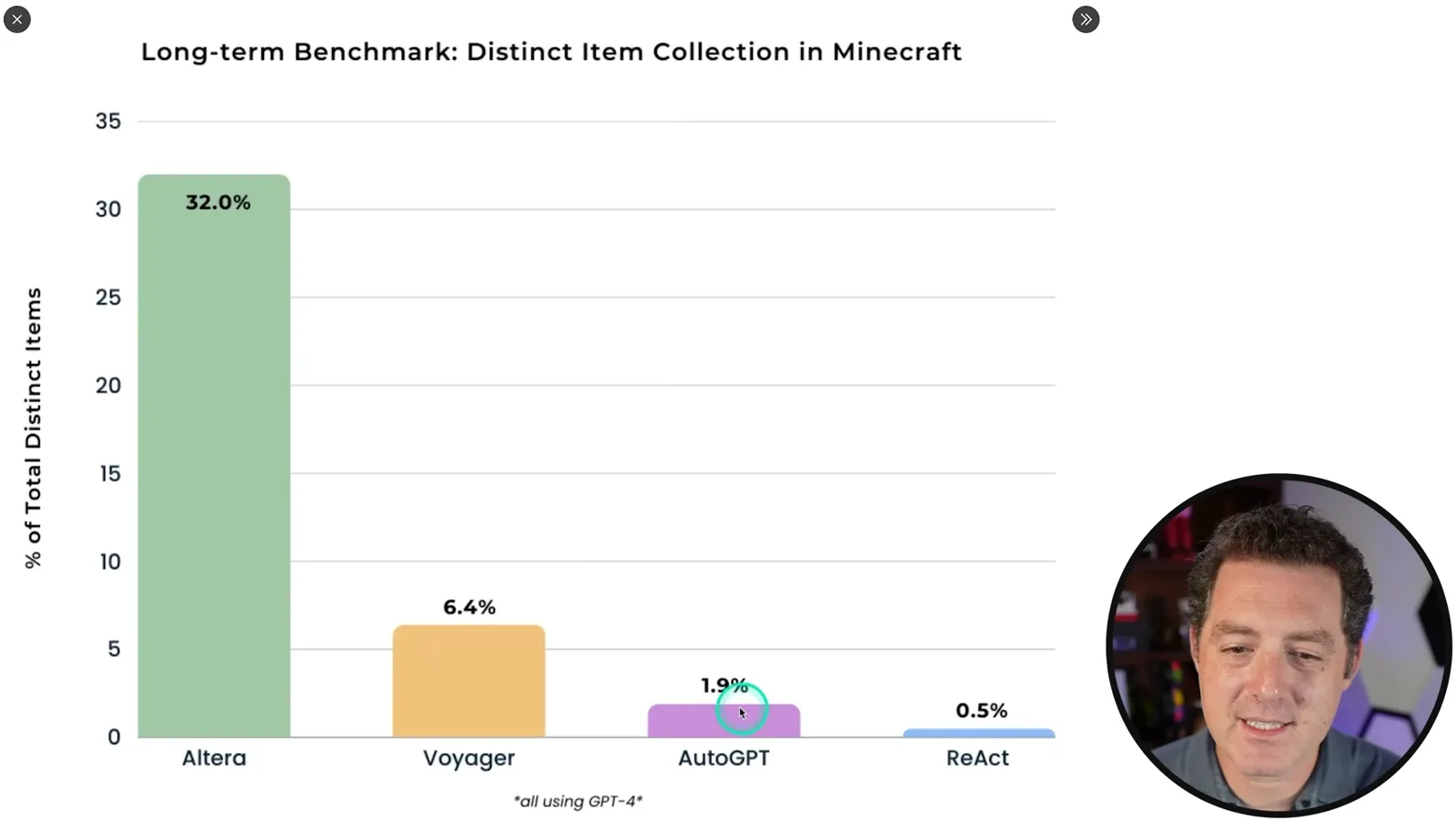
A chart compares distinct Minecraft items collected by Altera agents with Voyager, AutoGPT and ReAct. Altera reports 32% of total distinct items versus 6.4% for Voyager in the shown setup. This result concerns a particular benchmark and configuration, not general superiority on every task.
I show an informal comparison of GPU counts across AI companies and expect the cluster to support future Grok training. Hardware counts from different sources may not measure the same thing, so the graphic is not a verified like-for-like capacity ranking.
The project describes goals such as long-term autonomy, cooperation, pro-human behavior and communication. I agree that agents may need more autonomy, but the project’s language about agents caring or being consciously aware should be understood as a research aspiration, not a demonstrated fact.
I wonder whether much larger populations of agents could produce novel behavior, while acknowledging that safety and alignment remain open questions. That is my speculation about future systems, not a result established by the Minecraft demo.
The Information reported that Meta was considering lighter mixed-reality glasses under the code name Puffin. I discuss my experience with Ray-Ban smart glasses and compare the reported idea with heavier headsets; the product was described as under development, not as a confirmed launch.
I find the Vision Pro technically impressive but cumbersome to use daily, and I speculate that lighter, cheaper devices may appeal more broadly. My usage is a personal experience rather than evidence of all users’ habits or a verified market outcome.
The report described a device resembling bulky glasses, estimated at less than 110 grams. I question whether people who do not need corrective glasses will want to wear them indoors and suggest earbuds with cameras as another possibility; I am unsure which form factor will work.
Funding, adoption and safety
The roundup discusses reported OpenAI financing, usage figures, Midjourney hardware and safety-testing agreements. Berman offers his own business and release-policy views.
I read reports that OpenAI was in talks to raise funding at a valuation above $100 billion, with Thrive Capital and possible additional investors discussed. Those figures and participants were reported negotiations at the time, not a completed transaction established by this video.
I worry that language models may become commoditized as capable alternatives grow cheaper. I question how OpenAI will sustain its business if that happens, while acknowledging that the company may have plans I cannot see. This is my 2024 business analysis, not a financial forecast to rely on.
The Information reported that Meta AI had around 400 million monthly and 40 million daily users in early August 2024. I note that distribution through Meta’s existing products matters when interpreting those figures; the reported measures do not mean 400 million new standalone customers.
OpenAI told Axios that ChatGPT had more than 200 million weekly active users and that its products were used by 92% of Fortune 500 companies. These are company-reported figures at that time; I compare my own use of ChatGPT and Perplexity.
Midjourney announced that it was building a hardware team. I speculate about possible devices, such as a frame or a camera, but say I do not know what it intends to build. The announcement itself did not disclose a specific product in this segment.
I discuss announced collaborations between the US AI Safety Institute and OpenAI and Anthropic on research, testing and evaluation, including pre-release access to major models. My claim that the government had already seen a particular unreleased GPT-5 model is speculation not established by the agreement.
I express a preference for open models because more people can examine and test them. Broader access can enable scrutiny but does not by itself prove that any model is secure; this is my view in a continuing debate about release and safety.
Tools, long context and payments
Berman reviews data and interface updates, a long-context claim and an agent transaction. He ends with a report about a possible Alexa upgrade.
Nous Research released Hermes Function Calling V1 data for tool use and structured JSON output, including single- and multi-turn examples. I see it as useful material for training agentic systems, although the video does not test downstream performance.
Google AI Studio added prompt autosaving and automatic naming, with settings persisted alongside prompts. I comment on my own preference for fewer restrictions; the interface and defaults described are specific to the 2024 update.

Magic AI Labs described LTM-2-Mini as having a 100-million-token context window and showed a retrieval test. I find the claimed scale striking, but a needle-in-a-haystack result is not a complete evaluation of reasoning across all of that context.
Coinbase CEO Brian Armstrong described an AI-to-AI transaction using crypto: one agent used a digital asset to purchase model tokens from another. The two meanings of “token” differ: one is a payment asset, the other a unit used by a language model.
Armstrong presents crypto wallets as a way for agents to acquire resources or transact. I note that an agent might also operate with a user’s authorized payment credentials and predict that machine-to-machine transactions could become common; the demonstration does not establish universal adoption or zero costs.
Finally, I discuss a Reuters report that a future Alexa upgrade could use Anthropic’s Claude. This was reporting about plans at the time, not proof of a completed launch. I hope voice assistants will eventually perform more useful tasks proactively and see payments as one possible component.
More from this channel
 25:50EN
 32:20EN
 1:03:37EN
 0:53EN
 0:22EN
 45:08EN